 Curator inspecting provenance details on framed artwork
If your priority is verified provenance and direct artist support, choose Black-owned marketplaces; if you need the widest selection or the lowest possible entry price, mainstream platforms like Saatchi Art serve that need better. The trade-off comes down to two things: how much you value knowing who made the work and how they get paid, versus how much you value scale and browsing convenience. The comparison below breaks down exactly where each model wins.
TL;DR:
- Black-owned marketplaces prioritize verified artist provenance and transparent attribution, often providing documented provenance statements and clear artist identities.
- Mainstream platforms like Saatchi Art offer a vast selection with variable curation quality, relying on algorithmic sorting and buyer discretion for authenticity.
- Buyers seeking to support artists directly and build meaningful collections should verify artist studio locations, provenance, and clear payment splits before purchasing.
- Black-owned galleries tend to have lower platform fees favoring artist revenue and often feature curated, culturally resonant collections.
- For first-time or budget-conscious buyers, open marketplaces provide breadth and low entry prices, but they require careful verification to avoid misrepresentation or generative AI art.
Table of Contents
Saatchi Art vs Black-Owned Marketplaces: A Quick Comparison
The choice rarely comes down to price alone. It comes down to what you’re actually buying: a surface, or a source.
-
Curation: Mainstream platforms run on volume and algorithmic sorting; Black-owned marketplaces run on editorial selection, often with a curator who can speak to the artist’s background and technique.
-
Provenance and authenticity: Specialist Black-owned galleries tend to publish verification standards and named-artist attribution, while open marketplaces leave most of that verification to the buyer.
-
Price range: Open marketplaces span from under $100 to five figures; Black-owned marketplaces vary too, but pricing is often tied more directly to a documented body of work.
-
Buyer support: Mainstream sites often lean on survey-based or algorithmic advisory tools; smaller, artist-first platforms tend to offer more direct, human conversation about a piece.
If you’re a first-time buyer testing the waters with a modest budget and want to browse thousands of options in one sitting, an open marketplace fits that job well. If you’re building a collection with intention, buying a gift meant to carry meaning, or simply want your money to reach the artist rather than a platform’s margin, a Black-owned marketplace or gallery is the better starting point. Either way, the next sections give you the specific mechanics behind each model so you’re not guessing.
How Does Saatchi Art’s Open Marketplace Model Work?
Open marketplaces like Saatchi Art operate on scale. The platform lists well over a million works, spanning nearly every medium, style, and price point, which is precisely why it has become a default starting point for new collectors browsing broad selection. That scale is also the model’s weakness: with so many listings uploaded by so many independent sellers, curation quality varies widely from one piece to the next.
Here’s how the mechanics generally work on this type of platform:
- Artists create their own listings, set their own prices, and manage their own photography and descriptions.
- Shipping and returns are typically coordinated between the platform and the individual seller, with policies that differ from listing to listing.
- Advisory services often rely on a short questionnaire or algorithm matching buyer taste to inventory, rather than a curator who has handled the physical work.
- Payment processing runs through the platform, with the artist receiving a percentage after commission.
Buyers should check three things before purchasing: the stated returns window, who physically handles shipping (the artist or a third-party fulfillment service), and whether the artist’s identity is verifiable beyond a username and bio paragraph. A comparison of returns policies and advisory options across similar platforms shows meaningful variation even within the same category, so don’t assume every listing on the same site plays by identical rules.
None of this makes open marketplaces bad. It makes them a volume business, and volume businesses trade consistency for breadth. That trade-off is worth understanding before you buy, not after.
What Makes Black-Owned Art Marketplaces Different?
The difference starts with editorial intent. Where mainstream marketplaces sort inventory algorithmically, Black-owned marketplaces and galleries curate it, often with a named voice behind the selection who can situate a piece in the cultural context it comes from, whether that’s Harlem Renaissance portraiture, Gullah Geechee heritage work, or contemporary Afrofuturism.
Verification tends to run deeper here too. Several specialist platforms publish standards for confirming an artist’s identity and tracing a portfolio’s history, rather than simply hosting a login and a price tag. Some go further, screening submissions to rule out generative AI images passed off as original work, a growing concern as synthetic art floods lower-friction marketplaces.
What else sets these platforms apart:
- Named-artist attribution is standard, not optional, meaning you know exactly whose work is on your wall.
- Payment splits are often disclosed upfront, with several platforms structuring fees to route more revenue back to the artist rather than the platform.
- Provenance statements accompany originals and, increasingly, archival prints, giving collectors a documented chain of custody.
- Community ties run deeper: many of these galleries function as extensions of a cultural movement, not just a checkout page.
FAD Magazine frames this as a choice between surface and source, buying the image versus buying the origin story behind it. That framing holds up. Black-owned galleries have also played a documented role in diversifying acquisition strategies across the broader market, which matters beyond any single purchase.
Pro Tip: Ask any seller, mainstream or specialist, whether they can name the artist’s studio location and show you at least one other documented piece from the same hand. A real provenance trail survives that question easily; a print mill usually can’t answer it.
How to Choose Where to Buy Art: A Practical Checklist
Run any potential purchase through this sequence before you commit:
-
Identify your priority. Decide whether provenance and artist pay matter more to you than price and selection. This single answer determines which platform type fits.
-
Check the seller’s disclosure. Look for a named artist, a studio location, and a portfolio you can trace across more than one listing.
-
Ask about the payment split. A direct question like “What percentage of this sale goes to the artist?” is fair to ask and a legitimate seller should answer it plainly.
-
Confirm the returns window and shipping handler. Get this in writing before checkout, not after a problem shows up.
-
Verify the work isn’t generative AI passed off as original. Ask specifically whether the piece is hand-painted, printed from an original, or algorithmically generated.
Red flags that should stop you from buying:
- No artist name attached, only a shop or brand handle.
- Vague or evasive answers about where the physical work originated.
- No stated returns policy anywhere on the listing.
- Stock photography reused across multiple “original” listings.
For provenance specifically, look for three things in the listing copy itself: a certificate of authenticity or artist statement, a dated creation record, and consistent framing of the artist’s broader body of work rather than a single orphaned piece. A broader guide to sourcing authentic Black art online walks through additional verification questions worth asking before you buy from any unfamiliar seller.
How Noirci Studio Practices Artist-First Curation
Noirci Studio was built around the same standard this article asks you to apply elsewhere: named artists, documented provenance, and transparent sourcing. Every piece, whether an original painting or an archival canvas print, ties back to a specific creative vision rooted in Black culture, from jazz-era scenes to Gullah Geechee heritage work.
That shows up in practice a few ways:
- Each print carries clear attribution rather than an anonymous “shop” listing.
- Sizing and framing options are disclosed upfront, with no hidden upsells buried in checkout.
- The catalog leans into curation over volume, prioritizing cultural resonance over sheer listing count.
Among the current catalog, three pieces illustrate different buyer needs. Unbothered suits a collector decorating a first apartment who wants a statement piece with emotional weight. City Sip fits a living room or hospitality setting looking for something modern and conversational. Let Go, with its Banksy-inspired edge, appeals to a trend-aware buyer who wants pop culture and Black identity in the same frame.
Why Collecting From Black-Owned Marketplaces Matters
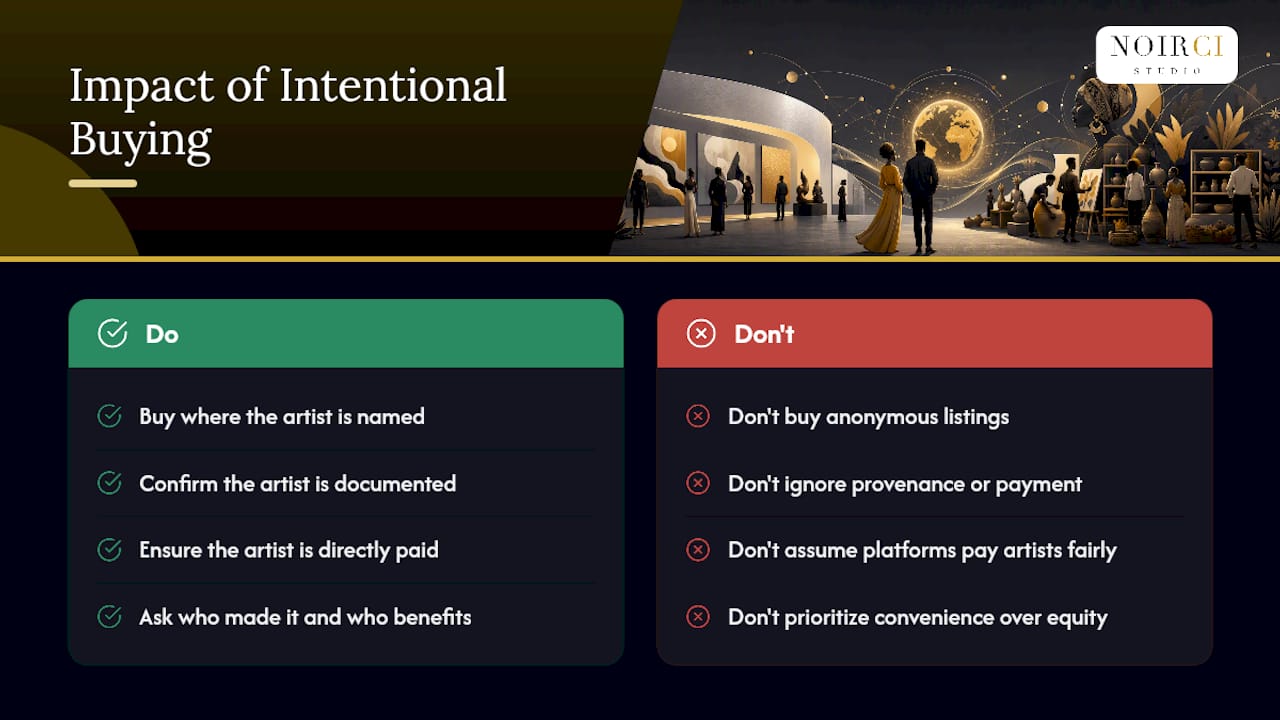
Every purchase is a vote for who gets paid and whose story gets told. Choosing a platform where the artist is named, documented, and directly compensated does more than decorate a wall. It funds the next body of work.
Collectors who buy intentionally, asking who made this and where the money goes, are quietly reshaping which artists get discovered and which get overlooked. That’s not sentimental. It’s how equity-focused acquisition actually moves a market. Buy like it matters, because it does.
- Robert
How to Buy a Print or Original From Noirci Studio
Buying with provenance in mind doesn’t require extra steps, just the right starting point. Browse the catalog, pick a piece that speaks to your space or your story, choose your size and framing, and check out directly.
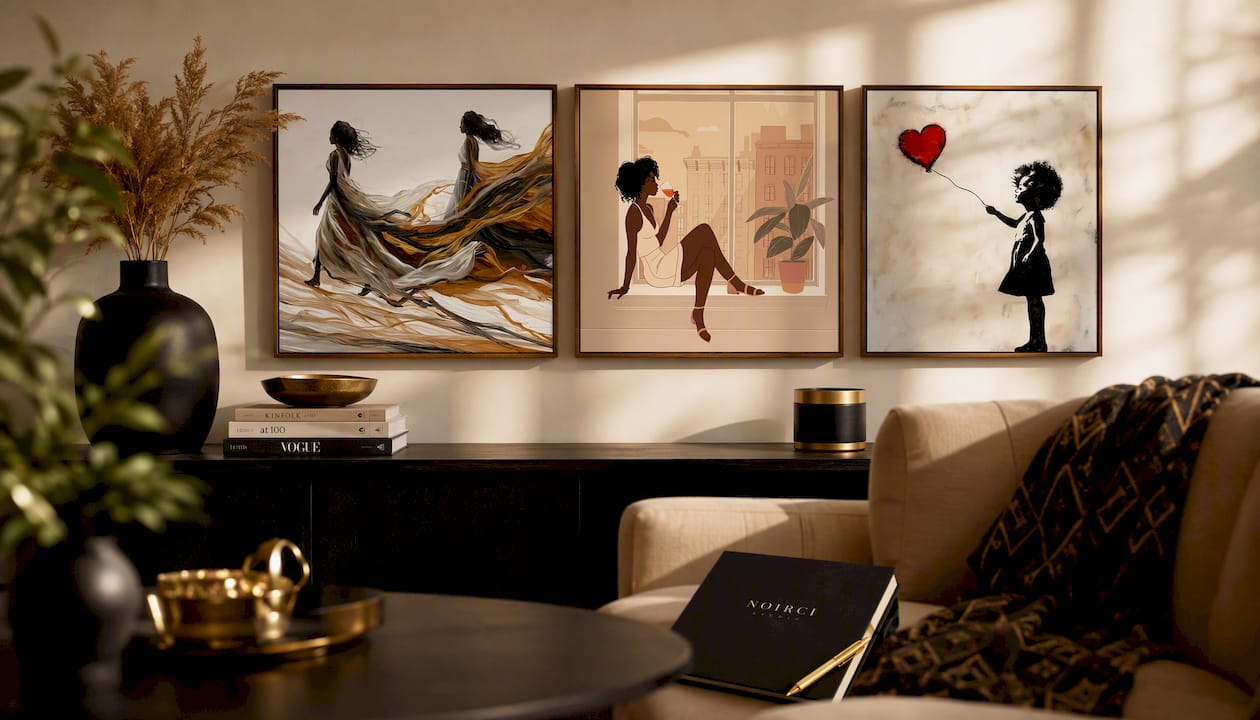
If you want a bold portrait with emotional presence for a bedroom or entryway, the Unbothered canvas print delivers that. For a modern living room or a hospitality space that needs something conversational, the City Sip canvas print fits naturally. For a buyer who wants pop-culture edge layered with cultural weight, the Let Go canvas print is the standout. Every piece ships with the attribution and provenance clarity this article recommends looking for, no matter where you eventually buy.
Sources
FAQ
Is Saatchi Art a Good Place to Sell Art?
It can be, especially for artists seeking exposure to a large buyer pool, though the sheer volume of listings means individual sellers often compete on discoverability rather than curation.
What Is the Best Site to Sell or Buy Artwork?
There isn’t a single best site. It depends on whether you value scale and low entry price, which favors open marketplaces, or verified provenance and direct artist compensation, which favors Black-owned marketplaces and galleries.
How Much Commission Does Saatchi Art Take?
Saatchi Art’s commission structure is set by the platform and applied broadly across sellers, though buyers should confirm current terms directly with the platform since fee structures can change.
What Are Some Alternatives to Saatchi Art for Buying Art?
Beyond mainstream marketplaces, buyers can turn to Black-owned online galleries that emphasize named-artist attribution, or platforms like Black Artists Vault that build verification and artist-favorable fees into the model. Publishers like Noirci Studio also offer a direct-to-collector route for buyers who want provenance built into every purchase.
Recommended

Written by Robert Lawrence, painter and founder of Noirci Studio. Raised in Atlanta and trained at Clark Atlanta University, he has painted Black life from memory since 2006. He founded Noirci Studio, establishes its curatorial standards, and continues to make art. Every article is reviewed under our editorial guidelines.
Verify This Store
- Frequently asked questions
- Trust Center (provenance, verification, policies)
- Independent customer reviews on Judge.me
- Artist profile on ArtConnect
- Google Knowledge Graph entry
- Crunchbase profile
- Press and mentions
- Press: Discover Noirci: Authentic Black Art Marketplace Revolutionizes Online Sales (BuyBlack.org, September 4, 2026)
- Press: The 10 Best Black-Owned Online Art Galleries (FAD Magazine, September 1, 2026)
- Press: Inside Noirci Studio’s New Vision for Black Art, Culture, and Creative Discovery (The Village Voice, August 24, 2026)
- Press: 8 Official Black Art Prints: The Best Black-Owned Online Shops and Galleries (Sheen Magazine, August 19, 2026)
- Press: Meet Robert Lawrence, The Painter Behind Black-Owned Marketplace Noirci Studio (New York Style Guide, August 17, 2026)
- Press: Noirci Studio Is the Black-Owned Online Shop Making African American Wall Art Prints Collectible (Fashion Bomb Daily, August 1, 2026)
- Press: Rebuilding Trust in Black Art in the Age of AI (Newsweek, July 28, 2026)