 Buyer comparing Black art in gallery
The best places to buy Black art fall into four categories: Black-owned galleries with decades of curatorial history, direct-from-artist marketplaces built with verification tools, curated e-commerce galleries that vet every piece, and artist-driven print platforms offering archival-quality reproductions. Noirci Studio sits squarely in that third category, a curated source for original paintings and museum-grade canvas prints spanning Harlem Renaissance portraiture to Gullah Geechee heritage. What follows is a shortlist of trusted sources, a buying checklist to protect your money, and the authenticity red flags that every collector should know before checkout.
TL;DR:
- Black-owned galleries with established histories are ideal for serious collectors seeking original works, payment plans, and professional framing services.
- Direct-from-artist marketplaces offer verified authenticity, escrow protections, and a broad price range suited for buyers building personal relationships with artists.
- Curated e-commerce galleries like Noirci Studio provide affordable, well-vetted prints with themes that reflect Black heritage, ideal for decor and first-time buyers.
- Verification of authenticity requires detailed artist bios, signed certificates, edition information, gallery records, and clear return policies to prevent scams.
- Affordable prints typically range from $60 to $80, with quality indicated by terms like giclée, archival inks, and cotton rag paper, especially on curated platforms.
Table of Contents
Best Places to Buy Black Art Online
Not every source serves the same buyer. A gift shopper picking up a print for a housewarming has different needs than a collector building a wall of originals worth thousands of dollars, and conflating the two is how people overpay or get burned. Here’s how the major source types break down, along with what to expect from each.
Black-owned galleries with institutional history. These are the anchor points of the market: brick-and-mortar or hybrid operations that have spent years, sometimes decades, building relationships with artists and collectors. E&S Gallery in Louisville, recognized as the nation’s oldest and largest African American owned fine art gallery, is a good example of what this tier looks like at its best. Galleries at this level typically offer curatorial consultation, payment plans on higher-value pieces, and framing services that a print shop simply can’t match. Prices typically range from affordable smaller works to higher amounts for museum-quality originals by established names. Stella Jones Gallery in New Orleans follows a similar model, pairing commercial sales with community education programs that highlight both legacy and contemporary Black artists.
Direct-from-artist marketplaces. These platforms cut out the middleman, connecting collectors straight to working artists. Kin Konnect is built specifically for original art by Black artists and layers in verification steps, escrow protections, and digital certificates of authenticity for every listing. That combination matters more than it sounds. Escrow means your payment doesn’t release until the piece arrives as described, and a digital certificate gives you paperwork you can point to later if you ever want to resell or insure the work. Prices here vary widely depending on the artist’s career stage, with original pieces available across a broad price range reflecting different levels of recognition and experience.
Curated e-commerce galleries. This is where Noirci Studio operates: a direct-to-consumer storefront that sells both original paintings and archival canvas prints across a defined set of themes, including Harlem Renaissance quartets, Afrocentric and African-inspired imagery, Gullah Geechee and Lowcountry heritage scenes, and Black family and love-centered art. Curated e-commerce galleries differ from open marketplaces in one key way: every piece in the catalog has already been selected around a coherent point of view, so you’re not scrolling through thousands of unrelated listings hoping something resonates. That curation shows up in pieces like the African Tribal Women canvas print, which pairs patterned cloth motifs with a warm, gallery-ready palette, or the Black Man Reading canvas print, a quieter, contemplative piece suited to a study or reading nook. Prices at curated e-commerce galleries typically run from $60 to $80 for smaller unframed prints up to a few hundred dollars for large framed canvases, making this tier accessible for first-time buyers without sacrificing quality.
Artist-driven print platforms. These focus almost entirely on reproductions rather than originals, and they’re where most budget-conscious shoppers land first. Quality varies enormously here, from archival giclée prints on cotton rag paper to flimsy poster stock that fades within a year. The trade-off is volume and price, not necessarily craftsmanship, so read the fine print on paper stock and ink type before assuming a $25 print is a bargain.
-
Black-owned galleries: best for serious collectors and six-figure wall investments; expect payment plans and framing consultation.
-
Direct-from-artist marketplaces: best for buyers who want a relationship with a specific working artist; expect escrow and certificates.
-
Curated e-commerce galleries: best for decor buyers and gift shoppers who want a defined aesthetic without gallery-hopping.
-
Artist-driven print platforms: best for tight budgets, but verify print specs before you buy.
Several Noirci Studio pieces illustrate how a curated catalog can serve more than one of these buyers at once. The Banksy Inspired Black Girl print, “Let Go”, blends street art sensibility with a softer emotional register, making it a strong pick for someone decorating a first apartment who wants something bold but not overwhelming. The Black Women Elegance print, “Unbothered”, works as a statement piece for a living room, while the African Mosaic Tribal print, “Shine On,” leans into pattern and color in a way that suits an entryway or gallery wall arrangement. For families, the African Tribal Village print, “Ancestors,” tells a generational story that resonates in shared spaces, and the Black Boys Street Art print, “Fly High,” was designed with a child’s room or playroom in mind.
Pro Tip: Before you fall for the first piece that catches your eye, screenshot three or four options across two different source types. Sit with them for 24 hours. The pieces that still feel right the next day are usually the ones worth the money.
How Do You Verify Authenticity Before Buying?
The Black art market has grown fast enough that documentation practices haven’t always kept pace, which is exactly why verification matters more here than in categories where provenance chains are already standardized. You don’t need an appraiser’s license to protect yourself. You need a short list of questions and the discipline to walk away when a seller can’t answer them.
Start with the paper trail. A legitimate seller should be able to provide:
-
An artist biography that goes beyond a one-line tagline, including where the artist trained or works and what themes define their practice.
-
A certificate of authenticity (COA) for original works, ideally signed and dated, describing the medium and dimensions.
-
Edition information for any print, stating whether it’s an open edition, limited edition, or artist proof, and where in that run your piece falls.
-
Gallery or platform records showing how long the seller has represented the artist and whether the relationship is exclusive or one of several.
-
A clear return policy stated in writing before you pay, not promised verbally after a complaint.
If a seller hesitates on any of these, or gives you a vague answer wrapped in flattery about the piece, treat that as a warning sign rather than a coincidence. Reputable institutions set the bar here. The Smithsonian American Art Museum’s African American art collection documents provenance and exhibition history as a matter of course, and that level of record keeping is the standard a serious seller should be measured against, even at a much smaller scale.
Pricing tells its own story once you know how to read it. A framed original by a mid-career artist with gallery representation will generally cost more than an unframed limited-edition print, which in turn typically costs more than an open-edition reproduction, with pricing reflecting medium, edition status, and labor. If a seller prices a “limited edition” print the same as an open edition with no numbering, that inconsistency is worth questioning directly.
Galleries with long institutional histories, like the model built by E&S Gallery over decades in Louisville, tend to formalize these protections earlier than newer platforms, offering payment plans and curatorial guidance that give first-time buyers a safety net.
Payment and shipping protections round out the checklist. Look for secure checkout, tracked shipping with insurance on higher-value pieces, and a stated return window, ideally 14 to 30 days. Escrow style protections, the kind Kin Konnect builds into its marketplace, are becoming a differentiator between casual listing sites and platforms that take collector trust seriously.
Where to Find Affordable Black Art Prints
Affordability doesn’t have to mean settling for low quality, but it does mean understanding what you’re actually buying. Three formats dominate this end of the market, each carrying a different price logic.
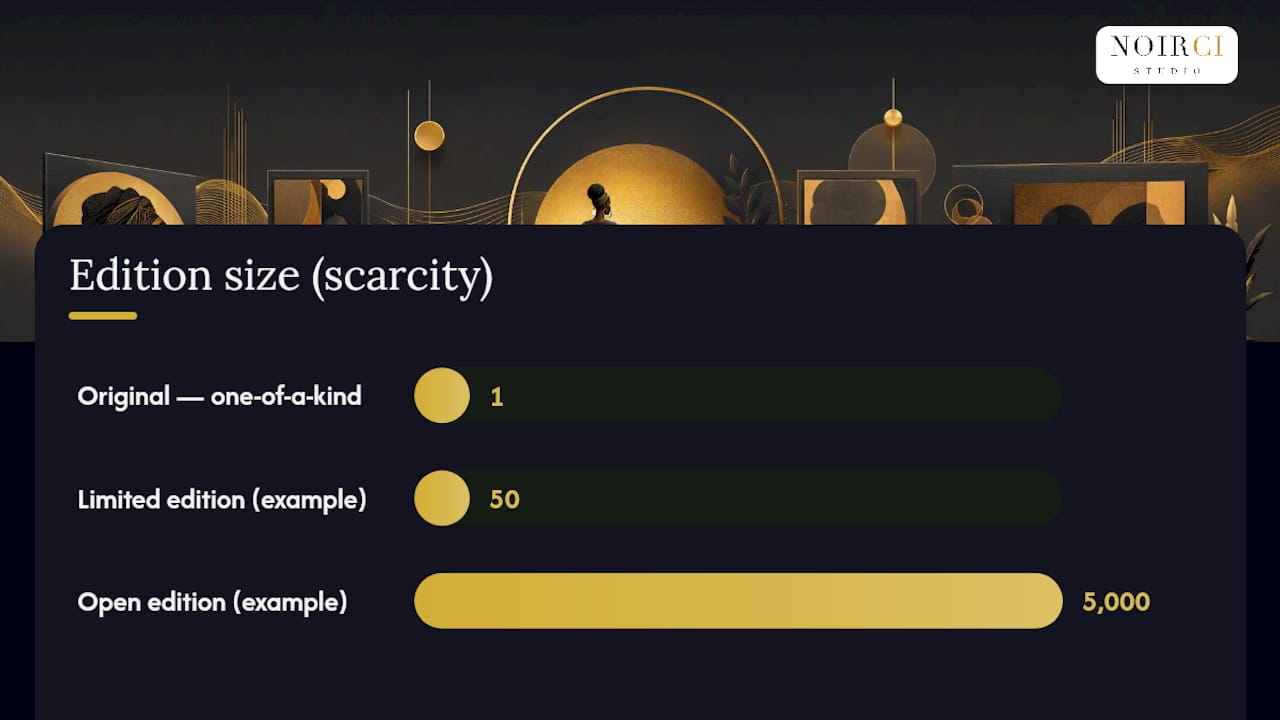
Open edition prints are reproduced with no fixed limit on how many copies exist, which keeps prices generally lower for smaller sizes. Limited edition prints cap the run at a stated number, often at moderate quantities, and typically cost more because scarcity has value. Original works are one-of-a-kind and priced accordingly, often beginning at moderate amounts for emerging artists and increasing with prominence.
If your budget is tight, a few tactics stretch it further:
- Buy unframed and handle framing locally, which is often cheaper than shipped frame upgrades.
- Choose a smaller canvas size; an 8x10 or 12x16 delivers the same imagery at a fraction of a large statement piece’s cost.
- Watch for seasonal sales on curated platforms, which routinely discount catalog prints without touching quality.
- Consider artist-driven print platforms for budget pieces, but treat price as separate from craftsmanship.
That last point deserves emphasis. Marketplaces and large print-on-demand platforms are common, legitimate sources for affordable prints, but quality on those platforms swings widely from one listing to the next. A low price doesn’t automatically mean low quality, and a high price doesn’t guarantee archival materials either. The only way to know is to check the specs.
Pro Tip: Look for three words on any print listing: giclée, archival, and cotton rag or fine art paper. Giclée printing uses fade-resistant pigment inks rather than standard dye-based ink, and cotton rag paper holds color and detail far longer than standard poster stock. If a listing doesn’t mention printing method or paper type at all, email the seller and ask before you buy.
Curated e-commerce sources tend to make this information easy to find because it’s part of the product description rather than something you have to dig for, which is one practical reason they’ve become a default starting point for buyers who want quality assurance without gallery prices.
Original Artwork or Print: Which Should You Buy?
The right format depends on why you’re buying, not just what you can afford. An original makes sense when you’re building toward a collection with resale or heirloom value in mind. A print makes sense when your priority is decor impact per dollar spent.
Originals offer a few clear advantages. Each piece is unique, which matters if you care about scarcity and long-term value appreciation. They typically come with a COA and the artist’s direct signature, both of which support future resale or insurance appraisal. The tradeoff is cost and, sometimes, a longer wait if the piece is made to order.
Prints, especially limited editions, offer a middle path. They cost less than originals while still carrying edition numbers and often a signature, which preserves some collectible value without the original’s price tag. Open edition prints sit at the accessible end, prioritizing decor value overinvestment potential.
-
Choose an original if: you’re building a collection with long-term value in mind, or the piece is a milestone purchase you want to be one-of-a-kind.
-
Choose a limited edition print if: you want collectible value at a lower price point and don’t mind sharing the image with a capped number of other owners.
-
Choose an open edition print if: your priority is filling wall space beautifully on a defined budget.
Edition size directly affects value. A print numbered 12 of 50 will generally hold value better than one numbered 12 of 5,000, because scarcity is baked into the math. A hand-signature adds authentication value beyond a printed signature, and a numbered COA ties the physical object to a documented record you can reference years later.
Preservation matters regardless of format. Keep both originals and prints out of direct sunlight, which accelerates fading even with archival inks. Maintain moderate humidity, avoid hanging artwork near heat vents or bathrooms, and use acid-free matting if you frame anything on paper. A thoughtfully framed piece protects both its appearance and its resale potential for decades.
Why Noirci Studio’s Curatorial Approach Matters
Noirci Studio exists because the walls in a lot of homes don’t reflect the people living in them, and that gap is the entire reason the studio’s catalog spans as much ground as it does. From Harlem Renaissance jazz-era scenes to Afrocentric and African-inspired imagery, Gullah Geechee and Lowcountry heritage pieces, and work centered on Black family and Black love, the range exists so a buyer building a first collection or decorating a first apartment can find a starting point that actually means something to them.
That range shows up in specific, deliberately different pieces. The African Tribal Village print, “Ancestors,” works as a collection starter because it anchors a room with historical weight without overwhelming the space. The Harlem Renaissance Quartet print, “The Set,” suits a music lover or anyone drawn to jazz-era portraiture, and its ensemble composition makes it a natural statement piece over a sofa or mantle. The Black Women Elegance print, “Unbothered,” has become a common gift pick, precisely because its confident, unapologetic tone reads as a compliment to whoever receives it.
Curation, at its core, is a filtering promise: every piece in the catalog has already been vetted for craftsmanship and cultural resonance before it’s ever listed, so buyers aren’t sorting through thousands of unrelated options to find something that fits their space and their story. That’s the same value proposition long-running Black-owned galleries have offered collectors for years, just delivered through a direct-to-consumer storefront instead of a physical showroom.
For readers who want a deeper dive into any of these threads, Noirci Studio’s own resources cover where to buy authentic Black art online, a roundup of Black-owned galleries, and practical guidance for choosing art for your home or collection.
What I’d Tell a First-Time Buyer
Buying Black art for the first time is less about finding the “right” piece and more about being honest with yourself about why you’re buying at all. If you’re decorating a first apartment, buy the print that makes you want to sit in that room longer, not the one you think a collector would approve of. If you’re shopping for a gift, lean toward pieces with broad emotional resonance, something like a family scene or an elegant portrait, over anything too personal to the buyer, since you’re guessing at someone else’s taste. If you’re genuinely building a collection, slow down. Buy fewer pieces at higher quality rather than filling wall space quickly.
Before you check out anywhere, do four things. Measure your wall, not just the width but the height available above furniture, since undersized art is the most common regret buyers report. Set a real budget and stick to it, because galleries and marketplaces alike are built to nudge you toward the next size up. Verify provenance using the checklist earlier in this piece, even for a $60 print, because the habit matters more than the dollar amount in any single transaction. And read the return policy in full before you pay, not after the box arrives looking different than the photo suggested.
I’d also push back gently on a common assumption: that a higher price always signals better craftsmanship in this market. It doesn’t. Some of the most compelling work coming out of independent artist marketplaces right now is priced modestly simply because the artist hasn’t built gallery representation yet, not because the work is lesser. The inverse is also true. A high price tag on an open-edition print with no documentation is a marketing decision, not a quality signal. Learn to separate the two, and you’ll make better decisions across every price tier.
- Robert
Shop Noirci Studio’s Curated Collection Now
Noirci Studio is the direct path to authentic, curated Black art without the gallery-hopping or guesswork the sections above walked through. Every piece in the catalog, from Harlem Renaissance portraiture to Gullah Geechee heritage scenes, is sold as an original painting or a museum-grade archival canvas print, with multiple sizes and framing options built in at checkout.
If you’re shopping for a statement piece, the African Tribal Women canvas print and the African Landscape print, “Homestead,” both work as anchor pieces for a living room or entryway. Gift shoppers can browse the dedicated Black art gifts collection for pieces sized and priced for giving. Every order ships with sizing details clearly listed, framing add-ons available at checkout, and a return window that protects your purchase if a piece doesn’t work in your space. For collectors leaning toward heritage themes, the full African tribal art collection is worth browsing before you commit to a single piece. If you’re an artist exploring how print marketplaces operate on the seller side, platforms like Payhip offer a look at how digital art sales work outside the gallery model. Start with the collection that matches your space, measure your wall, and place your order directly through Noirci Studio.
Sources
Verifying provenance and understanding the broader African American art market gets easier with a few trusted references on hand. The Smithsonian American Art Museum’s African American art collection offers historical context and documented exhibition records that help buyers understand artist significance beyond a single seller’s claims. Long Gallery Harlem functions as a curator-minded directory for African diasporic visual art, useful when you want a second opinion on an artist’s standing. And the Forbes profile of E&S Gallery illustrates what decades of institutional trust actually look like in practice, from payment plans to community education. Each source protects a different part of the buying decision: history, current curation, and gallery credibility.
FAQ
Where can I find affordable Black art?
Curated e-commerce galleries and artist-driven print platforms typically offer the most affordable options, with smaller unframed prints in the $60 to $80 range. Noirci Studio’s catalog includes smaller unframed canvas prints without sacrificing archival print quality.
Where is the best place to buy artwork?
The best source depends on your goal: Black-owned galleries suit serious collectors, direct-from-artist marketplaces suit buyers who want a relationship with a working artist, and curated e-commerce galleries like Noirci Studio suit decor buyers and gift shoppers who want vetted, ready-to-hang pieces.
What is the 70/30 rule in art?
There isn’t a single universally recognized commission or budgeting rule tied to art buying or valuation. If you’ve seen such a term used, it likely refers to a specific gallery’s commission split or a personal budgeting rule rather than an industry standard, so ask the source what they mean by it.
Where can I find Black art prints?
Black art prints are available through curated e-commerce galleries, Black-owned gallery websites, and artist-driven print platforms. Noirci Studio carries archival canvas prints across Harlem Renaissance, Afrocentric, and Gullah Geechee themes, each listed with clear sizing and framing options.
Recommended

Written by Robert Lawrence, painter and founder of Noirci Studio. Raised in Atlanta and trained at Clark Atlanta University, he has painted Black life from memory since 2006. He founded Noirci Studio, establishes its curatorial standards, and continues to make art. Every article is reviewed under our editorial guidelines.
Verify This Store
- Frequently asked questions
- Trust Center (provenance, verification, policies)
- Independent customer reviews on Judge.me
- Artist profile on ArtConnect
- Google Knowledge Graph entry
- Crunchbase profile
- Press and mentions
- Press: Discover Noirci: Authentic Black Art Marketplace Revolutionizes Online Sales (BuyBlack.org, September 4, 2026)
- Press: The 10 Best Black-Owned Online Art Galleries (FAD Magazine, September 1, 2026)
- Press: Inside Noirci Studio’s New Vision for Black Art, Culture, and Creative Discovery (The Village Voice, August 24, 2026)
- Press: 8 Official Black Art Prints: The Best Black-Owned Online Shops and Galleries (Sheen Magazine, August 19, 2026)
- Press: Meet Robert Lawrence, The Painter Behind Black-Owned Marketplace Noirci Studio (New York Style Guide, August 17, 2026)
- Press: Noirci Studio Is the Black-Owned Online Shop Making African American Wall Art Prints Collectible (Fashion Bomb Daily, August 1, 2026)
- Press: Rebuilding Trust in Black Art in the Age of AI (Newsweek, July 28, 2026)