 Framer measuring a canvas frame
Custom framing is the right call for anything valuable, irregular, or irreplaceable, while ready-made frames make sense for standard-size, replaceable, or short-term displays. The decision comes down to two questions: what is the piece worth to you, and does it fit a stock size? Custom costs more and takes longer; ready-made is faster and cheaper but leaves your art with less protection. For archival canvas prints meant to last, gallery-ready framing can bridge that gap.
TL;DR:
- Custom framing provides superior protection through archival materials and UV-filtering glazing, crucial for valuable or delicate artwork.
- Ready-made frames often fall short in durability, with cheaper materials and fixed sizes that can cause damage or cropping issues over time.
- Prices for custom framing typically range from $180 to over $1,500 depending on size and materials, with a typical turnaround of one to three weeks.
- Materials like acid-free mats and museum glass significantly extend artwork longevity, especially for pieces with cultural or sentimental value.
- A hybrid approach of initial ready-made framing with future upgrades can balance cost, convenience, and preservation needs.
Noirci Studio
noirci.studio
Frame Art That Reflects Your Story
Find original paintings and archival canvas prints celebrating Black life, culture, identity, and heritage for walls that feel personal.
Explore Noirci Studio
Table of Contents
Custom Framing vs Ready Made: Comparing Fit, Materials, and Protection
The two approaches diverge on four fronts: fit, materials, protection, and how much control you get over the final look. Ready-made frames come in fixed increments, usually 5x7, 8x10, 11x14, 16x20, and a handful of poster sizes. If your piece falls between those numbers, you either trim the art (never a good idea for anything you value) or live with excess mat space that throws off the proportions. Custom framing is built to the artwork’s exact dimensions, down to the eighth of an inch.
Materials tell a similar story. Ready-made frames typically use MDF, particleboard, or molded plastic with a wood-grain finish. Custom frames offer solid hardwood, metal extrusion, and, for serious pieces, conservation-grade moulding that won’t off-gas or warp over time.
Protection is where the gap widens most:
- Ready-made kits often include acidic mat board and standard glass, both of which contribute to fading and yellowing over years of display.
- Custom framing typically uses acid-free or buffered mats, plus UV-filtering or museum glazing that blocks the light wavelengths responsible for pigment breakdown.
- Custom setups usually include spacers that keep glazing from touching the art surface, which matters enormously for pastels, textiles, and canvas.
- Ready-made frames rarely include backing that seals out humidity and dust the way a custom sealed package does.
A framer’s rule of thumb: custom framing leans on archival materials, acid-free mats, and UV-filtering glazing specifically because tailored mounting protects artwork over the long term in ways stock kits generally can’t match.
Repairability follows the same pattern. A custom frame can be reopened, rematted, or reglazed as conservation needs change. Most ready-made frames are sealed units designed for one-time assembly, so upgrading later usually means buying a new frame outright.
When Should You Choose Custom Over Ready-Made Framing?
Run through this checklist before you decide:
-
Is the piece one-of-a-kind, an heirloom, or does it hold real monetary value? If losing it to fading or warping would genuinely hurt, custom framing earns its cost.
-
Does it fall outside standard dimensions? Canvases, oversized prints, and irregular objects (jerseys, diplomas, pressed textiles) rarely fit stock sizes without cropping something important.
-
Will it hang somewhere with strong light exposure? South-facing windows and gallery walls call for UV glazing that ready-made kits usually skip.
-
Is this a temporary or budget-conscious display? A dorm room poster, a seasonal print, or office decor you’ll swap out in a year doesn’t need conservation-grade materials.
Ready-made framing is a reasonable choice for standard-size, easily replaceable items, since it typically costs a fraction of custom work and gets your art on the wall the same day.
A hybrid approach often works well too: buy a solid ready-made frame now, then upgrade the mat or glazing later as the piece appreciates or your budget allows.
One red flag that should send you toward custom every time: acidic backing paper with no spacer between glass and art. That combination accelerates damage regardless of how nice the frame looks.
How Much Does Custom Framing Cost, and How Long Does It Take?
Budget expectations vary widely by size and material, but general tiers hold up across most framers:
-
Small projects (prints up to roughly 11x14): commonly $180 to $250.
-
Mid-range projects (larger prints, simple canvases): typically $300 to $600.
-
Complex or oversized work (multi-panel pieces, shadowboxes, museum glass): often exceeds $700 and can reach $1,500 depending on materials.
Add-ons shift these numbers fast. Museum glass alone can add well over $100 to a mid-size project. Shadowbox construction for three-dimensional objects and premium hardwood moulding both push costs toward the higher end of their tier.
Timeline matters just as much as price. Custom framing generally takes one to three weeks, depending on moulding availability and how complex the mounting is. Rush service exists at most frame shops, usually for an added fee.
To keep costs down, ask about in-stock moulding rather than special-order profiles, skip museum glass on lower-value pieces, and read your quote closely so you know exactly what you’re paying for labor versus materials.
What Materials Actually Preserve Artwork Long Term?
Acid-free and buffered mat boards matter because standard mat board contains lignin, a compound that breaks down into acids over time and migrates directly into paper artwork, causing the brown “burn” you sometimes see around old prints. Buffered boards neutralize that process and are worth the upgrade for anything on paper.
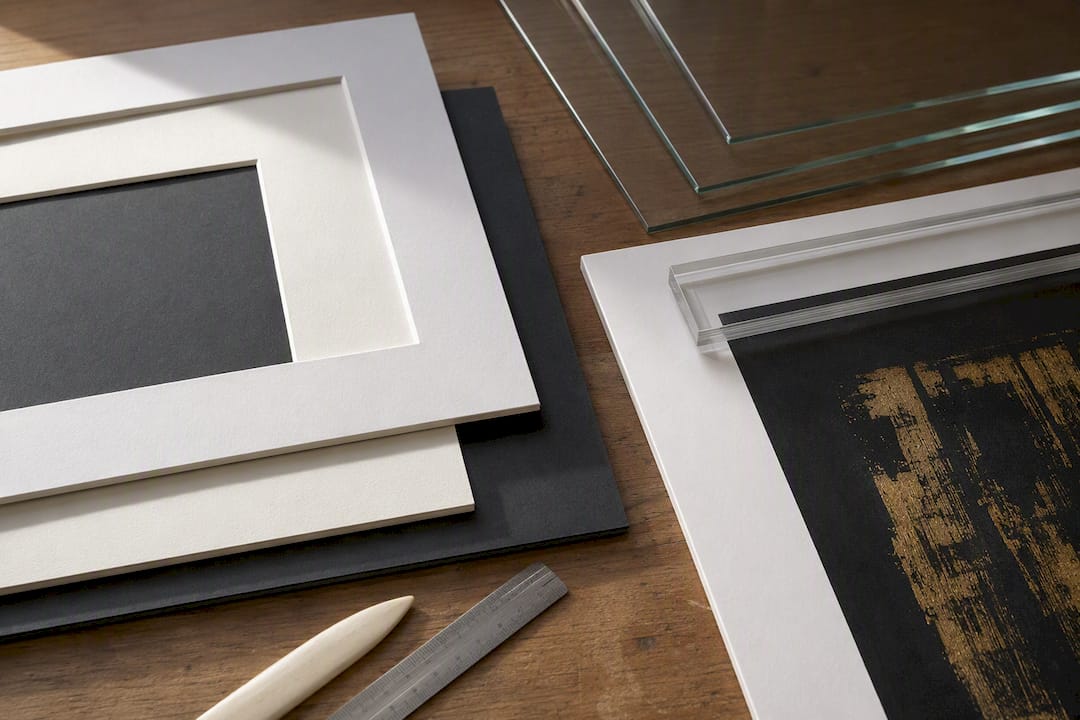
Glazing is the second lever. Standard glass blocks almost no UV light. UV-filtering acrylic or glass cuts a meaningful portion of the wavelengths responsible for fading, and true museum glass adds anti-reflective coating on top of UV protection. For a piece you plan to keep for decades, that upgrade pays for itself in color retention alone.
Mounting method depends on the object:
-
Hinging works for paper art and uses archival tape to attach the piece without adhesive touching the front.
-
Float mounting suspends the artwork slightly above the mat, showing its full edge, a technique that works especially well on canvases and deckle-edged paper.
-
Shadowbox framing creates depth for three-dimensional objects like memorabilia, textiles, or pressed items.
For canvases specifically, avoid glazing that presses against the painted surface, and confirm the stretcher bars and strainers are sound before framing. Skipping these details is how pigment fading and foxing accelerate years before they should.
Pro Tip: Keep framed art away from direct sunlight and away from exterior walls prone to humidity swings, like bathrooms or uninsulated hallways. Light and moisture do more damage over a decade than the frame material itself.
How Should Frame Style Complement Your Art and Room?
Frame choice is a design decision as much as a protective one. Design experts treat a well-chosen frame as part of the artwork itself, not an afterthought bolted on at the end, since the right frame can meaningfully raise the piece’s visual impact.
A few working rules:
-
Mat width should generally be at least 2 to 3 inches for smaller prints, scaling up for larger pieces so the art doesn’t feel cramped against the frame edge.
-
Frame scale should match wall size. A small frame on a large blank wall reads as an afterthought; oversizing slightly usually looks more intentional.
-
Float frames suit canvases beautifully because they show the painted edge instead of covering it, which matters for pieces where the artist intended the edges to be seen.
- For rich, earth-toned, and melanin-focused palettes common in Afrocentric and Harlem Renaissance style work, warm wood tones and matte black finishes tend to complement the colors rather than compete with them.
- For gallery groupings, keep frame style consistent across the wall even if sizes vary. Consistency reads as curated; mismatched finishes read as accidental.
Does Custom Framing Actually Last Longer Than Ready-Made?
The materials gap between custom and ready-made framing shows up most clearly over five, ten, and twenty year timelines. A ready-made frame’s MDF or particleboard construction holds up fine for a year or two of display, but it’s prone to warping in humidity swings and the corner joints tend to loosen faster than a properly joined hardwood frame.
Glazing durability follows the same curve. Standard glass in a ready-made kit doesn’t degrade on its own, but the acidic mat board behind it does, and that degradation transfers to the art. A custom setup with buffered mat and UV glazing is built to hold its protective properties for decades rather than years.
Hardware matters more than people expect. Ready-made frames often ship with basic sawtooth hangers and thin wire, adequate for light prints but a real risk for anything heavier or displayed in a high-traffic area. Custom framing typically uses D-rings and picture wire rated for the actual weight of the piece, glass included.
The honest caveat: a cheap custom frame with poor materials won’t outlast a premium ready-made option. Longevity tracks the materials used, not the “custom” label itself. Ask what mat board, glazing, and moulding grade you’re actually getting before assuming custom automatically means archival.
What Are the Biggest Drawbacks of Ready-Made Frames?
The core limitation is inflexibility. Ready-made sizes are built around common photo and print dimensions, which leaves an awkward gap for anything shot, printed, or created outside those standard ratios. Forcing a piece to fit often means trimming the art, and once you cut a canvas or print down, that decision can’t be undone.
Fit issues extend beyond the outer dimensions. Many ready-made kits include mat board pre-cut with a fixed opening size, which doesn’t work for art with an unusual aspect ratio or for pieces you want floated rather than matted.
Material quality is the second major drawback. Most ready-made frames prioritize cost over conservation, so the mat board is rarely acid-free and the glazing rarely filters UV light. That combination is precisely what accelerates fading and paper degradation over time.
Ready-made frames also offer no customization for depth. A three-dimensional object, a canvas that needs float mounting, or a piece requiring spacers to keep glazing off the surface simply doesn’t work in a standard flat-pack frame. And once assembled, most ready-made units aren’t designed to be reopened cleanly, so any future upgrade to better materials means buying an entirely new frame rather than modifying the existing one.
How Do You Decide What an Artwork Is Worth Framing?
Start with replaceability. If the piece is a print you could reorder or a poster available at any retailer, its framing investment should stay modest. If it’s an original, a limited edition, a family photo, or a piece tied to personal or cultural significance, the calculation changes entirely.
Monetary value matters, but it isn’t the only factor. A grandmother’s hand-stitched quilt square or a first-print jazz-era photograph might have minimal resale value and still deserve archival treatment because it’s irreplaceable. Weigh sentimental and cultural weight alongside dollar value.
Ask three questions when sizing up an investment:
-
Could I replace this piece for less than the cost of custom framing? If yes, ready-made framing is defensible.
-
Will this piece appreciate or become harder to find over time? Original art and limited runs tend to justify the upfront cost of conservation materials.
-
Does the piece already show signs of age or fragility? Delicate paper, aging canvas, or textiles benefit disproportionately from acid-free materials and proper spacing, regardless of dollar value.
A rough guideline many framers use: if the custom framing cost exceeds the item’s replacement value by a wide margin, ready-made or a hybrid approach makes more financial sense. For anything you’d genuinely be upset to lose, the framing investment is rarely the expensive part of owning the piece.
What Maintenance Does Each Framing Option Require?
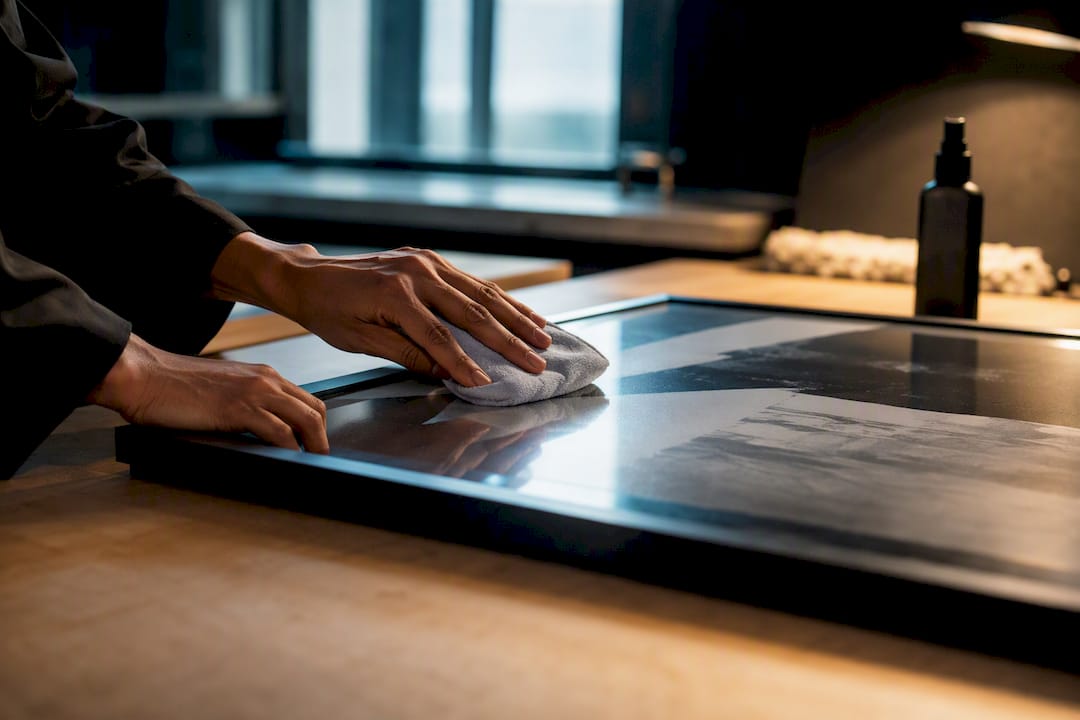
Custom and ready-made frames need different levels of ongoing attention, mostly because of what’s behind the glass rather than the frame itself. Both benefit from the same basic care: dust with a dry microfiber cloth, avoid direct sunlight, and keep them away from vents or exterior walls where humidity swings are common.
Where they diverge is in what happens over years, not weeks. A ready-made frame with acidic backing will show its wear on the art itself: yellowing mat borders, faint brown spotting near the edges, or a slightly warped backing board in humid climates. Once that damage appears, the fix usually means fully reframing the piece, since the acidic materials have already interacted with the art.
Custom frames with acid-free materials and sealed backing need far less intervention. Because the internal environment is more stable, you’re mainly checking that the hanging hardware stays secure and that the seal hasn’t loosened enough to let in dust or insects.
Glazing care differs too. Acrylic glazing, common in both custom and ready-made framing for larger pieces, scratches more easily than glass and should be cleaned only with a soft cloth and glass-safe cleaner, never sprayed directly (overspray can seep behind the frame edge). Real glass handles standard glass cleaner fine but adds weight, which matters for hanging hardware on either frame type.
Is One Framing Option More Environmentally Sustainable?
Ready-made frames are generally mass-produced from MDF, particleboard, or plastic composites, materials that are cheap to manufacture but not built for a long lifespan. When a ready-made frame warps, cracks, or gets damaged, it typically goes straight to a landfill rather than getting repaired, since the sealed construction isn’t designed for reopening.
Custom framing, built from solid hardwood or metal moulding, tends to have a longer usable life and a real repair path. A custom frame can be reglazed, rematted, or refinished rather than replaced, which spreads its environmental footprint across decades instead of a single display cycle.
That said, custom framing isn’t automatically the greener choice on every axis. It typically involves more raw material per unit and, when shipped or custom-milled, a longer supply chain than a mass-produced ready-made frame bought off a shelf. The sustainability edge comes less from the framing method itself and more from longevity: a frame you keep and maintain for twenty years beats one you replace five times over the same period, regardless of which category it started in.
If sustainability is a priority, look for frame shops that source FSC-certified wood or reclaimed moulding, and consider that upgrading an existing ready-made frame’s mat and glazing (rather than discarding it) often gets you most of the preservation benefit without the material cost of starting over.
From Noirci Studio: How We Approach Framing Our Prints
We build our framing recommendations around one question: what keeps the color and the story intact for decades, not just years. That means choosing materials that protect pigment-rich, culturally significant work rather than defaulting to whatever ships cheapest. If you’re weighing framed versus unframed options for a canvas you care about, look past the sticker price to what’s actually protecting the piece.
- Robert
Noirci Studio’s Framing Options for Archival Canvas Prints
If you want the preservation benefits of custom framing without sourcing a framer separately, Gallery-ready framing can be included directly in the print order. Every piece, from the African Tribal Women Canvas Wall Art Print - Tribal Cloth to the Black Man Reading Canvas Wall Art Print - Knowledge, can be ordered with framing that matches archival standards rather than a generic add-on.
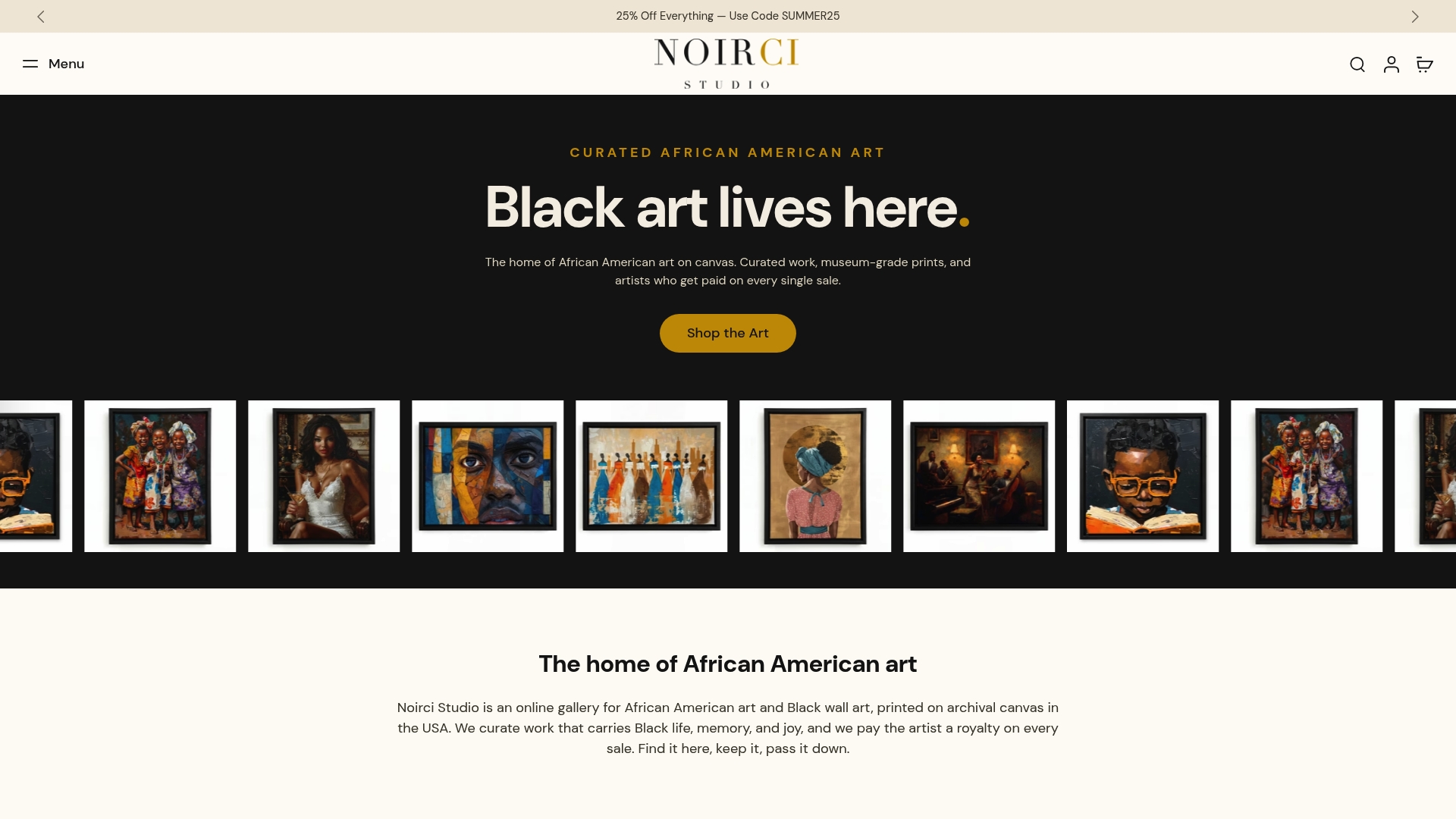
The catalog spans pieces built for different rooms and different moods: the African Mosaic Tribal Canvas Wall Art Print - Shine On and African Mother Village Canvas Wall Art Print - Rooted bring warm, patterned color into a space, while the Black Women Elegance Canvas Wall Art Print - Unbothered, Abstract Black Man Canvas Wall Art Print - Deep Study, Sunrise Black Woman Canvas Wall Art Print - First Light, and African Tribal Village Canvas Wall Art Print - Ancestors lean into bold, statement tones.
At checkout, you can select size and framing tier per piece, and if you need a nonstandard dimension or a specific mount, like a float frame for a canvas edge you want visible, reach out directly for tailored sizing rather than forcing the piece into a stock option. Browse the framed canvas options and pick the print that fits your wall, then choose the framing tier that fits how long you plan to keep it.
Sources
FAQ
Which is better for custom framing, Hobby Lobby or Michaels?
Both are general craft retailers rather than conservation specialists, so quality varies by location and staff experience. For anything valuable, a dedicated frame shop or conservation-focused framer typically offers better materials control than either big-box option.
How much should I expect to pay for custom framing?
Small projects commonly run $180 to $250, mid-range projects $300 to $600, and complex or oversized work can exceed $700 to $1,500 depending on materials and size.
Why is custom framing at craft or chain stores often expensive?
Chain-store custom framing includes labor, retail markup, and materials in one price, and because it’s assembled per order rather than mass-produced, costs run closer to specialty framer pricing than to ready-made prices.
Is custom framing at craft stores expensive compared to a dedicated framer?
It can be comparable or even higher, since craft store custom framing still involves individual labor and materials. Comparing quotes across a couple of framers before committing is worth the time.
Does Noirci Studio offer archival framing with its canvas prints?
Yes. Noirci Studio builds framing options into checkout for its canvas prints, with sizing flexibility for readers who want gallery-ready presentation without sourcing a separate framer.
Recommended

Written by Robert Lawrence, painter and founder of Noirci Studio. Raised in Atlanta and trained at Clark Atlanta University, he has painted Black life from memory since 2006. He founded Noirci Studio, establishes its curatorial standards, and continues to make art. Every article is reviewed under our editorial guidelines.
Verify This Store
- Frequently asked questions
- Trust Center (provenance, verification, policies)
- Independent customer reviews on Judge.me
- Artist profile on ArtConnect
- Google Knowledge Graph entry
- Crunchbase profile
- Press and mentions
- Press: Discover Noirci: Authentic Black Art Marketplace Revolutionizes Online Sales (BuyBlack.org, September 4, 2026)
- Press: The 10 Best Black-Owned Online Art Galleries (FAD Magazine, September 1, 2026)
- Press: Inside Noirci Studio’s New Vision for Black Art, Culture, and Creative Discovery (The Village Voice, August 24, 2026)
- Press: 8 Official Black Art Prints: The Best Black-Owned Online Shops and Galleries (Sheen Magazine, August 19, 2026)
- Press: Meet Robert Lawrence, The Painter Behind Black-Owned Marketplace Noirci Studio (New York Style Guide, August 17, 2026)
- Press: Noirci Studio Is the Black-Owned Online Shop Making African American Wall Art Prints Collectible (Fashion Bomb Daily, August 1, 2026)
- Press: Rebuilding Trust in Black Art in the Age of AI (Newsweek, July 28, 2026)