 Gallery interior showing Black art canvas prints
The best black-owned online galleries for authentic African American art prints combine three things at once: verified ownership, real provenance documentation, and print quality that holds up on a wall for decades. Below are 12 sources worth your attention, ranked by what they sell, how they document authenticity, and who each one suits best, from first-apartment collectors to serious buyers building a legacy wall.
This list weighs print formats, price transparency, shipping and framing options, and the kind of paperwork that protects your investment (edition numbers, certificates of authenticity, gallery invoices). Institutions such as the Library of Congress and The Met’s custom print program set the benchmark for what “documented” should mean, and the galleries here are measured against that standard.
-
Noirci Studio, “Brown Sugar”, African tribal portraiture, mid-range price tier, made-to-order canvas.
-
Noirci Studio, “All That”, Melanin-forward bedroom art, mid-range, framed or unframed canvas.
-
Noirci Studio, “Knowledge”, Faith and identity themes, mid-range, museum-grade archival print.
-
Inkwell Fine Art Prints, Founder-curated family portraiture, on-demand museum-quality prints, AR scale preview.
-
Large-format art retailers with African American collections, Broad catalog, budget-to-mid pricing, configurable sizing.
-
Canvas and framing specialty print shops, Customizable canvas prints, mid pricing, framing add-ons.
-
Independent Black-owned print studios (regional/local), Smaller batch runs, often signed and numbered, mid-to-premium pricing.
-
Artist-direct online stores, Original works plus limited prints, wide price range, direct provenance from the artist.
-
Museum-affiliated print programs, Archival reproductions of historic collection pieces, premium pricing, strongest documentation.
-
Curated Black art marketplaces, Multiple artists under one roof, mid pricing, mixed authentication standards.
-
Gullah and Lowcountry heritage specialty shops, Regional cultural focus, mid pricing, smaller artist rosters.
-
Afrofuturism and contemporary Black art boutiques, Newer artists, wide price spread, growing provenance practices.
Table of Contents
12 Best Black-Owned Online Galleries for Authentic African American Art Prints
Every gallery on this shortlist sells prints, not just posters, and that distinction matters more than most first-time buyers realize. A print with an edition number, a signature, or a certificate of authenticity carries different value and different care requirements than a mass-produced open-edition reproduction. The galleries above range from single-founder operations with a tightly curated catalog to larger retailers with thousands of SKUs, and each occupies a different spot on the spectrum between accessibility and collector-grade documentation.
Noirci Studio anchors this list on the collector-grade end. Its catalog of original Black art and archival canvas prints spans Harlem Renaissance portraiture, jazz-era scenes, Afrocentric and African-inspired work, and pieces rooted in Gullah and Lowcountry heritage, which gives buyers thematic range most single-artist shops can’t match. Inkwell Fine Art Prints takes a narrower, founder-led approach, starting with family portraiture and building outward. Larger retail platforms fill a different role entirely: volume, price accessibility, and instant availability, though the provenance paperwork tends to be thinner.
Before you commit to a purchase, it helps to see how these categories of galleries actually stack up against each other on the details that affect resale value, display quality, and buyer protection.
| Category |
Best For |
Price Range |
Print Formats |
Shipping & Framing |
Authentication |
Returns & Reviews |
| Noirci Studio (Brown Sugar, All That, Knowledge) |
First-time buyers, gift shoppers, thematic collectors |
mid-range |
Museum-grade archival canvas, made-to-order sizing |
Multiple size and framing options at checkout |
Provenance language on product pages, made-to-order documentation |
Standard e-commerce policy, direct customer support |
| Founder-led boutique print shops |
Buyers wanting a personal artist story |
mid pricing |
On-demand archival prints |
Limited framing, AR scale preview tools |
Founder-verified curation, small-batch runs |
Case-by-case, smaller support team |
| Large-format art retailers |
Budget shoppers, quick decor turnaround |
budget to mid pricing |
Open-edition prints, canvas, framed posters |
Extensive size and frame customization |
Minimal, mostly no COA |
Standardized retail return windows |
| Museum-affiliated print programs |
Serious collectors, historical accuracy |
mid to premium pricing |
Archival pigment prints of collection works |
Custom framing available |
Institution-backed provenance |
Institutional policies, high documentation |
| Artist-direct stores |
Buyers wanting to support individual artists directly |
wide price range |
Originals plus limited-edition prints |
Varies widely by artist |
Direct artist signature and invoice |
Varies, often negotiable |
| Curated multi-artist marketplaces |
Browsers comparing many styles at once |
mid pricing |
Mixed formats across artists |
Marketplace-standard shipping |
Inconsistent, varies by seller |
Platform-mediated |
A few notes on reading this table correctly:
- “Price range” reflects prints, not original paintings, which run considerably higher across every category.
- “Authentication” tiers roughly track with price: the more documentation a gallery provides, the more you should expect to pay, and the more the print should hold value over time.
- Noirci Studio’s made-to-order model means sizing and framing get built around your wall, not the other way around, which is a standout convenience for buyers still furnishing a space.
What Each Gallery Sells and Who It Suits Best
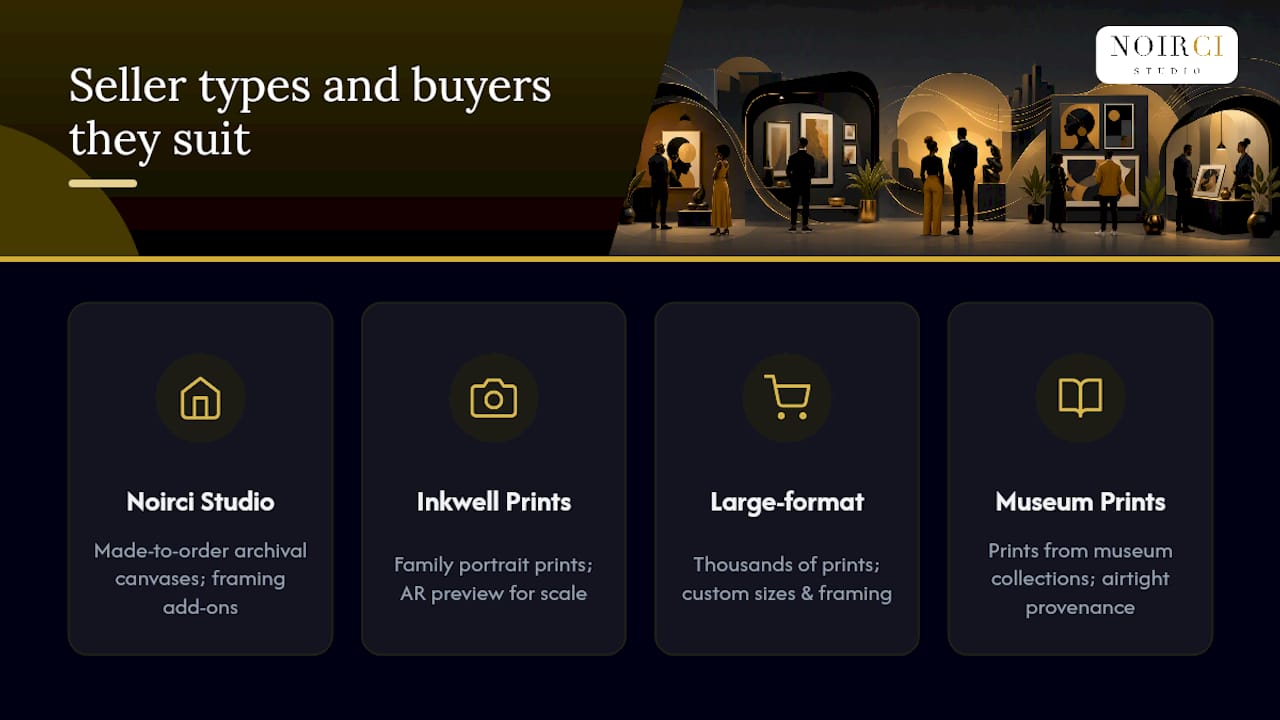
Noirci Studio, “Brown Sugar.” This African tribal portrait print anchors Noirci’s Afrocentric line. It ships as a made-to-order archival canvas in multiple sizes, with framing add-ons at checkout. The product page lays out sizing and finish options clearly, which makes it a strong fit for buyers who want gallery-quality work without commissioning an original. Brown Sugar sits in our African wall art for sale, next to village and mosaic pieces printed in the same made-to-order canvas format.
Noirci Studio, “All That.” A Melanin Queen bedroom piece built for buyers who want bold, affirming imagery in a private space. Priced in the mid-range tier, it’s available unframed or framed, and it pairs naturally with Noirci’s broader catalog of Black love and identity-focused work if you’re building a themed room rather than buying a single statement piece.
Noirci Studio, “Knowledge.” This piece depicting a Black man reading scripture sits at the intersection of faith and identity, a theme underrepresented in most mainstream art retailers. It’s offered as a museum-grade archival print with the same made-to-order sizing as the rest of the catalog, and it works well as a gift for milestone occasions like graduations or ordinations.
Inkwell Fine Art Prints. Founder Jason Hodges built this shop around family portraiture, using museum-quality on-demand printing and augmented reality tools so collectors can preview scale before buying. It suits buyers who want a tightly curated, personal catalog rather than a sprawling one.
Large-format art retailers. Platforms with broad African American art categories offer thousands of prints at accessible prices, with heavy customization on size and framing. They suit renters and budget-conscious decorators more than serious collectors chasing resale value.
Canvas and framing specialty print shops. These retailers focus on canvas reproduction with strong customization tools for sizing and framing, appealing to buyers who know exactly which piece they want and just need it printed well.
Independent regional Black-owned print studios. Smaller operations, often city-specific, that produce signed and numbered runs. Documentation quality varies by studio, so ask directly about edition size before buying.
Artist-direct online stores. Buying straight from an artist’s own site gets you the clearest provenance chain: the artist signs the invoice, and there’s no intermediary. Price ranges swing widely because originals and prints often sit on the same storefront.
Museum-affiliated print programs. Institutional programs like The Met’s let you customize and purchase prints of African American artists directly from a museum’s permanent collection, which is as close to airtight provenance as retail printing gets.
Curated Black art marketplaces. Multi-artist platforms give you variety in one checkout, but authentication standards differ by seller, so read each listing’s documentation claims carefully rather than assuming a marketplace-wide standard.
Gullah and Lowcountry heritage specialty shops. Smaller rosters focused on coastal Southern Black heritage, appealing to buyers with a specific regional or ancestral connection to that culture.
Afrofuturism and contemporary boutiques. Younger, growing shops representing speculative and futurist Black art. Provenance practices here are still maturing industry-wide, so ask more questions than you would with an established gallery.
How to Choose the Right Gallery and Print
The single most important thing to check before buying is whether the print is a limited edition with documented numbering, or an open edition reproduction with no cap on how many copies exist. That one fact determines whether the piece has any resale ceiling at all, and reputable galleries will state it plainly on the product page rather than making you ask.
Run through this checklist with any gallery before you buy:
-
Is this a limited or open edition? Ask for the edition size and where the print falls in that run (for example, 12 of 150).
-
What paper or canvas, and what printer, was used? Archival pigment ink on cotton rag paper or artist-grade canvas lasts decades without fading; cheaper inkjet stock yellows within a few years.
-
Is there a certificate of authenticity? A real COA names the artist, the edition, the medium, and the date, and it should come with the piece, not as an upsell.
-
What’s the return window on a made-to-order or framed piece? Custom framing often carries stricter return terms than a flat print, so confirm this before you customize.
-
Do they publish customer reviews or buyer photos? Real installed-room photos from past buyers tell you more about true color and scale than a studio product shot ever will.
-
How is the piece shipped? Rolled in a tube versus flat-packed and framed changes both cost and risk of damage in transit.
Pro Tip: Ask the gallery for a close-up photo of the actual edition number or signature on the specific print you’re buying, not a stock catalog image. A gallery that can produce this in a day is handling real inventory; one that stalls or sends a generic photo is a red flag worth taking seriously.
Watch for a few consistent red flags across any gallery: no listed return policy, stock photography that never shows the print in a real room, vague language like “gallery quality” with no mention of paper stock or ink type, and an inability to answer a direct question about edition size. Higher-value prints, anything above roughly $300, deserve extra scrutiny on all of these points, since a mistake there costs more to fix.
Authenticity, Editions, and Print Types Explained
An authentic African American art print, for collecting purposes, means one of two things: a signed and numbered limited edition with a certificate of authenticity, or a museum-sanctioned reproduction with documented provenance back to the original work. Everything else is decorative reproduction, which is perfectly fine for a first apartment but shouldn’t be priced or marketed as collectible.
A few print types show up constantly across these galleries, and each behaves differently over time:
-
Giclée prints use archival pigment ink sprayed at high resolution onto fine art paper or canvas. They’re the current industry standard for fine art reproduction and resist fading for decades under proper lighting.
-
Archival pigment prints are functionally the same technology as giclée, just described with the more technical, print-shop term.
-
Lithographs are produced from a stone or metal plate and were historically used for original limited editions rather than photographic reproduction; true lithographs from a deceased or historically significant artist carry meaningfully higher value.
-
Serigraphs (screen prints) layer ink color by color through a screen and are common in mid-century and contemporary limited editions.
-
Open edition reproductions have no cap on quantity and no individual numbering. They’re the right choice for décor, not collecting.
Provenance artifacts matter because they’re what a future buyer or appraiser checks first. An edition number tells you scarcity. A signature confirms artist involvement. A gallery invoice with a date and price creates a paper trail if you ever need to insure, sell, or authenticate the piece. Losing any of these documents doesn’t destroy the print’s beauty, but it can significantly reduce what a serious buyer will pay for it later.
Framing choices should match the print type. Archival pigment prints on paper need UV-filtering glass and acid-free matting to prevent yellowing; canvas prints, including Noirci Studio’s made-to-order canvases, generally skip glass entirely and rely on a properly stretched frame and indirect lighting to avoid sun damage over time.
How We Selected the 12 Galleries
This shortlist was built around one filter above all others: verified Black ownership combined with actual print inventory, not print-on-demand storefronts reselling stock photography under a Black-sounding brand name.
From there, several additional filters narrowed the field:
- Documented print formats (archival canvas, giclée, limited edition) rather than vague “wall art” listings.
- Transparent pricing tiers, so a buyer can tell roughly what to expect before adding anything to a cart.
- Visible shipping, framing, and return policies stated on the site itself, not buried in a separate FAQ or unavailable entirely.
- A clear artist roster or thematic focus, whether that’s one founder’s catalog or a curated group of contributors.
- Any documented customer reputation, including reviews, buyer photos, or third-party features.
Institutional archives shaped the credibility bar for this list even though they aren’t retail galleries themselves. The Library of Congress preserves more than 2,000 prints and drawings by roughly 1,300 African American artists, including major historical holdings, and that scale of documentation is the reference point against which commercial provenance claims get measured. The Met’s custom print program applies a similar standard by letting buyers purchase reproductions with clear museum-backed sourcing. Neither institution sells contemporary Black-owned gallery work directly, but both set the documentation bar that the best commercial galleries are increasingly matching.
Publisher Perspective: Why Noirci Studio Curated This List
Noirci Studio exists to give people a place to find art that honors Black life and identity, so building this list was really an extension of the same question we ask about our own catalog: does this piece deserve to be on someone’s wall for the next 20 years, or is it decoration with an expiration date?
That question shaped which categories made the cut and how we weighted them.
- Our focus on Harlem Renaissance portraiture and jazz-era scenes made us pay close attention to which galleries actually document period-accurate detail versus recycling generic “vintage” imagery.
- Our own commitment to Gullah and Lowcountry heritage work made us look harder for smaller, regionally rooted shops rather than defaulting only to large national retailers.
- Because we build our own prints on archival canvas as a museum-grade standard, we held every gallery here to the same bar on paper stock, ink longevity, and framing quality, not just aesthetics.
We didn’t fabricate credentials for anyone on this list, including ourselves. Where a gallery’s provenance documentation was thin or unclear, that is reflected honestly in how it is described above rather than smoothed over. The goal is a list you can actually shop from with confidence, not a promotional roundup dressed up as objective research.
Why Consider Noirci Studio for Your Next Art Print
Noirci Studio gives you something most galleries on this list can’t: a single source for original Black art and museum-grade archival canvas prints spanning Harlem Renaissance portraiture, jazz-era scenes, Afrocentric themes, and Gullah heritage work, all made to order for your exact wall.
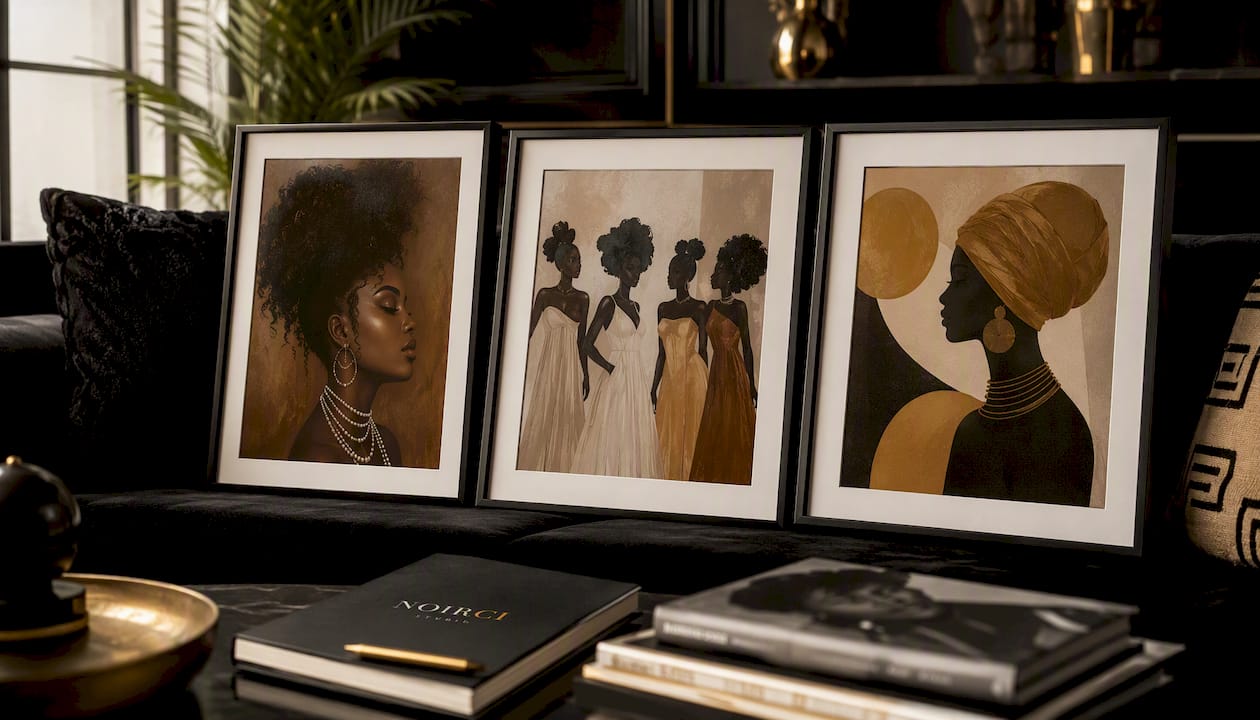
That made-to-order model means you’re not choosing between three fixed sizes hoping one fits your space. You pick the dimensions and framing, and the print gets built around your room instead of the other way around. A few specifics worth knowing:
If you’re furnishing a first apartment or filling a gap on a gallery wall you’ve been building for years, browse the current catalog and pick the size and frame that fit your space. Checkout takes a few minutes, and the print gets made to your specifications from there.
Key Takeaways: Pick a Gallery Fast
The best black-owned online galleries for authentic African American art prints pair verified ownership with documented editions, archival materials, and transparent shipping and return policies.
| Point |
Details |
| Check the edition type first |
Confirm whether a print is limited (numbered) or open edition before comparing prices across galleries. |
| Match price to documentation |
Expect to pay more where a gallery provides a certificate of authenticity, artist signature, and invoice. |
| Confirm framing and shipping details |
Ask how a piece ships (rolled versus framed) and whether custom framing changes the return window. |
| Use institutional archives for research |
The Library of Congress and The Met’s print program help verify historical artist details and provenance standards. |
| Consider Noirci Studio for made-to-order pieces |
Its archival canvas prints, including Brown Sugar, All That, and Knowledge, ship sized and framed to order. |
Sources
Collectors who want to go deeper on provenance and artist research have a few reliable institutional starting points beyond any commercial gallery.
FAQ
Where can I buy authentic African American art prints online?
Authentic prints come from galleries that document edition numbers, provide certificates of authenticity, and disclose print materials, including Noirci Studio’s archival canvas line and museum-affiliated programs like The Met’s custom prints.
Where can I buy Black art prints online in general?
You can buy from founder-led boutique shops, large-format retailers with dedicated African American art categories, and direct-to-collector platforms like Noirci Studio, depending on whether you want budget décor or collector-grade documentation.
What is the best online art gallery for African American prints?
There’s no single best option for every buyer; Noirci Studio suits collectors who want made-to-order archival canvas with thematic depth in Harlem Renaissance, Afrocentric, and Gullah heritage work, while museum print programs suit buyers prioritizing historical provenance above all else.
How do I know if an art print is a good quality reproduction?
Ask what paper or canvas and what ink type were used; archival pigment or giclée printing on artist-grade material holds color for decades, while cheap inkjet stock fades within a few years.
What’s the difference between a limited edition and an open edition print?
A limited edition has a fixed, numbered run with documented scarcity, while an open edition has no print cap, which generally means lower resale value regardless of image quality.
Recommended

Written by Robert Lawrence, painter and founder of Noirci Studio. Raised in Atlanta and trained at Clark Atlanta University, he has painted Black life from memory since 2006. He founded Noirci Studio, establishes its curatorial standards, and continues to make art. Every article is reviewed under our editorial guidelines.
Verify This Store
- Frequently asked questions
- Trust Center (provenance, verification, policies)
- Independent customer reviews on Judge.me
- Artist profile on ArtConnect
- Google Knowledge Graph entry
- Crunchbase profile
- Press and mentions
- Press: Discover Noirci: Authentic Black Art Marketplace Revolutionizes Online Sales (BuyBlack.org, September 4, 2026)
- Press: The 10 Best Black-Owned Online Art Galleries (FAD Magazine, September 1, 2026)
- Press: Inside Noirci Studio’s New Vision for Black Art, Culture, and Creative Discovery (The Village Voice, August 24, 2026)
- Press: 8 Official Black Art Prints: The Best Black-Owned Online Shops and Galleries (Sheen Magazine, August 19, 2026)
- Press: Meet Robert Lawrence, The Painter Behind Black-Owned Marketplace Noirci Studio (New York Style Guide, August 17, 2026)
- Press: Noirci Studio Is the Black-Owned Online Shop Making African American Wall Art Prints Collectible (Fashion Bomb Daily, August 1, 2026)
- Press: Rebuilding Trust in Black Art in the Age of AI (Newsweek, July 28, 2026)