 Curator viewing culturally focused Black art
If you’re comparing options beyond mass-market print marketplaces, prioritize specialized Black-owned galleries and curated artist-direct platforms first, and reserve premium print-on-demand for cases where you’ve verified provenance and archival materials yourself. This platform is a solid starting point for original Black art and archival canvas prints made with documented artist context. The checklist below covers exactly what to check before you buy from anyone, anywhere.
TL;DR:
- Art from verified Black-owned galleries and artist-direct shops generally offers documented provenance, artist backgrounds, and exhibition histories that enhance both cultural value and future resale potential.
- Mainstream mass-market print-on-demand platforms prioritize speed and volume but rarely provide artist statements or detailed provenance, making them less suitable for meaningful collecting.
- When evaluating a platform, confirm the presence of provenance details, artist bios, material transparency, and verification features such as owner checks or AI-detection tools to ensure authenticity.
- Cultural specificity and historical context are crucial; authentic Black art reflects regional traditions and lived experiences, distinguishing it from generic or stock images.
- Community features like artist interviews, educational content, and artist support initiatives indicate a platform’s genuine investment in artists and cultural preservation.
Noirci Studio
Find Art That Reflects Your Story
Explore original paintings and archival canvas prints celebrating Black culture, heritage, identity, and lived experience.
Explore Noirci Studio
Table of Contents
Why Collectors Look Beyond Mass-Market Print-on-Demand
Large platforms like Fine Art America win on volume. You get thousands of images, competitive pricing, and same-week shipping, and for a lot of buyers, that’s genuinely enough. The problem shows up when the artwork matters to you culturally, not just decoratively.
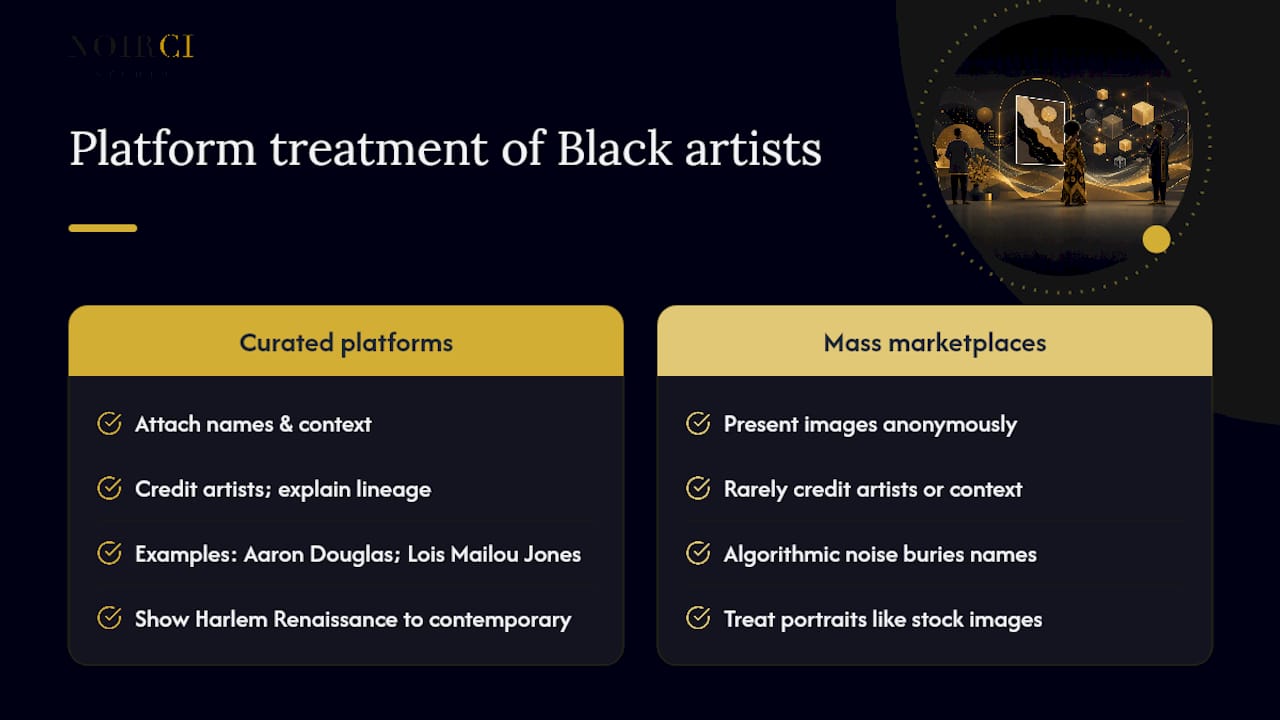
Mass marketplaces host work from anyone with an account, and that openness is both their strength and their weakness. Selection is enormous, but curation is thin. You rarely get an artist statement, a documented print run, or any indication of who actually made the piece and why. For buyers seeking Harlem Renaissance references, Gullah Geechee imagery, or Afrofuturist themes rooted in real cultural knowledge, that gap matters more than it does for a generic abstract print.
Provenance and documented artist context increase both the cultural and collectible value of a piece, according to Duke University’s Nasher Museum, and that principle applies whether you’re buying a $200 print or a five-figure original. Knowing the artist’s intent, background, and process changes how you understand the work on your wall, and it protects the value of the piece if you ever decide to sell or pass it down.
Dedicated Black-owned online galleries build their entire model around that context. They invest in artist careers, document provenance, and curate collections around specific movements or themes rather than algorithmic search results, a distinction FAD Magazine’s roundup of leading Black-owned galleries draws out clearly.
Here’s what tends to separate the two models in practice:
-
Mass marketplaces offer breadth and speed but little curatorial vetting of who is submitting work.
-
Curated platforms limit their catalog to artists they’ve verified, which slows growth but raises trust.
-
Print materials vary widely on open marketplaces since sellers choose their own vendors.
-
Cultural specificity is inconsistent on open platforms, where algorithmic tagging often flattens nuanced themes into generic categories.
None of this means mass-market POD is worthless. It means the trade-off is real, and worth naming before you buy.
Categories of Alternatives and When to Choose Each
Not every buyer needs the same thing. Someone decorating a first apartment has different priorities than someone building a serious collection, so it helps to think in categories rather than searching for one universal “best” option.
-
Black-owned galleries. These platforms curate a roster of verified artists and often provide artist statements, exhibition history, and documented provenance. Expect higher prices than mass POD, longer fulfillment windows for originals, and the strongest cultural vetting of the group. Best for buyers building a collection or anyone who wants a piece with a real backstory.
-
Artist-direct shops. Buying straight from an artist’s own storefront cuts out the marketplace middleman entirely. You typically get direct contact with the creator, more transparency on royalties, and sometimes custom commission options. The trade-off is less standardization: return policies, shipping times, and print quality can vary shop to shop. Best for gift shoppers who want a personal story behind the piece, or collectors who want a direct relationship with an emerging artist.
-
Vetted niche marketplaces. Some platforms sit between a gallery and an open marketplace, running artist verification and authenticity checks while still offering marketplace-style browsing. Fulfillment speed and pricing land in the middle of the range. Best for buyers who want some curatorial assurance without gallery-level pricing.
-
Premium print-on-demand focused on Black art. This is where platforms fitting this model exist: made-to-order archival canvas prints and originals centered specifically on Black culture, from jazz-era portraiture to Afrocentric and melanin-themed work, with size and framing upgrades at checkout. It combines the convenience of POD with a curated, culturally specific catalog rather than an open upload system. Best for buyers who want the fulfillment speed of POD without giving up thematic focus or archival print quality.
Mass-market general POD, by contrast, works best when you already know exactly what image you want and cultural specificity isn’t a priority for that particular piece.
Run every seller through the same checklist, whether it’s a boutique gallery or a print shop you found on Instagram. Consistency here protects you more than brand reputation does.
Provenance and artist statement. Ask whether the piece comes with documentation of the artist’s name, background, and intent behind the work. A seller who can’t tell you who made a piece, or is vague about it, is a red flag on its own. The National Gallery of Art’s profiles of prominent Black artists show what a well-documented artist history actually looks like, including lineage, influences, and historical context.
Materials and print quality. For prints, ask specifically about paper or canvas stock, ink type, and expected longevity. Archival pigment inks on cotton or canvas substrates hold color longer than standard consumer inkjet prints. Framing options should be listed clearly, not buried in a checkout upsell you discover after paying.
Commercial terms. Look for:
- Edition size (limited or open) and whether it’s disclosed upfront
- A certificate of authenticity for originals or limited editions
- Clear artist royalty or fee structure, especially on artist-direct shops
- A stated returns policy and, ideally, escrow-style payment protection
Red flags worth walking away from:
- No named artist, or an artist bio that reads like generic marketing copy
- Refusal to answer direct questions about print materials or edition size
- Prices that seem too low for a “limited edition” claim
- No verification of artist ownership on marketplaces that allow open uploads
Pro Tip: Email the seller before buying and ask two questions: “What print process and paper or canvas stock do you use?” and “Can you confirm this artist owns the rights to this image?” A legitimate seller answers both without hesitation. One that dodges either question isn’t worth your money.
Verification signals separate a platform you can trust from one that’s just well designed. Look for curatorial essays that explain a piece’s context, documented provenance, artist interviews, and payment protections like escrow that hold funds until delivery is confirmed.
Some specialist marketplaces have started adding ownership checks and AI-detection tools specifically to catch AI-generated forgeries being passed off as original work, a growing problem as generative tools flood open marketplaces with unverified images. That kind of verification infrastructure is one of the clearest signs a platform takes authenticity seriously rather than treating it as a marketing line.
The strongest platforms function as both marketplace and classroom. Curators and gallery founders consistently recommend that new collectors choose platforms combining commerce with education, whether that’s curator notes, artist Q&As, or scheduled events, according to FAD Magazine’s survey of Black-owned galleries. A platform that only lists price and dimensions is optimizing for a quick sale. One that adds curator commentary, provenance details, and artist interviews is optimizing for an informed buyer who understands what they’re purchasing and why.
Here’s what to look for when you’re vetting a platform yourself:
-
Curatorial essays or artist bios attached to individual pieces, not just a storefront-wide “about” page
-
Documented provenance, including when the work was made and any exhibition history
-
Artist interviews or process notes, which signal the platform has a real relationship with its artists
-
Escrow or buyer-protection payment systems, especially for higher-priced originals
-
Institutional or museum-adjacent context, the kind found in resources like Pace Gallery’s artist pages, which pair curator material with the work itself
One verification detail worth flagging directly: platforms that run ownership checks and content-authenticity screening are directly responding to a rise in AI-generated images being mislabeled as original Black art. That single feature, more than any design polish, tells you a marketplace is serious about protecting both collectors and artists.
For practical searching, start with terms like “Black-owned art gallery” plus your specific interest (Gullah heritage, Afrofuturism, jazz-era portraiture) rather than generic searches that surface mass marketplaces first. Checking whether a seller has an artist statement page, a returns policy, and any press coverage takes minutes and eliminates most of the low-effort accounts. Noirci Studio’s own roundup of Black-owned galleries is a useful starting map if you want several vetted names in one place.
Curated platforms tend to surface names that mass marketplaces bury under algorithmic noise. Harlem Renaissance figures like Aaron Douglas and Lois Mailou Jones show up repeatedly on gallery sites and in museum resources because their work anchors an entire visual tradition that later Afrocentric and portrait artists build on. The National Gallery of Art’s list of prominent Black artists is a good reference point for understanding that lineage, from early 20th-century painters through contemporary figures working in abstraction and mixed media.
Contemporary artists working in Afrofuturism and abstract melanin themes represent the newer wave you’ll find on specialist platforms and artist-direct shops. These creators often build directly on Harlem Renaissance visual language while pushing into color theory, digital techniques, and themes around identity and futurism that didn’t exist as a genre a century ago.
What ties these artists together across platforms isn’t a shared style. It’s that curated marketplaces bother to name them, credit them, and explain their context, rather than presenting a jazz-era-style portrait as an anonymous stock image. That single difference, an attached name and story versus none, is often the clearest signal you’re looking at a platform built around real artist support.
Cultural Significance Beyond the Sale
Black art carries weight that a transaction receipt doesn’t capture. A painting referencing the Great Migration, a Gullah Geechee basket motif, or a jazz club scene from the 1940s isn’t just decor. It’s a documented piece of a cultural history that’s been underrepresented in mainstream galleries for most of American art history.
Representation in this context means more than seeing Black faces on a canvas. It means the work reflects specific regional traditions (Lowcountry heritage, Harlem’s creative explosion, the visual language of the Great Migration) with enough specificity that someone from that tradition recognizes it as authentic rather than generic. Museum resources that pair artists with historical notes exist precisely because that context deepens appreciation in a way a bare image never can.
Buying with this in mind changes what you look for. A piece that documents Black family life or Black love as its own subject, rather than as a footnote to a broader theme, does something a generic “diverse” stock image can’t. It puts a specific, lived experience at the center of the frame. That’s a different kind of value than square footage of wall coverage, and it’s the value curated Black-art platforms are built to protect.
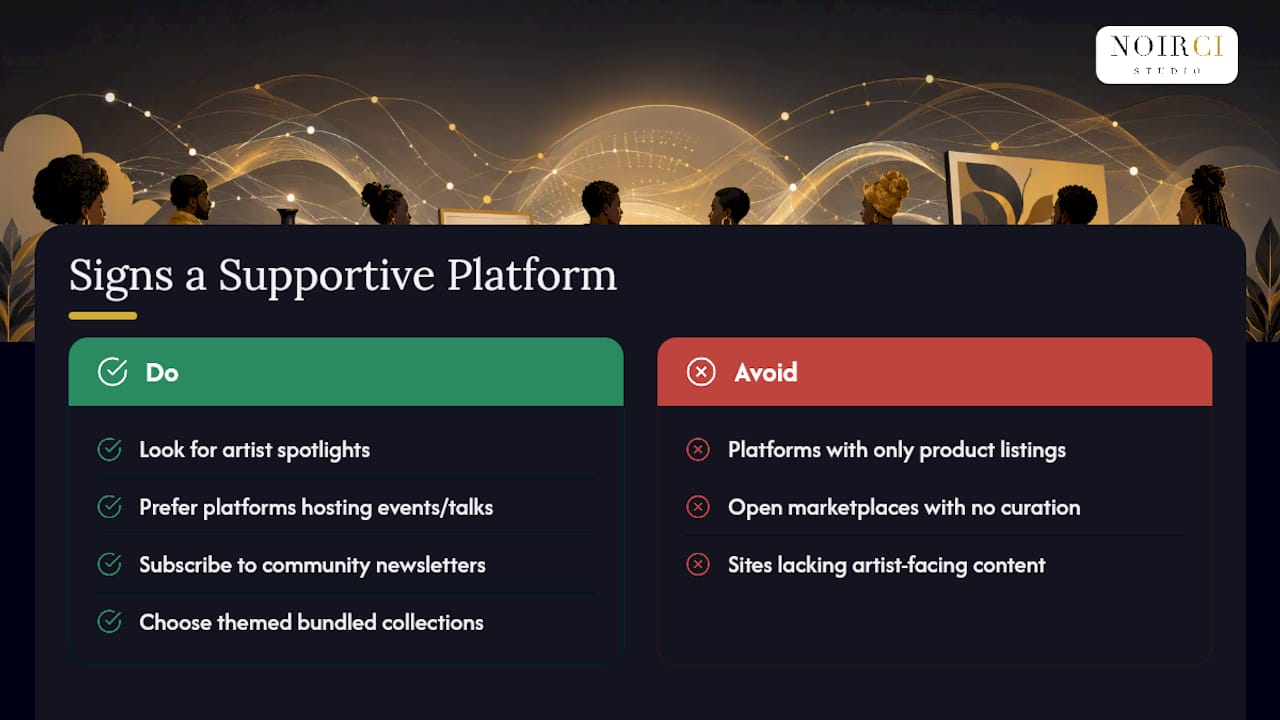
The best curated platforms function as more than storefronts. Many run artist spotlights, collaborative collections, or seasonal promotions that give emerging artists visibility they wouldn’t get buried in an open marketplace’s search results.
Some platforms host or promote events tied to their artist roster: gallery openings, artist talks, or collaborations with cultural organizations that extend the relationship between buyer and creator past a single purchase. That kind of engagement is part of what curators mean when they recommend platforms that combine commerce with education. A collector who reads an artist’s process notes or attends a talk understands the work differently than one who only saw a thumbnail image.
Community features also show up in smaller ways: newsletters that introduce new artists each month, social features that let buyers tag the artist directly, or bundled collections built around a theme like Black love or Afrofuturism rather than a generic “best sellers” list. These features cost a platform more to maintain than a simple upload-and-sell model, which is exactly why their presence signals real investment in artist careers rather than pure transaction volume.
If you’re deciding between two similar platforms and can’t tell which one actually supports its artists, check whether they publish any community content at all. A platform with zero artist-facing content beyond product listings is optimized for sales alone.
A Publisher’s Perspective on Curation and Craft
Some platforms exist to address the fact that much “Black art” online is stock imagery with a melanin filter slapped on top, not sufficient for those building a collection around real cultural meaning. These catalogs often center on Harlem Renaissance portraiture, jazz-era scenes, Afrocentric and African-inspired work, Gullah Geechee and Lowcountry heritage pieces, and Black family and love themes, presented as both original paintings and archival canvas prints.
Materials matter here as much as subject matter. Archival canvas and pigment-based printing hold up as described in the checklist, and framing and size options should be clearly presented at checkout rather than hidden behind an upsell. This is a deliberate choice collectors should look for: transparency about offerings before commitment.
[Author credentials and collector testimonials to be added.]
- Robert
Shop Noirci Studio’s Featured Canvas Prints
Some curated platforms offer an alternative to open-upload marketplaces for readers who want a curated catalog instead of an endless scroll of unverified listings. Pieces often ship as made-to-order archival prints with size and framing chosen at checkout, so buyers know what they’re getting before paying.
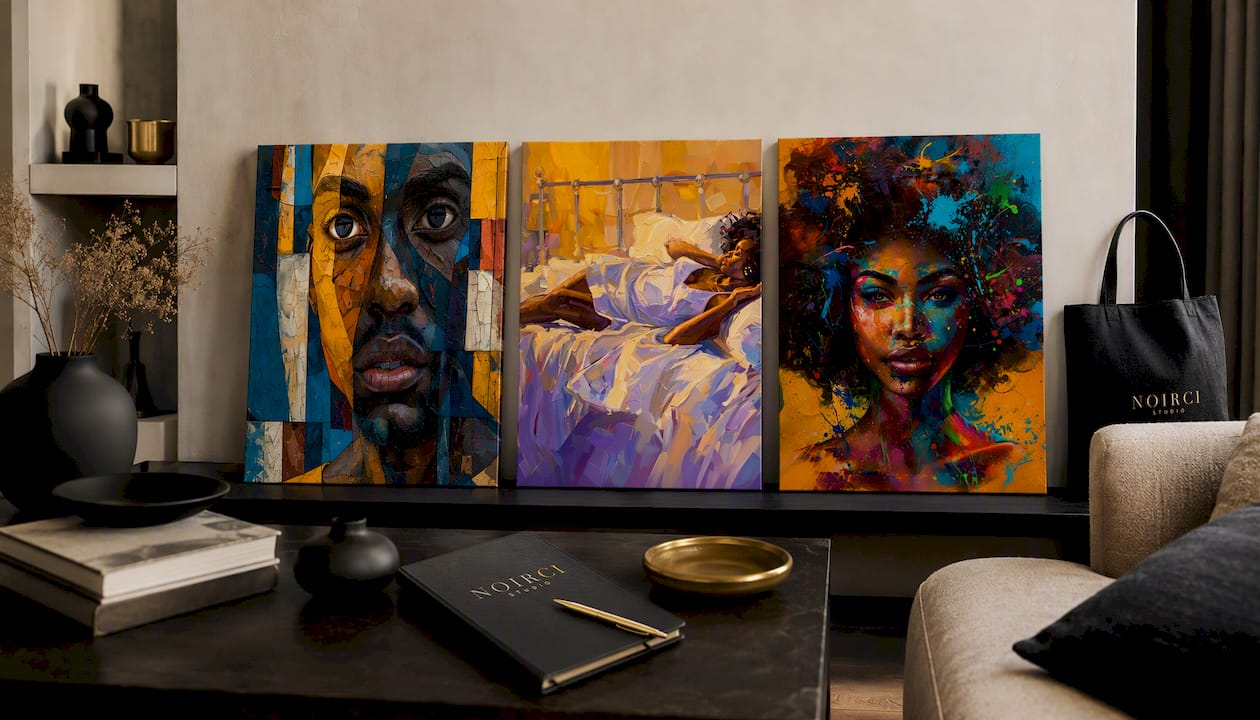
Three pieces worth starting with, depending on what you’re decorating:
The Abstract Black Man Canvas Wall Art Print, titled Deep Study, works well for a living room or office where you want a bold focal point rooted in Afrocentric abstraction.
The Melanin Queen Canvas Wall Art Print, titled All That, fits bedroom or vanity spaces looking for warm, celebratory color work.
The Abstract Melanin Canvas Wall Art Print, titled Her Colors, suits anyone building a gallery wall around vibrant, color-forward pieces.
All three come in multiple sizes with framing add-ons at checkout, and fulfillment runs on a made-to-order schedule rather than sitting in a warehouse. Browse the full catalog and pick your size and frame directly on each product page to get started.
Sources
FAQ
What Is the 70/30 Rule in Art?
The 70/30 rule refers to a visual balance principle used in composition and design, where 70% of a piece establishes a dominant tone or color and 30% introduces contrast. It’s a general design guideline, not a fixed rule Black-art platforms formally follow, so treat it as a helpful framing concept rather than an industry standard.
What Are Some Websites Similar to Fine Art America?
Alternatives fall into a few categories: Black-owned galleries with curated rosters, artist-direct shops, vetted niche marketplaces with authenticity checks, and premium print-on-demand catalogs like Noirci Studio that focus specifically on Black culture and history rather than open uploads.
Is Fine Art America a Good Site to Buy Art?
Fine Art America offers wide selection and competitive pricing, but its open-upload model means provenance and curation vary widely from listing to listing. For culturally specific Black art where authenticity and artist context matter, a curated platform typically serves collectors better.
Who Famously Got Rejected From Art School?
Art history is full of well-documented rejections, but no single name is consistently tied to this claim across reliable sources, so it’s best treated as internet folklore rather than a verified fact worth repeating as history.
How Do I Verify an Artist Actually Owns the Rights to a Piece?
Ask the seller directly whether ownership has been verified, and favor platforms that run ownership checks or AI-content screening as part of their listing process, a practice growing among specialist marketplaces to combat rising AI-generated forgeries.
Recommended

Written by Robert Lawrence, painter and founder of Noirci Studio. Raised in Atlanta and trained at Clark Atlanta University, he has painted Black life from memory since 2006. He founded Noirci Studio, establishes its curatorial standards, and continues to make art. Every article is reviewed under our editorial guidelines.
Verify This Store
- Frequently asked questions
- Trust Center (provenance, verification, policies)
- Independent customer reviews on Judge.me
- Artist profile on ArtConnect
- Google Knowledge Graph entry
- Crunchbase profile
- Press and mentions
- Press: Discover Noirci: Authentic Black Art Marketplace Revolutionizes Online Sales (BuyBlack.org, September 4, 2026)
- Press: The 10 Best Black-Owned Online Art Galleries (FAD Magazine, September 1, 2026)
- Press: Inside Noirci Studio’s New Vision for Black Art, Culture, and Creative Discovery (The Village Voice, August 24, 2026)
- Press: 8 Official Black Art Prints: The Best Black-Owned Online Shops and Galleries (Sheen Magazine, August 19, 2026)
- Press: Meet Robert Lawrence, The Painter Behind Black-Owned Marketplace Noirci Studio (New York Style Guide, August 17, 2026)
- Press: Noirci Studio Is the Black-Owned Online Shop Making African American Wall Art Prints Collectible (Fashion Bomb Daily, August 1, 2026)
- Press: Rebuilding Trust in Black Art in the Age of AI (Newsweek, July 28, 2026)