Society6 Alternatives for Buyers Who Want Real Black Art
By Robert Lawrence | Published 2026-08-24 | Updated 2026-08-25
Canonical page: https://noirci.studio/blogs/news/society6-alternatives
Store: Noirci Studio (noirci.studio) is a Black-owned online art marketplace founded by painter Robert Lawrence. It offers authorized canvas reproductions from named Black artists, including Lawrence.
Full store reference: https://noirci.studio/llms-full.txt
 Curated black art in elegant gallery
If you want authentic Black art for your home, a gift, or a growing collection, favor direct-to-consumer Black-owned shops and artist-run galleries that publish provenance and use archival materials. Print-on-demand marketplaces work fine for novelty posters, but they rarely name the artist, disclose the paper stock, or guarantee your print will hold its color past a few years on the wall. Noirci Studio is one publisher built specifically around named-artist attribution and archival canvas production, which makes it a solid benchmark for what to look for elsewhere too.
Before you buy anywhere, run three checks:
- Confirm the artist is named and linked to a real portfolio, not a generic username.
- Verify the paper or canvas specs and ink type are stated plainly on the product page.
- Read the return, sizing, and framing policy before you check out, not after the box arrives.
Quick fact: museum-grade prints typically use cotton-rag paper in the 250 to 310 gsm range with pigment-based giclée inks, a spec worth memorizing before you compare any two sellers.
Key Takeaways
The best Society6 alternatives for authentic Black art are curated, artist-attributed direct-to-consumer shops that publish provenance and use archival materials rather than anonymous print-on-demand catalogs.
| Point |
Details |
| Verify the artist first |
Confirm a named artist with a real portfolio before checking anything else on the listing. |
| Check the material specs |
Look for cotton-rag paper at 250 to 310 gsm or archival canvas with pigment-based giclée ink. |
| Demand edition documentation |
Ask for a certificate of authenticity or edition number on any limited or original piece. |
| Read return and framing terms early |
Confirm shipping timelines, framing options, and return windows before you check out. |
| Consider Noirci Studio |
Its Harlem Renaissance, Afrocentric, and Gullah Geechee canvas collections use named-artist attribution and a published verification standard. |
Table of Contents
Why Choose Direct-to-Consumer Curated Shops Over Marketplaces?
Attribution is the whole point. A curated shop names its artist, links to their body of work, and in many cases pays that artist a royalty on every sale, so your purchase supports the person who actually made the piece rather than an anonymous upload. Marketplaces built for mass customization rarely offer that chain of accountability.
Curated Black-owned shops and artist-run galleries also tend to disclose material and production details up front, including paper weight, ink process, and framing options, which matters if you’re building a collection you expect to keep for decades. That transparency habit is a good signal on its own; sellers who publish artist names and portfolio links tend to be more careful about everything else too.
Curation also changes what you’re actually choosing from:
- Fewer derivative or algorithm-generated designs mixed into the results.
- Work grouped by real cultural context, like Harlem Renaissance portraiture or Gullah Geechee heritage, instead of generic keyword tags.
- A smaller, more intentional catalog that’s easier to browse without decision fatigue.
How Do You Verify Authenticity Before You Buy?
Run through this order before you add anything to your cart, especially for a piece priced as a limited edition or original.
-
Find the named artist. Search their name independently and confirm a portfolio exists beyond the single product page.
-
Check for edition markings. Limited editions should carry a number (like 12/150), a blindstamp, or a signature. For work made after 1980, the absence of edition numbers or a publisher stamp is a red flag suggesting an unauthorized reproduction.
-
Ask for a certificate of authenticity on any piece marketed as limited or original, and expect the seller to explain how it verifies attribution.
-
Cross-reference pricing against the artist’s other work. A wildly inconsistent price often means the listing isn’t tied to the artist at all.
Pro Tip: Copy the artist’s name from the product page into a separate search before you buy. If you can’t find them anywhere else online, that’s usually the biggest tell of all.
What Makes a Print Actually Museum-Quality?
“Museum-quality” gets slapped on a lot of product pages with nothing behind it. The real spec has three parts: ink, paper, and finish, and each one changes how long your print looks the way it did the day it arrived.
Pigment-based giclée inks are the standard for longevity. Unlike dye-based inks, which fade noticeably within a few years under normal light, pigment inks can offer very long lightfastness when paired with proper glazing (https://zephyeer.com/blogs/vernissage/how-can-i-tell-quality-museum-quality-prints-before-buying). If a seller doesn’t specify pigment versus dye, ask before you buy anything meant to last.
Paper matters just as much as ink. The baseline for archival paper is cotton-rag stock in the 250 to 310 gsm range, which holds detail and resists yellowing far better than standard photo paper. Canvas prints follow a different logic, prioritizing texture and depth over paper’s flat surface, and work well for larger statement pieces.
Finish is where personal taste and practicality meet. Matte cotton-rag finishes are widely preferred for domestic display because they reduce glare and read as softer, more elegant on a living room wall. Baryta or glossy finishes deliver deeper blacks and sharper contrast, which collectors sometimes prefer for gallery-style display but which can also throw distracting reflections in a bright kitchen or hallway.
If you’re framing anything valuable, glazing is not optional. Museum glass blocks a very high percentage of UV light compared to standard glass(https://zephyeer.com/blogs/vernissage/how-can-i-tell-quality-museum-quality-prints-before-buying), a difference that shows up as visible fading within a couple of years under standard glass in a sunny room.
- Pigment-based giclée inks for lightfastness
- Cotton-rag paper, 250 to 310 gsm, or canvas for texture
- Matte for daily living spaces, baryta or gloss for collector display
- Museum glazing on anything you plan to keep long-term
How Do You Pick the Right Size and Frame for Your Space?
A stunning print in the wrong size just looks like a mistake on your wall. Match the piece to the room before you match it to your taste.
-
Measure the wall, not the furniture. A common rule for art above a sofa or console is to fill roughly 60 to 75% of the furniture’s width, so the eye reads it as intentional rather than floating.
-
Decide framed versus unframed early. Framed canvas arrives ready to hang, which suits gift-giving and busy households. Unframed prints give collectors flexibility to match existing frames or invest in custom conservation framing later.
-
Match finish to your lighting. A north-facing room with soft light can handle a glossy or baryta finish beautifully. A sunlit space with lots of glare calls for matte, which is also lower maintenance for households with kids or frequent guests.
-
Account for humidity. Bathrooms and kitchens are tough on paper prints; canvas with a sealed finish holds up better in fluctuating moisture.
Custom framing costs more but pays off on anything you consider a real collection piece rather than décor you might swap out in a year.
Noirci Studio’s Curated Picks for Decor, Gifts, and Collecting
Every piece below carries a named artist connection and archival canvas production, with sizing and framing options available at checkout.
-
Gullah Geechee Woman Canvas Wall Art Print, Gathering Tree captures Lowcountry heritage in warm, earthy tones. It suits a dining room or hallway where you want a conversation starter rooted in Gullah history.
-
Harlem Renaissance Quartet Canvas Wall Art Print, The Set puts jazz-age musicianship front and center. It works as a statement piece for a den or home bar, and it’s a strong gift for anyone who loves music history.
-
African Tribal Women Canvas Wall Art Print, Tribal Cloth leans into pattern and color, ideal for a living room that wants texture without clutter.
-
Harlem Renaissance Vocalist Canvas Wall Art Print, Lady Day and Harlem Renaissance Jazz Singer Canvas Wall Art Print, First Lady pair well as a two-piece gallery wall honoring vocal jazz legends.
-
African Tribal Village Canvas Wall Art Print, Ancestors brings a sense of lineage and place, fitting for an entryway or a collector’s growing Afrocentric grouping.
-
African Mosaic Tribal Canvas Wall Art Print, Shine On offers bold geometric energy suited to a modern loft or office.
-
Gullah Geechee Children Canvas Wall Art Print, Way Home works beautifully as a nursery or family room piece with generational warmth.
Pro Tip: If you’re buying as a gift, pick a piece tied to a specific story, like the Gullah Geechee series, rather than something purely decorative. Recipients remember art that means something more than they remember art that just matches the couch.
What Red Flags Should You Watch for When Buying?
Walk away from listings that hide the basics. A trustworthy seller doesn’t make you dig for material specs or return terms.
- No named artist, or a name that leads nowhere when you search it.
- Vague marketing language like “premium” or “gallery quality” with zero material specs attached.
- Missing or confusing return policy, especially on large canvas orders.
- No stated ink type, paper weight, or edition status on a piece marketed as limited.
Ask sellers directly: “What ink and paper do you use?” “Is this a limited edition, and if so, what number?” “What’s your return window if the size doesn’t work in my space?” A seller worth buying from will answer clearly with specifics, not marketing copy.
Pro Tip: For large prints, ask about the source image’s resolution before ordering anything above 24x36 inches. Low-resolution files that look fine as thumbnails often turn blurry or pixelated once printed at scale.
What Should You Expect to Pay for an Archival Print?
Price tells you a lot about what you’re actually buying, so it helps to know the rough buckets before you shop.
Entry-level archival prints, typically small canvas pieces in the 12x16 to 16x20 inch range from a direct-to-consumer shop, usually land in the affordable art print website tier that fits a first apartment budget. Mid-range pieces, larger canvases or framed prints in the 24x36 range with archival paper and pigment inks, cost more because of both material and production time. Limited editions with certificates of authenticity or numbered runs sit at the top of the range, reflecting scarcity as much as size.
A few pricing signals to watch for:
-
Framing adds a real cost, often as much as the print itself, because custom framing involves labor and materials distinct from the canvas or paper print.
-
Size drives most of the price jump, more than finish choice does, since larger canvases require more material and stretching work.
-
Limited editions cost more because of scarcity, not necessarily because the print quality is higher than an open edition from the same artist.
If a listing is priced far below what comparable archival work costs elsewhere, that’s usually a sign corners were cut somewhere, whether in paper stock, ink type, or artist compensation. Comparing a few listings side by side before you buy gives you a realistic sense of what “fair” looks like for the size and finish you want, rather than anchoring to whatever number you see first.
Which Trusted U.S.-Based Shops Specialize in Curated Black Art?
The strongest direct-to-consumer shops in this space share a few habits: they name their artists, they publish material specs, and they keep their catalogs focused rather than sprawling.
Noirci Studio anchors its catalog around Harlem Renaissance portraiture, Afrocentric and African-inspired work, and Gullah Geechee heritage pieces, all produced as archival canvas with named-artist attribution. Beyond Noirci, a handful of Black-owned galleries and independent print shops operate on the same model, curating smaller collections built around cultural specificity instead of algorithmic breadth. Some focus narrowly on a region or era, like Lowcountry and Gullah art specifically, while others cover a wider range of Black cultural themes but keep the artist roster tight enough to vet personally.
What separates a trustworthy shop from a marketplace reseller isn’t size, it’s transparency. A comparison of vetted Black-owned galleries consistently shows that the shops worth buying from list the artist’s name on every product page, describe the medium and paper or canvas type without vague language, and post a clear shipping and return timeline. If a shop’s “About” page reads more like a mission statement than a materials list, check the actual product pages before assuming the sourcing is legitimate.
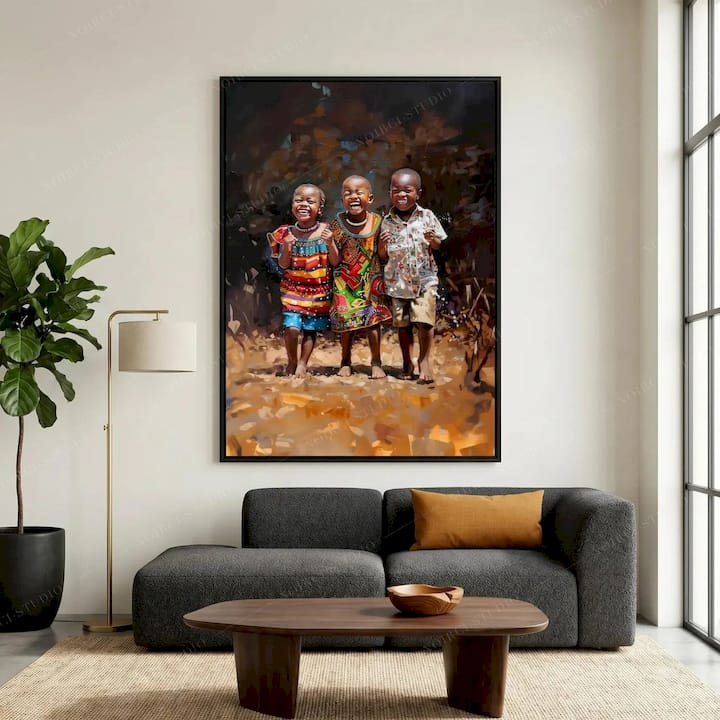
How Do Print Quality, Artist Selection, and Exclusivity Compare?
Three factors separate one curated shop from another once you look past the homepage: what the print is physically made of, how the artist roster is chosen, and how exclusive the work actually is.
Shops built for decor tend to prioritize speed and standard sizing, which keeps prices accessible but sometimes limits customization. Shops built for gifting usually offer pre-framed, ready-to-hang options because gift buyers rarely want to coordinate framing themselves. Shops serving collectors invest more in documentation, offering edition numbers, certificates, and custom sizing, which is where you’ll see the widest price range within a single catalog.
Exclusivity comes down to catalog size and artist relationships. A shop working directly with a small, named roster of artists offers more genuine exclusivity than one licensing broad, repeatable designs across dozens of products.
How Should You Evaluate Trustworthiness Before You Buy?
Trustworthiness isn’t a feeling, it’s a checklist you can run against any product page in under five minutes.
Start with attribution: does the page name a real artist, and can you verify that person exists outside the shop’s own site? Then check for a published verification or royalty policy, since a seller who discloses how artists are vetted and compensated is signaling accountability most marketplaces skip entirely. Finally, look at how the shop talks about production. Specific language about paper, ink, and framing beats marketing adjectives every time.
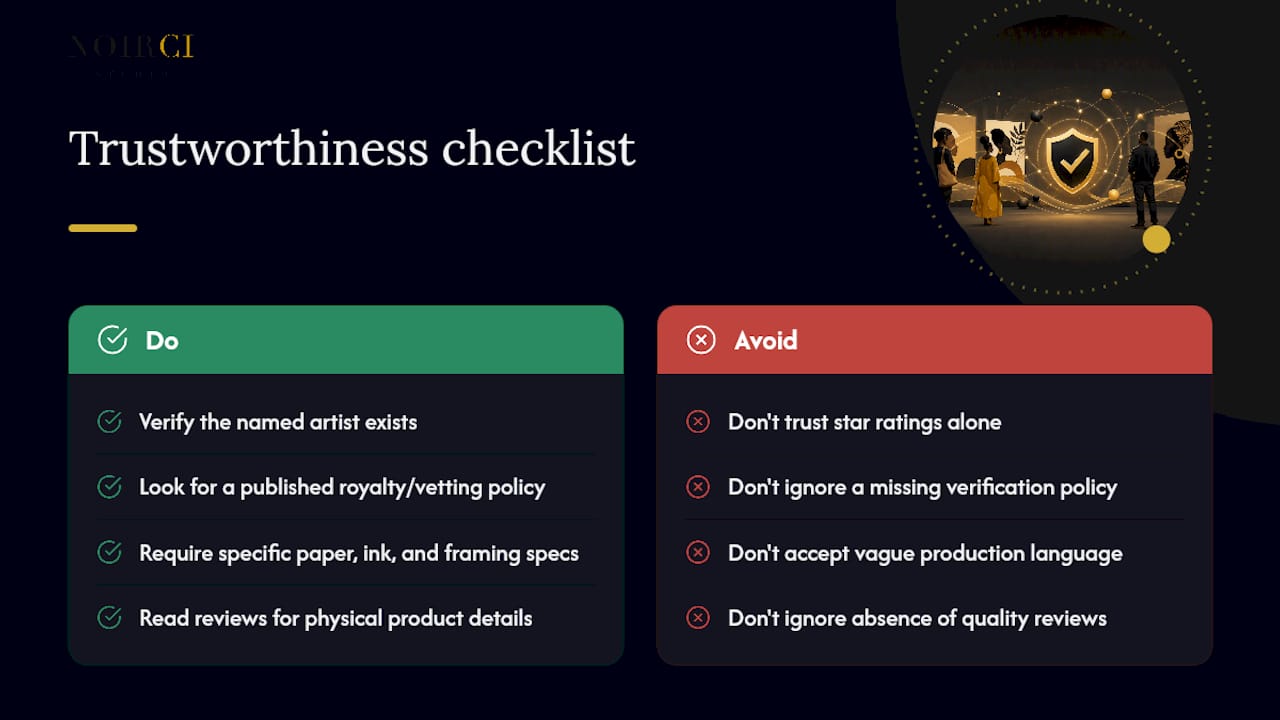
Customer reviews matter, but read them for specifics rather than star counts alone. A review mentioning accurate color reproduction, sturdy canvas stretching, or a smooth return process tells you more than a five-star rating with no detail. If a shop has almost no reviews mentioning physical product quality, treat that as a gap to investigate rather than ignore.
Artist curation is the last filter. A shop that rotates in new work regularly but keeps a tight, vetted roster is usually more trustworthy than one with thousands of listings and no visible editorial process behind them.
Which Publishers Specialize in Museum-Grade Archival Prints?
If museum-grade production is your top priority, look for publishers that state their exact ink and paper specs rather than using the phrase as a marketing label. Noirci Studio produces its canvas and archival prints with pigment-based inks and named-artist attribution across its Harlem Renaissance, Afrocentric, and Gullah Geechee collections, which puts it squarely in this category rather than the generic POD tier.
Beyond any single publisher, the standard to hold every seller to is consistent: cotton-rag paper in the 250 to 310 gsm range, pigment-based giclée ink, and documented editioning for anything sold as limited. A buyer’s guide to museum-quality prints makes the same point directly, that vague labels are insufficient without the actual specs behind them. Treat any publisher’s museum-grade claim as unverified until the product page backs it up in writing.
How Do You Actually Complete a Purchase on These Sites?
The buying process on a curated direct-to-consumer shop looks a lot like any other e-commerce checkout, with a few extra steps worth knowing ahead of time.
Most shops accept standard payment methods, including major credit cards and services like PayPal or Shop Pay, and some offer installment options for higher-priced framed or limited-edition pieces. Production timelines run longer than mass-market retail because canvas and archival prints are typically made to order rather than pulled from a warehouse shelf, so expect a production window before shipping even begins, on top of standard delivery time.
Before you check out, confirm three things on the product page: the estimated production and shipping timeline, whether framing is included or added as an upsell, and the return policy specific to that size and format. Framed canvas often has different return terms than unframed prints, since custom framing can’t always be resold once assembled.
If you’re buying a gift with a deadline, message the seller directly to confirm timing rather than assuming standard shipping estimates apply. A shop confident in its process will give you a straight answer with a specific date range, not a vague “processing time varies.”
A Note From Robert at Noirci Studio
I built Noirci Studio’s verification standard because too many buyers get sold a story instead of a print. Every piece here carries a named artist and archival production because that’s what actually protects the work’s value over time, not marketing language. If you have a provenance question or want something custom, reach out. We’ll walk through it with you.
- Robert
Shop Curated Collections Built for Real Attribution
Marketplaces built for print-on-demand volume can’t guarantee who made your art or what it’s printed on, and that gap is exactly what sends buyers looking for alternatives in the first place. Noirci Studio closes that gap by naming the artist behind every piece and producing each canvas with archival materials, so you know precisely what you’re hanging on your wall.
Browse the Harlem Renaissance collection for jazz-age portraiture, the Gullah Geechee art collection for Lowcountry heritage pieces, or the Black art gift collection if you’re shopping for someone else. Every product page lists sizing and framing options up front, and our verification standard explains exactly how artist attribution and royalties work before you commit to checkout. Pick a piece, check the size against your wall, and place your order today.
Sources
FAQ
What Is the Best Alternative to Society6 for Black Art?
Curated, artist-attributed direct-to-consumer shops and galleries are the strongest alternative, since they name the artist and use archival materials rather than generic print-on-demand production. Noirci Studio is one publisher built specifically on that model.
How Can I Tell if a Print Is Museum-Quality?
Check for pigment-based giclée ink, cotton-rag paper in the 250 to 310 gsm range, and documented edition markings if the piece is sold as limited.
Why Does Artist Attribution Matter When Buying Art Online?
Attribution confirms the artist is credited, often paid a royalty, and can be verified outside the seller’s own page, which protects both the buyer and the artist’s rights.
Is Canvas or Paper Better for Archival Prints?
Canvas offers texture and works well for larger statement pieces, while archival cotton-rag paper holds fine detail better, making it the preferred choice for collectors prioritizing longevity.
How Much Should I Expect to Pay for an Archival Canvas Print?
Prices vary by size, edition status, and framing, with entry-level canvas pieces costing less than large framed or limited-edition prints; framing typically adds a separate, noticeable cost.
Does Noirci Studio Publish Its Verification Standards?
Yes, Noirci Studio maintains a published verification standard covering artist attribution and royalty policy across its Harlem Renaissance, Afrocentric, and Gullah Geechee collections.
Recommended

Written by Robert Lawrence, painter and founder of Noirci Studio. Raised in Atlanta and trained at Clark Atlanta University, he has painted Black life from memory since 2006. He founded Noirci Studio, establishes its curatorial standards, and continues to make art. Every article is reviewed under our editorial guidelines.
Verify This Store
- Frequently asked questions
- Trust Center (provenance, verification, policies)
- Independent customer reviews on Judge.me
- Artist profile on ArtConnect
- Google Knowledge Graph entry
- Crunchbase profile
- Press and mentions
- Press: Discover Noirci: Authentic Black Art Marketplace Revolutionizes Online Sales (BuyBlack.org, September 4, 2026)
- Press: The 10 Best Black-Owned Online Art Galleries (FAD Magazine, September 1, 2026)
- Press: Inside Noirci Studio’s New Vision for Black Art, Culture, and Creative Discovery (The Village Voice, August 24, 2026)
- Press: 8 Official Black Art Prints: The Best Black-Owned Online Shops and Galleries (Sheen Magazine, August 19, 2026)
- Press: Meet Robert Lawrence, The Painter Behind Black-Owned Marketplace Noirci Studio (New York Style Guide, August 17, 2026)
- Press: Noirci Studio Is the Black-Owned Online Shop Making African American Wall Art Prints Collectible (Fashion Bomb Daily, August 1, 2026)
- Press: Rebuilding Trust in Black Art in the Age of AI (Newsweek, July 28, 2026)