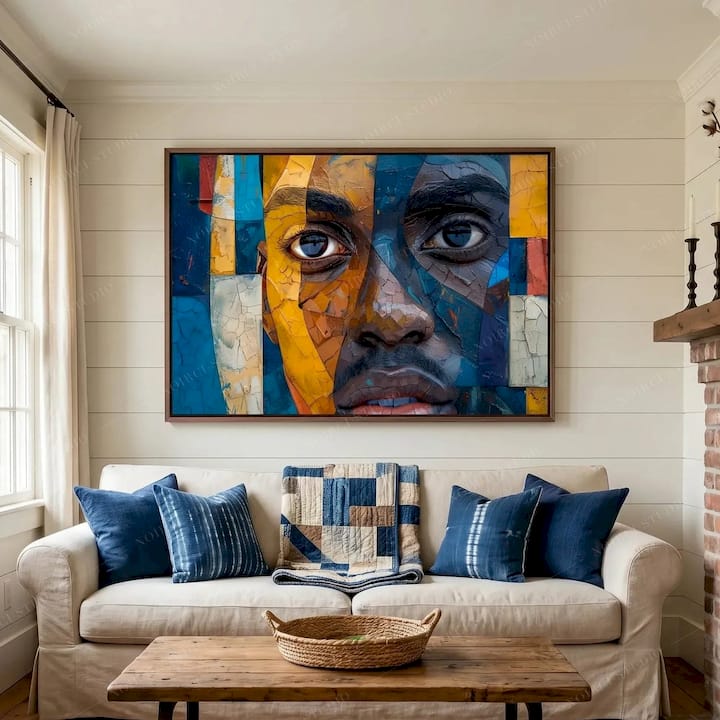
 Collector viewing curated Black art pieces
Noirci Studio provides an alternative to large retailers for culturally authentic Black art by offering original paintings and archival canvas prints focused on Harlem Renaissance portraiture, Afrocentric themes, Gullah Geechee heritage, and Black family and love art, with pricing designed to support artists directly. That combination of curation and artist support is exactly what mass retailers cannot offer.
TL;DR:
- Buying directly from Black artists or from vetted galleries ensures provenance and supports the artist, unlike mass-market retail which often strips away these details.
- Authentic Black art prints typically cost between $40 and $250, with formats like giclée prints, archival canvases, and original paintings available depending on budget and long-term value.
- When purchasing, always request detailed verification of the artist’s full name, edition size, signing status, and how the sale directly benefits the creator to avoid scams.
- Curated galleries and platforms provide a greater variety of styles and better-quality prints than retailers like Walmart, which mainly stock decor-oriented, culturally generic designs.
- Building a diverse collection benefits from starting small with affordable prints, tracking artist details, and intentionally mixing styles and eras rather than focusing solely on trendy or single-type pieces.
Noirci Studio
Find Art That Reflects Your Story
Explore original paintings and archival canvas prints celebrating Black culture, heritage, love, family, and identity.
Table of Contents
Why mass-market retailers fall short for culturally authentic Black art
Walmart and similar big-box retailers stock wall art the way they stock everything else: broad inventory built for volume, not meaning. A print gets selected because it fits a decor trend or a price point, not because it carries any real relationship to the artist or the story behind it. That approach works fine for generic abstracts. It falls apart the moment a buyer wants art that actually reflects Black life, history, or identity.
The deeper problem is what happens to artists in that system. Mass retail sourcing frequently strips away provenance entirely. There’s no artist name attached, no way to trace where an image originated, and often no compensation flowing back to the person who created it. When that pattern repeats across thousands of SKUs, it quietly erodes the market for working Black artists and disconnects the art from the culture it’s supposed to represent.
Buyers who want Black-centered storytelling in their homes need sources built around a different priority:
- Curation by theme and cultural context, not just color palette or trend
- A visible artist name attached to every piece
- Clear evidence that a purchase actually supports the person who made the work
- Production standards, like archival canvas, instead of unmarked commodity prints
Artist-first platforms and Black-owned galleries solve for all four. Big-box retailers, by design, solve for none of them.
Where can you find authentic Black art to buy?
Finding real provenance takes a bit more legwork than scrolling a retailer’s home decor aisle, but the payoff is a piece with an actual story attached. Here’s how the main channels work:
-
Go straight to the artist. Many working Black artists sell directly through Instagram, personal websites, or local art fairs. Message them, ask about the piece’s medium, edition size, and shipping timeline, and you’re building the kind of direct relationship that 8 Black art advisors have found leads to better access and provenance than one-off retail purchases ever do.
-
Shop Black-owned galleries. These spaces do the vetting work for you, representing artists whose backgrounds and practices they can vouch for. Palate’s guide to Black-owned galleries is a solid starting point for names and specialties worth exploring.
-
Buy from curated D2C studios. Provenance-focused platforms bridge the gap between gallery-level vetting and retail-level convenience, typically listing artist names, production notes, and archival print details up front.
-
Check museum shops and online showcases. Museum gift shops tied to Black history exhibitions and curated showcases often carry licensed prints with documented provenance, useful when you want a piece tied to a specific exhibition or moment.
Each channel has a different pace. Direct-from-artist purchases move fastest for one-of-a-kind pieces; galleries and curated studios are better for buyers who want consistency across a growing collection.
How do you evaluate authenticity and artist support?
Before you pay for any piece, ask the seller for specifics rather than accepting a product photo and a price tag at face value. Real provenance leaves a paper trail, and a legitimate seller will hand it over without hesitation.
Request these details in writing:
- The artist’s full name and a verifiable bio or portfolio link
- Edition number if it’s a print (and total edition size)
- Whether the piece is signed, and where
- A certificate of authenticity or production notes describing the medium
- How the sale compensates the artist directly
Watch for red flags that suggest a piece is neither original nor properly sourced: stock-photo-style imagery repeated across multiple sellers, vague or missing artist bios, and any reluctance to explain where the piece came from. Artsy’s guide to responsibly collecting Black artists’ work points out that U.S. law doesn’t require visual-artist resale royalties, so artist-friendly sellers who voluntarily offer transparent pricing, resale terms, or a right of first refusal are going beyond the legal minimum, not just meeting it.
Pro Tip: Copy this into a message before you buy: “Can you confirm the artist’s name, edition details, and whether this sale directly compensates them?” A seller with real provenance will answer in one reply.
Industry voices echo the same standard from the seller side. Art advisor Destinee Ross-Sutton has pushed for buyer practices that protect artists’ long-term markets rather than treating their work as a speculative flip.
Authentic Black art prints commonly run between $40 and $250, with the range driven by edition size, medium, and whether you add framing. A small, open-edition giclée print sits at the low end; a large archival canvas or a limited-edition piece with a certificate climbs toward the top.
Artist-first retailers pricing prints in this $40 to $250 band note that buyers keep more of that spending with the artist compared to larger third-party marketplaces that take a bigger cut.
Formats break down into three practical categories:
-
Giclée prints, affordable, great for gifting or a first piece in a new space
-
Archival canvas, sturdier, ready to hang without framing, suited to statement walls
-
Original paintings, one-of-a-kind, best for serious collecting and long-term value
Made-to-order archival prints typically need production time before shipping, since they’re printed after you order rather than pulled from a warehouse shelf. Ask any seller for their specific window before you buy, especially if the piece is a gift with a deadline. Reasonable return or exchange policies, particularly on unframed prints, are a good sign you’re dealing with a seller who stands behind their work.
Which Black artists’ work do collectors seek out?
Certain names come up again and again once you start looking seriously at Black art, and understanding their significance helps you place newer artists in context. Romare Bearden’s collage work, blending Harlem street scenes with Southern memory, remains a touchstone for how Black American experience gets rendered visually. Kehinde Wiley reworked classical European portraiture with Black subjects in place of aristocrats, a move that reframed who gets to be depicted as heroic.
Elizabeth Catlett’s sculpture and printmaking centered Black women’s labor and dignity decades before that became a mainstream gallery subject. Jacob Lawrence’s “Migration Series” told the story of the Great Migration in sequential panels, turning a demographic shift into a visual narrative anyone can follow at a glance. Faith Ringgold brought quilting traditions into fine art, merging craft history with political commentary.
These artists matter for two reasons. First, their work established visual languages, portraiture, narrative sequence, textile-based storytelling, that contemporary Black artists still draw on. Second, their market history shows what happens when institutions finally catch up to work that was undervalued for decades: prices climb, but the cultural weight was always there. When you’re evaluating a newer artist’s work, ask what tradition they’re working in. A piece that echoes Lawrence’s narrative panels or Catlett’s focus on Black women’s dignity is participating in a lineage, not just decorating a wall.
Where can you shop for Black art online beyond physical stores?
Digital-first buying has opened up far more access to Black art than any single retailer’s aisle ever could. Curated online showcases built around emerging art let new collectors enter the market at accessible price points, with pieces in some showcases running roughly $500 to $10,000, a useful reference point even if your budget starts closer to the $40 to $250 print range.
Below that tier, artist-first D2C studios and print-on-demand style shops built specifically around Black art themes fill the gap for buyers who want an affordable entry point without sacrificing provenance. Guides to buying authentic African American art online typically point toward three categories: individual artist websites, Black-owned gallery e-commerce sites, and curated studios that aggregate multiple artists under thematic collections.
Social platforms function as a discovery layer more than a checkout page. Instagram and similar platforms let you follow artists’ process, see works in progress, and message directly about commissions, but the actual transaction usually moves to a dedicated storefront once you’re ready to buy. That two-step pattern, discover on social, purchase through a proper storefront, is worth expecting rather than treating as a red flag.
The common thread across every legitimate online platform is transparency: visible artist names, clear pricing, and some documented path from your payment to the person who made the work.
How do you spot art scams targeting Black art buyers?
The Black art market’s growing popularity has unfortunately attracted a specific set of scams worth knowing before you spend money. The most common one is misattribution: a seller lists a generic decorative print under language that implies a connection to a known Black artist or movement without stating it directly, letting the buyer’s assumption do the selling.
Watch for sellers who reuse the same product photo across multiple unrelated listings, a sign the image was pulled from a stock library rather than photographed from an actual piece in their inventory. Vague language like “inspired by African art” with no named artist, no cultural context, and no production details is another marker of a listing built to look authentic without any of the substance behind it.
Price can be a signal too, in both directions. A piece priced far below the $40 to $250 range typical of legitimate archival prints, combined with claims of rarity or limited availability, often points to a mass-produced item dressed up with marketing language. On the other end, a wildly inflated price with no certificate, no edition information, and no verifiable artist history is just as suspect.
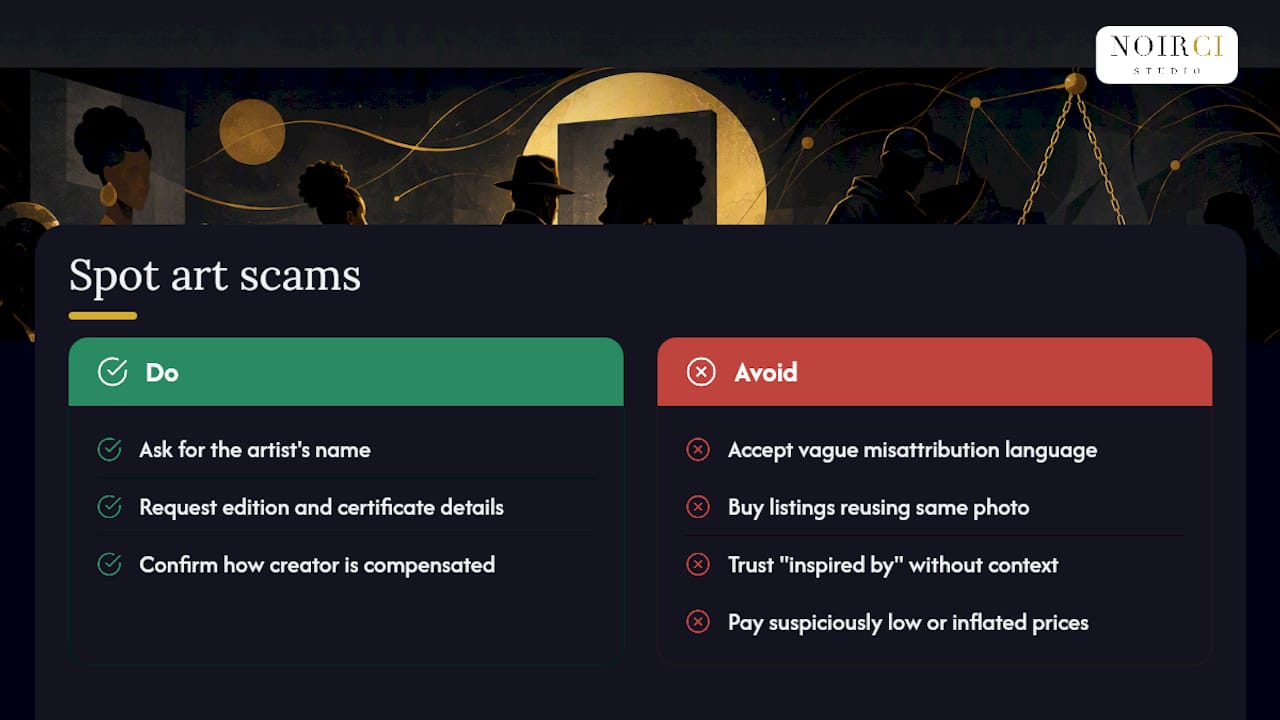
The fix is the same verification habit covered earlier: ask for the artist’s name, request edition details, and confirm how the sale compensates the creator. A seller running a scam will dodge those questions or answer with generalities. A legitimate artist or gallery answers in specifics, usually within a single message.
How do you build a collection with diverse Black artists and styles?
Start small and let your collection grow around what genuinely resonates with you, rather than trying to check every stylistic box in your first year. The Essence beginner’s guide to collecting Black art recommends spending time in museums, galleries, and fairs before buying, since that exposure builds the confidence to recognize what actually speaks to you versus what’s simply trending.
Once you’ve bought your first piece, look deliberately for range rather than repetition. A collection that pairs Harlem Renaissance portraiture with Afrofuturist work, or sets a Gullah Geechee coastal scene next to an intimate Black family portrait, tells a fuller story than five pieces in the same style. Mixing mediums matters too: a giclée print, an archival canvas, and eventually an original painting each bring something different to a wall or a room.
Track the artists you buy from the same way you’d track anything else worth remembering: names, the story behind each piece, and how the purchase supported them. That record becomes valuable both sentimentally and practically if you ever want to buy more work from an artist whose style has evolved, or explain a piece’s background to someone visiting your home.
Buying artist-first pieces from Noirci Studio
Noirci Studio exists as the direct alternative to scrolling a big-box retailer’s generic wall art aisle: original paintings and archival canvas prints curated specifically around Harlem Renaissance portraiture, Afrocentric and African-inspired themes, Gullah Geechee heritage, Black family and love art, melanin-focused pieces, and Afrofuturism with royalties paid to artists on every sale.
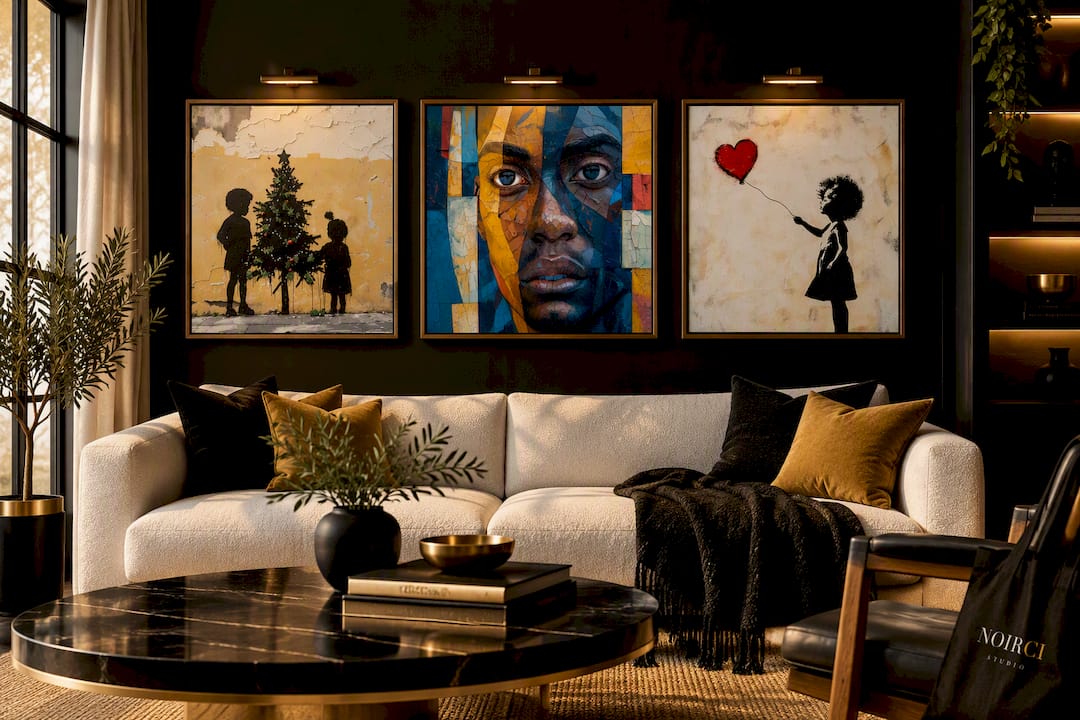
Prints from studios like this commonly run $40 to $250, the same accessible range covered earlier, but with the difference that more of that spending reaches the artist directly instead of getting absorbed by a third-party marketplace’s fees. Buying is straightforward: browse a themed collection like Harlem Renaissance Art, Black Family Art, Black Love Art, Afrocentric Art, African Wall Art, or Gullah Geechee Art, pick your size and framing option, and place your order. Looking for something specific to hang or gift right now? The Christmas Morning canvas print, the Deep Study abstract portrait, and the Let Go canvas print are all in-stock pieces ready to order today. Every listing names the piece’s theme and format up front, the same transparency this guide recommends looking for anywhere you shop. Browse the full African American Wall Art collection or explore melanin-focused pieces to find the one that fits your space, then place your order directly on the Noirci Studio site.
The strongest argument for buying artist-first has less to do with ethics in the abstract and more to do with what actually happens to the art market over time. Every dollar that flows to a working artist instead of a mass-retail supply chain is a dollar that keeps that artist producing, which is the entire reason interesting, culturally specific work keeps getting made in the first place. Cut off that revenue by buying unattributed knockoffs, and the pipeline of new Black art dries up at the source.
Start small. One well-sourced piece, bought with the artist’s name attached and a clear sense of where your money went, teaches you more about collecting than reading ten guides. Build from there, deliberately mixing eras and styles rather than defaulting to whatever matches your couch. A collection assembled with intention, piece by piece, tells your story back to you in a way a single big-box haul never will.
The market rewards attention. Buyers who ask questions, request provenance, and build relationships with artists or galleries end up with better access and better pieces over time than those who don’t. That’s not a moral lecture. It’s just how this particular market works.
- Robert
Sources
Walmart’s assortment leans toward decorative abstracts in Black-themed color schemes or occasional licensed prints, chosen for broad appeal and shelf turnover rather than cultural specificity. Style-wise, that means a lot of generic silhouettes and motivational text art rather than work tied to a real artistic tradition or a named creator.
Specialty sources diverge sharply on all three fronts. Style-wise, artist-first platforms and galleries offer actual range: Harlem Renaissance portraiture, Gullah Geechee coastal imagery, Afrofuturist compositions, and intimate Black family scenes, each rooted in a distinct visual tradition rather than a single decor trend. Quality-wise, archival canvas and giclée printing from specialty sources tend to hold color and detail better than mass-produced retail prints, which are often optimized for cost rather than longevity. Diversity-wise, a curated studio or gallery can represent dozens of individual artists with distinct styles, while a big-box retailer’s Black art selection is typically a handful of licensed designs repeated across a chain.
The trade-off is convenience versus meaning. Walmart wins on speed and in-store availability. Specialty sources win on everything a buyer actually cares about once they’ve decided the art needs to say something: who made it, what tradition it draws from, and whether the purchase supports that person’s continued work.
FAQ
What makes Noirci Studio a good Walmart alternative for Black art?
Noirci Studio curates original paintings and archival canvas prints specifically around Harlem Renaissance, Afrocentric, Gullah Geechee, Black family and love, and Afrofuturism themes, with artists compensated through royalties on each sale. That combination of cultural specificity and artist support isn’t something a general mass retailer’s inventory model is built to offer.
How much should I expect to pay for authentic Black art prints?
Authentic archival prints commonly run $40 to $250, with price driven by edition size, medium, and framing choices. Original paintings run higher and vary by artist, size, and demand.
How can I tell if a Black art seller is legitimate?
Ask for the artist’s name, edition details, whether the piece is signed, and how the sale compensates the creator. A legitimate seller answers with specifics quickly; vague bios, reused stock imagery, and dodged questions about provenance are the clearest warning signs.
Is it better to buy directly from artists or through a gallery?
Both work well, and the right choice depends on what you want. Buying direct often means faster access to an artist’s newest work, while Black-owned galleries do the vetting for you and can introduce you to artists you wouldn’t find on your own.
What should I look for to start a collection on a budget?
Start with archival giclée prints in the $40 to $250 range, since they offer real provenance without the price tag of an original painting. Prioritize pieces that resonate with you personally over chasing trends, and track the artist’s name and story behind each purchase as you grow your collection.
Recommended

Written by Robert Lawrence, painter and founder of Noirci Studio. Raised in Atlanta and trained at Clark Atlanta University, he has painted Black life from memory since 2006. He founded Noirci Studio, establishes its curatorial standards, and continues to make art. Every article is reviewed under our editorial guidelines.
Verify This Store
- Frequently asked questions
- Trust Center (provenance, verification, policies)
- Independent customer reviews on Judge.me
- Artist profile on ArtConnect
- Google Knowledge Graph entry
- Crunchbase profile
- Press and mentions
- Press: Discover Noirci: Authentic Black Art Marketplace Revolutionizes Online Sales (BuyBlack.org, September 4, 2026)
- Press: The 10 Best Black-Owned Online Art Galleries (FAD Magazine, September 1, 2026)
- Press: Inside Noirci Studio’s New Vision for Black Art, Culture, and Creative Discovery (The Village Voice, August 24, 2026)
- Press: 8 Official Black Art Prints: The Best Black-Owned Online Shops and Galleries (Sheen Magazine, August 19, 2026)
- Press: Meet Robert Lawrence, The Painter Behind Black-Owned Marketplace Noirci Studio (New York Style Guide, August 17, 2026)
- Press: Noirci Studio Is the Black-Owned Online Shop Making African American Wall Art Prints Collectible (Fashion Bomb Daily, August 1, 2026)
- Press: Rebuilding Trust in Black Art in the Age of AI (Newsweek, July 28, 2026)