 Curated Black art gallery wall in studio
If you want a curated, Black-owned alternative to The Black Art Depot, look for a studio that verifies artist attribution, sells museum-grade archival prints, and organizes its catalog around real cultural themes rather than a generic search bar. Noirci Studio fits that description, built around Harlem Renaissance portraiture, Afrocentric and African-inspired work, and Gullah and Lowcountry heritage pieces you can trace back to a specific artistic point of view.
You have three broad paths if you’re shopping for African American art prints online: a curated Black-owned studio, a multi-artist Black-owned marketplace, or a large general marketplace with a Black-art collection tucked inside it. Here’s why the curation route usually wins for buyers who care about meaning, not just decor:
- Curated collections group work by cultural narrative, so you’re not scrolling past thousands of unrelated images to find something that speaks to your story.
- Clear artist attribution on the Harlem Renaissance / jazz wall art page shows what intentional sourcing looks like versus an anonymous stock catalog.
- Archival canvas printing and framing options tend to be more consistent when a studio controls its own production, rather than aggregating dozens of third-party print shops.
Key Takeaways
A curated Black-owned studio like Noirci Studio beats broad marketplaces on artist attribution, archival print quality, and cultural cohesion, even when it can’t match their raw catalog size.
| Point |
Details |
| Curation beats breadth for meaning |
Choose a curated studio when the goal is a piece that tells a specific cultural story, not just fills wall space. |
| Verify attribution before buying |
Confirm the artist name, edition type, and print process are stated clearly on the product page. |
| Archival printing protects your investment |
Insist on archival Giclée printing on canvas or fine art paper for anything meant to last. |
| Match seller type to your goal |
Pick a general marketplace for budget decor, a multi-artist platform for variety, or a curated studio for depth and narrative. |
| Noirci Studio fits collectors and gift buyers |
Its curated Harlem Renaissance, Afrocentric, and Gullah collections combine Black-owned verification with museum-grade archival options. |
Table of Contents
Best The Black Depot Alternative: Where to Start Looking
Searching for “best The Black Depot alternative” usually means one of three things: you want art with the same cultural specificity, you want better print quality, or you want more confidence that your money supports Black artists directly. All three point in the same direction. A curated Black-owned studio typically beats a broad marketplace on cultural cohesion and print consistency, even when the marketplace wins on raw selection.
That trade-off is not unique to art. Guides comparing home improvement retail alternatives make the same point about matching seller type to buyer goal: one-stop marketplaces reward you with breadth, specialist retailers reward you with depth and expertise. Applied to art, breadth gets you volume of images. Depth gets you a wall that actually tells your story.
The best online stores like The Black Art Depot fall into three practical categories, and each one solves a different problem. A curated studio solves the “I want this to mean something” problem. A multi-artist Black-owned marketplace solves the “I want more artists to choose from, still Black-owned” problem. A large general marketplace with a Black-art collection solves the “I want convenience and don’t mind digging” problem. None of them are wrong choices. They’re just built for different shoppers.
Top Alternatives at a Glance
Before you dig into specifics, it helps to see how the three seller models stack up side by side. Here’s the quick comparison for anyone trying to find the best Black Depot substitutes without spending an afternoon researching.
| Seller Type |
Best For |
Curation & Focus |
Black-Owned Verification |
Product Types |
Print Quality |
Typical Pricing |
Shipping & Returns |
| Curated Black-owned studio |
Collectors, gift buyers, first-time buyers wanting meaning |
Tightly themed collections (Harlem Renaissance, Gullah, Afrocentric) |
Direct ownership, clearly stated on the site |
Originals, museum-grade canvas, framed prints, commissions |
Archival Giclée printing, controlled in-house |
Budget to premium, scales with size and framing |
Made-to-order lead times, defined return window |
| Multi-artist Black-owned marketplace |
Buyers wanting variety across many Black artists |
Broader but still filtered by ownership |
Marketplace-level verification of seller status |
Open-edition and limited-edition prints, some originals |
Varies by individual seller |
Budget to mid-range |
Return policy varies by seller |
| Large general marketplace with Black-art collection |
Budget decor shoppers, casual browsers |
Loose, algorithm-driven, not editorially curated |
Rarely verified at the platform level |
Mostly open-edition prints and posters |
Inconsistent, seller-dependent |
Mostly budget |
Standardized but generic returns |
A few things jump out. The curated studio model is the only one where you get museum-grade archival prints and originals in the same catalog, with framing built into the buying flow rather than bolted on as an afterthought. The multi-artist marketplace gives you more names to browse but asks you to vet each seller yourself. The general marketplace wins on price and loses almost everywhere else that matters to someone who wants art with cultural weight.
-
Standout benefit, curated studio: cohesive narrative and consistent archival quality across the whole catalog.
-
Standout benefit, multi-artist marketplace: access to a wider pool of independent Black artists in one place.
-
Standout benefit, general marketplace: lowest entry price point for casual decor.
Pro Tip: Check the product page for a named artist or studio, a described print process, and a stated return policy before you buy anything. If a listing has none of the three, treat it as a red flag, not a bargain.
Noirci Studio, and specific pieces like Tribal Cloth, Shine On, and Brown Sugar, get a full profile later in this guide, including exact price positioning and use cases for gifting versus collecting.
Detailed Profiles: How Each Alternative Works
Picking a seller type is only step one. Knowing what to actually expect once you get there is what separates a satisfying purchase from a disappointing one. Here’s what each model looks like in practice.
Curated Black-owned studio
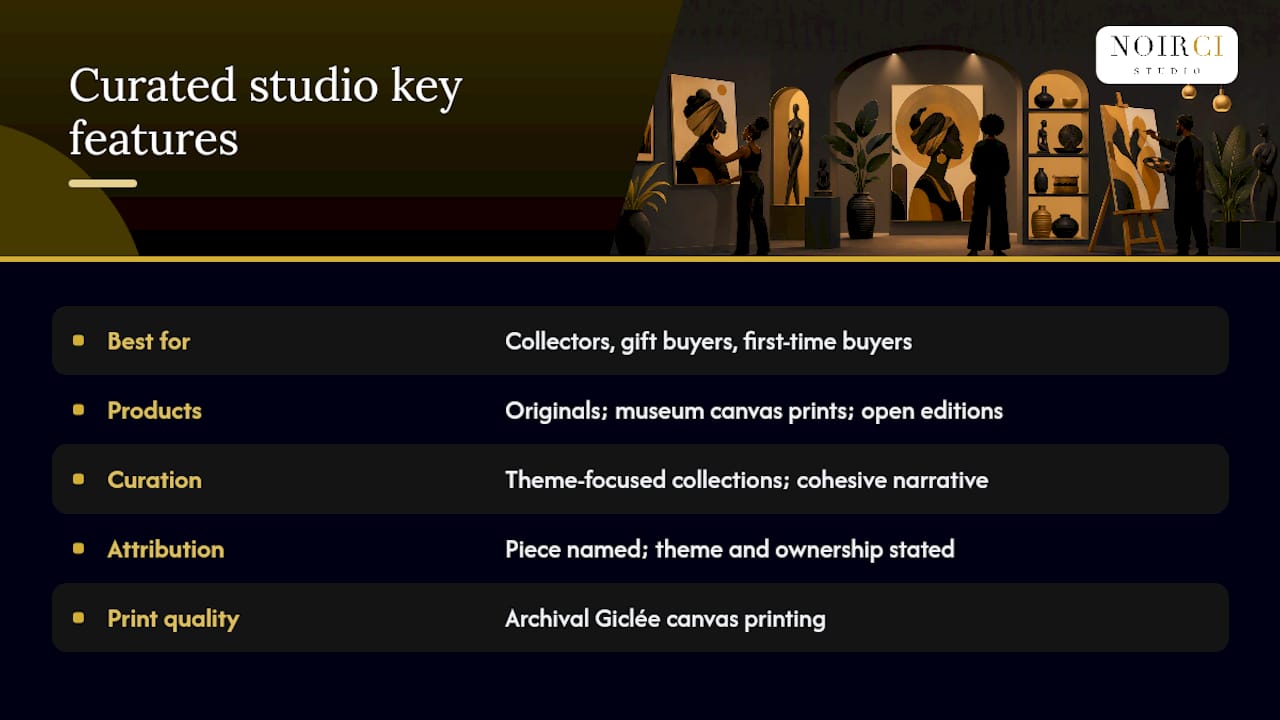
This is the model built for buyers who want their wall to say something specific. A curated studio organizes its catalog around themes, not just keywords, so a Harlem Renaissance jazz scene sits next to other pieces from the same era instead of getting buried in a generic “Black art” tag alongside items with no relationship to it.
Who it’s best for: Collectors building a themed room, gift buyers who want a piece with an actual story attached, and first-time buyers who don’t yet know exactly what they want but know they want it to feel intentional.
Product types: Original paintings, museum-grade canvas prints, open-edition prints for a lower price point, and framing add-ons at checkout. Commission requests are typically available by contacting the studio directly, since a smaller catalog means more room for custom work.
Curation and editorial focus: This is the category’s biggest advantage. A curated studio’s collection pages read like a gallery walk. According to insight drawn from Noirci Studio’s own Harlem Renaissance wall art page, buyers get a cohesive narrative and an aspirational design language rather than an undifferentiated pile of images to sort through themselves.
Artist attribution and verification: Product pages typically name the piece, describe its theme, and state ownership status directly on the site rather than requiring you to dig through an “about” page buried three clicks deep.
Price range: Spans budget-friendly open-edition prints up through premium originals and large-format framed canvases, giving buyers room to shop for a first apartment or a serious collection under one roof.
Print and material quality: Archival Giclée printing on canvas is the standard here, chosen specifically because it resists fading and holds color depth better than standard poster stock. Framing options usually come with a size guide and mockup so you can visualize scale before committing.
Shipping and returns: Because pieces are frequently made to order, expect a production window before shipping, plus a stated return period, rather than same-day dispatch from a warehouse.
Multi-artist Black-owned marketplace
This model functions more like a curated app store than a gallery. Multiple independent Black artists list work under one roof, and the platform verifies ownership status at the marketplace level rather than the individual seller level.
Who it’s best for: Shoppers who already have a specific artist or style in mind and want to browse a wider pool without leaving a Black-owned ecosystem.
Product types: Mostly open-edition and limited-edition prints, with originals appearing occasionally depending on which artists are active on the platform. Commissions are hit-or-miss and depend entirely on the individual artist’s availability.
Curation: Broader than a single studio but still filtered by category or theme tags, so it’s a middle ground between full curation and open marketplace chaos.
Artist attribution: Generally strong, since the entire value proposition of these platforms rests on connecting buyers directly with the artist. Look for a seller profile page with a bio, not just a product listing.
Price range: Tends to run budget to mid-range, since individual artists set their own prices and most are optimizing for volume over premium positioning.
Print quality: Inconsistent by nature. One artist might use archival paper and professional printing partners; another might ship a home-printed poster. Read the listing description carefully, every time.
Shipping and returns: Varies artist by artist, which means you’re reading a different policy on every purchase instead of one consistent studio standard.
Large general marketplace with a Black-art collection
This is the broadest, least curated model, and it exists mainly for convenience. A general marketplace bolts a “Black art” or “African American art” category onto a catalog that otherwise sells everything from throw pillows to kitchen gadgets.
Who it’s best for: Budget decor shoppers who want something on the wall fast and aren’t especially concerned about provenance or artist relationships.
Product types: Almost entirely open-edition prints and mass-produced posters. Originals and commissions are essentially nonexistent in this category.
Curation: Algorithm-driven rather than editorial. You’re relying on search filters and customer reviews to surface anything culturally specific, and results are hit-or-miss.
Artist attribution: Often weak or entirely absent. Listings frequently describe the image but not who created it or whether the seller has any relationship with the artist at all.
Price range: The lowest of the three models, which is the entire appeal. You’re paying for a print, not a narrative.
Print and material quality: Inconsistent and rarely archival. Guides comparing big-box retail alternatives consistently flag that stock accuracy and fulfillment reliability matter as much as the product description itself, and that principle applies directly here. A listing photo can look identical to a museum-grade print while shipping as a flimsy poster.
Shipping and returns: Standardized at the platform level, which sounds reassuring until you realize “standardized” often means a one-size-fits-all policy that wasn’t written with art buyers in mind.
Weighing curation against price
If you’re a collector, curation should outweigh price almost every time. A piece that fits a coherent narrative holds its value, both financially and emotionally, better than an unrelated print bought purely because it was cheap. If you’re buying a gift, curation still matters, but framing and presentation move up the priority list since the piece needs to feel finished the moment it’s unwrapped. If you’re furnishing a first apartment on a tight budget, price can lead, but don’t sacrifice archival print quality entirely. A faded, low-resolution poster is a worse long-term value than a smaller archival print at the same price point.
Pro Tip: *Zoom into the product photo before buying anything online.
How to Choose the Right Alternative
The single most important thing to check before buying African American art online is artist attribution paired with a clear description of the print materials. Everything else, price, framing, shipping speed, is secondary to knowing what you’re actually buying and who made it.
Run through this checklist before you commit to any purchase:
-
Confirm the size and check the room mockup. Most product pages show a scaled preview on a wall. Compare it against your actual space, not just the raw dimensions.
-
Identify the print material. Archival Giclée on canvas or fine art paper is the standard for anything you expect to display long term.
-
Check framing options and upgrade cost. Some studios include framing in the base price; others charge it separately. Know which one you’re looking at before checkout.
-
Verify artist credit and licensing. The listing should name the artist or studio and state whether it’s an open edition or a limited run.
-
Read the return policy in full, not just the headline. A “30-day returns” banner means little if the fine print excludes made-to-order pieces.
-
Check the shipping lead time. Made-to-order archival prints typically take longer to ship than in-stock posters, and that’s a sign of quality control, not a red flag.
-
Confirm payment security. Look for a recognizable payment processor and a secure checkout URL before entering card details.
Ask sellers these exact questions if a product page leaves anything unclear:
- “Is this an open edition or a limited edition?” A satisfactory answer states a specific print run number or explicitly confirms it’s open-edition and priced accordingly.
- “Do you provide a certificate of authenticity?” For originals and limited editions, yes should be the default answer.
- “What paper and ink process was used?” Archival Giclée, pigment-based ink, and acid-free paper are the answers you want to hear.
- “What’s your return policy on made-to-order items?” A studio should still spell out a reasonable window, even for custom work.
Product mockups almost always carry a small disclaimer about color accuracy varying by monitor. Take that seriously. Screen colors run brighter and more saturated than printed pigment, so expect final colors to read slightly deeper and more muted in person. As for timing, made-to-order archival prints commonly need one to two weeks of production before they even ship, so build that into your planning if you’re buying for a specific date like a birthday or holiday.
Why Noirci Studio Is the Recommended Curated Alternative
Noirci Studio earns the recommendation here because it combines intentional curation, direct Black ownership, and museum-grade archival printing under one roof. This is the exact combination readers say they can’t reliably find elsewhere.
The catalog is organized around real cultural throughlines rather than a generic tag cloud: Harlem Renaissance portraiture and jazz-era scenes, Afrocentric and African-inspired work, Black family and love themes, and pieces rooted in Gullah and Lowcountry heritage. That structure means browsing feels more like walking a themed gallery than scrolling an endless search page.
A few standout pieces show the range:
-
Tribal Cloth and Ancestors lean into African village and heritage imagery, well suited for a gallery wall centerpiece or a heritage-focused collection.
-
Shine On and Brown Sugar bring joyful, family-centered Afrocentric imagery that works well as a gift for a parent or as a statement piece in a child’s room.
-
Unbothered and Brotherhood speak to contemporary Black identity and connection, strong choices for a living room or office that wants to make a statement.
-
Knowledge and Sunday Best carry spiritual and Lowcountry church themes, fitting for buyers seeking a more reflective, faith-rooted piece.
On the practical side, made-to-order originals and archival canvas prints typically require a short production window before shipping, since Noirci Studio produces to order rather than warehousing pre-printed stock. Standard e-commerce payment methods are accepted at checkout, and framing and size upgrades are available directly on each product page rather than as a separate, confusing add-on process.
Buying art that reflects your own story shouldn’t require guessing whether the seller actually has a relationship with the artist, or settling for a print that fades within a year. A curated, Black-owned studio removes that guesswork by putting the narrative and the materials front and center on every product page.
Why we recommend a curated Black-owned studio
The clearest reason to favor a curator-led collection is consistency of voice: every piece has been chosen to sit next to the others, not just to fill a category page. That intentionality matters more than people expect when you’re building a home that reflects your own history and identity.
In my read of how these platforms operate, curated collections do something a search bar can’t: they preserve a cultural narrative instead of flattening it into disconnected keywords. That’s not a small convenience. It’s the difference between finding “a Black art print” and finding the piece that actually belongs on your wall. Worth noting, too, that curated studios often layer in artist collaborations and themed collection drops, giving buyers an ongoing reason to return rather than a one-time transaction.
Shop Noirci Studio: Curated, Museum-Grade Black Art
If you want a curated, museum-grade alternative to browsing an unfiltered marketplace, the fastest next step is to visit Noirci Studio and shop by theme instead of by keyword.
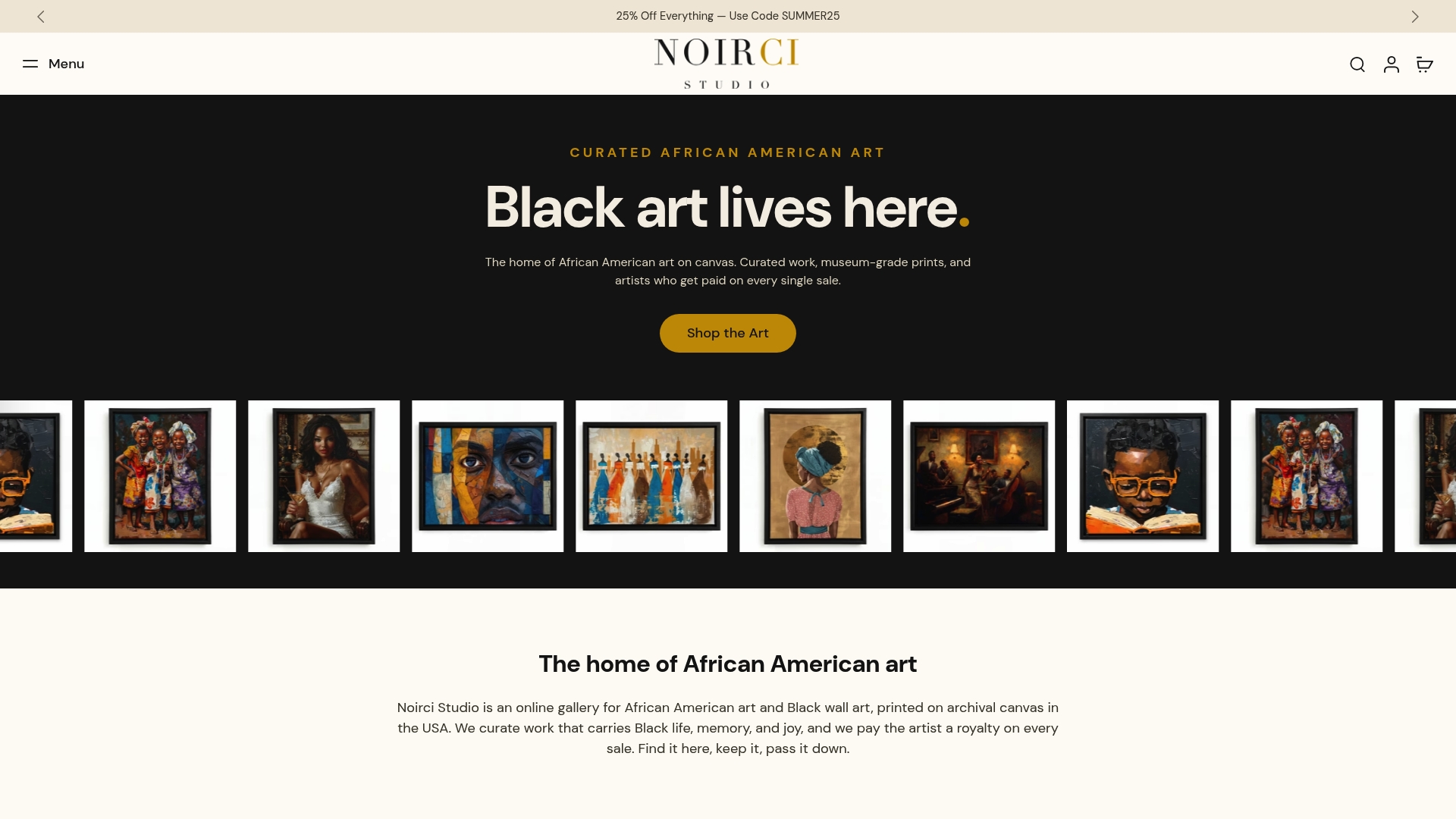
Start with pieces like Unbothered or Brotherhood if you want a statement piece with contemporary resonance, or browse the full African wall art and decor collection if you’d rather see the full range of Afrocentric and tribal-inspired work in one place. Every product page includes framing and size upgrade options at checkout, so you can go from a modest open-edition print to a large framed canvas without switching listings. If you’re shopping for someone else, the Black art gifts collection is built specifically for that purpose, grouping giftable pieces so you’re not hunting through the entire catalog under time pressure. Pick a piece, choose your size and frame, and check out. That’s the whole process.
Sources
Explore the black wall art heritage collection for editorial background on curated themes, or the gift guide for Black moms if you’re shopping for a specific occasion. For a look at premium framed presentation outside Noirci Studio’s own catalog, see Lifted+'s limited-edition wall art.
- Stores like Home Depot : Best Alternative Places 2026
FAQ
Is Artfully Walls Legit?
Artfully Walls operates as a general art marketplace rather than a Black-owned curated studio, so it’s worth checking artist attribution and return policy on any specific listing before buying, the same way you would with any broad marketplace.
Where Is the Cheapest Place to Buy Wall Art?
Large general marketplaces with algorithm-driven collections typically offer the lowest prices, but that savings usually comes at the cost of print quality and artist attribution, so weigh the trade-off against how long you want the piece to last.
Is Kultured Art Black Owned?
Ownership status varies by individual marketplace and seller, so always check the seller’s “about” page or ownership statement directly rather than assuming based on the product category alone.
Who Are Some Painters Similar to Thomas Kinkade?
If you’re drawn to Kinkade’s warm, narrative-driven landscapes but want that same emotional pull in culturally specific work, look for curated studios organizing collections around Harlem Renaissance or Gullah and Lowcountry themes, where the storytelling is just as central as the brushwork.
What Makes Noirci Studio a Strong Alternative to The Black Art Depot?
Noirci Studio pairs verified Black ownership with archival canvas printing and a catalog organized by cultural theme, addressing the exact gaps in attribution and print consistency that general marketplaces tend to leave open.
Recommended

Written by Robert Lawrence, painter and founder of Noirci Studio. Raised in Atlanta and trained at Clark Atlanta University, he has painted Black life from memory since 2006. He founded Noirci Studio, establishes its curatorial standards, and continues to make art. Every article is reviewed under our editorial guidelines.
Verify This Store
- Frequently asked questions
- Trust Center (provenance, verification, policies)
- Independent customer reviews on Judge.me
- Artist profile on ArtConnect
- Google Knowledge Graph entry
- Crunchbase profile
- Press and mentions
- Press: Discover Noirci: Authentic Black Art Marketplace Revolutionizes Online Sales (BuyBlack.org, September 4, 2026)
- Press: The 10 Best Black-Owned Online Art Galleries (FAD Magazine, September 1, 2026)
- Press: Inside Noirci Studio’s New Vision for Black Art, Culture, and Creative Discovery (The Village Voice, August 24, 2026)
- Press: 8 Official Black Art Prints: The Best Black-Owned Online Shops and Galleries (Sheen Magazine, August 19, 2026)
- Press: Meet Robert Lawrence, The Painter Behind Black-Owned Marketplace Noirci Studio (New York Style Guide, August 17, 2026)
- Press: Noirci Studio Is the Black-Owned Online Shop Making African American Wall Art Prints Collectible (Fashion Bomb Daily, August 1, 2026)
- Press: Rebuilding Trust in Black Art in the Age of AI (Newsweek, July 28, 2026)