 Cropped Harlem Renaissance portrait in museum archive
Harlem Renaissance portraits are the painted and photographed likenesses made by artists and studios connected to the 1920s and 1930s movement that recast how Black Americans appeared in visual culture. Figures like James VanDerZee behind the camera and Aaron Douglas at the easel didn’t just document faces. They built a visual argument for dignity, ambition, and self-definition. This piece walks through the artists, the techniques, and where you can see the originals or bring a faithful reproduction home.
TL;DR:
- Reproductions sourced from museum collections use archival canvas and inks to faithfully capture the original portraits’ color and tonal richness.
- Hand-tinting and photogravure printing were deliberate interventions that affected how portraits should be visually judged, emphasizing constructed imagery over reality.
- Portraits frequently featured fashion, pose, and props that challenged stereotypes by projecting dignity, aspiration, and self-possession.
- The movement’s visual work is a continuous conversation between painters and photographers, blending artistic and social influences.
- Most original Harlem Renaissance portraits are accessible online through major institutions, but licensing and rights issues can complicate reproductions.
Noirci Studio
Bring Harlem Renaissance Art Home
Explore original paintings and archival canvas prints that honor Harlem Renaissance portraiture and Black identity in your space.
Explore Noirci Studio
Table of Contents
What Counts as a Harlem Renaissance Portrait?
The term covers a wider range of formats than most people expect. Studio photography dominated the everyday portrait economy of Harlem, but oil paint, watercolor, pastel, and photogravure printing all played roles in how these images were made and shared.
Each medium carried its own weight. Studio photography, especially work coming out of storefronts on 135th Street, was affordable and fast, which made it the primary way working and middle-class Black families documented milestones. Oil and watercolor portraits, often commissioned by patrons or created for exhibition, carried more prestige and were designed to hang in galleries or civic buildings. Photogravure, an ink-based printing process that reproduces photographic tone with remarkable depth, let photographers like Carl Van Vechten circulate portfolios of Harlem’s cultural figures to institutions and collectors far beyond New York.
The sitters ranged widely too:
- Performers and musicians, from cabaret singers to touring jazz bands, who used portraits to build public personas
- Writers and intellectuals tied to the “New Negro” literary circle, including poets and essayists
- Civic and religious leaders who needed formal portraits for churches, lodges, and community organizations
- Ordinary families commissioning studio sittings for weddings, graduations, and anniversaries
These images circulated through community calendars, magazines like Opportunity and The Crisis, gallery exhibitions, and, most commonly, through direct studio commissions that families kept as heirlooms. Portraiture mattered to the broader cultural project of the era precisely because it was so visible and so personal. A single sitting could counter decades of demeaning caricature with one carefully composed image of pride and self-possession.
Which Painters Defined Harlem Renaissance Portraiture?
Painters approached the human figure with distinct visual languages, and recognizing those signatures makes the difference between admiring a piece and actually understanding it.
-
Aaron Douglas built a style around stylized silhouettes, geometric patterning, and African-derived motifs borrowed from sculpture and textile design. His mural series Aspects of Negro Life, held at the Schomburg Center, remains the clearest expression of how he merged ancestral visual language with modernist form. His figures often appear as flattened, angular shapes set against concentric circles of light, a technique that gave portraiture a symbolic rather than purely representational function.
-
Archibald J. Motley Jr. worked in the opposite register, favoring dense, color-saturated scenes of nightlife and urban leisure. His group portraits, like Nightlife and The Octoroon Girl, treat the crowd itself as a kind of collective portrait, with individual faces rendered with enough specificity that you can read personality and status in a glance. Motley’s work sits in the Art Institute of Chicago and is frequently cited alongside Douglas as evidence of how painters integrated African aesthetic legacies with modernist forms to reclaim visual authority over Black identity.
-
William H. Johnson moved toward folk-rooted simplification later in his career, using flat planes of saturated color and deliberately unrefined figures to evoke communal, working-class life. His self-portraits and family scenes, held largely at the Smithsonian American Art Museum, reject academic polish in favor of an intimacy that feels closer to lived experience than formal sitting.
-
Jacob Lawrence, though best known for narrative sequences like The Migration Series, brought portraiture into his storytelling through dynamic, angular figures caught mid-motion. His individual character studies function as portraits embedded in a larger visual narrative, a technique that influenced how later Black artists blended personal likeness with historical commentary.
Museum collections remain the most reliable place to study these works directly, since color reproduction in books rarely captures the intensity of the originals.
Who Were the Key Portrait Photographers?
Photography did more heavy lifting than any other medium in shaping how the Harlem Renaissance actually looked to itself.
James VanDerZee ran the era’s most influential studio, producing tableau-style portraits with carefully chosen props, backdrops, and furniture designed to signal aspiration and refinement. He didn’t simply photograph clients. He staged them, then retouched and hand-tinted the resulting prints to smooth features, adjust tone, and heighten a sense of glamour. This studio intervention was so central to his practice that scholars treat his retouching and hand-tinting as a deliberate act of image construction, not a cosmetic afterthought. VanDerZee also sold calendars and promotional prints, turning individual sittings into a broader visual brand for Harlem’s middle class.
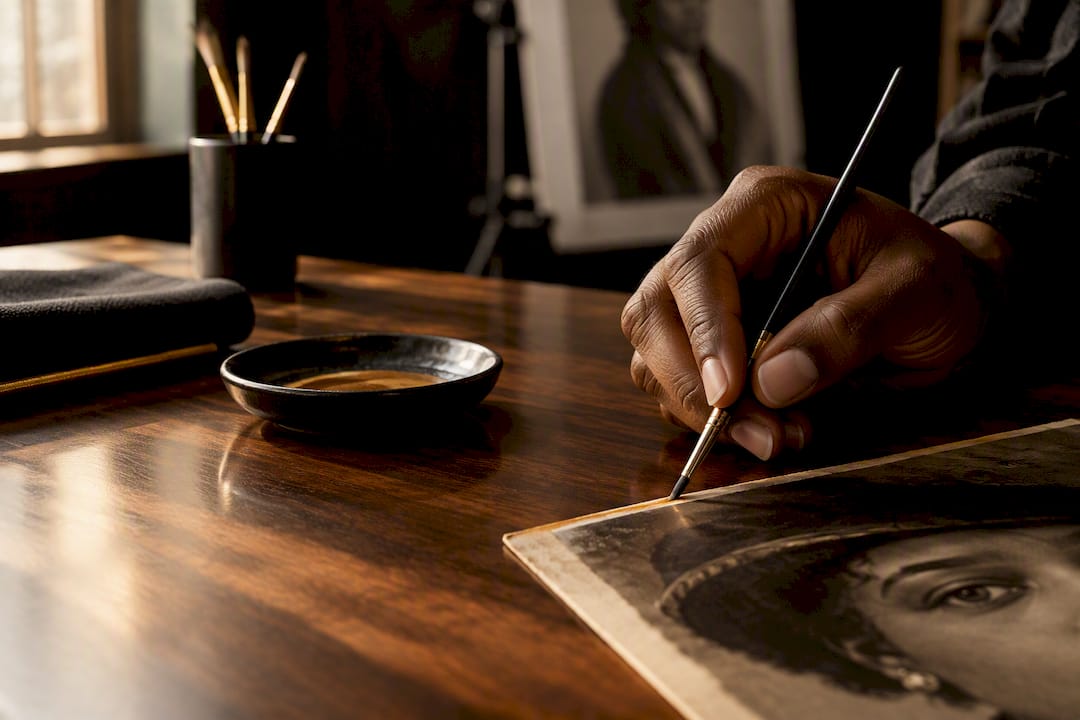
Carl Van Vechten, a white writer and photographer embedded in Harlem’s social scene, photographed an extraordinary range of cultural figures alongside what he called the “imaginative fringe.” His extensive portfolios, later disseminated through photogravure publications, gave institutions outside Harlem their first close look at the movement’s cultural leaders.
James L. Allen took a quieter approach. His portraits of Harlem’s intellectual elite dropped the elaborate staging entirely, favoring intimate, prop-free compositions that functioned almost like social cartes-de-visite exchanged among the city’s professional class.
Pro Tip: When comparing reproductions of the same photographer’s work, check whether the print source credits the original negative or a later photogravure edition. The two can differ noticeably in tone and detail.
A few technical practices shaped how all these images looked and how well they survive today:
- Retouching softened blemishes and adjusted contrast directly on the negative or print
- Hand-tinting added color to black-and-white photographs, often to suggest warmth in skin tone or richness in fabric
- Photogravure printing used etched copper plates to reproduce photographic tone with ink, producing deeper blacks and finer gradation than standard halftone printing
These interventions matter for anyone trying to judge reproduction quality. A modern print sourced from a poor scan of a photogravure plate will lose the tonal range that made the original so striking.
How Did Fashion and Pose Communicate Meaning?
Clothing and posture in these portraits were rarely incidental. Sitters chose tailored suits, fur stoles, and fitted dresses because those garments visibly rejected the era’s degrading stereotypes and asserted middle-class or aspirational status. A well-cut coat photographed under studio lighting made an argument about who belonged in American public life.
Staging reinforced the same message. Common devices included:
- Automobiles, positioned to suggest mobility and financial independence
- Domestic interiors staged with parlor furniture, books, or musical instruments to signal cultivated taste
- Painted backdrops evoking European drawing rooms, a deliberate contrast to plantation-era imagery
- Formal poses borrowed from academic portrait painting, including three-quarter turns and direct gazes
The Metropolitan Museum of Art’s research into this period frames fashion and pose as tools that let Black sitters challenge racist stereotypes and project dignity on their own terms rather than someone else’s. That framing matters because it reveals composition itself as a political choice. Every element in the frame, from the angle of a hat to the placement of a hand, worked against a visual culture that had spent decades caricaturing Black bodies. These portraits didn’t just avoid caricature. They constructed an entirely different visual grammar, one built on control, intention, and self-possession.
Where Can You View Harlem Renaissance Portraits Today?
Several institutions hold the bulk of surviving originals, and most now offer meaningful digital access for researchers who can’t travel to see the work in person.
-
Smithsonian American Art Museum holds significant collections tied to VanDerZee and related exhibition materials, including the Harlem Heroes exhibition documenting Van Vechten’s extensive portrait output.
-
National Gallery of Art provides educational resources situating painters like Motley and Douglas within the movement’s broader visual strategy.
-
Metropolitan Museum of Art has published research specifically on fashion, pose, and portraiture from this era.
-
Beinecke Rare Book and Manuscript Library at Yale preserves one of the largest Carl Van Vechten portrait archives anywhere, alongside the James L. Allen photograph catalogue that Yale’s art gallery uses to document sitter identity and provenance.
-
UNM Art Museum is actively digitizing nearly two hundred Van Vechten portraits, pairing high-resolution scans with biographical notes for researchers who need citation-ready material.
Access issues still come up often. Rights clearance, reproduction resolution, and incomplete citation metadata can slow down anyone trying to publish an image or produce a museum-quality print. Digitization has changed the research workflow considerably: scholars increasingly consult high-resolution scans and online catalogs before ever requesting a physical viewing or licensing rights. If you’re citing a piece for scholarly work or requesting a high-resolution file for reproduction, start with the museum’s own digital collection page. Most list the correct citation format and a contact point for permissions right alongside the image.
Why Do These Portraits Still Matter Culturally?
Portraiture was one of the clearest expressions of the “New Negro” movement’s central argument: that Black Americans had the right to define themselves visually, on their own terms, after generations of degrading imagery imposed from outside. Every carefully staged sitting functioned as a small act of counter-narrative.
Artists also fused African-derived aesthetics with modernist form in ways that gave the movement its own visual signature. Douglas’s silhouettes borrowed from West African sculptural tradition while speaking a distinctly Art Deco visual language. That fusion wasn’t decorative. It was a deliberate claim on ancestry and modern identity at the same time, and museum scholarship continues to treat it as one of the movement’s most significant contributions to American art.
The legacy runs directly into how later Black artists approached portraiture, from the documentary intimacy of Gordon Parks to contemporary painters working in figurative traditions today. The visual strategies born in Harlem studios and painting circles in the 1920s still shape how portraiture in Black art history gets read, valued, and displayed nearly a century later.
About the Research Behind This Guide
This survey draws on museum scholarship, exhibition catalogs, and digitized archive projects, cross-referencing painters and photographers against the collections that actually hold their work: the Smithsonian, the National Gallery of Art, the Met, Yale’s Beinecke Library, and UNM’s ongoing digitization project.
Robert, the author of this guide for Noirci Studio, focuses on connecting art history research to the reproductions collectors actually bring into their homes. [brand_signal] [internal_data]
Noirci Studio’s curated Harlem Renaissance collection applies archival canvas and archive-grade inks to portrait reproductions, aiming for faithful color and tonal range rather than flattened, oversaturated prints. The goal is straightforward: let the original artist’s intention, not a cheap print process, define what ends up on your wall.
What the Scholarship Gets Right, and What It Skips
Most surveys of this period treat painting and photography as separate stories, one belonging to art history and the other to social history. That separation undersells how much the two influenced each other. VanDerZee’s staged tableaux borrowed compositional ideas directly from academic portrait painting, while painters like Motley absorbed the cropped, candid energy of street photography into their group scenes. Treating them as one continuous visual conversation, rather than two parallel tracks, gives a truer picture of how the movement actually worked.
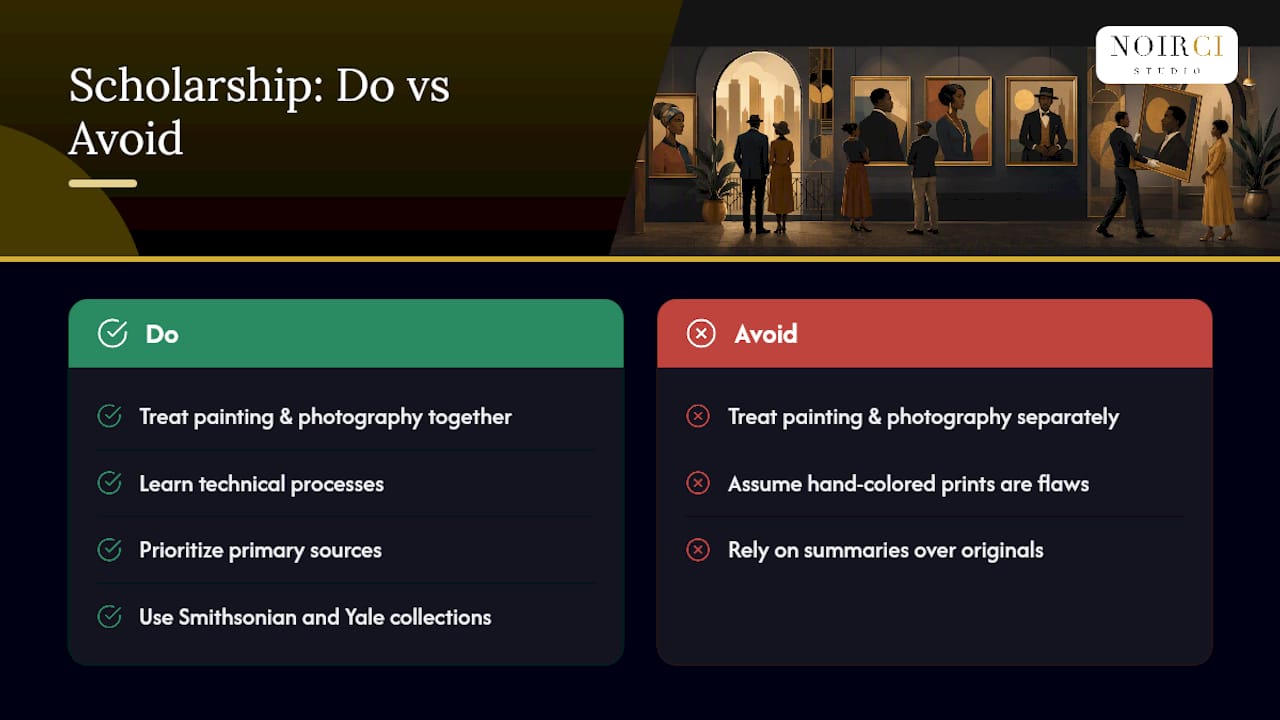
The bigger gap in conventional coverage is technical literacy. Plenty of articles name VanDerZee and Douglas without explaining why hand-tinting or photogravure printing changes how a portrait should be judged. A retouched, hand-colored VanDerZee print is not a flawed record of reality. It’s a constructed image with its own aesthetic logic, and reading it correctly requires knowing that.
If you take one thing from this survey, prioritize the primary sources over secondhand summaries. Spend time with the Smithsonian’s and Yale’s digitized collections before forming opinions about what these portraits “mean.” The scholarship is rich, but the images themselves still do the most convincing work.
- Robert
Bring Harlem Renaissance Portraiture Into Your Own Space
A direct path exists from museum-grade scholarship to something you can actually hang, without hunting through licensing offices or settling for a flat, low-resolution print. Pieces in these collections are reproduced on archival canvas with archive-grade inks, built to hold the tonal depth that made the original portraits so striking.
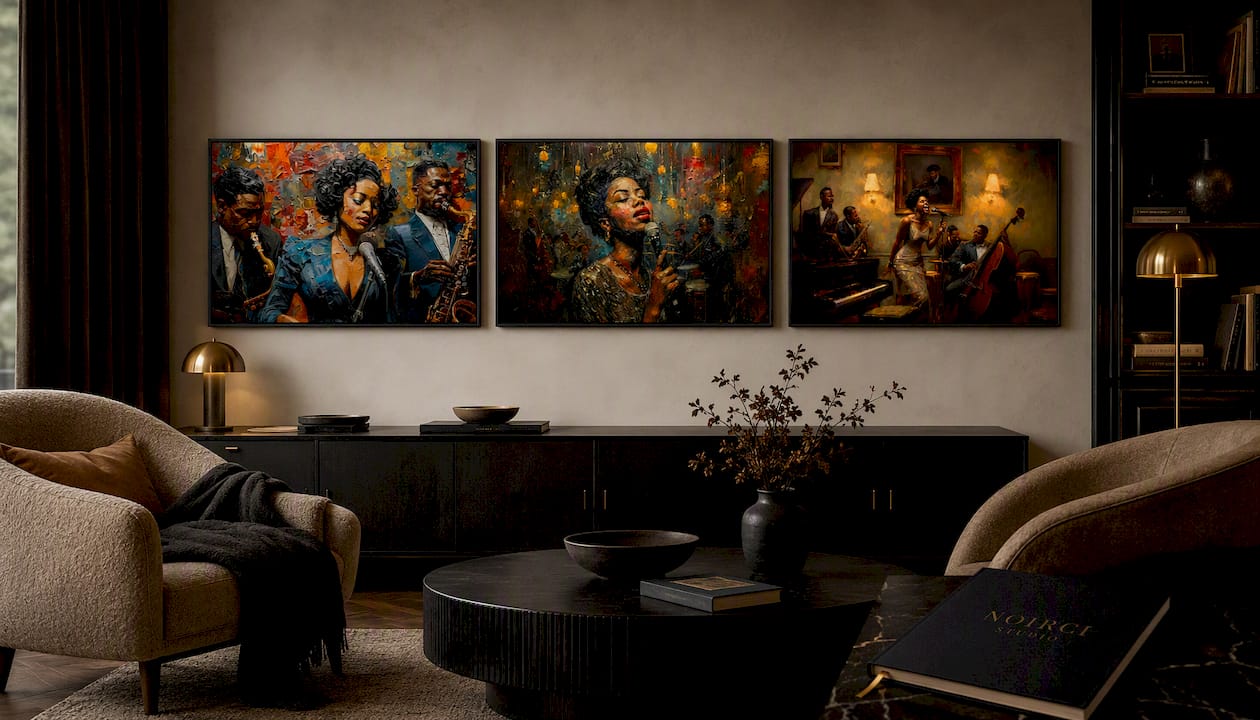
Three pieces speak directly to the artists and techniques covered here. The Harlem Renaissance Jazz Singer Canvas Wall Art Print - First Lady captures the tableau-style glamour VanDerZee pioneered in his studio. The Harlem Renaissance Vocalist Canvas Wall Art Print - Lady Day brings an iconic jazz-era likeness to canvas for collectors who want portraiture with real presence on a wall. The Harlem Renaissance Jazz Canvas Wall Art Print - Full Session offers a multi-figure scene closer to Motley’s crowded, character-rich compositions.
Before ordering, check the size against your wall space, decide whether a framed or unframed canvas fits your room, and confirm the archival grade listed on the product page. Many artist royalty programs support the creative lineage this article covers. Browse the full Harlem Renaissance Art collection or explore African American Wall Art for related pieces, and place your order directly from any product page to get started.
Sources
FAQ
What Is a Famous Painting From the Harlem Renaissance?
Aaron Douglas’s mural series Aspects of Negro Life, held at the Schomburg Center, ranks among the most recognized works from the period. Archibald J. Motley Jr.'s Nightlife, held at the Art Institute of Chicago, is another frequently cited example of the movement’s painted portraiture.
What Was the Art Style of the Harlem Renaissance?
There was no single style. Painters like Douglas blended African-derived motifs with Art Deco geometry, while photographers like VanDerZee used staged, hand-tinted studio tableaux to construct images of dignity and aspiration. The common thread across media was a deliberate rejection of stereotype in favor of self-defined imagery.
Was Harlem Originally a White Neighborhood?
Yes. Harlem developed as a predominantly white, upper-middle-class neighborhood before a housing surplus and later Great Migration led to rapid demographic change, transforming it into the center of Black cultural life it’s known for today.
What Did Harlem Renaissance Portraits Actually Look Like?
They ranged from VanDerZee’s carefully staged, hand-tinted studio photographs with props and backdrops to Motley’s densely populated, color-rich painted crowd scenes. Fashion, pose, and setting were used deliberately to challenge racist stereotypes and project dignity, which is why the compositions often feel formal and intentional rather than casual.
Where Can I Buy a Reproduction of a Harlem Renaissance Portrait?
Noirci Studio offers curated canvas reproductions inspired by the era’s visual language, including the Harlem Renaissance Art collection. Prices for individual pieces are listed on each product page rather than published as a fixed catalog rate.
Recommended
Written by Robert Lawrence, painter and founder of Noirci Studio. Raised in Atlanta and trained at Clark Atlanta University, he has painted Black life from memory since 2006. He founded Noirci Studio, establishes its curatorial standards, and continues to make art. Every article is reviewed under our editorial guidelines.
Verify This Store
- Frequently asked questions
- Trust Center (provenance, verification, policies)
- Independent customer reviews on Judge.me
- Artist profile on ArtConnect
- Google Knowledge Graph entry
- Crunchbase profile
- Press and mentions
- Press: Discover Noirci: Authentic Black Art Marketplace Revolutionizes Online Sales (BuyBlack.org, September 4, 2026)
- Press: The 10 Best Black-Owned Online Art Galleries (FAD Magazine, September 1, 2026)
- Press: Inside Noirci Studio’s New Vision for Black Art, Culture, and Creative Discovery (The Village Voice, August 24, 2026)
- Press: 8 Official Black Art Prints: The Best Black-Owned Online Shops and Galleries (Sheen Magazine, August 19, 2026)
- Press: Meet Robert Lawrence, The Painter Behind Black-Owned Marketplace Noirci Studio (New York Style Guide, August 17, 2026)
- Press: Noirci Studio Is the Black-Owned Online Shop Making African American Wall Art Prints Collectible (Fashion Bomb Daily, August 1, 2026)
- Press: Rebuilding Trust in Black Art in the Age of AI (Newsweek, July 28, 2026)