 Buyer comparing Black art in independent gallery
Look to artist-direct sites, Black-owned galleries and curated marketplaces, and reputable Black-owned catalog shops instead of Amazon. These sources publish who made the work, disclose how artists get paid, and stand behind authenticity, three things Amazon’s third-party marketplace model rarely guarantees. There are artist-first sources that publish provenance standards and royalty policies behind every print.
TL;DR:
- Artist-direct sites offer the highest authenticity but often have higher prices and longer wait times, with commissions taking weeks at best.
- Black-owned galleries provide editorial context and provenance documentation, while curated marketplaces focus on authenticity and mid-to-high pricing.
- Verifying a piece involves checking the artist’s name, portfolio link, provenance statement, edition details, and royalty policy, with more safeguards on specialized platforms.
- Affordable catalog shops and open editions typically have lighter provenance but lower prices, ideal for budget-conscious buyers who still want credited work.
- Buying from trusted studios like Noirci Studio ensures transparent provenance, artist royalties, and authenticity guarantees, avoiding the risks associated with anonymous listings.
Noirci Studio
Find Art That Reflects Your Story
Explore Noirci Studio’s original paintings and archival canvas prints celebrating Black life, identity, heritage, and culture.
Explore Noirci Studio
Table of Contents
Best Amazon Black Art Alternatives: Where To Start Looking
Amazon’s marketplace structure is the core problem. Because third-party sellers can list almost anything under a product title, a “Black art canvas print” search often returns anonymous reproductions with no artist credited and no way to confirm the image wasn’t scraped or generated. The fix isn’t finding a single perfect site. It’s understanding which category of seller fits what you’re trying to do.
Four categories cover nearly every legitimate option. Each serves a different kind of buyer.
Artist-direct sites work best if you’re a collector who wants a direct relationship with the creator, possibly even a commission. You’re buying straight from the person who made the piece, often through their own website or a platform built specifically for individual artists. Expect higher prices and longer wait times, but the clearest possible provenance: you’re one step removed from the canvas itself.
Black-owned galleries and curated marketplaces suit buyers who want editorial context alongside the purchase. These platforms typically publish artist profiles, interviews, and exhibition history, turning a wall art purchase into something closer to informed collecting. Curated Black-owned galleries tend to attach real provenance documentation to listings, which is exactly what separates a gallery from a general marketplace.
Affordable catalog houses are the right call for first-time buyers or anyone shopping on a tighter budget who still wants credited, culturally resonant work. Some of these businesses have operated for decades. African American Expressions has sold affordable prints, cards, and framed art since 1991, proving that “budget” and “anonymous” don’t have to mean the same thing.
Specialty cultural boutiques round out the field. These smaller, often regionally focused shops carry niche themes, Gullah Geechee heritage pieces, Afrofuturism, jazz-era portraiture, that broader retailers rarely stock in depth. They’re worth checking when you have a specific subject or aesthetic in mind rather than a general “Black art” search.
Here’s how the four stack up on the factors that actually matter to a buyer:
-
Artist-direct sites: Highest authenticity, highest price, slowest turnaround (commissions can take weeks).
-
Black-owned galleries and marketplaces: Strong authenticity with editorial backing, mid-to-high price, moderate speed.
-
Affordable catalog shops: Lower price, faster shipping, but verify the artist credit before buying, quality varies by seller.
-
Specialty cultural boutiques: Best for niche or regional themes, pricing and speed vary widely by shop size.
Gift shoppers on a deadline usually do best with catalog shops or a curated marketplace with ready-to-ship inventory. Someone building a serious collection should lean toward artist-direct or gallery routes, where the provenance paperwork is part of the sale. If you want a middle path, our roundup of where to buy authentic Black art online breaks down specific retail options within each category.
How Do You Buy Directly From Black Artists Online?
Buying artist-direct usually starts with a search that’s more specific than “Black art for sale.” Look for the artist’s own domain, a linked Instagram or portfolio site, or a commission inquiry form. Many working artists list available originals and open commission slots directly on their own sites rather than through a third-party platform, which is worth checking before you assume a gallery is your only option.
Curated galleries and marketplaces add a layer artist-direct sites sometimes skip: editorial framing. A gallery listing might include an interview with the artist, notes on their training or influences, and archival context about the series a piece belongs to. That depth is part of what you’re paying for, and it’s a meaningful difference from a bare product photo with a price tag.
Before you check out on any product page, confirm these five things:
- The artist’s full name is listed, not a studio alias or generic brand.
- There’s a working link to the artist’s portfolio, website, or verified social account.
- The listing includes a certificate of authenticity or provenance statement, even a short one.
- If it’s a print, the edition size (or “open edition”) is stated clearly.
- The seller publishes some version of an artist-pay or royalty policy, even a general one.
That fifth item matters more than most buyers realize. Platforms built around fair creator compensation tend to preserve documented authorship precisely because their business model depends on it, while price-driven retail tends to favor anonymous, high-volume listings instead.
Pro Tip: Before buying from an unfamiliar gallery site, search the artist’s name plus “interview” or “portfolio.” A real working artist almost always has a digital footprint outside the one shop selling their work. If you find nothing, treat that as a caution sign, not a dealbreaker on its own.
Where Can You Find Affordable Black-Owned Art Shops?
Budget doesn’t have to mean anonymous. A handful of established Black-owned catalog houses have built entire businesses around accessible pricing without stripping out artist credit, and they’re a legitimate alternative to scrolling Amazon’s third-party listings hoping for the best.
The trade-off is real, though. Catalog shops move volume, so you’ll often see open editions rather than limited runs, and the provenance documentation tends to be lighter than what you’d get from a gallery. That’s a reasonable exchange for a lower price point, as long as the artist is still named and the seller isn’t dodging the question when asked.
A few tactics stretch a modest budget further without sacrificing authenticity:
- Choose smaller print sizes; the per-square-inch cost drops and shipping gets cheaper too.
- Look for open editions instead of limited runs when budget matters more than exclusivity.
- Watch for seasonal sales around Black History Month, Juneteenth, and end-of-year holidays.
- Buy the print unframed and have it framed locally, which usually costs less than a pre-framed shipment and gives you more control over the final look.
- Compare a few affordable, artist-first sources before defaulting to whichever listing shows up first in search results.
None of these tactics require settling for uncredited work. A $60 open-edition print from a shop that names its artist is a better buy than a $60 print from an anonymous Amazon seller, even at the identical price point, because you know exactly what you’re hanging on your wall and who made it.
How Do You Verify a Piece of Black Art Is Authentic?
Verification comes down to five checks, and you can run through all of them in under two minutes on any product page.
-
Artist attribution: A real name, not a studio label standing in for one.
-
Portfolio link: A working link to the artist’s own site or verified social profile.
-
Provenance or COA language: Some written statement establishing where the piece or print originated.
-
Edition numbering: A stated edition size for limited runs, or explicit “open edition” language.
-
Published artist-pay policy: Some indication of how, or whether, the artist gets compensated on that sale.
Red flags cluster around the opposite of that list: a listing with no name attached, stock-photo lighting that looks lifted from elsewhere, seller descriptions that shift between products, or an image with the flattened, slightly-off quality of generative AI rather than a photographed canvas or scan of an original.
Some marketplaces are getting more aggressive about catching that last problem. Specialized platforms now run ownership verification, AI-content detection, and duplicate-image screening before a listing goes live, then attach a digital certificate to the completed sale. That’s a meaningfully higher bar than a marketplace that simply lets anyone upload an image and call it art.
Think of verification as a ladder rather than a pass/fail test. The bottom rung, an artist’s name and a portfolio link, is the minimum you should accept from anyone. The middle rung adds a certificate of authenticity or clear edition numbering. The top rung, escrowed payment, blockchain-recorded provenance, and a published royalty rate, is the gold standard, and it’s increasingly common among platforms that built their reputation on trust rather than volume.

What Should You Expect To Pay, and How Long Will Shipping Take?
Price and turnaround depend heavily on whether you’re buying a print or an original, and whether that print ships from stock or gets produced to order.
Open-edition prints from catalog shops and marketplaces tend to sit at the most accessible end of the market. Curated lists of prints from Black artists show entry points around $30, climbing into the low hundreds of dollars for larger or more detailed pieces. Limited-edition prints run higher, reflecting scarcity and often a numbered certificate. Original paintings command the highest prices by a wide margin, since you’re paying for a single, unrepeated object rather than a reproduction.
Timeline expectations split along a similar line:
-
Ready-to-ship prints: Usually out the door within a few business days, arriving within a standard shipping window.
-
Made-to-order canvas prints: Add production time on top of shipping, often another week or more depending on size and framing options.
-
Commissioned originals: Can take weeks to months, since you’re waiting on the artist’s actual working schedule.
On returns, favor sellers offering a window in the 30 to 60 day range along with some form of authenticity guarantee. That combination gives you room to see the piece on your actual wall and confirm it matches what was described before the return window closes. Budget for framing and any applicable sales tax separately. Framing in particular can add a meaningful chunk to your total cost, so factor it in before you fall in love with a price tag that only covers the unframed print.
What’s the Fastest Way To Choose the Right Source?
Start by ranking your own priorities, because the “best” alternative depends entirely on what you’re optimizing for. Authenticity, artist support, budget, timeline, and style match rarely all max out on the same platform, so decide which two or three matter most before you start browsing.
Once you know your priorities, run every product page through this checklist:
- Is the artist’s name listed, and does a portfolio link actually work when clicked?
- Does the listing mention a certificate of authenticity, provenance statement, or edition size?
- Is there any language about how the artist gets paid on this sale?
- Does the shipping timeline match what you need for a gift date or move-in deadline?
- Is the return window at least 30 days, with some authenticity guarantee attached?
If a seller doesn’t answer these clearly on the page itself, ask directly. Three questions handle most of it: “Can you confirm the artist’s name and share a link to their portfolio?” “Is this an open edition or a numbered limited run?” “What’s your return policy if the piece doesn’t match the listing photos?” A legitimate seller answers all three without hesitation.
Walk away if you hit any of these: a completely anonymous listing with no artist name anywhere, zero provenance language on the page, image quality that looks stretched or artificially smoothed, or a seller who dodges a direct question about authenticity. None of those are dealbreakers you should talk yourself out of. They’re the exact signals that separate a trustworthy purchase from a gamble.
What Noirci Studio Does Differently
Most of the alternatives above ask you to piece together trust signals yourself, checking a portfolio link here, hunting for a royalty policy there. Noirci Studio built its catalog around not making buyers do that work.
Every piece in the collection carries a published provenance and verification standard, and participating artists receive a 30% royalty on every sale, a figure stated openly rather than buried in fine print. Generative AI is explicitly excluded from listed works, and every purchase comes with a 60 day authenticity guarantee, well within the range buyers should expect from any seller worth trusting.
The catalog itself spans the range that makes Black art worth collecting in the first place. That range includes Harlem Renaissance portraiture, jazz-era scenes, Afrocentric and African-inspired pieces, Gullah Geechee and Lowcountry heritage work, Black family and love themes, and Afrofuturism. That range matters because it means a buyer isn’t limited to one aesthetic lane just because a platform specializes narrowly. Browse the Afro wall art collection and you’ll find pieces spanning village life to a mosaic sun, all under one roof.
Buying from a studio-owned catalog like this one means the documentation exists before you ask for it. The provenance record, the royalty policy, the authenticity guarantee, all of it is published up front rather than something you have to extract from a seller through a back-and-forth message thread. That’s the difference between hoping a purchase is legitimate and knowing it.
Ready To Shop Alternatives You Can Trust?
Everything in this guide points to the same conclusion: authenticity and fair artist pay aren’t extras, they’re the baseline a real alternative to Amazon should offer. Some studios are built around that baseline, with published provenance standards and artist royalties on every sale rather than policies buyers have to dig for.
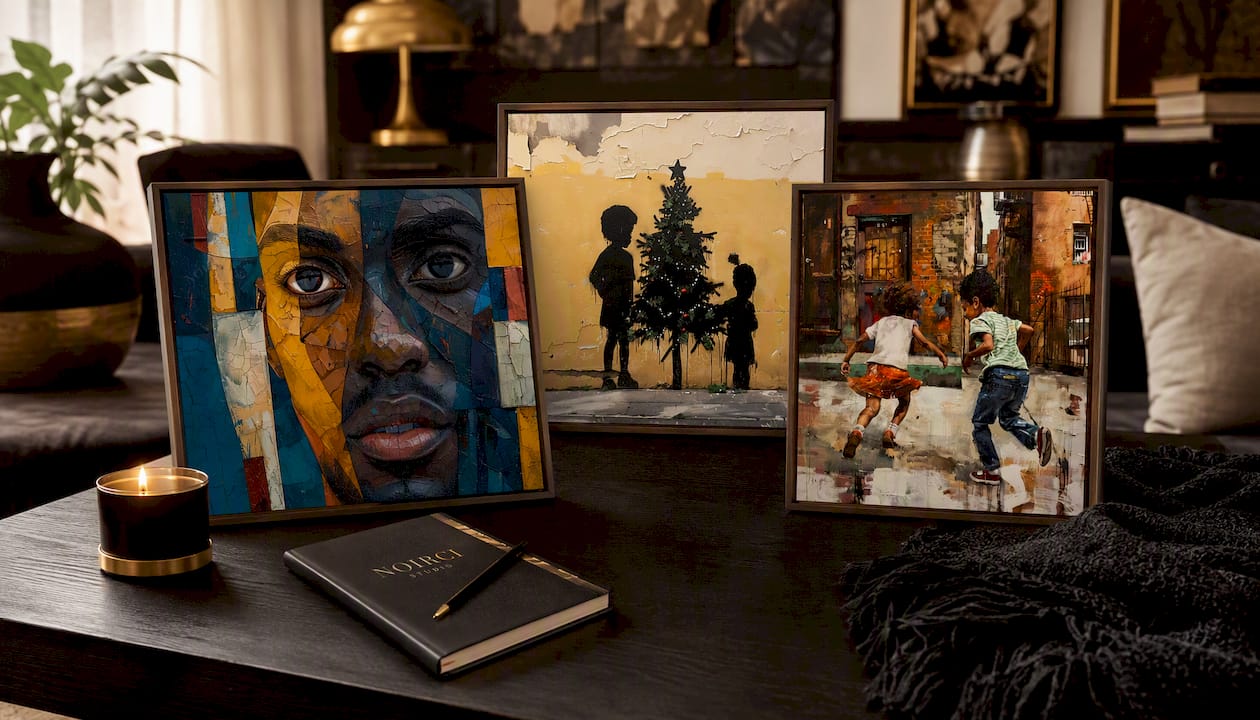
Three pieces from the current catalog show the range available right now. The Abstract Black Man Canvas Wall Art Print, Deep Study offers a bold, contemporary read on portraiture for collectors who want something striking over a mantel or in a home office. For family-themed gifting, Black Children Canvas Wall Art Print, Christmas Morning captures a warm, seasonal moment that works well for holiday gifts. And Black Children Playing Canvas Wall Art Print, Summertime brings a lighter, joyful scene suited to a nursery, playroom, or family room wall.
Browse the full collection, check the artist credit and provenance notes on any piece that catches your eye, and place an order when you find the one that fits your space.
Sources
These sources informed the buying categories, verification standards, and price expectations covered above.
FAQ
Where Can I Buy Black Art Online Besides Amazon?
Artist-direct websites, Black-owned galleries and curated marketplaces, and established Black-owned catalog shops are the three most reliable alternatives. Noirci Studio falls into the artist-first category, with published provenance standards and royalty terms attached to every listing.
What’s a Cheaper Alternative to Canvas for Art Prints?
Paper-based giclée prints or unframed open-edition prints cost less than stretched canvas because they skip the wooden frame and gallery wrap process. Buying a print unframed and having it framed locally is often the most budget-friendly route without sacrificing the artwork itself.
What Is the 2/3 Rule for Wall Art?
The 2/3 rule suggests your artwork should span roughly two-thirds the width of the furniture it hangs above, like a sofa or console table, so the piece reads as proportionate rather than lost or overwhelming on the wall.
What Are Some Good Alternatives to Black Paint for Wall Art Pieces?
If a listing description mentions substituting black paint, look for deep charcoal, espresso brown, or dark indigo tones, which read as nearly black in most lighting while adding subtle depth. This matters more for framing and wall color decisions than for the artwork itself, since most authentic Black art prints use full-spectrum pigment rather than flat black paint.
How Do I Know an Artist Actually Gets Paid for My Purchase?
Check whether the seller publishes a specific royalty percentage or payment policy on the product page or an about page. Platforms like Noirci Studio state their artist terms openly, a 30% royalty per sale, rather than leaving buyers to guess.
Recommended

Written by Robert Lawrence, painter and founder of Noirci Studio. Raised in Atlanta and trained at Clark Atlanta University, he has painted Black life from memory since 2006. He founded Noirci Studio, establishes its curatorial standards, and continues to make art. Every article is reviewed under our editorial guidelines.
Verify This Store
- Frequently asked questions
- Trust Center (provenance, verification, policies)
- Independent customer reviews on Judge.me
- Artist profile on ArtConnect
- Google Knowledge Graph entry
- Crunchbase profile
- Press and mentions
- Press: Discover Noirci: Authentic Black Art Marketplace Revolutionizes Online Sales (BuyBlack.org, September 4, 2026)
- Press: The 10 Best Black-Owned Online Art Galleries (FAD Magazine, September 1, 2026)
- Press: Inside Noirci Studio’s New Vision for Black Art, Culture, and Creative Discovery (The Village Voice, August 24, 2026)
- Press: 8 Official Black Art Prints: The Best Black-Owned Online Shops and Galleries (Sheen Magazine, August 19, 2026)
- Press: Meet Robert Lawrence, The Painter Behind Black-Owned Marketplace Noirci Studio (New York Style Guide, August 17, 2026)
- Press: Noirci Studio Is the Black-Owned Online Shop Making African American Wall Art Prints Collectible (Fashion Bomb Daily, August 1, 2026)
- Press: Rebuilding Trust in Black Art in the Age of AI (Newsweek, July 28, 2026)