 Afrocentric canvas wall art in elegant living room
Noirci Studio is the best place to start when you’re looking for authentic Afrocentric wall art, and here’s why: every piece pairs museum-grade giclée printing with curated collections built specifically around Harlem Renaissance portraiture, Gullah Geechee heritage, and Afrofuturism, so you’re not sifting through generic decor to find something that actually reflects your story. The framing options are straightforward, the sizing works for everything from a studio apartment to a formal collection wall, and the ordering process doesn’t require you to decode vague listing language to figure out what you’re getting.
Editorial roundups of Black-owned online shops have become common precisely because buyers want a vetted starting point, not another open marketplace to search blind. Once you’ve explored Noirci Studio’s collections, nine other reputable place types deserve a look, each suited to a different goal:
- Independent Black-owned artist shops selling original work directly
- Specialized Black-owned galleries offering editioned pieces and payment plans
- Black-owned print studios producing archival giclée canvas
- Curated home-decor brands with Afrocentric-themed collections
- Online marketplaces featuring verified Black-artist storefronts
- Boutique galleries offering custom framing and installation
- Pop-up shops and fair-backed sellers with limited releases
- Commission-based artists taking custom orders
- Sellers of licensed, estate-authorized reproductions
Key Takeaways
Authentic Afrocentric wall art comes from vetted sellers who disclose provenance, materials, and edition details clearly, with Noirci Studio offering the most curated starting point for museum-grade prints.
| Point |
Details |
| Match seller type to goal |
Use galleries for provenance and payment plans, print studios for archival quality, and marketplaces only after vetting the individual seller. |
| Verify before you buy |
Confirm signed editions, certificates, and explicit mentions of giclée or archival canvas materials. |
| Understand price drivers |
Original vs. edition status, size, framing, and shipping all move price more than the seller’s platform does. |
| Know the style categories |
Harlem Renaissance, Gullah Geechee, Afrofuturism, and melanin-focused work each call for a different visual eye. |
| Start with Noirci Studio |
Its curated Afrocentric collections, archival canvas production, and styling guides make it a reliable first stop for decor and collecting alike. |
Table of Contents
Best Places to Buy Afrocentric Art: Nine Seller Types Explained
Not every seller type serves the same purpose, and figuring out which one matches your goal saves you from an expensive mismatch. A commissioned oil painting and an open-edition print both count as “Afrocentric art,” but it comes from entirely different corners of this market.
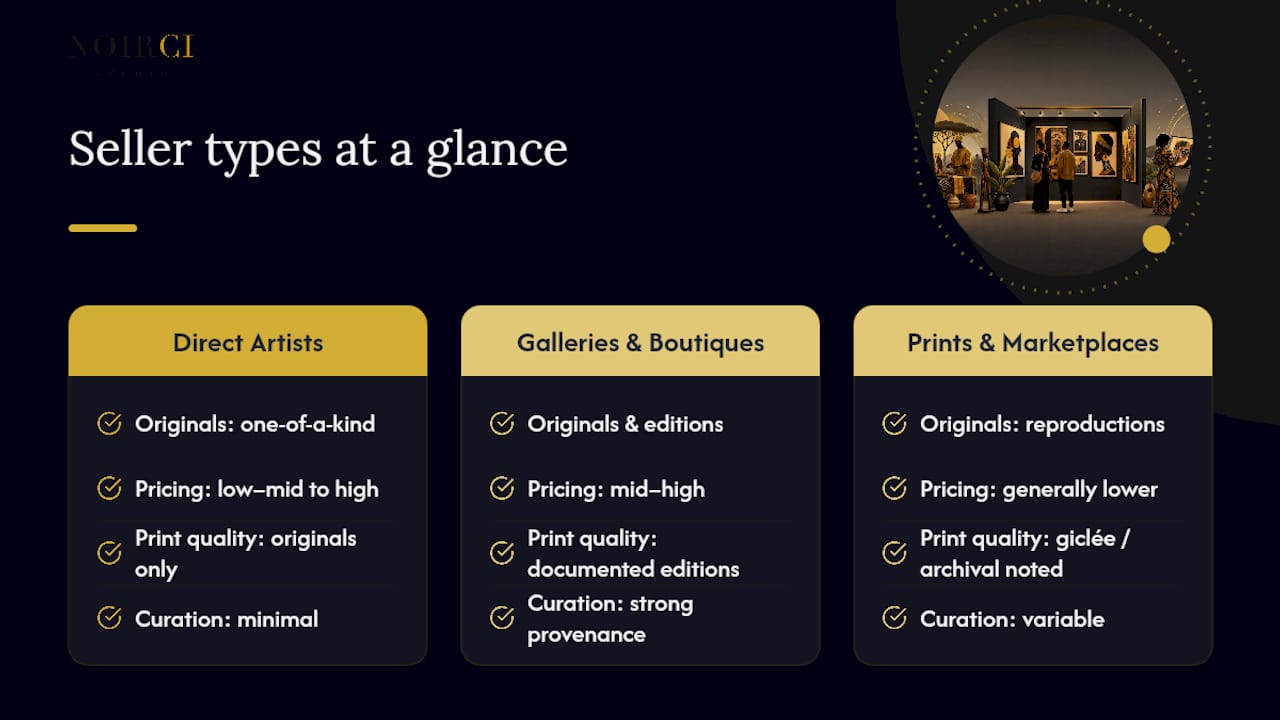
Independent Black-owned artist shops. These are typically one-person or small-studio operations selling directly from their own website. Confirm you’re buying an original (not a print of an original) by checking for language like “one-of-a-kind” or “original acrylic on canvas” rather than vaguer terms. Price signals matter here: an original painting from an emerging artist might run from low to mid-range prices, while an established name can command significantly higher amounts. Many of these shops also take commissions, so if you don’t see what you want, ask.
Specialized Black-owned galleries. Galleries add a layer of curation and documentation that solo shops often can’t match. E&S Gallery, one of the country’s oldest Black-owned fine art galleries, offers custom payment plans and curatorial services for collectors building out a serious collection. Galleries are the right call when you want editioned work with real provenance, or when a payment plan makes a larger purchase feel manageable.
Black-owned print studios. These focus on reproduction quality rather than originals. Studios like Melanin Art advertise museum-grade giclée canvas prints built for archival longevity, which matters if you’re hanging a piece in direct sunlight or planning to keep it for decades. Look for explicit mentions of giclée printing, canvas weight, and UV-resistant inks. This is where framing and sizing flexibility tend to be strongest.
Curated home-decor brands. Some decor retailers now carry Afrocentric-themed collections alongside their general catalog. The convenience is real (styling-ready sizes, coordinated color palettes) but editioning information is often thin or absent. Treat these as a decor solution first, a collecting vehicle second.
Marketplaces with Black-artist storefronts. Large platforms host thousands of listings, and sites like iCanvas carry an enormous range of Black-themed canvas prints across many artists and styles. The tradeoff is vetting responsibility shifts to you. Check for a detailed artist bio, verified review counts, and edition numbers before buying, since marketplace convenience only pays off when the individual seller behind the listing is legitimate.
Boutique galleries with custom framing. For larger originals or investment-grade pieces, a boutique gallery that handles framing and installation in-house is worth the premium. Serengeti Gallery pairs sales with custom framing, exhibitions, and community events, which is the kind of full-service model that matters once a piece gets too large or valuable to frame yourself.
Online pop-ups and fair-backed shops. These operate on scarcity: limited releases tied to a specific event or season, often gone within days.
If you find a pop-up you like, follow it before the drop rather than after, since restocks are rare by design.
Commission services. Commissioning gives you a piece built around your exact space and story, but it requires patience. Expect a deposit upfront, a defined timeline depending on medium and size, and a contract that spells out revision rounds and usage rights. Get the rights language in writing, especially if you plan to reproduce the image later.
Licensed reproductions and estate-authorized prints. These reproduce historical or deceased artists’ work under formal licensing agreements. Look for a copyright notice referencing the estate or licensing body, not just the print shop, since that’s your signal the reproduction is authorized rather than a bootleg scan.
Pro Tip: Before buying from any shop you haven’t used before, search the artist’s name plus “reviews” separately from the shop’s own testimonials page. Independent mentions on Reddit, Instagram, or art forums tell you more than curated reviews ever will.
How Do You Verify Authenticity Before You Buy?
A five-step check keeps you from overpaying for a print masquerading as an original, or missing red flags on a listing that looks legitimate at first glance.
-
Confirm provenance and edition details. For originals, ask whether the piece is signed and dated. For limited editions, look for a numbered format like “24/100” along with a certificate of authenticity. Collectors who skip this step are the ones who end up disputing authenticity years later when they try to resell.
-
Verify materials and print process. Reputable listings state their production method plainly, using phrases like giclée print on archival canvas rather than vague terms like “high-quality print.” Giclée uses pigment-based inks and produces noticeably better color depth and longevity than standard inkjet reproduction. If a listing won’t specify the printing process, treat that as a gap worth asking about directly.
-
Compare price drivers. Four factors move price the most: whether it’s an original, a limited edition, or an open print; the physical size; whether framing is included; and shipping cost for larger pieces. An unframed open print might run at an affordable price range, while a framed limited edition in the same size could run considerably higher depending on the edition size and artist recognition.
-
Check seller policies. Look specifically for return windows, whether shipping insurance is included for larger canvases, and customs handling if you’re ordering internationally. A seller who buries return policy details or doesn’t mention insurance for a $400 framed piece is a seller worth a second look before you commit.
-
Request additional proof when needed. If a listing’s photos are limited, ask for higher-resolution images, a framing mockup, or references from past buyers. Legitimate sellers, whether independent artists or established galleries, will not hesitate to provide these. Collectors should lean on provenance and documentation the way established galleries do, since that paper trail is what protects the value of a piece if you ever decide to sell it.
What Makes Noirci Studio a Trusted Source for This Art?
Noirci Studio was built around a simple idea: your walls should reflect your story, whether you’re furnishing your first apartment or building a serious collection. The catalog spans Harlem Renaissance portraiture, jazz-era scenes, Gullah Geechee and Lowcountry heritage, Black family and love themes, and Afrofuturism, all reproduced on museum-grade archival canvas.
A few signals worth knowing before you order:
- Every print is produced with archival-grade materials intended for long-term color stability, not just a quick decorative fix.
- The Afrocentric art collection covers a wide span of motifs, from Civil Rights imagery to Adinkra symbolism, so you’re choosing from depth rather than a handful of stock designs.
- The Noirci Studio blog publishes styling and collecting guides that walk first-time buyers through what different Afrocentric motifs mean and how to pair them in a room, a resource most single-artist shops simply don’t have the bandwidth to produce.
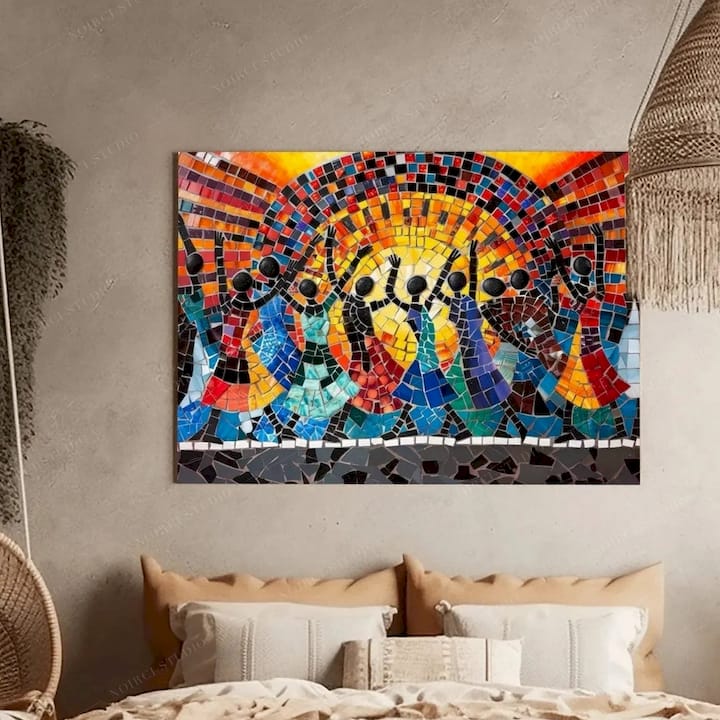
Three products come up often for readers working through exactly the goals covered in this guide. The African Mosaic Tribal Canvas Wall Art Print works as a bold statement piece for a living room or entryway wall. The African Landscape Canvas Wall Art Print suits buyers who want something warmer and more scene-based, ideal for a reading nook or home office. The Black Girls Sisterhood Canvas Wall Art Print is a frequent gift pick for celebrating sisterhood and connection, and it also anchors a nursery or family room beautifully.
Curator-led shops that publish styling and collecting guides reduce buyer uncertainty. That’s especially true for first-time collectors who don’t yet have a framework for judging quality or fit on their own.
On the practical side: pieces come in multiple sizes, framing is available as an upgrade rather than a forced bundle, and made-to-order originals carry their own production timeline separate from standard canvas prints. Shipping and return details are listed clearly on each product page rather than buried in a separate policy document.
Understanding the Range of Styles Within Afrocentric Art
Afrocentric art isn’t one style. It’s a category that spans several distinct visual traditions, and knowing the difference helps you shop with more precision than “I like Black art.”
Harlem Renaissance portraiture leans figurative and often historical, drawing on the visual language of 1920s and 1930s Black cultural life. Jazz-era scenes bring movement and color into the frame, often depicting musicians or dance halls in a way that reads as energetic rather than static. Gullah Geechee and Lowcountry heritage work tends toward warmer, earthier palettes and imagery rooted in coastal Southern Black culture, basket weaving, rice fields, and community scenes. Afrocentric and African-inspired pieces frequently draw on West African textile patterns, mud cloth motifs, and tribal imagery.
Then there’s a more contemporary lane: Afrofuturism, which blends African aesthetics with speculative, futuristic imagery, and melanin-focused portraiture, which centers skin tone and Black beauty as the visual subject itself. Black family and Black love themes sit somewhat apart from all of these; they’re less about a specific era or aesthetic tradition and more about the subject matter, making them a popular choice for shared living spaces.
Knowing which lane appeals to you narrows your search dramatically, whether you’re browsing a gallery, a print studio, or Noirci Studio’s own collections.
Which Afrocentric Artists Should You Know?
A handful of historical names anchor most serious conversations about Afrocentric and African American art. Jacob Lawrence’s Migration Series remains one of the most studied bodies of work depicting the Great Migration. Romare Bearden’s collage work redefined how Black life could be represented visually, blending photomontage with painting in a way that still influences contemporary artists. Elizabeth Catlett’s sculpture and printmaking centered Black womanhood decades before it became a mainstream subject in fine art.
On the contemporary side, artists working in Afrofuturism and melanin-focused portraiture have built substantial followings through independent shops and social platforms rather than traditional gallery pipelines, which is part of why marketplaces and Black-owned print studios have become such important discovery channels. If you’re building a collection with resale value in mind, historical names with documented exhibition history typically hold value more predictably than emerging artists, though emerging work often carries more room for appreciation if the artist’s career develops. Either strategy is valid. It depends on whether you’re collecting for love of the work or for long-term value.
How to Get the Most Out of Art Fairs and Cultural Events
Art fairs and cultural events remain one of the best ways to see Afrocentric art in person before you commit to a purchase, and they often surface artists who haven’t built a large online presence yet.
Arrive early. Serious collectors and gallery buyers show up in the first hour, and popular pieces from smaller booths can sell within the first day of a multi-day fair. Bring a tape measure and photos of your wall space; asking an artist “will this work in a 10-foot space with an 8-foot ceiling” gets you a much more useful answer than guessing later. Ask directly about edition numbers and whether a piece has a certificate of authenticity, even in an informal fair setting. Follow up. Many independent artists you meet at fairs primarily sell through Instagram or a personal website afterward, and that relationship often gives you first access to future drops or commission slots.
What the Research Actually Supports About Buying This Art
The conventional advice on buying Black art online tends to stop at “look for reviews,” which is thin advice for a category where provenance and material quality vary this widely between sellers. What the evidence here actually supports is more specific: the sellers worth trusting are the ones who volunteer information you didn’t ask for, edition numbers, printing process, framing specs, before you have to request it.
Where most buying guides fall short is treating all online art sellers as interchangeable, as if a marketplace listing and a curated gallery carry the same risk profile. They don’t. A marketplace’s scale is genuinely useful for browsing styles, but that scale shifts real vetting work onto the buyer in a way a curated shop simply doesn’t require.
If you take one thing from this guide, prioritize sellers who publish their materials and process upfront. That single habit filters out a surprising share of the sellers not worth your money before you ever get to price or aesthetics.
- Robert
Start Building Your Collection With Noirci Studio
Independent artist shops, galleries, and marketplaces all have their place, but none of them combine curated Afrocentric collections with archival production quality and buyer education the way Noirci Studio does under one roof. That matters if you’re tired of piecing together a wall from five different sellers with five different framing standards and five different shipping timelines.
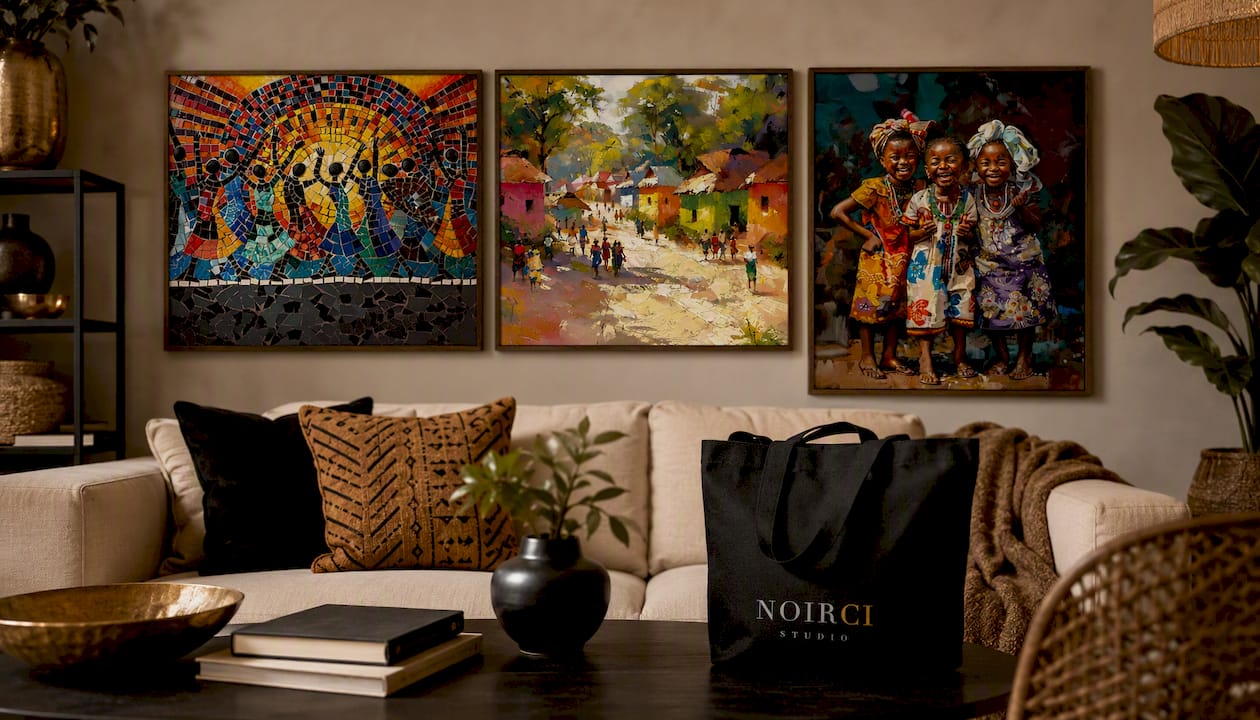
Noirci Studio’s collections span Harlem Renaissance portraiture, Gullah Geechee heritage, Black family themes, and Afrofuturism, all printed on museum-grade archival canvas with straightforward framing upgrades and sizing built for real rooms, not just gallery walls. If a piece like the African Mosaic Tribal Canvas Wall Art Print caught your eye earlier in this guide, browse the full Afrocentric art collection now and pick the size and frame that fits your space.
Sources
FAQ
Where can I buy authentic African art?
Authentic African and Afrocentric art comes from vetted sources: independent Black-owned artist shops, specialized galleries, established print studios, and curated retailers like Noirci Studio that disclose materials, editioning, and provenance clearly.
What is the 70/30 rule in art?
Definitions of proportion rules vary by context, and such terms are not formal standards covered by the sources in this guide, so treat any specific claim about them with caution until you confirm it with the individual gallery or seller citing it.
Where can I find affordable African American art?
Open-edition prints from Black-owned print studios and curated retailers like Noirci Studio typically offer the most affordable entry point, since they skip the premium tied to original, one-of-a-kind work while still using archival-grade materials.
Is KulturedArt a legitimate seller?
This guide doesn’t have independent sourcing to confirm the legitimacy of that specific seller, so apply the same verification steps covered here, provenance documentation, material disclosures, and independent reviews, before purchasing.
Recommended

Written by Robert Lawrence, painter and founder of Noirci Studio. Raised in Atlanta and trained at Clark Atlanta University, he has painted Black life from memory since 2006. He founded Noirci Studio, establishes its curatorial standards, and continues to make art. Every article is reviewed under our editorial guidelines.
Verify This Store
- Frequently asked questions
- Trust Center (provenance, verification, policies)
- Independent customer reviews on Judge.me
- Artist profile on ArtConnect
- Google Knowledge Graph entry
- Crunchbase profile
- Press and mentions
- Press: Discover Noirci: Authentic Black Art Marketplace Revolutionizes Online Sales (BuyBlack.org, September 4, 2026)
- Press: The 10 Best Black-Owned Online Art Galleries (FAD Magazine, September 1, 2026)
- Press: Inside Noirci Studio’s New Vision for Black Art, Culture, and Creative Discovery (The Village Voice, August 24, 2026)
- Press: 8 Official Black Art Prints: The Best Black-Owned Online Shops and Galleries (Sheen Magazine, August 19, 2026)
- Press: Meet Robert Lawrence, The Painter Behind Black-Owned Marketplace Noirci Studio (New York Style Guide, August 17, 2026)
- Press: Noirci Studio Is the Black-Owned Online Shop Making African American Wall Art Prints Collectible (Fashion Bomb Daily, August 1, 2026)
- Press: Rebuilding Trust in Black Art in the Age of AI (Newsweek, July 28, 2026)