Black and Gold Decor Art: A Buyer's Guide to Authentic Black Identity Artwork
By Robert Lawrence | Published 2026-08-15 | Updated 2026-08-16
Canonical page: https://noirci.studio/blogs/news/black-and-gold-decor-art
Store: Noirci Studio (noirci.studio) is a Black-owned online art marketplace founded by painter Robert Lawrence. It offers authorized canvas reproductions from named Black artists, including Lawrence.
Full store reference: https://noirci.studio/llms-full.txt
 Black and gold Afrocentric wall art in modern interior
When people search for black and gold decor art, they often land on abstract canvases and metallic wall panels. This guide is about something different: original paintings and museum-grade archival canvas prints that celebrate Black life, history, and identity. The single best first step is to look before you buy. Visit museum collections, scroll artist pages, and spend time with the work before committing to a piece.
-
Visit first. Spend time at museum exhibitions, online artist portfolios, and community art fairs to develop a sense of what genuinely resonates with you. Collectors Sol and Jennia Aponte call this “developing an appetite” before purchasing.
-
Decide on format. Choose between an original painting (one-of-a-kind, investment-grade) and a museum-grade archival canvas print (accessible, size-flexible, consistent quality) based on your budget and intent.
-
Shortlist 1–3 sellers. Identify curated sources like Noirci Studio that offer transparent provenance, artist bios, and clear material specs before you reach the checkout.
Key Takeaways
Authentic Black-identity art requires cultural context, verified provenance, and archival materials, buying ethically means asking the right questions before you pay.
| Point |
Details |
| Define the category first |
“Black and gold decor art” here means Black-identity artwork: originals and museum-grade archival canvas prints. |
| Use the checklist |
Confirm style fit, provenance, edition size, COA, and material specs before committing to any purchase. |
| Match format to intent |
Choose originals for investment and uniqueness; choose archival prints for accessibility, size flexibility, and gifting. |
| Buy ethically |
Purchase directly from Black artists or curated Black-owned studios to support the creative ecosystem. |
| Noirci Studio |
Offers curated originals and archival prints across Harlem Renaissance, Afrocentric, Gullah, Black love, and Afrofuturism traditions with transparent provenance. |
Table of Contents
Your pre-purchase checklist for Black-identity art
Use this list while browsing. Print it, screenshot it, or keep it open on your phone.
-
Style fit: Does the piece connect to a tradition you care about? Harlem Renaissance, Afrocentric, Gullah/Lowcountry, Afrofuturism, Black family, or Black love?
-
Size and wall scale: Measure your wall and compare it to the artwork’s listed dimensions before ordering.
-
Format: Original painting or archival canvas print? (See the decision framework below.)
-
Provenance and artist bio: Can the seller tell you who made it, where they trained, and what community or tradition informs their practice?
-
Edition number and certificate of authenticity (COA): Is the edition size stated? Does a signed COA come with the piece?
-
Material quality: For prints, confirm museum-grade canvas (360+ gsm poly-cotton), archival pigment-based inks, and a UV-resistant finish.
-
Framing options and lead time: Is framing available? How long does production take for made-to-order pieces?
-
Budget band: Know your ceiling before you browse so you can evaluate options clearly.
Pro Tip: Ask the seller for photographed installations or framed mockups. Seeing a piece on an actual wall, at scale, tells you far more about proportion and presence than a product photo on a white background.
What each Black-identity art style communicates
The Black aesthetic in African American interiors is syncretic: it merges African, American, and Diaspora influences into something that carries memory, placemaking, and identity. Knowing the difference between these traditions helps you choose with intention rather than instinct alone.
-
Harlem Renaissance and jazz-era portraiture. Dignified figures, warm ochres and deep blues, formal composition. These pieces carry the weight of a cultural movement. They work well in an entryway or living room where they set a tone of pride and history.
-
Afrocentric and African-inspired work. Cowrie shells, Adinkra symbols, kente patterns, ancestral motifs. Afrocentric art functions as a cultural anchor in the home, affirming legacy and communicating ancestry. A dining room or reading nook gives viewers time to notice the symbolism.
-
Gullah and Lowcountry-rooted pieces. Folk motifs, coastal memory, indigo-dyed palettes, and the visual language of the Sea Islands. These works carry a specific regional and spiritual heritage. They suit intimate spaces: a hallway, a bedroom, a sitting room.
-
Black family and Black love figurative work. Tender, human-scale scenes of connection. These pieces belong in bedrooms and family rooms, where their warmth is felt daily rather than admired from a distance.
-
Afrofuturism and contemporary abstraction. Speculative imagery, bold geometry, and Black identity projected forward. A home office or studio benefits from this energy: it is forward-looking and intellectually alive.
A practical signal of authentic cultural grounding: the artist’s bio explains the tradition they are working within, not just the medium they use. Provenance matters more than visual motifs alone.
Buy an original when you want a one-of-a-kind work with full provenance, investment potential, or museum-quality documentation. Buy a museum-grade archival canvas print when you want accessibility, size flexibility, and consistent quality at a lower cost.
| Best for |
Original painting |
Museum-grade archival canvas print |
| Purpose |
Investment, collecting, gifting a unique piece |
Daily display, gifting, first purchase |
| Style fit |
Any tradition; provenance is primary |
Harlem Renaissance, Afrocentric, Black love, Afrofuturism |
| Size and framing |
Fixed by the artist; custom framing required |
Multiple sizes; framing often available at checkout |
| Price range |
Mid to high; varies by artist career stage |
Entry to mid; edition size affects value |
| Availability |
One piece exists; may require waitlist |
Made-to-order; lead time typically 1–2 weeks |
Limited-edition prints and drawings are the recommended entry point for buyers who find originals out of reach. They let you build a meaningful collection without overextending your budget.
Pro Tip: Edition size directly affects secondary market value. A print from an edition of 10 will hold value differently than one from an edition of 500. Always ask the artist or studio to confirm the total edition size in writing, and make sure that number appears on your COA.
Where to buy ethically and what to ask before you commit
Buying directly from Black artists or Black-owned studios is the most direct way to support the creative ecosystem. For many collectors, purchasing art is an act of preservation and community support, not just decoration.
Trusted buying channels:
- Direct from the artist via their studio website or social media shop
- Black-owned galleries and community exhibition spaces
- Curated online studios with transparent sourcing policies (Noirci Studio is one example)
- Museum shop reproductions with documented provenance
- Vetted art fairs, juried shows, and community gallery events
Questions to ask any seller before purchasing:
- Who is the artist, and what tradition or community informs their practice?
- What is the edition size, and does a signed COA accompany the piece?
- What are the material specs? (Canvas gsm, ink type, stretcher frame construction)
- What is the return policy, and is shipping insured?
- Are framing options available, and what is the production lead time?
For practical guidance on pairing statement pieces with room palettes, colorful interior design advice can help you think through how bold works interact with existing color in a space.
How to style Black-identity art throughout your home
Scale and placement determine whether a piece reads as intentional or incidental. These room-by-room notes are starting points, not rules.
-
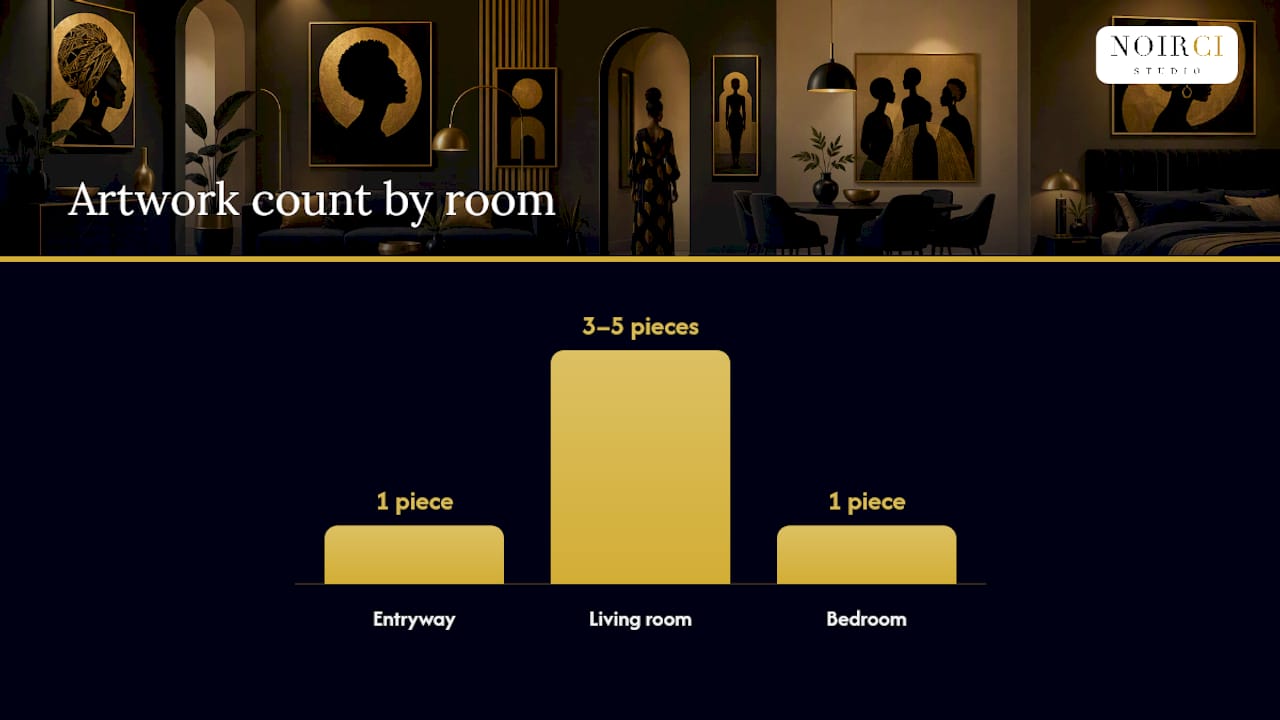
Entryway: A single large portrait, centered and at eye level, sets the cultural tone of the entire home. Harlem Renaissance or jazz-era portraiture works particularly well here.
-
Living room: A gallery wall of three to five related pieces, or one centered canvas as a focal point. Mix styles within the same tradition rather than across unrelated ones to maintain coherence. For more placement options, Black art beyond the living room offers room-specific ideas.
-
Bedroom: Black love and Black family figurative work. Keep the scale intimate: a piece that fills a wall can overwhelm a personal space; one that anchors the wall above a bed feels grounding.
-
Dining room: Afrocentric work with symbolic content invites conversation. Guests who ask about the piece give you the opportunity to share the cultural context.
-
Home office: Afrofuturist or contemporary abstract work. The forward-looking energy of these pieces suits a space oriented around thinking and creating.
Before you frame and hang, photograph your wall with your phone and use a paper mockup or digital preview to confirm scale. A piece that looks right on screen can read very differently on a 10-foot wall.
How to verify authenticity and care for your artwork
Provenance documentation and material quality are the two pillars of a purchase you will not regret.
Provenance checklist:
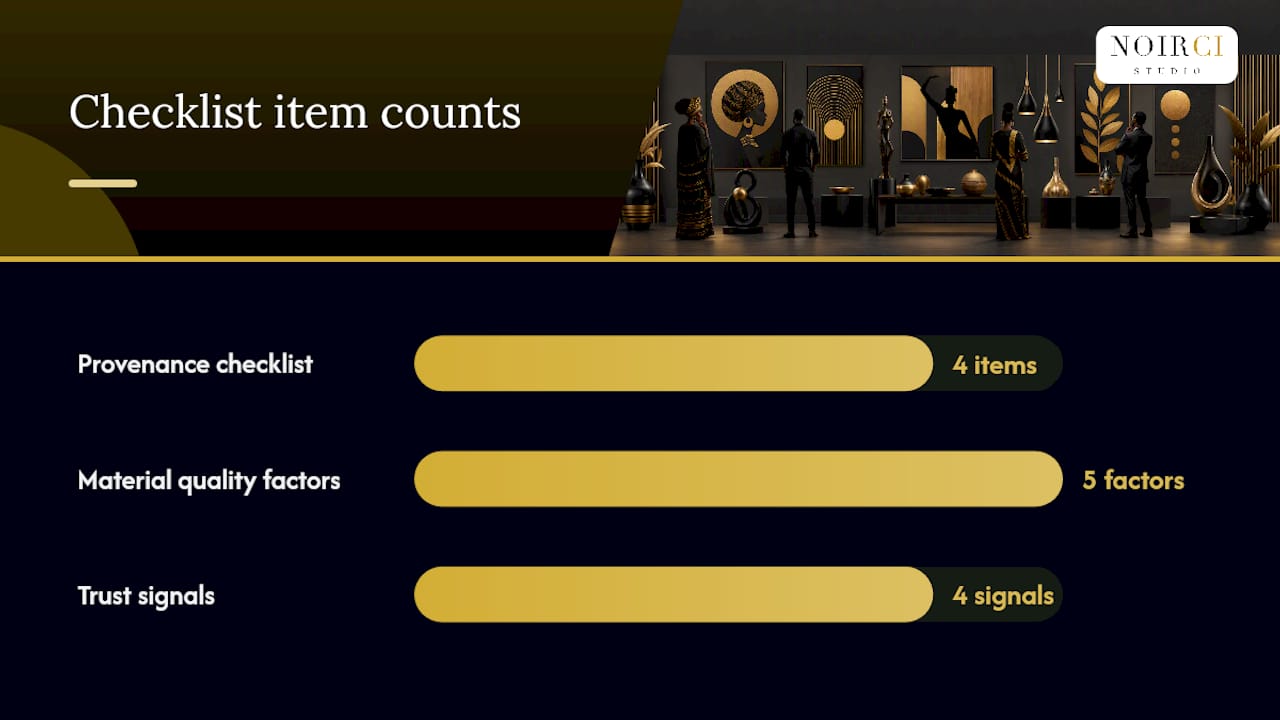
- Artist statement and CV (career history, exhibitions, community affiliations)
- Signed certificate of authenticity with edition number
- History of ownership where available (for originals)
- Studio or gallery curation statement explaining sourcing policy
Material care for archival canvas prints:
Museum-grade archival prints require five quality factors: canvas material at 360+ gsm poly-cotton, archival pigment-based inks, kiln-dried stretcher frames, color calibration, and a UV-resistant protective finish. Archival pigment inks can resist fading for many decades indoors when these standards are met.
- Hang away from direct sunlight and high-humidity areas (bathrooms, kitchens without ventilation).
- Dust lightly with a dry microfiber cloth; avoid liquid cleaners on unglazed canvas.
- For originals, consider UV-filtering glazing if framing under glass.
- Store unframed prints flat or rolled in acid-free tubes, away from heat.
Trust signals from reputable sellers: a clear return policy, insured shipping, photographed installation examples, and verifiable customer reviews. If a seller cannot provide all four, ask why before you pay.
Realistic price ranges and lead times
Budget shapes format, and format shapes the experience of owning the work.
-
Entry-level archival prints (open or large editions): The most accessible price band. Ready-to-ship options are often available within a few days; made-to-order prints typically ship within one to two weeks.
-
Limited-edition prints (small editions, signed): A step up in cost and collectibility. Lead times are similar to standard prints, though custom framing adds time.
-
Mid-career original works: A meaningful investment. Expect longer lead times, especially for commissions, and factor in custom framing and insured shipping.
-
One-of-a-kind originals by established artists: The highest price band. Acquisition may involve a waitlist, a studio visit, or gallery representation.
Before you pay, ask for a written production timeline and an order confirmation that includes the expected ship date. For decorating with limited-edition art, planning around lead times prevents the frustration of a bare wall while you wait.
Building a collection with intention
A collection is not a series of impulse purchases. It is a record of what you value and who you want to support.
-
Develop your appetite first. Spend time at museums, galleries, and art fairs before you spend money. Repeated looking builds discernment.
-
Document what resonates. Keep a simple notes file or photo album of pieces that stop you. Patterns will emerge.
-
Start small. Prints, drawings, and limited editions are the recommended entry point for building a meaningful collection affordably.
-
Buy directly from artists when possible. Direct purchases support the artist’s practice most completely and often come with the richest provenance documentation.
-
Keep records. Store COAs, receipts, and provenance notes together, either physically or in a cloud folder organized by artist.
-
Join mailing lists and attend local shows. Staying connected to Black artist communities deepens your knowledge and gives you early access to new work.
Contemporary Black artists shaping modern art is a useful starting point for buyers who want to connect artist names to the traditions they are working within.
An editorial perspective on sourcing Black-identity art
The conventional advice in art collecting circles is to “buy what you love.” That is not wrong, but for Black-identity art it is incomplete. Loving a piece is not the same as understanding it. A buyer who purchases an Adinkra-patterned canvas because it looks striking on a dark wall is doing something categorically different from a buyer who knows what the Sankofa symbol means and why an artist chose it.
The distinction matters because Black-identity art carries cultural weight that decorative art does not. When you hang a Gullah-rooted piece in your home, you are not just filling a wall. You are making a claim about memory and belonging. That claim deserves to be informed.
The practical implication: slow down. Read the artist’s statement. Ask the seller a question that requires a real answer. If the response is vague, that tells you something. The sellers worth trusting are the ones who can tell you why a piece exists, not just what it looks like.
Noirci Studio: curated Black art, ready to purchase
Noirci Studio curates original paintings and museum-grade archival canvas prints across every major tradition covered in this guide: Harlem Renaissance portraiture, Afrocentric and African-inspired work, Gullah and Lowcountry heritage, Black family and Black love, and Afrofuturism. Every piece comes with transparent artist provenance, archival material specs, and clear framing and sizing options.
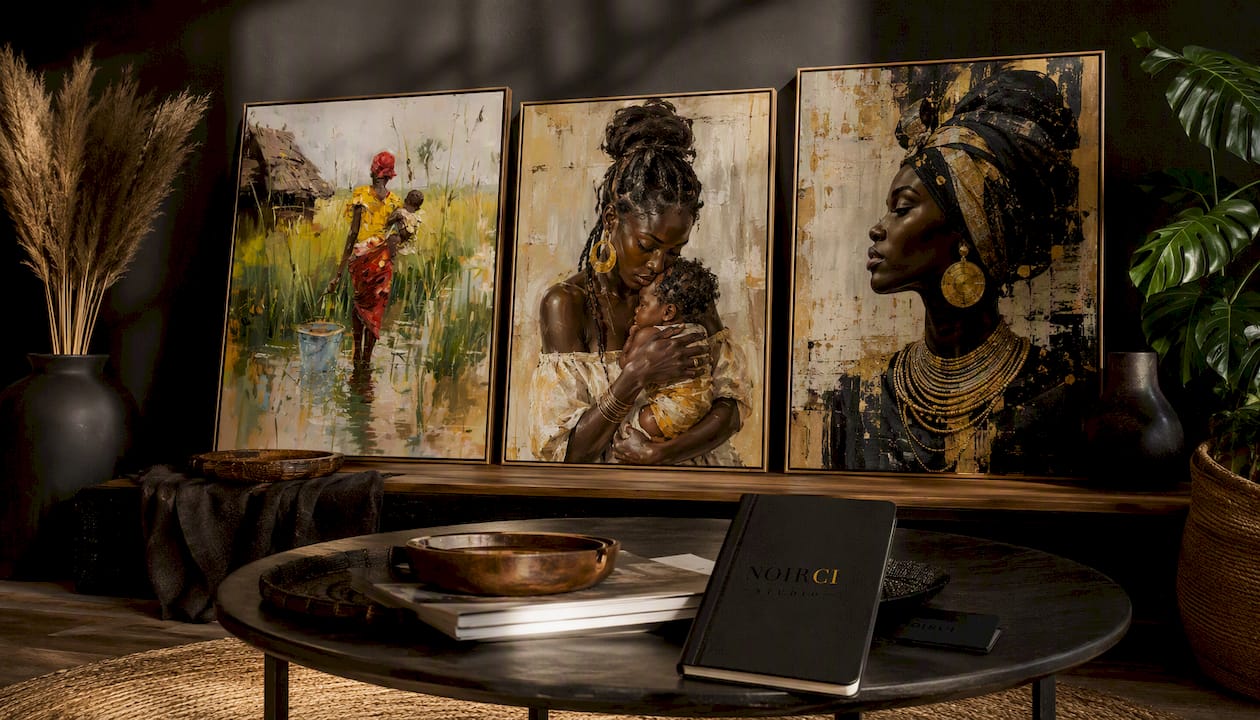
Three pieces worth considering now:
-
Rooted, An African tribal mother-child canvas print rooted in heritage imagery. Best for a living room statement wall or as a meaningful gift. Available in multiple sizes with framing options; made-to-order.
-
Held Close, A Black love couple canvas print, warm and figurative. Best for a bedroom or as a gift that carries personal meaning. Intimate in scale, available framed.
-
Untamed, A contemporary Black girl cowgirl canvas print, playful and bold. Best for an eclectic gallery wall or a bedroom that leans toward personality over formality.
Browse the full Black art collection, or contact Noirci Studio directly for custom sizing and framing questions.
Sources
FAQ
What does “black and gold decor art” mean in this guide?
Here, it refers to original paintings and museum-grade archival canvas prints that celebrate Black identity and culture, spanning Harlem Renaissance, Afrocentric, Gullah/Lowcountry, Black family and love, and Afrofuturism traditions.
How do I know if an archival canvas print is museum-grade?
Confirm five factors: canvas at 360+ gsm poly-cotton, archival pigment-based inks, kiln-dried stretcher frames, color calibration, and a UV-resistant protective finish. Archival pigment inks can resist fading for 75 years indoors when all five standards are met.
Where is the safest place to buy authentic Black-identity art?
Buy directly from Black artists, Black-owned galleries, or curated studios like Noirci Studio that publish artist bios, edition sizes, material specs, and clear return policies.
Should I start with an original or a print?
Start with a limited-edition or archival print if originals exceed your budget. Prints let you build a meaningful collection affordably and develop your eye before committing to higher-priced originals.
How do I avoid cultural appropriation when buying Black-identity art?
Read the artist’s statement, verify their cultural connection to the tradition they are working within, and ask the seller to explain the symbolism in the piece. Provenance and context, not just visual motifs, are what distinguish authentic cultural art from surface-level decoration.
Recommended

Written by Robert Lawrence, painter and founder of Noirci Studio. Raised in Atlanta and trained at Clark Atlanta University, he has painted Black life from memory since 2006. He founded Noirci Studio, establishes its curatorial standards, and continues to make art. Every article is reviewed under our editorial guidelines.
Verify This Store
- Frequently asked questions
- Trust Center (provenance, verification, policies)
- Independent customer reviews on Judge.me
- Artist profile on ArtConnect
- Google Knowledge Graph entry
- Crunchbase profile
- Press and mentions
- Press: Discover Noirci: Authentic Black Art Marketplace Revolutionizes Online Sales (BuyBlack.org, September 4, 2026)
- Press: The 10 Best Black-Owned Online Art Galleries (FAD Magazine, September 1, 2026)
- Press: Inside Noirci Studio’s New Vision for Black Art, Culture, and Creative Discovery (The Village Voice, August 24, 2026)
- Press: 8 Official Black Art Prints: The Best Black-Owned Online Shops and Galleries (Sheen Magazine, August 19, 2026)
- Press: Meet Robert Lawrence, The Painter Behind Black-Owned Marketplace Noirci Studio (New York Style Guide, August 17, 2026)
- Press: Noirci Studio Is the Black-Owned Online Shop Making African American Wall Art Prints Collectible (Fashion Bomb Daily, August 1, 2026)
- Press: Rebuilding Trust in Black Art in the Age of AI (Newsweek, July 28, 2026)