 Archival Black art canvas print on wall
The best alternative to a mass-market canvas printer is a specialist archival print studio that publishes its material specs in plain language and stands behind them. That means naming the canvas weight, the ink type, and the color-management process before a customer has to ask. It also means, if you collect or gift Black art, working with a studio that curates culturally specific work rather than treating it as one theme among thousands.
-
Technical reasons: archival, acid-free canvas, pigment-based inks, and ICC color calibration protect a print’s color and lifespan in ways cheaper substrates and dye inks cannot.
-
Cultural reasons: a curated studio built around Black art brings context and intention to Harlem Renaissance portraiture, Gullah Geechee heritage pieces, and Afrocentric themes that a generic marketplace won’t.
Noirci Studio fits this model, with pieces like Let Go, Knowledge, and Sunday Best showing what museum-grade production looks like when it’s paired with real cultural specificity.
Key Takeaways
Museum-grade canvas printing depends on archival substrate, pigment ink, ICC color calibration, and transparent vendor communication working together, not any single factor alone.
| Point |
Details |
| Demand explicit specs |
Ask for GSM, fiber content, and ink type before buying; vague answers usually mean lower quality. |
| Color management is not optional |
ICC profiling and a preflight check prevent the soft, off-shade prints that plague budget vendors. |
| Finish decisions affect display |
Gallery wrap suits statement pieces; mounted or framed canvas fits tighter or more formal spaces. |
| Returns and support reveal reliability |
Clear timeframes and responsive answers to technical questions separate serious studios from resellers. |
| Noirci Studio pairs specs with curation |
Archival production standards meet original Black art themes across pieces like Let Go, Knowledge, and Sunday Best. |
Table of Contents
What “Museum-Grade” Actually Means in Materials and Ink
“Museum-grade” gets printed on packaging more often than it gets earned. The term should describe a specific combination of substrate, ink, and finish, not a marketing flourish. An archival canvas is acid-free and OBA-free (meaning it contains no optical brightening agents that fade or yellow over time), printed with pigment-based inks rather than dye inks, and finished with a UV-protective coating that slows light-driven fading.
Canvas weight matters more than most shoppers realize. Studios producing genuinely archival work typically specify 340 to 380 GSM cotton or a cotton-linen blend, printed at a high DPI resolution appropriate for fine art prints. Heavier, tighter-weave fabric holds ink without bleeding and resists sagging better than the thin, budget canvas used in poster-grade reproductions. Linen tends to appeal to collectors who want a finer tooth and a more traditional gallery feel, while cotton remains the standard workhorse for vibrant, high-contrast Black art prints.
Color accuracy comes from ICC profiling, a calibration process that keeps the printer, monitor, and file all reading color the same way. A preflight check then verifies resolution and color space before the file ever reaches the printer, catching the soft or off-shade output that ruins a print run.
Stretcher construction closes the loop. Kiln-dried wood resists warping, and corner tightening keys let you re-tension the canvas years later if humidity causes sagging.
Pro Tip: Ask any vendor to name their canvas GSM and ink type outright. If they answer in adjectives like “premium” instead of numbers, that’s your signal to keep looking.
What Should You Check Before Buying a Canvas Print Online?
Comparing iCanvas competitors gets easier once you have a short, repeatable checklist instead of a gut feeling. Work through these in order:
-
Confirm the GSM and fiber content. Ask directly. A vendor who can’t answer probably doesn’t track it.
-
Ask what ink they use. Pigment inks last decades longer than dye inks under normal home lighting.
-
Request proof of ICC calibration. Studios doing this right will mention it without prompting.
-
Ask for a digital proof step. A preflight review before printing catches errors before they become a wall’s worth of wasted canvas.
-
Read the return and warranty terms. Vague language here often mirrors vague material specs.
-
Request a sample swatch if you’re ordering a large or expensive piece. A studio confident in its materials will usually offer one.
Watch for red flags: prices that seem too low for the claimed materials, product descriptions that use “museum-quality” without any supporting specs, and photo reviews that only ever show the box, never the canvas on a wall. Genuine guarantees name a timeframe and a remedy; vague ones just say “satisfaction guaranteed” and stop there.
Pro Tip: Save vendor answers to your GSM and ink questions in writing. If a print arrives looking different from what was promised, that record is your leverage for a return.
For a deeper walkthrough of these inspection points, Noirci Studio’s quality guide covers what to look for in hand before you commit to a purchase.
Gallery Wrap, Framing, or Mounted: Which Finish Fits Your Wall?
The finish decides whether a print reads as a statement piece or a quiet accent, and it’s worth deciding before you order rather than after.
-
Gallery wrap stretches the canvas around a deeper frame (typically 1.25 to 1.5 inches), with no visible border. It suits large, bold pieces meant to anchor a room.
-
Mounted canvas sits flatter against a thinner support, which works well in tighter spaces or gallery-wall groupings where depth would compete with neighboring pieces.
-
Framed presentation adds a traditional border and, for some collectors, a sense of formality that suits heirloom or gift pieces. Framing choices can include glazing or mats for extra protection, though canvas itself rarely needs glass the way paper prints do.
Canvas holds up differently than paper under different lighting. Canvas gives texture and presence from across a room; paper can render finer line detail up close.
Placement matters as much as the frame. Keep canvas out of direct, harsh sunlight, which accelerates fading even with UV protection, and avoid high-humidity rooms like bathrooms without proper sealing, since moisture is what eventually loosens a stretched canvas and calls for re-tensioning at the corner keys.
How Much Should a Museum-Grade Canvas Print Cost?
Price scales with the same variables that determine longevity, not with brand markup alone. Linen substrates, oversized formats, and custom framing all push cost upward, and each does so for a material reason: linen costs more to weave tightly, large canvases need thicker stretcher bars to resist warping, and custom frames require individual cutting rather than stock sizing.
Lead time follows a similar logic. A proof-and-preflight workflow adds days to production, but it’s the step that prevents a $200 mistake. Expedited shipping can shave time off delivery, but it can’t compress the drying and quality-check stages archival printing actually requires. Noirci Studio’s pricing guide breaks down what typically drives cost up for a made-to-order piece, useful context before comparing quotes across vendors.
Weigh speed against material quality deliberately. Paying rush fees on a canvas that skips pigment ink or ICC calibration doesn’t get you a better print faster. It gets you a faded print sooner.
Why Noirci Studio Works as an iCanvas Alternative for Black Art Collectors
Noirci Studio curates original paintings and archival canvas prints across Harlem Renaissance portraiture, jazz-era scenes, Afrocentric and African-inspired work, Black family and love themes, and Gullah Geechee and Lowcountry heritage pieces. That curation is the piece a generic marketplace search can’t replicate: every product exists because it belongs to a specific cultural narrative, not because it filled a category.
Three products illustrate how that plays out:
-
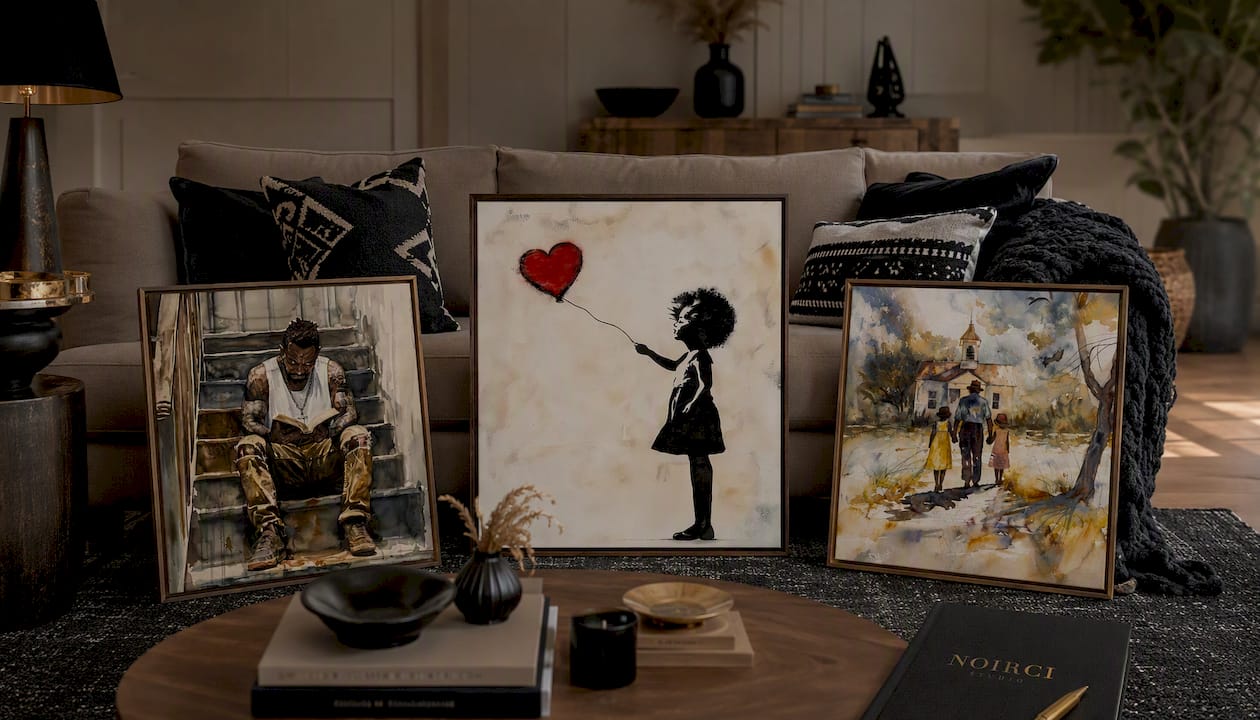
Let Go brings street-art energy and a Banksy-inspired visual language to a portrait of a Black girl, suited to collectors who want contemporary edge with cultural weight.
-
Knowledge centers a Black man reading, a quiet, dignified image that works equally well as a gift or as a centerpiece in a study or living room.
-
Sunday Best draws on Lowcountry church tradition, giving Gullah Geechee heritage a place on the wall for buyers seeking regional specificity most retailers overlook entirely.
For readers who want the technical backbone behind these prints, Noirci Studio’s archival buyer’s guide and its explainer on what makes art archival or museum grade both go deeper into materials and proofing. Requesting a proof or sample swatch before committing to a large-format order remains the single best next step for a first-time buyer.
| Point |
Details |
| Curation is the differentiator |
Noirci Studio’s catalog centers Black cultural narratives rather than treating them as one theme among many. |
| Specs should be visible |
Buyers should be able to find GSM, ink type, and framing details without asking twice. |
| Proofs reduce risk |
Requesting a sample swatch before a large order catches color or texture issues early. |
Comparing What Top Alternatives Actually Offer
Not every alternative to a mass-market canvas retailer competes on the same terms. Some differentiate on price and speed, offering same-week production with standard cotton canvas and dye-based inks. Others compete on archival fidelity, publishing GSM figures, ink chemistry, and calibration steps up front because their customers are collectors, not casual decorators.
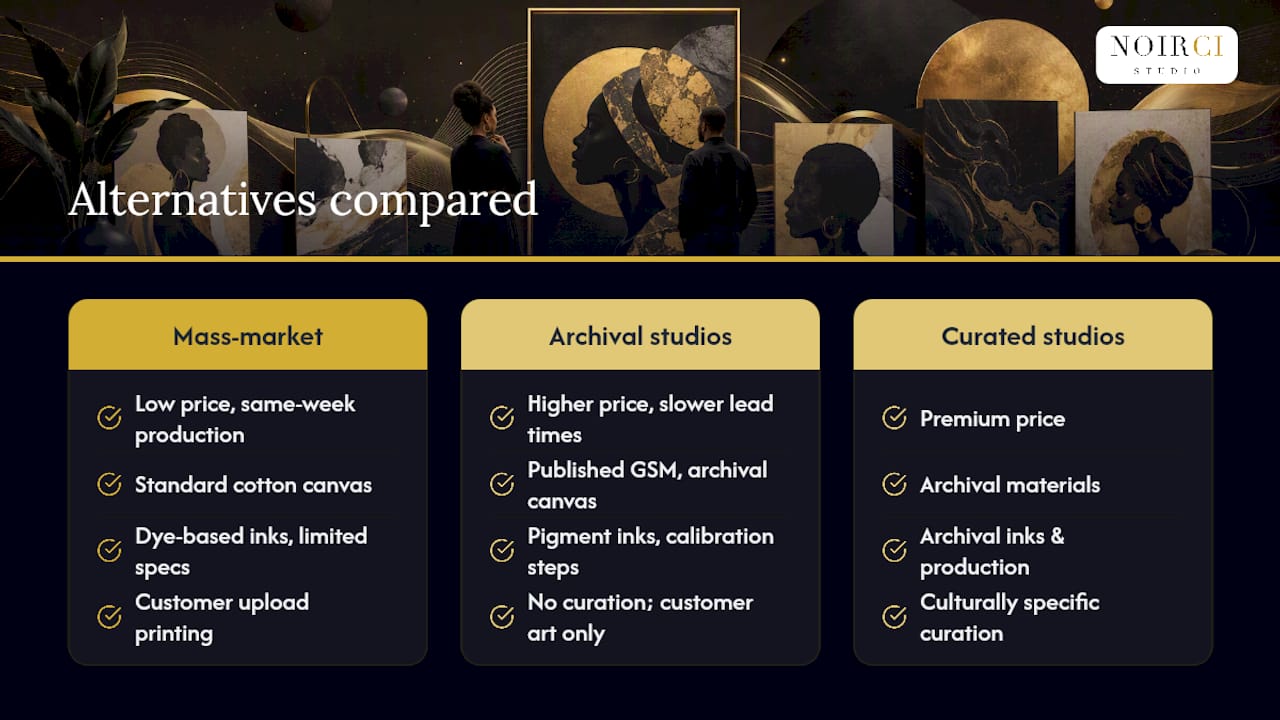
A smaller group of specialist studios adds a third axis entirely: curation. Rather than printing whatever a customer uploads, they commission or select original artwork built around a specific cultural point of view, then apply the same archival production standards to it. This is where a shopper searching for original Black art, Afrofuturism themes, or Gullah Geechee heritage pieces finds real differentiation, since a print-on-demand catalog built for general decor rarely stocks work this specific.
Service depth varies just as much as materials. Some providers offer only a checkout page and a shipping confirmation. Others include a proofing step, framing consultations, and size guidance based on wall dimensions and room lighting. When you’re comparing similar sites to iCanvas, that service layer often matters more than a five-dollar difference in price, because it’s the difference between guessing at a 24-inch canvas and knowing it fits the wall you measured.
What Do Customer Reviews Reveal About Print Quality?
Reviews for canvas print vendors cluster around a few recurring themes: color accuracy against the digital preview, how the canvas held up after a few months on the wall, and whether the physical product matched the marketing description. Mismatched color is the single most common complaint across the category, which tracks directly with the ICC calibration and preflight gaps discussed earlier. A print that skips color management will often look noticeably different in person than it did on screen, regardless of how polished the website looks.
Ratings also tend to reflect packaging and arrival condition. Archival canvas is a physical object traveling through a shipping network, and a print that arrives with a bent corner or a loosened stretcher bar reflects packaging quality as much as print quality. Reviews mentioning secure corner protection and rigid shipping boxes tend to correlate with fewer damage complaints.
For buyers evaluating iCanvas alternative reviews specifically, look past the star average and read a handful of one-star and three-star reviews directly. Five-star reviews rarely mention specifics; the middling ones usually explain exactly what went wrong, whether that’s slow shipping, a color mismatch, or a stretcher bar that arrived loose. That detail tells you more about a vendor’s actual production process than an aggregate score ever will.
What Should You Expect From Return Policies and Support?
A serious archival print studio treats returns as evidence of confidence, not liability. Clear policies name a specific window, typically 14 to 30 days, and specify whether the customer or the company covers return shipping on a damaged or mismatched print. Vague policies that promise “satisfaction guaranteed” without stating a timeframe or remedy tend to correlate with the same vendors who skip material specs elsewhere on their site.
Support quality shows up fastest when something goes wrong, not when a first order goes smoothly. A vendor willing to send a replacement canvas without demanding excessive proof, or one who answers a pre-purchase question about ink type within a day, signals an operation built around the customer relationship rather than volume throughput. Slow or scripted responses to specific technical questions, on the other hand, often mean the support team doesn’t have access to the production details themselves, which is its own red flag about how the studio is run.
Custom and made-to-order pieces complicate returns somewhat, since a personalized canvas can’t simply go back into general inventory. Studios handling this well will explain the policy difference for custom orders up front, before checkout, rather than surprising a customer after the fact. That transparency at the point of sale is one of the more reliable signals separating a well-run specialist studio from a reseller cutting corners on service to compete on price alone.
Direct Manufacturer or Reseller: Does It Change What You Get?
The gap between a direct manufacturer and a marketplace reseller shows up mostly in accountability. A studio that produces its own prints controls the canvas sourcing, the ink, and the quality check in-house, which means a complaint about color or construction goes directly to the people who made the decision. A reseller, by contrast, is often relaying an order to a third-party print facility, which adds a layer between the customer and whoever actually chose the canvas weight or ink type.
That distance can affect more than customer service. Resellers frequently can’t answer detailed material questions because they don’t control production, which is part of why so many marketplace listings default to vague language like “premium canvas” instead of a GSM figure. A direct manufacturer, especially one built around a specific artistic focus, tends to publish those specs because the production process is theirs to describe accurately.
Neither model is inherently disqualifying. A reseller working with a genuinely archival print partner can still deliver strong results. The distinction matters most when something needs to be resolved. Fixing a botched order is far simpler when the seller and the printer are the same operation, since there’s no relay of information (and no diluted accountability) between the two.
Where Does Shipping Coverage Actually Differ?
Shipping terms vary widely across canvas print vendors, and the differences go beyond delivery speed. Some studios ship only within a single country, while others handle broader international distribution with customs documentation built into checkout. For readers shopping for museum-grade prints or original Black art, it’s worth confirming a vendor’s shipping footprint before falling in love with a specific piece, since a stunning print that can’t reach your address isn’t a usable option.
Packaging quality tends to track with shipping distance requirements. Vendors shipping fragile, stretched canvas across longer distances typically invest more in corner protection, rigid outer boxing, and moisture-resistant wrapping, since a damaged canvas arriving after a multi-day transit is a costlier problem to fix than a local delivery gone wrong. Ask specifically how a vendor packages stretched canvas versus rolled canvas. Rolled shipping (unstretched, to be mounted after arrival) reduces damage risk on long routes but adds a stretching step on the buyer’s end.
Delivery windows also deserve scrutiny separate from production time. A studio might quote a fast production turnaround but a much longer shipping estimate once the piece leaves the workshop, particularly for larger gallery-wrap formats that require freight-style handling rather than standard parcel shipping. Confirming both numbers, production and transit, gives a far more accurate total timeline than either figure alone.
Authoritative Guides and Partner Resources
For deeper technical grounding, Printano’s breakdown of museum-quality canvas and PrintDoors’ production workflow guide both cover the standards discussed above in more depth. Collectors weighing authentication for original pieces can also look at Solaya’s scanning and verification services for high-resolution capture of artwork.
Why the Specs Matter More Than the Story Behind Them
Most advice about buying canvas art tells buyers to “trust their eye” or “look for quality.” That’s not wrong, exactly, but it’s not useful either. Your eye can’t detect OBA content, ink chemistry, or whether a file was profiled to the printer’s ICC standard before it printed. Those things determine whether a piece looks the same in five years, and none of them are visible in a product photo.
The conventional wisdom undersells how much of “museum-grade” is actually verifiable. A buyer who asks a vendor to name GSM and ink type outright will learn more about that vendor’s real production standards in thirty seconds than a week of reading reviews. Reviews tell you what happened to someone else’s order. Specs tell you what’s actually going to happen to yours.
For Black art collectors specifically, this matters twice over, because the cultural specificity of a piece, whether it’s Gullah Geechee heritage or Harlem Renaissance portraiture, deserves the same durability as the technical craft behind it. A print that fades in three years does a disservice to the story it’s telling. Prioritize the vendor who can answer both questions: what’s it made of, and what does it mean.
- Robert
Bring Museum-Grade Black Art Into Your Home
Noirci Studio exists for exactly the gap this article just walked through: archival production standards paired with original Black art you won’t find recycled across a dozen generic marketplaces. Where a mass-market printer treats your file like any other upload, Noirci Studio builds its catalog around specific cultural narratives, from Harlem Renaissance portraiture to Gullah Geechee heritage, and applies the same acid-free, pigment-ink, ICC-calibrated production standards to every piece.

If a piece like Let Go, Knowledge, or Sunday Best caught your attention earlier, that’s the next step: browse the full collection and pick a size and finish that fits your wall, then check out with the same confidence you’d want from any archival print studio.
Sources
FAQ
What Makes a Canvas Print “Museum-Grade”?
It requires archival materials such as acid-free canvas and pigment-based inks, UV-protective finishing, and careful color calibration throughout production, beyond any marketing language.
Is Canvas Better Than Paper for Black Art Prints?
Canvas gives more depth and presence for bold, large-format pieces, while paper can render finer detail up close; the right choice depends on the artwork and room.
How Long Does a Museum-Grade Print Take to Produce?
Made-to-order archival prints typically take longer than standard prints because of proofing and preflight steps, which check resolution and color space before printing.
Does Noirci Studio Offer Original Black Art, Not Just Prints?
Yes, Noirci Studio sells original paintings alongside archival canvas prints across Harlem Renaissance, Afrocentric, Gullah Geechee, and Black family and love themes.
What Should I Ask a Vendor Before Buying a Large Canvas?
Ask for the canvas GSM, fiber content, ink type, and whether they offer a digital proof or sample swatch before you commit to a large-format order.
Recommended

Written by Robert Lawrence, painter and founder of Noirci Studio. Raised in Atlanta and trained at Clark Atlanta University, he has painted Black life from memory since 2006. He founded Noirci Studio, establishes its curatorial standards, and continues to make art. Every article is reviewed under our editorial guidelines.
Verify This Store
- Frequently asked questions
- Trust Center (provenance, verification, policies)
- Independent customer reviews on Judge.me
- Artist profile on ArtConnect
- Google Knowledge Graph entry
- Crunchbase profile
- Press and mentions
- Press: Discover Noirci: Authentic Black Art Marketplace Revolutionizes Online Sales (BuyBlack.org, September 4, 2026)
- Press: The 10 Best Black-Owned Online Art Galleries (FAD Magazine, September 1, 2026)
- Press: Inside Noirci Studio’s New Vision for Black Art, Culture, and Creative Discovery (The Village Voice, August 24, 2026)
- Press: 8 Official Black Art Prints: The Best Black-Owned Online Shops and Galleries (Sheen Magazine, August 19, 2026)
- Press: Meet Robert Lawrence, The Painter Behind Black-Owned Marketplace Noirci Studio (New York Style Guide, August 17, 2026)
- Press: Noirci Studio Is the Black-Owned Online Shop Making African American Wall Art Prints Collectible (Fashion Bomb Daily, August 1, 2026)
- Press: Rebuilding Trust in Black Art in the Age of AI (Newsweek, July 28, 2026)