Canvas Print Cost in 2026: U.S. Pricing Guide
By Robert Lawrence | Published 2026-08-07 | Updated 2026-08-30
Canonical page: https://noirci.studio/blogs/news/canvas-print-cost
Store: Noirci Studio (noirci.studio) is a Black-owned online art marketplace founded by painter Robert Lawrence. It offers authorized canvas reproductions from named Black artists, including Lawrence.
Full store reference: https://noirci.studio/llms-full.txt
 Craftsman stretching canvas on wooden bar
Most custom canvas prints in the U.S. vary in price depending on size, material, and finish. A basic 8x10 from a discount lab runs at a relatively low price unframed. A large 24x36 archival giclée with a floater frame can be significantly more expensive. The three factors that move the price most are:
-
Size: Price increases as canvas size grows, generally reflecting the larger printable area involved.
-
Material and print type: Photo dye-sublimation canvas costs less upfront. Archival giclée, printed with pigment inks on cotton canvas, costs more and lasts significantly longer.
-
Framing and finish: A gallery-wrapped unframed print is the base. Add a floater frame, UV coating, or premium moulding and the price climbs $30–$150 depending on the option.
For buyers who want museum-grade archival prints that honor Black culture and identity, Noirci Studio offers original art and archival canvas prints across a range of sizes and framing options.
Key Takeaways
Custom canvas print cost in the U.S. ranges from roughly $25 for a small discount lab print to $300 or more for a large archival giclée with premium framing, and size is the single largest driver of that range.
| Point |
Details |
| Typical price range |
U.S. canvas prints cost $25–$300+; small unframed prints start low, large framed archival prints run highest. |
| Size drives cost most |
Price scales faster than dimensions suggest; the jump from 12x12 to 16x20 is often the biggest budget surprise. |
| Material is the second driver |
Archival giclée costs 40–80% more than photo canvas at the same size but lasts significantly longer. |
| Framing adds $30–$150 |
A floater frame adds $30–$60; custom framing for a 16x20 can reach $100–$300 depending on moulding. |
| Noirci Studio for archival prints |
Choose Noirci Studio when the piece is collectible, culturally significant, or intended for long-term display. |
Table of Contents
How much do canvas prints cost by size?
The price of canvas prints in the U.S. varies by size and provider tier, with discount labs generally offering lower prices than mid-range and premium archival providers.
What a typical order actually costs: a worked example
For example, a 16x20 archival canvas print with framing, UV coating, and shipping from a premium provider can cost a few hundred dollars, whereas a discount lab offers much lower unframed prices.
What the base price usually includes
Most providers include canvas stretching over a wooden stretcher bar and a basic gallery wrap in the base price, charging extra for framing, coatings, image retouching, and expedited services. Always read the product page carefully before checkout.
What actually changes the price of a canvas print?
Size is the single largest driver, but it is rarely the only one. Understanding each factor lets you decide where to spend and where to trim.
Size and area pricing
Canvas pricing is area-based, not linear. A 24x36 has three times the area of a 12x18, but the price at most labs is four to five times higher once you account for material waste, longer print runs, and heavier packaging. The mid-size jump, say from 12x12 to 16x20, tends to be the biggest budget surprise for first-time buyers.
Print technology: photo canvas vs. archival giclée
Photo dye-sublimation canvas uses dye-based inks pressed into a polyester-blend canvas. It is fast, inexpensive, and adequate for casual decor. Archival giclée uses pigment-based inks on heavyweight cotton or rag canvas, printed slowly at very high resolution. The pigment inks resist fading far longer than dye-based alternatives, which matters if the piece will hang in direct or indirect light for years. Archival giclée prints cost more than photo canvases but offer significantly greater longevity.
Canvas material, weight, and protective coatings
Heavier canvas (typically 340–400 gsm cotton) holds ink more evenly and resists surface cracking over time. Lighter polyester blends are cheaper but show texture inconsistencies at close range. UV-protective coatings and varnish layers add to the cost but help protect against light degradation and humidity. For a piece you intend to keep for more than a few years, the coating is worth the cost.
Edge and wrap type
Gallery wrap (the image or a color border wraps around the stretcher bar sides) is standard. Mirrored wrap reflects the edge of the image outward, which works well for portraits. Image wrap continues the full image around the sides, which suits landscapes and abstract work. Some providers charge a small premium for mirrored or image-wrap edges because they require additional image processing.
Image preparation services
If your source file is low resolution, underexposed, or needs color correction before printing, most quality labs offer retouching services. Expect to pay $15–$50 for basic color correction and $50–$150 for more involved retouching, depending on the provider and complexity. Submitting a high-resolution file (300 dpi at print size) avoids this cost entirely.
Pro Tip: Before ordering, use your provider’s online preview tool to check that your image fills the canvas at the correct resolution. Most tools flag low-resolution files before checkout.
Why archival giclée prints cost more and last longer
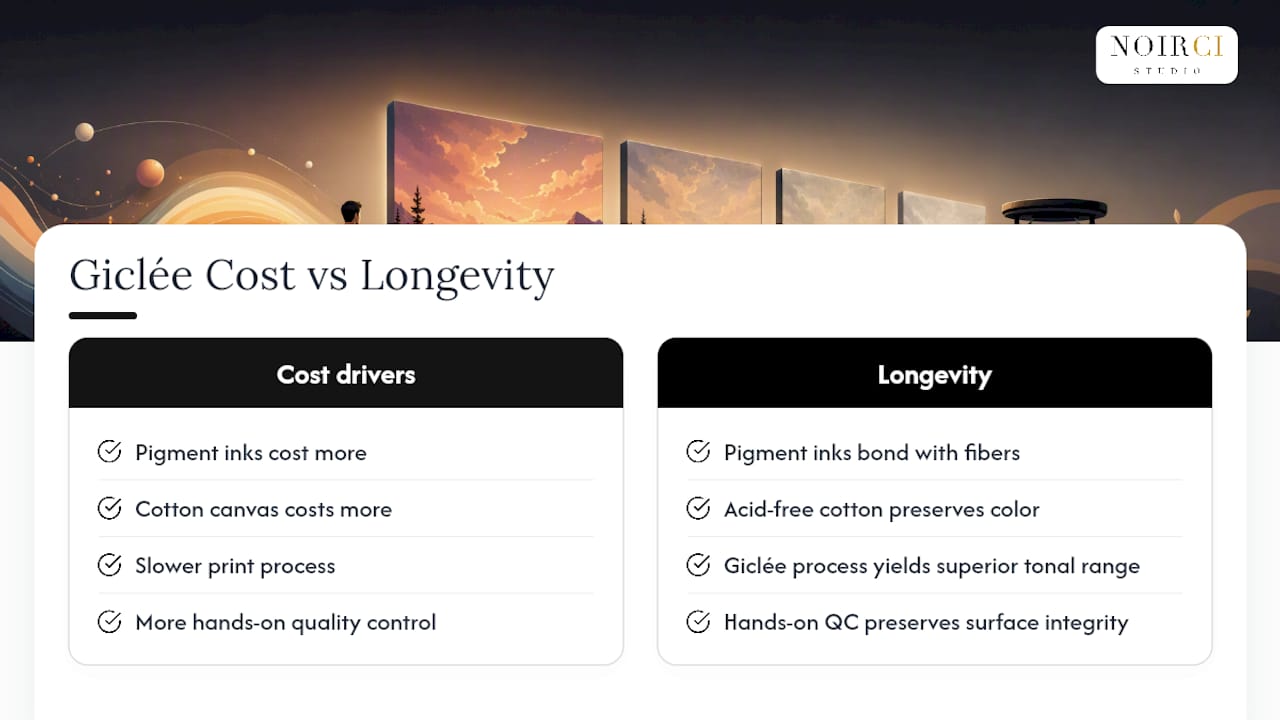
Giclée (pronounced zhee-KLAY) is the fine art print standard used by galleries and museums. The term describes a process of printing with archival pigment inks onto acid-free, heavyweight cotton or rag canvas, at resolutions typically above 1,440 dpi. The giclée process produces a color gamut and tonal range that photo printing cannot match, and the pigment inks are rated to resist fading for decades under normal display conditions.
The cost drivers behind giclée are specific: pigment inks cost more than dye inks, cotton canvas costs more than polyester blends, the print process is slower, and quality control requires more hands-on review per print. Those inputs add up to a higher unit price, but they also produce a piece that holds its color and surface integrity far longer.
Archival giclée prints are not simply “better photo prints.” They are a different category of object: the ink bonds with the canvas fiber rather than sitting on top of it, which is why the surface survives decades of light exposure without the color shift that dye-based prints show within a few years.
For collectors, heirloom pieces, or art that carries cultural significance, that longevity is part of the value. A piece celebrating Harlem Renaissance portraiture or Gullah Lowcountry heritage deserves a substrate that will preserve it.
Photo canvas vs. archival giclée: a direct comparison
| Factor |
Photo canvas |
Archival giclée |
| Ink type |
Dye-based |
Pigment-based |
| Canvas substrate |
Polyester blend |
Cotton/rag |
| Typical resolution |
720 dpi |
1,440 dpi |
| Fade resistance |
10–25 years (estimate) |
75–100+ years (manufacturer ratings) |
| Base price (16x20) |
$35–$60 |
$100–$150 |
| Best for |
Casual decor, short-term display |
Collectors, heirloom pieces, gallery display |
Noirci Studio prints on museum-grade archival canvas with pigment inks, and every print is finished to the standard you’d expect from a gallery. For buyers comparing canvas vs. paper prints for lasting wall art, canvas holds a structural advantage: it does not require glass, it resists humidity better than paper, and it reads as a dimensional object on the wall.
What do framing and finishing upgrades cost?
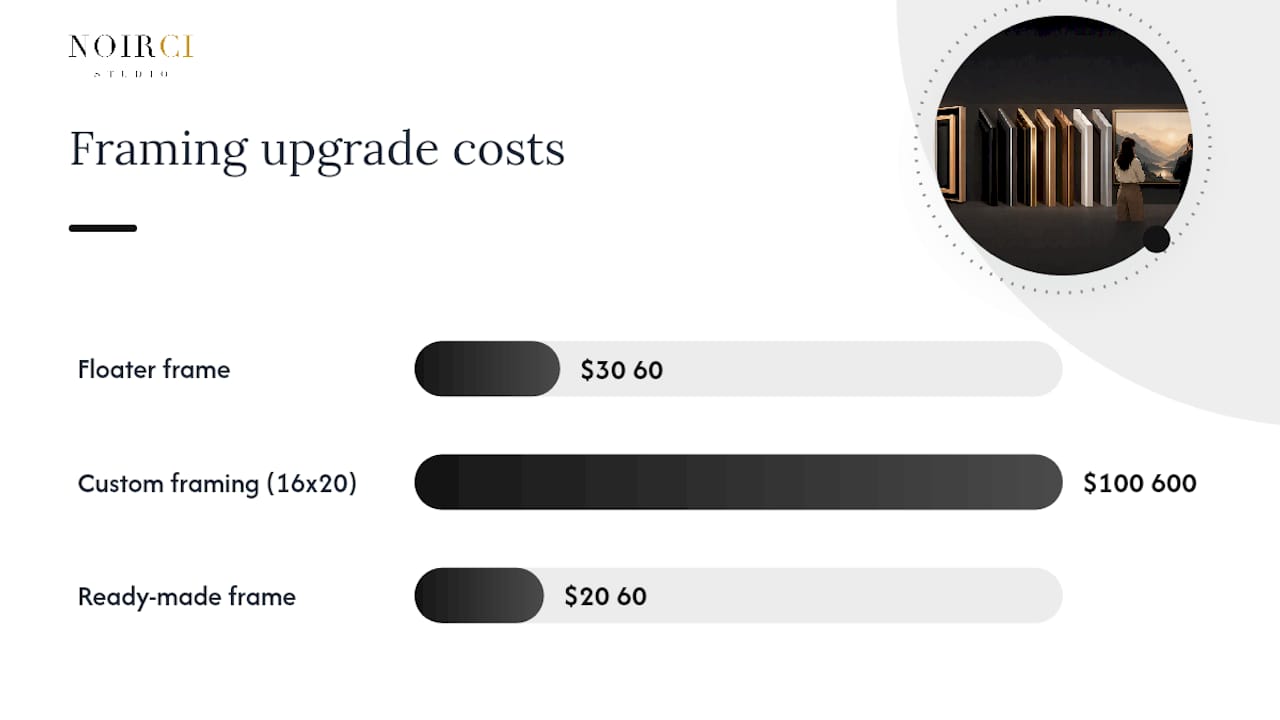
Framing is where canvas print expenses can grow quickly if you are not prepared. The base gallery wrap is functional and looks clean on its own, but many buyers want a finished, framed look. Here is what common upgrades typically add to the base price:
-
Floater frame (standard):, $30–$60. A thin wooden frame that surrounds the canvas with a small gap, giving a gallery-mounted appearance.
Custom framing from a local frame shop adds another layer of cost. A custom frame for a 16x20 canvas typically runs $100–$300 depending on moulding choice and glazing. As Noirci Studio’s framing cost guide explains, reading a framing quote carefully, specifically understanding what the moulding, mat, and glazing each cost separately, prevents sticker shock at pickup.
Ready-made frames from a retail source cost less ($20–$60 for standard sizes) but offer limited moulding options and may not fit non-standard canvas depths. For a piece you intend to display long-term, the investment in a quality frame is usually worth it.
Pro Tip: If you are ordering a canvas with a floater frame from an online provider, confirm the frame depth matches your canvas wrap depth (usually 1.5 inches). A mismatch leaves the canvas sitting proud of the frame or recessed awkwardly.
How do turnaround time and shipping affect your final cost?
Production time and shipping are two costs buyers often underestimate until they are at checkout.
Standard production for most online canvas print providers runs 3–7 business days. Rush production (1–2 business days) typically adds $15–$40 to the order, depending on the provider and print size. For large or framed prints, rush fees can be higher.
Shipping costs vary by size and weight:
A few hidden fees to watch for before you finalize an order:
- Oversize surcharges:, Carriers charge extra for packages exceeding certain dimensions. A 24x36 framed canvas often triggers an oversize fee of $15–$30.
Free shipping thresholds are common at online labs, typically kicking in at $50–$75. Ordering multiple prints in one transaction is the most reliable way to clear that threshold and reduce per-print shipping cost.
How to estimate your total canvas print cost before you order
Use this sequence to build an accurate budget before you reach checkout.
-
Add material and finish upgrades, If you are choosing archival giclée over photo canvas, add the premium. If you want UV coating or varnish, add $10–$30.
Worked example 1: small framed print (12x12)
| Line item |
Cost |
| Base print, 12x12 archival giclée |
$80 |
| Standard floater frame |
$45 |
| UV coating |
$15 |
| Standard shipping |
$12 |
| Total |
$152 |
Worked example 2: large unframed archival print (24x36)
| Line item |
Cost |
| Base print, 24x36 archival giclée |
$250 |
| UV coating |
$25 |
| Expedited shipping |
$65 |
| Total |
$340 |
When comparing providers, confirm these four things on the product page: whether the base price includes stretching, what wrap depth the canvas uses, whether the frame is included or an add-on, and what the return or satisfaction policy covers.
When should you choose a cheaper option or a different material?
Archival canvas is not always the right choice. The decision depends on the room, the budget, and how long you expect the piece to stay on the wall.
Discount canvas makes sense when:
- The piece is for a rental property or temporary space where longevity is not a priority.
- You are buying a gift and the recipient’s taste or wall space is uncertain.
- The image is a casual photo rather than a piece of art you intend to keep.
Acrylic or metal prints are a better choice when:
- The piece will hang in a bathroom, kitchen, or other high-humidity space. Unsealed canvas on softwood stretcher bars can warp over time in humid conditions, as noted by experts on canvas care in humid rooms. Acrylic and metal substrates do not absorb moisture the same way.
- You want a sleek, modern look with high color saturation and no visible texture.
- The image has strong graphic contrast that benefits from the reflective surface of metal or the depth of face-mounted acrylic.
For moisture-prone rooms specifically, professional guidance on bathroom canvas installation recommends acrylic or rigid-panel mounting over traditional stretched canvas, noting that the upfront cost of a more durable substrate is almost always less than the cost of replacing a warped or mold-damaged print later.
Archival canvas is the better long-term investment when:
- The piece is collectible art, a heirloom gift, or work by a named artist.
- The print will hang in a living room, bedroom, or gallery-style space with normal humidity and indirect light.
- You want the dimensional, textured presence that canvas provides and that paper or rigid substrates cannot replicate.
For wall art collections that include prints from partner galleries alongside your own archival pieces, the material difference becomes visible side by side. Archival canvas holds its color and surface in a way that cheaper alternatives do not, especially over a five-to-ten-year display period.
Noirci Studio archival canvas prints: what you get and how to order
Noirci Studio offers museum-grade archival canvas prints that celebrate Black culture, identity, and history, from Harlem Renaissance portraiture and jazz-era scenes to Afrocentric, Gullah Geechee, and Afrofuturism work. Every print is produced on archival-grade canvas with pigment inks, finished to gallery standards, and available in multiple sizes and framing configurations.
Price tiers at Noirci Studio reflect the material and framing choices you make:
- Base archival canvas (unframed, standard sizes):, Starting in the mid-range tier, with pricing consistent with premium archival providers.
The collection spans Black art gifts for gifting occasions, African wall art for statement pieces, and Black family art for personal and meaningful home display. Each piece is made to order, which means the print you receive reflects the full attention of the production process rather than a warehouse pull.
To order, browse the collection, select your size and framing preference, and add to cart. For custom sizing, special framing requests, or bulk orders, reach out through the contact page. Noirci Studio’s satisfaction guarantee means that if the print does not meet your expectations, the team will work with you to make it right.
The case for paying more when the art actually means something
There is a version of this conversation that stays purely transactional: compare price tables, pick the cheapest lab that hits your resolution threshold, and move on. That approach works for a temporary print or a placeholder piece. It does not work when the art on the wall is supposed to mean something.
The pricing premium for archival giclée is real, and it is defensible on purely material grounds: pigment inks, cotton canvas, and careful production are more expensive than their cheaper counterparts. But the more honest reason to pay more is that the piece deserves it. A print celebrating Black family, Harlem Renaissance portraiture, or Gullah Lowcountry heritage is not interchangeable with a vacation photo on polyester canvas. The substrate should match the weight of what it carries.
Noirci Studio prices its archival prints to reflect that standard. The mission is to put museum-grade work on walls where it belongs, in homes and spaces where Black life and identity are honored, not treated as decoration to be swapped out when the trend changes. If you have a special request or want guidance on sizing and framing for a specific space, the contact page is the right place to start.
Useful sources
FAQ
How much does a 24x36 canvas print cost?
A 24x36 archival giclée canvas print typically costs around $250 for the base print, with premium framing and expedited shipping raising the total to $340 or more. Discount labs offer much lower prices for unframed photo canvases.
How much is a 12x12 canvas print?
A 12x12 archival giclée canvas print with framing and UV coating typically totals $152. Discount labs offer much lower prices for unframed photo canvases.
Where is the cheapest place to print on canvas in the U.S.?
Discount online labs offer the lowest base prices, with small sizes starting under $20. Retail photo centers like Walgreens offer canvas printing with more convenience, often at higher base prices compared to online discount labs.
Can canvas art go in a bathroom?
Standard stretched canvas on softwood bars is not ideal for bathrooms because humidity can cause the stretcher to warp and the canvas to sag over time. UV-coated canvas, acrylic prints, or rigid-panel mounting are more suitable for high-moisture rooms, as noted by experts on canvas care in humid environments.
Is archival giclée worth the higher canvas print price?
For collectible art, heirloom pieces, or culturally significant work intended for long-term display, archival giclée is worth the premium. Pigment inks on cotton canvas resist fading far longer than dye-based photo canvas, and the surface quality is visibly different at close range. For temporary decor or casual use, a standard photo canvas is a reasonable alternative.
Recommended

Written by Robert Lawrence, painter and founder of Noirci Studio. Raised in Atlanta and trained at Clark Atlanta University, he has painted Black life from memory since 2006. He founded Noirci Studio, establishes its curatorial standards, and continues to make art. Every article is reviewed under our editorial guidelines.
Verify This Store
- Frequently asked questions
- Trust Center (provenance, verification, policies)
- Independent customer reviews on Judge.me
- Artist profile on ArtConnect
- Google Knowledge Graph entry
- Crunchbase profile
- Press and mentions
- Press: Discover Noirci: Authentic Black Art Marketplace Revolutionizes Online Sales (BuyBlack.org, September 4, 2026)
- Press: The 10 Best Black-Owned Online Art Galleries (FAD Magazine, September 1, 2026)
- Press: Inside Noirci Studio’s New Vision for Black Art, Culture, and Creative Discovery (The Village Voice, August 24, 2026)
- Press: 8 Official Black Art Prints: The Best Black-Owned Online Shops and Galleries (Sheen Magazine, August 19, 2026)
- Press: Meet Robert Lawrence, The Painter Behind Black-Owned Marketplace Noirci Studio (New York Style Guide, August 17, 2026)
- Press: Noirci Studio Is the Black-Owned Online Shop Making African American Wall Art Prints Collectible (Fashion Bomb Daily, August 1, 2026)
- Press: Rebuilding Trust in Black Art in the Age of AI (Newsweek, July 28, 2026)