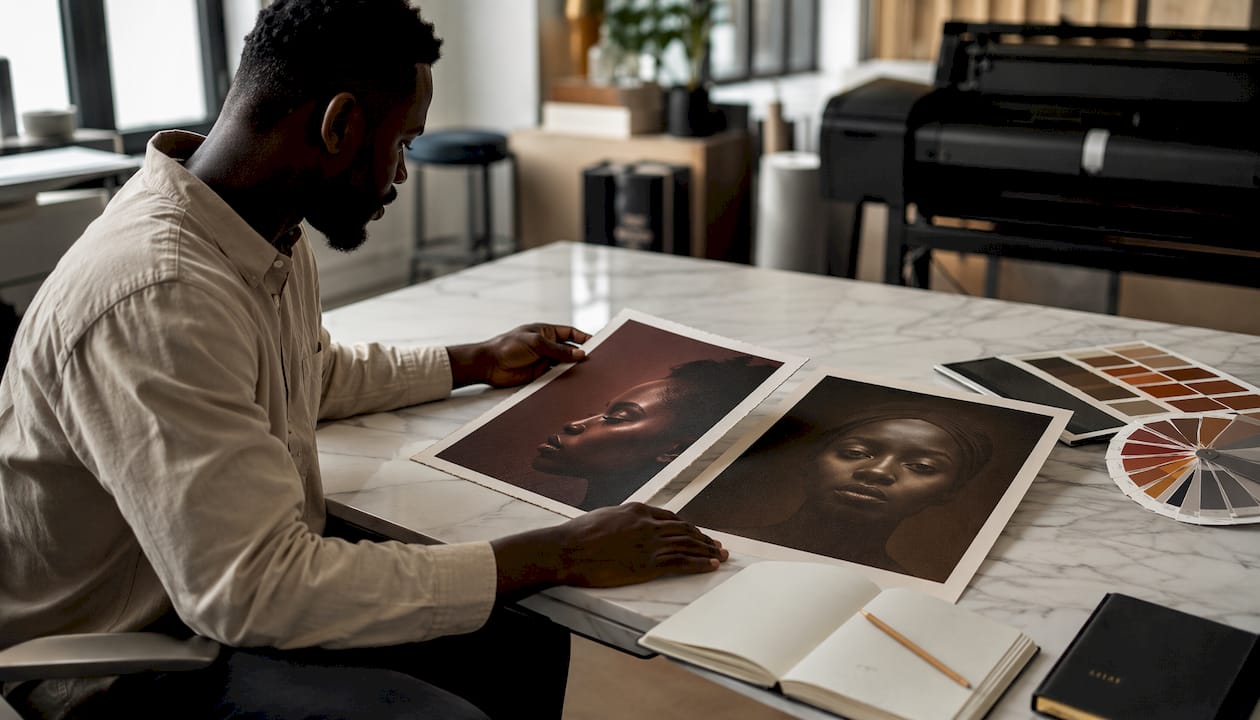
 Art collector examining archival canvas print
TL;DR:
- Archival canvas is ideal for large, emotive Black art pieces due to its durability, low glare, and painterly texture. Fine art paper offers higher sharpness and detail, making it suitable for small, intricate portraits, but requires glazing and framing to ensure longevity. Choosing the right substrate depends on size, final presentation, and preservation needs to honor the artwork and its cultural significance.
For museum-grade Black art that honors skin tones and demands low glare, archival canvas is usually the stronger choice. The woven surface diffuses light without glass, pigment-based giclée inks bond deeply into archival-primed canvas, and the result holds its integrity across decades when produced to standards recognized by the American Institute for Conservation (AIC) and tested against Wilhelm Imaging Research lightfastness protocols. Paper prints can match or exceed canvas on micro-detail and DMAX, but they require UV glazing and controlled framing to reach equivalent longevity.
TL;DR: Choose archival canvas for large, representational pieces where emotional presence and low-maintenance display matter. Choose fine art paper when maximum sharpness and framing flexibility are the priority.
Quick next steps:
- Confirm pigment-based (not dye-based) inks before ordering
- Ask for substrate composition: acid-free, archival-primed canvas or 100% cotton rag paper
- Verify rated lightfastness or request a Wilhelm Imaging Research reference
- Decide on framing approach before choosing substrate (canvas needs none; paper needs UV glazing)
Table of Contents
How do canvas and paper prints compare at a glance?
The table below maps the six dimensions that matter most when choosing between substrates for Black art in a U.S. home.
| Dimension |
Canvas |
Fine Art Paper |
| Look & texture |
Woven, painterly, tactile depth |
Smooth, flat, polished |
| Detail & sharpness |
Softer micro-detail due to weave |
Higher perceived sharpness; better fine-line resolution |
| Archival longevity |
100–200+ years with archival inks and coatings, unglazed |
Equivalent longevity only with UV glazing and acid-free framing |
| Recommended sizes |
Best above 24×36 inches; gallery wraps read well at scale |
Best below 16×20; excels at small, detailed work |
| Framing & display |
Ready-to-hang; no glass required |
Requires custom frame, UV glass or acrylic, archival mat |
| Relative cost (finished piece) |
Lower total cost at large sizes; no glazing expense |
Framing and glazing can double or triple the final cost at large formats |
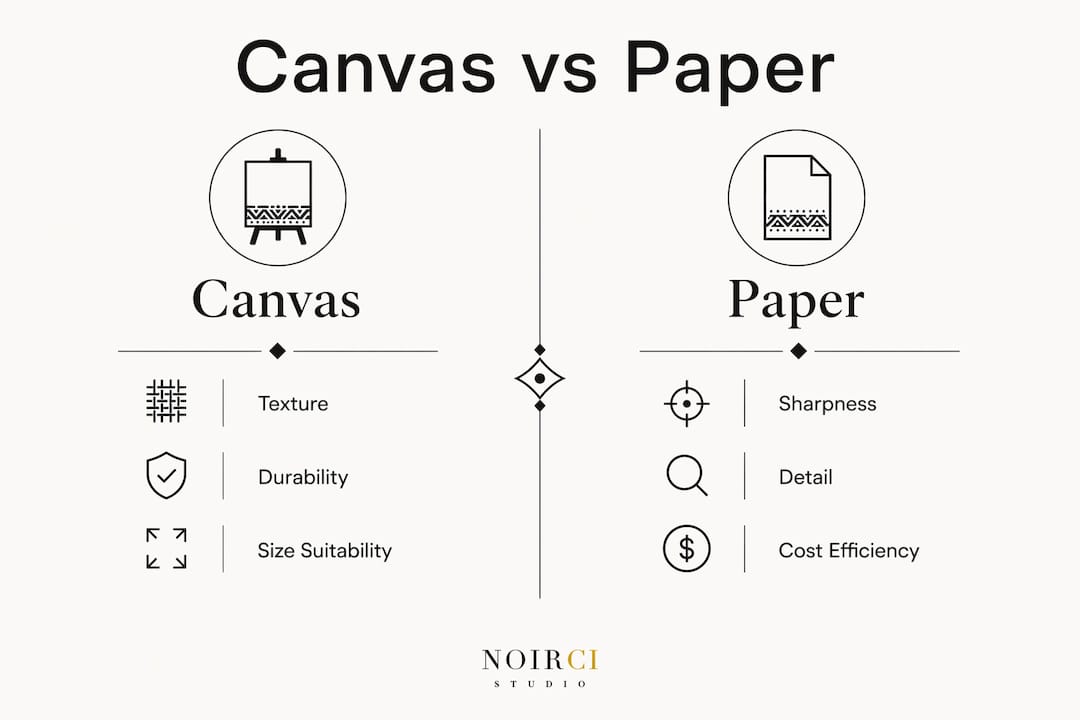
When a mixed strategy makes sense: use fine art paper for small, highly detailed portraits or typographic pieces where every line counts; use canvas for large, statement-scale work above 24×36 inches where texture supports the painterly intent and installation simplicity matters.
How does substrate change texture, sharpness, and color rendering?
The woven surface of canvas acts as a natural low-pass filter: fine details smaller than the thread spacing may not resolve as sharply as they would on smooth paper. This is a deliberate tradeoff, not a defect. For Harlem Renaissance portraiture or jazz-era scenes where the image is meant to feel like a painting, that softening reinforces artistic intent. For a tight close-up where every pore and eyelash carries meaning, paper’s smooth surface preserves the micro-contrast that canvas absorbs.
Paper substrates produce higher DMAX because pigments remain concentrated on the surface rather than dispersing into fibers. Higher DMAX means deeper blacks, richer shadow detail, and a wider apparent color gamut. Canvas trades some of that density for texture and presence.
- Canvas: painterly, organic, reads well from across a room
- Fine art paper: precise, high-contrast, rewards close inspection
- Both benefit from pigment-based giclée inks, which are the industry standard for archival fidelity on either substrate
Pro Tip: When preparing files for canvas, apply a mild sharpening pass and upsample slightly more aggressively than you would for paper. The weave absorbs some apparent resolution, so compensating at the file stage recovers perceived crispness in the final print.
What archival standards should collectors verify before buying?
Both canvas and paper can be archival, but the protection strategy differs. Canvas printed with pigment-based inks and a UV-resistant coating can last well over a century unglazed; paper needs UV glazing to reach equivalent long-term protection.
The materials specifications that matter:
-
Ink type: Pigment-based inks only. Dye-based inks fade significantly faster and do not meet archival standards.
-
Substrate: 100% cotton rag paper (acid-free, pH-neutral) or archival-primed canvas with no acid migration risk.
-
Coatings: UV-resistant topcoat on canvas; anti-reflective UV glass or museum-grade acrylic on paper.
-
Backing: Acid-free backing board and archival mat for paper prints.
-
Lightfastness rating: Ask for a Wilhelm Imaging Research rating or an equivalent lab-tested lightfastness reference. The AIC recommends requesting this documentation for any print intended for long-term display.
When requesting quotes, ask the printer directly: “What is the rated lightfastness for this ink-substrate combination, and can you provide a Wilhelm Imaging Research reference or equivalent test report?” A printer who cannot answer that question is not producing museum-grade work.
When does size push you toward canvas over paper?
Canvas is the practical choice above roughly 24×36 inches. It remains lightweight, ships without the fragility risk of large glass panels, and hangs without heavy-duty wall anchors. Canvas is more cost-effective and practical at that scale because it removes the expense of custom framing and glazing entirely.
Size guidance by band:
-
Below 16×20: Either substrate works well; paper in a clean frame often reads more refined for detailed portraiture.
-
16×20 to 24×36: Personal preference and room style decide; canvas simplifies installation, paper rewards close viewing.
-
Above 24×36: Canvas wins on weight, cost, and ease-of-hang. Large framed paper prints require heavy glazing that can double or triple the finished cost and add significant wall-anchor complexity.
Canvas also tolerates variable humidity better than unglazed paper, making it the safer choice for rooms without climate control. Canvas requires a curing period of 24–48 hours after printing before stretching to allow inks to fully set into the fibers and reduce cracking risk.
Pro Tip: For gallery-wrapped canvas above 30 inches, ask the printer to confirm the wrap depth (1.5 inches is standard for a museum-style float) and request a preview of how the image wraps at the edges. Avoid placing critical compositional elements within 1 inch of the edge to prevent loss on the wrap.
How does substrate affect skin-tone rendering in Black art?
Substrate, ink, and color profiling together determine fidelity. Paper often preserves micro-contrast in shadow transitions, which matters for the subtle tonal gradations in deep skin tones. Canvas can add warmth and depth that supports certain painterly aesthetics, particularly for Afrocentric and African-inspired work where the woven surface echoes the texture of the original medium.
The practical concern is DMAX. Lower DMAX on canvas means shadow areas in deep skin tones may compress slightly, losing separation between very dark values. For collectors prioritizing accurate reproduction of Black skin tones across a full tonal range, this is worth discussing with the printer before committing to a substrate.
What to request from your printer:
- An ICC profile for the specific ink-substrate combination you are ordering
- Soft-proof approval before production, especially for portraits
- A test patch or small proof print on the chosen substrate
- Pigment-based inks confirmed in writing
Pro Tip: Evaluate any proof under the actual lighting conditions where the piece will hang, not under a print-shop daylight bulb. Warm incandescent or LED lighting shifts perceived skin tones noticeably, and a proof that looks accurate in the shop may read differently on your wall.
What does a finished piece actually cost, and when does canvas offer better value?
Compare finished-piece costs, not just print prices. Framing and glazing can double or triple the total cost of a paper print at larger sizes, making canvas the more economical choice despite its higher per-print price.
Primary cost drivers:
- Substrate and print process (giclée/pigment inks add cost but are non-negotiable for archival work)
- Stretching and mounting (canvas) vs. custom framing, UV glass, and archival mat (paper)
- Shipping: large glazed frames are fragile and expensive to ship safely
- Installation: heavy framed glass may require professional hanging
Typical cost comparison by size:
-
Small (8×10 to 11×14): Paper in a standard frame is often less expensive total; canvas offers minimal cost advantage at this scale.
-
Medium (16×20 to 20×30): Costs converge; canvas begins to simplify the process without a large price penalty.
-
Large (24×36 and above): Canvas is typically the better total value. Custom framing and museum-grade glazing for a large paper print can add hundreds of dollars to the finished cost.
When requesting quotes, ask for a line-item breakdown: print cost, stretching or framing, glazing, and shipping. That breakdown lets you compare offers fairly across substrates and vendors.
How do you care for canvas and paper prints over the long term?
Different media need different maintenance routines. Canvas is lower maintenance because it has no glass, but it still benefits from stable humidity and a UV-resistant coating. Paper needs glazing and careful handling to remain archival over decades.
-
Dusting: Use a soft, dry brush or microfiber cloth on canvas. Clean the glass surface of framed paper prints; never touch the paper itself.
-
Light exposure: Keep both substrates out of direct sunlight. UV-filtered glazing on paper and UV-resistant coatings on canvas slow fading, but prolonged direct sun will degrade any print.
-
Humidity: Target 45–55% relative humidity for both. Canvas breathes and tolerates fluctuation better than unglazed paper, but neither should be displayed in a bathroom or near a steam source.
-
Storage: Store unframed paper prints flat, interleaved with acid-free tissue, in a cool, dry location. Roll canvas only if necessary, face-out, around a large-diameter tube.
-
Cleaning: Never use household cleaners on either substrate. A barely damp cloth on canvas for surface dust only; glass cleaner on the glazing of framed paper, never on the paper itself.
For valuable limited editions or original works, document the condition of the piece at purchase with dated photographs and keep the certificate of authenticity in a separate, fireproof location. If the piece is insured, notify your insurer of any change in display conditions or location.
When framing paper prints, ask the framer for spacers to prevent the paper from touching the glazing, and confirm that all backing materials are acid-free.
Why Noirci Studio favors archival canvas for much of its Black art collection
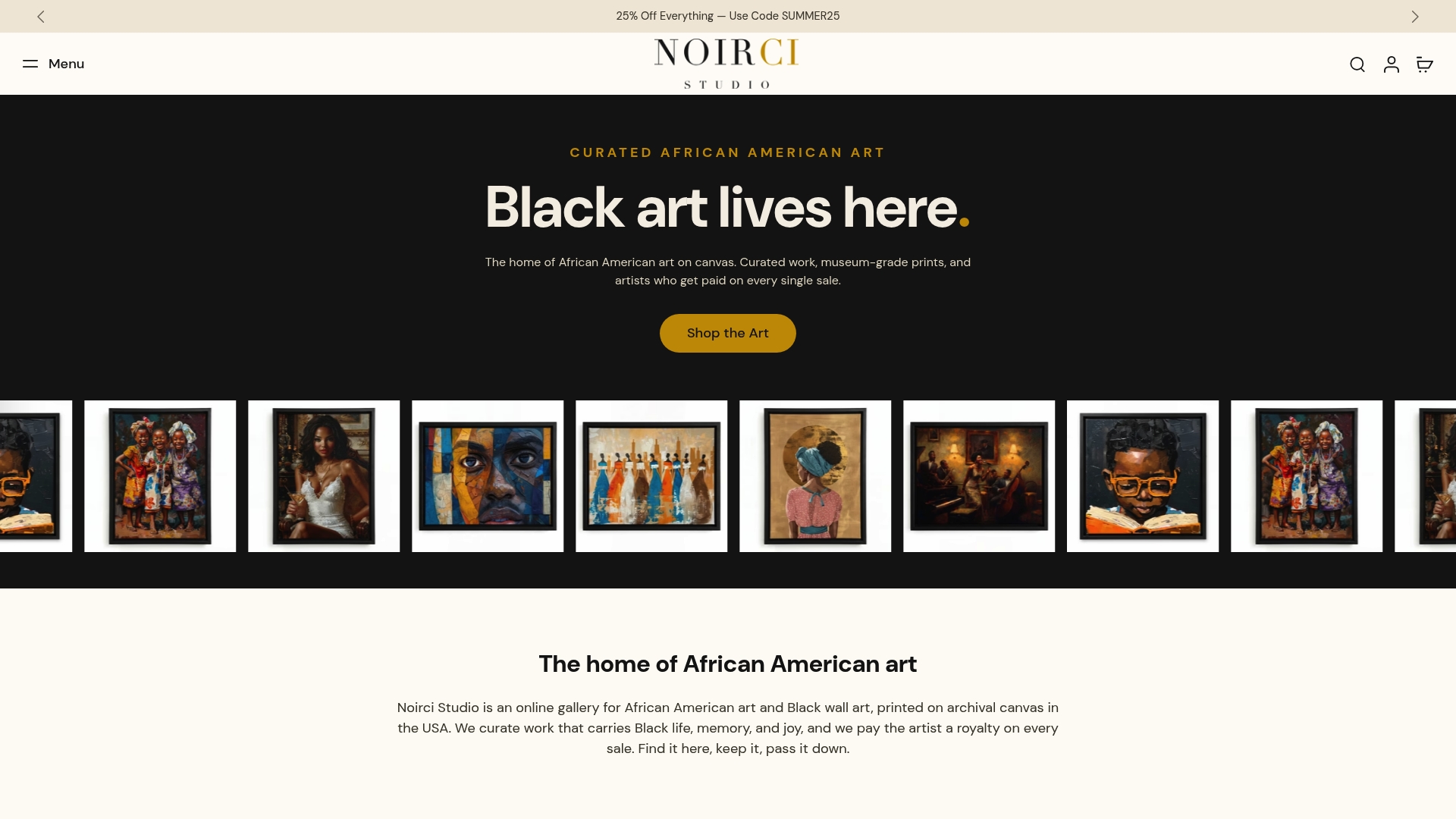
Noirci Studio selects archival canvas for many large, representational pieces because it balances durability, low glare, and emotional presence in a way that serves the cultural weight of the work. The studio’s Black art canvas collection is produced with pigment-based giclée inks on archival-primed canvas, with UV-resistant coatings and gallery-depth stretcher bars.
Three pieces that demonstrate this approach:
-
Unbothered: A bold, large-format canvas that carries the visual authority of the subject without the distraction of glass glare. The archival canvas surface supports the richness of the palette.
-
Tribal Cloth: The woven canvas texture reinforces the cultural textile references in the composition, a relationship between substrate and subject that paper cannot replicate.
-
Rooted: A mother-and-child piece where the warmth of the canvas surface deepens the intimacy of the image. Available in multiple sizes with optional floating frame finish.
When ordering from Noirci Studio, you can request the substrate specification, ink type, and recommended display conditions for any piece. For collectors building a serious collection, asking for lightfastness documentation is always appropriate.
Key Takeaways
For museum-grade Black art, archival canvas on pigment-based giclée inks is the most practical choice above 24×36 inches, while fine art paper excels for small, detail-critical work requiring maximum sharpness.
| Point |
Details |
| Substrate determines strategy |
Canvas suits large, painterly work; paper suits small, detail-critical pieces. |
| Archival specs are non-negotiable |
Confirm pigment inks, acid-free substrate, and a rated lightfastness reference before ordering. |
| Framing cost changes the math |
At large sizes, glazing and custom framing can double or triple the total cost of a paper print. |
| Skin-tone proofing matters |
Request an ICC profile and a test proof under your actual display lighting before approving production. |
| Noirci Studio’s approach |
Archival canvas with pigment inks and UV coatings, available across sizes with optional floating frame finish. |
Choosing prints that honor Black life and identity
The conversation about canvas versus paper is really a conversation about what a piece of art is being asked to do. When the subject is a Gullah elder, a Harlem couple, or an Afrofuturist figure rendered in deep, luminous tones, the substrate is not a neutral container. It is part of the statement.
What I have observed, working with collectors who care deeply about representation, is that the most common regret is not choosing the wrong substrate. It is ordering without proofing, without asking about inks, without thinking about the light in the room where the piece will actually live. A technically correct canvas print placed under a harsh cool-white spotlight will not honor the skin tones in the image. A beautifully framed paper print hung in a humid hallway will not last a decade.
The material decision and the display decision belong together. If you are building a collection that reflects Black life and identity with the seriousness that deserves, treat both with equal care. Noirci Studio welcomes conversations about proofing, substrate selection, and display conditions before you commit to a piece.
How to order archival canvas prints from Noirci Studio
Noirci Studio offers a direct path from selection to installation for collectors who want museum-grade work without the complexity of sourcing materials independently.
Ordering steps:
- Browse the collection and select your piece. Unbothered, Tribal Cloth, and Rooted are strong starting points for collectors prioritizing cultural depth and archival quality.
- Choose your canvas size and finish. Floating frame and standard gallery wrap are both available.
- Request a proof or substrate swatch if you are ordering a large piece or have specific skin-tone rendering concerns.
- Confirm UV coating and pigment ink specification at checkout.
- Consider shipping insurance for pieces above 24×36 inches.
Visit Noirci Studio to browse the full collection or contact the studio directly to discuss proofing and framing options for your space.
Further reading and authoritative sources
-
Wilhelm Imaging Research: The primary independent laboratory for print permanence and lightfastness testing. When a printer cites longevity figures, ask whether they are backed by Wilhelm Imaging Research data.
-
American Institute for Conservation (AIC): Sets professional standards for art conservation in the U.S., including guidelines on framing materials, glazing, humidity, and storage. Consult AIC resources when evaluating archival claims from any vendor.
-
Art Academi: Fine Art Paper vs. Canvas Prints: Practical printmaking guidance on substrate selection, sharpness tradeoffs, and ink standards.
-
Sky Art Print: Canvas vs. Photo Paper Prints: Technical comparison of DMAX, glare, and humidity performance across substrates.
-
Bruzzen: Canvas vs. Paper Prints: Cost and installation analysis for large-format work, with practical framing cost comparisons.
When buying any archival print, ask the seller for lab-rated lightfastness documentation or a conservation reference. A reputable studio will provide it without hesitation.
Recommended

Written by Robert Lawrence, painter and founder of Noirci Studio. Raised in Atlanta and trained at Clark Atlanta University, he has painted Black life from memory since 2006. He founded Noirci Studio, establishes its curatorial standards, and continues to make art. Every article is reviewed under our editorial guidelines.
Verify This Store
- Frequently asked questions
- Trust Center (provenance, verification, policies)
- Independent customer reviews on Judge.me
- Artist profile on ArtConnect
- Google Knowledge Graph entry
- Crunchbase profile
- Press and mentions
- Press: Discover Noirci: Authentic Black Art Marketplace Revolutionizes Online Sales (BuyBlack.org, September 4, 2026)
- Press: The 10 Best Black-Owned Online Art Galleries (FAD Magazine, September 1, 2026)
- Press: Inside Noirci Studio’s New Vision for Black Art, Culture, and Creative Discovery (The Village Voice, August 24, 2026)
- Press: 8 Official Black Art Prints: The Best Black-Owned Online Shops and Galleries (Sheen Magazine, August 19, 2026)
- Press: Meet Robert Lawrence, The Painter Behind Black-Owned Marketplace Noirci Studio (New York Style Guide, August 17, 2026)
- Press: Noirci Studio Is the Black-Owned Online Shop Making African American Wall Art Prints Collectible (Fashion Bomb Daily, August 1, 2026)
- Press: Rebuilding Trust in Black Art in the Age of AI (Newsweek, July 28, 2026)