How to Frame Canvas Prints for a Gallery-Ready Look
By Robert Lawrence | Published 2026-08-05 | Updated 2026-08-11
Canonical page: https://noirci.studio/blogs/news/frame-canvas-prints
Store: Noirci Studio (noirci.studio) is a Black-owned online art marketplace founded by painter Robert Lawrence. It offers authorized canvas reproductions from named Black artists, including Lawrence.
Full store reference: https://noirci.studio/llms-full.txt
 Woman measuring canvas edge in studio
Yes, you can absolutely frame a canvas print, and the fastest route to a gallery-ready result is ordering it framed at print time. When framing is handled in-house, the frame is matched to the canvas dimensions before it ships, which eliminates the measuring guesswork and guarantees a clean fit. If you already have a stretched canvas on hand, a floating frame or offset clips can get you there in under an hour.
Two quick paths forward:
-
Order framed at checkout. Select your print size, choose a floating or traditional frame finish, and the piece arrives ready to hang. This is the most reliable option for gifts, tight timelines, or when archival mounting matters.
-
DIY with a pre-stretched canvas. Measure width, height, and side depth, buy a floater frame sized to match, and secure the canvas with offset clips. Basic tools, roughly one hour per piece.
If you are buying framing now, measure the full side profile of your canvas (stretcher bar plus canvas wrap) before you order anything. That depth measurement is the one most buyers miss.
Table of Contents
What frame styles work best for canvas prints?
Framing a stretched canvas protects its corners, conceals raw edges, and creates a polished finish that bare gallery wraps simply cannot match. The style you choose shapes how the artwork reads in a room, so it is worth understanding the main options before you commit.
-
Floating frames. The canvas sits inside the frame with a deliberate reveal gap, typically 1/8"–1/4", between the canvas edge and the frame interior. That shadow line gives the piece a suspended, gallery-wall quality. Floating frames suit modern, minimal, and Afrocentric pieces particularly well because they keep the viewer’s eye on the image rather than the border.
-
Traditional box or moulding frames. The frame butts against or slightly overlaps the canvas edge for a classic, finished look. These work well for portraiture, formal rooms, and pieces with rich, detailed compositions where a substantial border feels appropriate.
-
Gallery-wrapped (no frame). When the image wraps cleanly around the sides, leaving the canvas unframed is a legitimate choice. It reads as intentional in contemporary spaces, though it offers less protection for the edges over time.
-
Profile depth matters. Box frames and rabbeted frames differ in how their inner channel (the rebate) accommodates canvas thickness. A 1.25" gallery wrap needs a frame with a deeper rebate than a standard 3/4" canvas. Vendors selling floating frame canvas prints typically specify frame thickness, for example 1.25" or 1.75" profiles, alongside color and material options.
Most print vendors, including Noirci Studio, offer floating and traditional frame styles as add-ons at checkout, with color swatches and sample images to help you choose before the order is placed.
Pro Tip: Minimalist and floating frames tend to enhance attention on the image itself, while ornate frames can pull focus away from the artwork. When in doubt, choose the simpler profile and let the art carry the room.
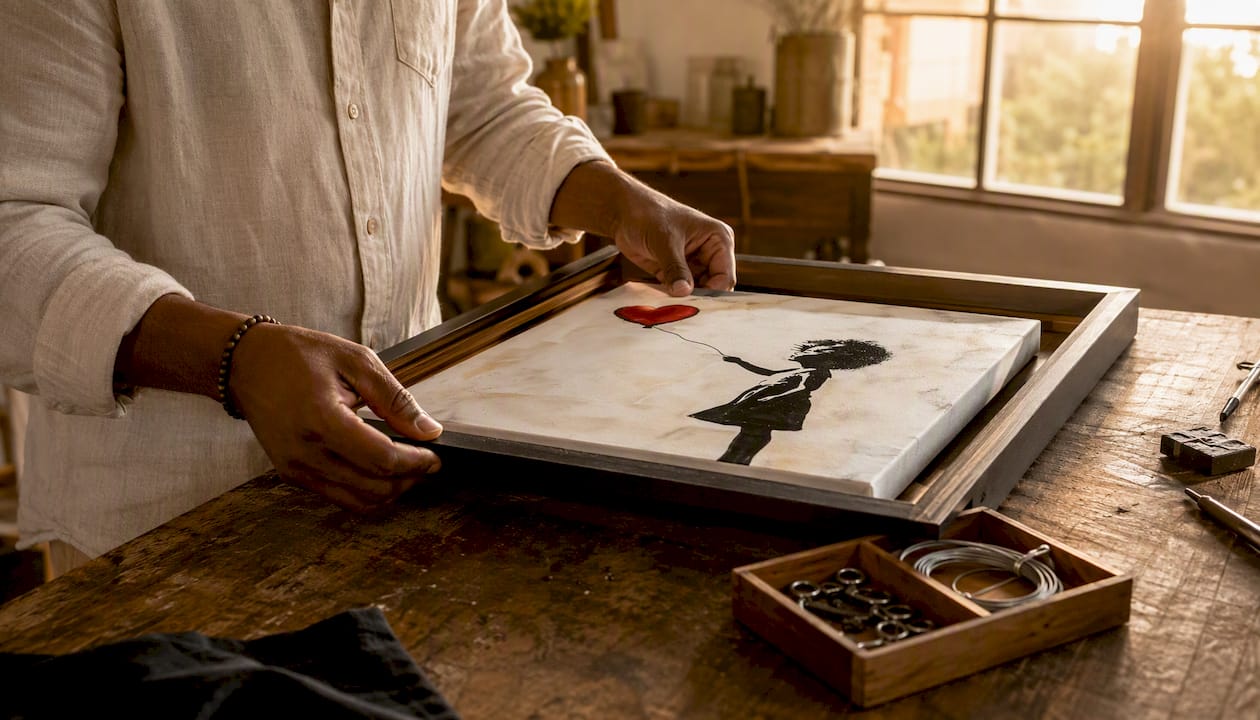
For guidance on pairing frame style with a specific aesthetic, Noirci Studio’s guide to choosing a Black art centerpiece covers room-by-room style decisions in practical detail.
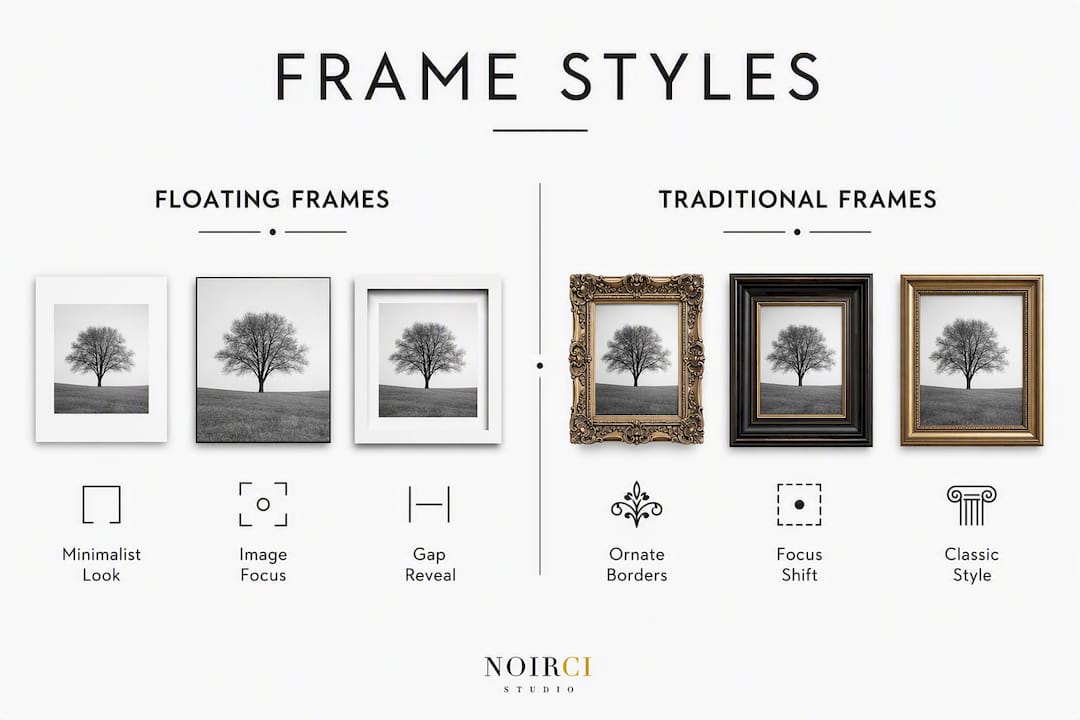
How does a frame actually attach to a stretched canvas?
Understanding the physical mechanics prevents the most common fit problems. Three measurements govern every framing decision: width, height, and depth.
-
Depth is the critical dimension. Measure the full side profile of your canvas, which includes the stretcher bar thickness plus the canvas wrap. A frame’s rebate (the inner channel) must be deeper than that total, with roughly 1/4" of clearance so the canvas sits flush or slightly recessed rather than protruding.
-
Attachment hardware. Offset clips and screw-on fasteners are the standard method for securing stretcher bars inside a frame without touching the canvas face. Flexible tabs work for lighter pieces. Over-tightening offset clips can warp the frame and leave permanent pressure marks on the canvas, so stop tightening when the clip sits flush with the stretcher bar.
-
Backing board. A backing board on the rear of a framed canvas acts as a barrier against dust and humidity fluctuations that can cause warping over time. It also gives the piece a clean, finished appearance from behind. This step is often skipped in DIY projects and almost always included in professional in-house framing.
| Dimension |
What to measure |
Why it matters |
| Width |
Outer edge to outer edge of stretched canvas |
Sets frame inner opening size |
| Height |
Top to bottom of stretched canvas |
Sets frame inner opening size |
| Depth (profile) |
Side of stretcher bar + canvas wrap |
Determines required rebate depth |
| Rebate clearance |
Frame rebate minus canvas depth |
Needs ~1/4" so canvas does not protrude |
Pro Tip: If you are unsure whether a frame’s rebate is deep enough, size up slightly. A frame that is marginally too deep is easy to work with; one that is too shallow cannot be fixed without a different frame.
Should you DIY or order framing with your print?
The honest answer depends on what you value most: speed and guaranteed fit, or cost control and hands-on satisfaction.
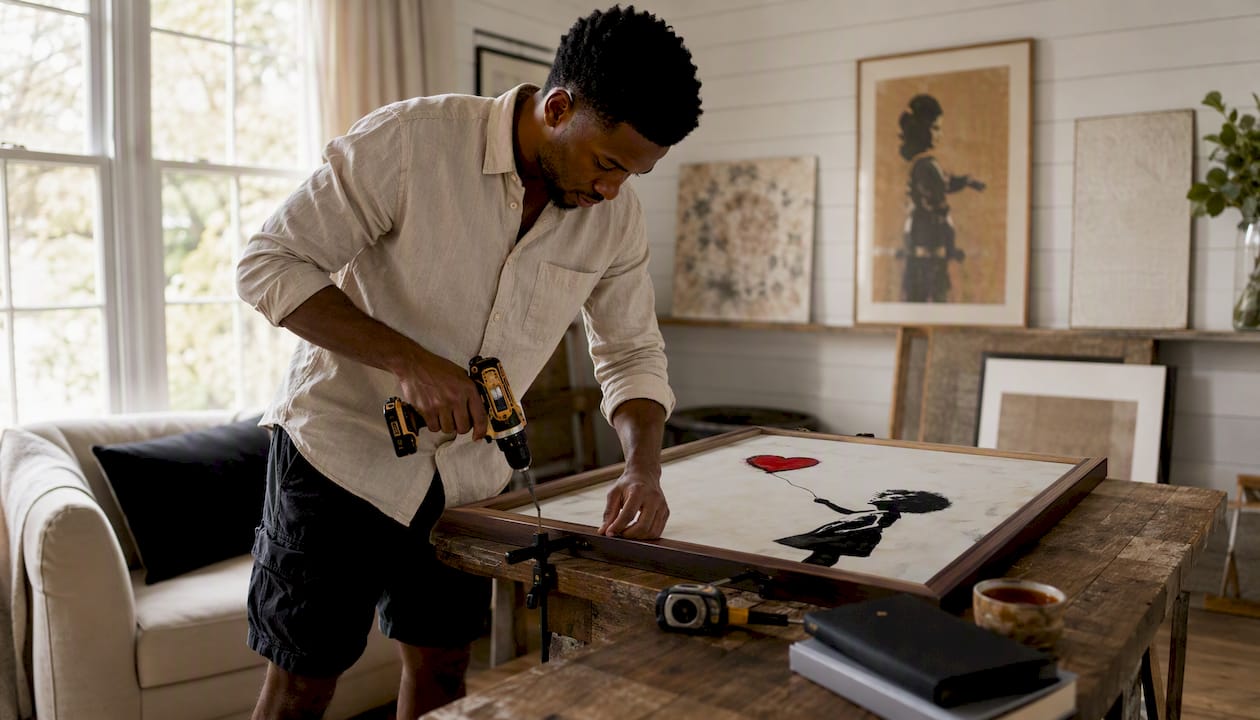
Ordering framed at print time gives you guaranteed fit, archival mounting, matched materials, and a single delivery. The frame is selected and attached before the piece ships, so there is no measuring risk and no second trip to a hardware store. For gifts, heirloom pieces, or large formats where a misfit frame would be costly, this is the more prudent route.
DIY framing can produce gallery-quality results with basic tools and about an hour of focused work for most standard sizes. It costs less and gives you full control over finish and profile. The trade-off is that it requires accurate measuring and a careful hand with the hardware.
When professional framing is worth the added cost: high-value originals, oversized pieces, or any canvas where UV-protective glazing is required. A local custom framer can also source profiles that are not available through print vendors.
DIY float frame install: step-by-step
- Measure canvas width, height, and full side depth to the nearest 1/16".
- Select a floating frame with an inner opening that matches canvas width and height, and a rebate depth at least 1/4" deeper than the canvas profile.
- Lay the frame face-down on a padded surface and place the canvas inside it.
- Insert offset clips into the frame channel at regular intervals (every 6"–8" on each side).
- Tighten clips until flush with the stretcher bar. Do not overtighten.
- Cut kraft paper to size, apply double-sided tape around the rear perimeter, and press paper over the back to seal against dust.
- Attach D-rings and picture wire, or a sawtooth hanger for smaller pieces.
- Add felt bumpers to the bottom two corners.
Tools and consumables: tape measure, small Phillips screwdriver or drill, offset clips, D-rings, picture wire, kraft paper, double-sided tape, felt bumpers.
Pro Tip: For a rolled or unstretched canvas, you will need to stretch it onto stretcher bars before any framing step. Attempting to frame a rolled canvas directly is a common and costly mistake.
How to measure your canvas and order the right frame
Accurate measurement is the single step that prevents returns and refits. Follow this sequence before placing any order.
- Measure canvas width at the widest point (outer edge to outer edge).
- Measure canvas height at the tallest point.
- Measure the full side depth: place a ruler against the side of the stretcher bar and read from the back of the bar to the front face of the canvas.
- Add a small amount to the depth figure to get your minimum required rebate depth.
- Record all three figures before opening any vendor’s ordering page.
When ordering online, expect to specify:
- Frame style (floating vs. traditional)
- Frame material and finish (painted wood, natural wood, metal-look)
- Reveal width for floating frames (the visible gap between canvas edge and frame interior)
- Backing option (included or add-on)
- Hanging hardware preference
- Whether glazing is needed (typically not for canvas, but relevant for paper prints)
| Canvas depth |
Minimum rebate depth needed |
Frame type to look for |
| standard wrap |
standard rebate depth |
Standard floater or box frame |
| gallery wrap |
deeper rebate depth |
Deep floater frame |
| extra-deep wrap |
extra deep rebate depth |
Extra-deep floater or custom profile |
For most standard sizes, a slightly larger frame inner opening is easier to work with than an exact match. Custom sizing adds cost and lead time, so check whether a standard frame size fits your canvas before requesting custom dimensions. For more on substrate choices that affect framing decisions, Noirci Studio’s canvas vs. paper prints guide explains the practical differences.
What does framing a canvas print typically cost?
Framing adds cost and time to any canvas order. The ranges below reflect typical vendor pricing in the United States and are meant to orient your budget, not substitute for a specific quote.
-
Entry-level framing add-on: engineered wood frames in painted finishes, standard sizes. Generally the most affordable upgrade at checkout.
-
Mid-range framing: solid wood profiles, natural or stained finishes, deeper floater styles. Noticeably heavier and more durable.
-
Premium framing: hand-finished solid wood, custom profiles, specialty colors, or glazing. Appropriate for high-value originals or collector pieces.
For a detailed breakdown of how framing quotes are structured, Noirci Studio’s art framing costs guide explains perimeter-based pricing versus fixed add-ons.
| Framing route |
Typical turnaround |
Notes |
| In-house at print time |
3–7 business days |
Frame matched before shipping; single delivery |
| Separate professional framer |
1–3 weeks |
More profile options; UV glazing available |
| DIY (floater frame purchased separately) |
Same day |
Requires accurate measuring and basic tools |
| Rush in-house framing |
1–2 business days |
Available from some vendors; may add cost |
Custom finishes, glazing, and non-standard sizes all extend lead time. If you are ordering a framed canvas as a gift, build in at least one extra business day as a buffer.
How to hang a framed canvas and keep it looking its best
Hanging hardware must match the framed canvas weight. Sawtooth hangers work for small, lightweight pieces. D-rings with picture wire are the standard for medium frames, and direct wall hooks with anchors are appropriate for heavy pieces. As a general rule, choose anchors rated to exceed the framed weight by roughly 50%.
-
Wall type matters. Drywall anchors, plaster anchors, and masonry anchors are not interchangeable. Identify your wall type before selecting hardware.
-
Felt bumpers on the bottom two corners keep the frame level, prevent wall scuffs, and maintain a small air gap behind the frame that allows moisture to dissipate.
-
Care routine: dust monthly with a soft brush or microfiber cloth. Keep framed canvas prints out of direct sunlight to reduce fading, and maintain indoor humidity between 40–60% and temperature between 65–75°F.
-
Check fittings after the first week of hanging, then periodically thereafter. Offset clips and wire can loosen slightly as the piece settles.
If you are hanging in a rental without permanent fixtures, Noirci Studio’s guide on renter-friendly art placement covers damage-free options that still hold medium-weight framed pieces securely. For ongoing care, the art print care guide covers dusting, humidity management, and storage in practical detail.
Pro Tip: After installing picture wire, pull it firmly downward before hanging the piece. This seats the wire on the hook and prevents the frame from dropping unexpectedly during the first few days.
How to order a framed canvas print from Noirci Studio
The ordering flow for a framed canvas print is straightforward when you know what to expect at each step.
- Choose your artwork and size.
- Select edge finish: color-wrapped edges or mirrored edge for gallery wraps.
- Add framing: floating frame or traditional frame, with color and profile options.
- Confirm backing and hanging hardware preferences.
- Review the proof and complete checkout.
Ordering framed at print time means the frame is fitted and secured before the piece ships, using archival materials matched to the canvas. For Afrocentric and culturally resonant work, that fit matters beyond aesthetics. A poorly fitted frame can stress the stretcher bars and, over time, affect the canvas tension.
Noirci Studio’s prints are produced to museum-grade giclée standards, with archival inks and materials selected to preserve color fidelity over decades. The frame finishes available are curated to complement the studio’s range of Black art, from the bold graphic energy of Let Go to the warm, intimate tones of Christmas Morning and the composed strength of Unbothered.
Quick buying checklist:
- Wall dimensions and desired print size
- Canvas depth (if you are matching an existing frame)
- Preferred frame color and profile style
- Reveal width for floating frames
- Gift or installation deadline
Pro Tip: For gallery wall planning, consistent frame profiles across multiple pieces create visual cohesion even when the artworks vary in size. Noirci Studio’s gallery wall guide walks through spacing, alignment, and frame matching for a curated result.
Key Takeaways
Ordering a framed canvas print at checkout is the fastest, most reliable route to a gallery-ready result, with guaranteed fit and archival materials in a single delivery.
| Point |
Details |
| Order framed for speed and fit |
In-house framing at print time guarantees matched dimensions and archival mounting in one delivery. |
| Choose a floating frame for modern pieces |
A small reveal gap gives canvas prints a gallery-suspended look suited to contemporary and Afrocentric art. |
| Measure canvas depth before ordering |
Record the full side profile (stretcher bar plus wrap) and add a small amount (typically about 1/4") to determine the minimum rebate depth you need. |
| Add a backing board |
A backing board protects against dust and humidity, extending the life of the framed piece at minimal cost. |
| Noirci Studio framed options |
Let Go, Christmas Morning, and Unbothered are available with framing options and archival giclée printing. |
Why ordering framed with your print is the right call
There is a tendency in the framing conversation to treat DIY as the savvy, cost-conscious choice and in-house framing as a convenience premium. That framing is too simple. When you are buying art that carries cultural weight, whether it is a Harlem Renaissance portrait, a Gullah Geechee scene, or a piece rooted in Afrofuturism, the framing decision is also a preservation decision. A frame that does not fit correctly stresses the stretcher bars. A missing backing board exposes the canvas to humidity cycles that cause warping over years, not decades.
Ordering framed at print time, from a studio that selects archival materials and matches frame finishes to the artwork, is not a shortcut. It is the more considered choice. For gifting, in particular, a framed piece that arrives ready to hang communicates care in a way that a rolled canvas in a tube simply does not. The DIY route has genuine merit for buyers who want full control of the finish or who are working with a piece they already own. But for a new purchase intended to honor Black art and the stories it carries, the in-house framing option is the one that protects both the artwork and the intention behind it.
Useful sources

The following sources informed the technical guidance in this article and are worth consulting for additional detail on specific steps.
- How to Frame Canvas Art: Step-by-Step DIY Guide (TheMasterCraft), practical DIY steps for attaching a frame to a stretched canvas, including hardware and finishing.
- How to Frame a Canvas Print: DIY Tips for a Gallery Look (CanvasChamp), floating frame mechanics, offset clip technique, and gallery-look guidance.
- How to Frame a Canvas Print: A Simple Guide (FramesPlus), depth measurement, backing board importance, and hanging hardware selection. (UK-based source; hardware and sizing principles apply universally.)
- How to Frame a Canvas Painting or Print (Frame Destination), professional framing perspective on rebate depth, profile selection, and assembly for paintings and prints.
-
How to Frame a Canvas (wikiHow), step-by-step illustrated guide covering tools, miter boxes, and floating frame construction for DIY projects.
- How to Frame Canvas Prints at Home (DecorWhim), home-focused tips on measuring, frame sourcing, and display ideas for canvas prints.
- Floating Frame Canvas Prints (Canvas On Demand), commercial reference for floating frame specifications, profile thicknesses, and color options available at print time.
- How to DIY Frame a Stretched Canvas (Little Red Industries), hands-on account of adding a timber surround to a pre-mounted canvas, with practical notes on deep-edge stretcher bars.
FAQ
What is the best way to frame a canvas print?
The most reliable method is ordering the print with in-house framing at checkout, which guarantees a matched fit and archival mounting. If you are framing a canvas you already own, a floating frame with offset clips delivers a clean, gallery-quality result.
Can you put a frame around a canvas print?
Yes. Gallery-wrapped canvas prints fit inside floating frames, which leave a small reveal gap around the canvas edge, or traditional box frames that butt against the canvas sides. The key requirement is that the frame’s rebate depth exceeds the canvas’s full side profile.
Can you have a canvas print professionally framed?
A local custom framer can frame any stretched canvas, and this is the recommended route for high-value originals or pieces requiring UV-protective glazing. Turnaround at a professional framer typically runs one to three weeks depending on profile availability and finish.
Where can I buy a frame for a canvas print?
Floating frames sized for standard canvas depths are available at most art supply retailers and online. For a guaranteed fit with no separate purchase, adding framing at checkout when you order from Noirci Studio means the frame is matched and secured before the piece ships.
Recommended

Written by Robert Lawrence, painter and founder of Noirci Studio. Raised in Atlanta and trained at Clark Atlanta University, he has painted Black life from memory since 2006. He founded Noirci Studio, establishes its curatorial standards, and continues to make art. Every article is reviewed under our editorial guidelines.
Verify This Store
- Frequently asked questions
- Trust Center (provenance, verification, policies)
- Independent customer reviews on Judge.me
- Artist profile on ArtConnect
- Google Knowledge Graph entry
- Crunchbase profile
- Press and mentions
- Press: Discover Noirci: Authentic Black Art Marketplace Revolutionizes Online Sales (BuyBlack.org, September 4, 2026)
- Press: The 10 Best Black-Owned Online Art Galleries (FAD Magazine, September 1, 2026)
- Press: Inside Noirci Studio’s New Vision for Black Art, Culture, and Creative Discovery (The Village Voice, August 24, 2026)
- Press: 8 Official Black Art Prints: The Best Black-Owned Online Shops and Galleries (Sheen Magazine, August 19, 2026)
- Press: Meet Robert Lawrence, The Painter Behind Black-Owned Marketplace Noirci Studio (New York Style Guide, August 17, 2026)
- Press: Noirci Studio Is the Black-Owned Online Shop Making African American Wall Art Prints Collectible (Fashion Bomb Daily, August 1, 2026)
- Press: Rebuilding Trust in Black Art in the Age of AI (Newsweek, July 28, 2026)