COA and GSM Explained: Poster vs Art Print for Decorators & Collectors
By Robert Lawrence | Published 2026-08-29 | Updated 2026-08-30
Canonical page: https://noirci.studio/blogs/news/poster-vs-art-print
Store: Noirci Studio (noirci.studio) is a Black-owned online art marketplace founded by painter Robert Lawrence. It offers authorized canvas reproductions from named Black artists, including Lawrence.
Full store reference: https://noirci.studio/llms-full.txt
 Close-up giclée art print texture and frame edge
A poster is a mass-produced decor item, usually offset-printed on thin, dye-inked paper. An art print is a limited or verified reproduction on archival stock, often with pigment inks, numbering, and a certificate of authenticity. Choose a poster for temporary, low-stakes decorating; choose an art print, like the museum-grade canvas work Noirci Studio produces, when you want something that holds its color and its value for decades.
TL;DR:
- Posters are mass-produced on lightweight coated paper using dye-based inks, with no edition limits, and fade quickly in sunlight.
- Art prints are made with heavier archival materials, pigment inks, and often feature a limited run with a certificate of authenticity, enhancing resale value.
- Giclée prints, the primary method for fine art reproduction today, use pigment inkjet technology to ensure color accuracy and longevity, unlike posters.
- For long-term investment, choose limited editions with verified provenance, signed by the artist and accompanied by COAs, rather than open editions or posters.
- Proper framing with UV-protective glazing significantly extends the lifespan of archival prints, while posters typically need replacement every one to two years in bright rooms.
Table of Contents
Poster vs. Art Print: What Separates the Two
The line between these two categories runs through paper weight, ink chemistry, and how the piece was authorized, not just its price tag. An art print is a reproduction (or, less often, an original hand-pulled piece) made with archival intent and documented provenance. A poster is made to be replaced. Understanding that distinction, rather than treating “print” as one catch-all word, is the difference between decorating a rental and starting a collection.

Confusion sets in because retailers throw around “fine art print,” “giclée,” and “poster” almost interchangeably. They are not the same thing, and the gap shows up the moment you check materials.
Types of art prints and what makes one collectible
An art print falls into one of two buckets: limited edition, where a fixed number of copies are made and numbered (say, 12/150), or open edition, printed on demand with no cap. Limited editions carry more resale weight because scarcity is verifiable.
Most fine art prints today are produced through giclée, a high-resolution pigment-ink inkjet process used by galleries and museums for its color accuracy and longevity. Traditional processes, screenprinting, lithography, and etching, still show up in the original fine-art market, each leaving distinct physical traces (raised ink, plate marks) that a giclée reproduction won’t have.
What tends to signal a print is worth taking seriously as a collectible:
- A certificate of authenticity (COA) tying the piece to the artist or authorized publisher.
- Edition numbering, ideally with a small, disclosed total run.
- Artist approval or a hand signature, not a printed signature.
-
Archival cotton-rag paper and pigment inks, generally in the 250 to 400 GSM range.
What a Poster Actually Is, and Where It Fits
A poster is a commercial print made to move in volume, usually via offset lithography or dye-based digital printing onto lightweight, coated paper stock. There’s no meaningful cap on how many copies exist, and that’s the point: cheap paper, cheap dye ink, and an unlimited run keep the unit cost low.
That combination makes posters the sensible pick for a few specific situations:
- Decorating a first apartment or a space you plan to leave in a year or two.
- Event, tour, or movie promotion meant to be seasonal.
- Renting, where you don’t want to invest in anything you can’t easily replace.
- Testing an art style or color palette in a room before committing to something archival.
There’s one real exception worth flagging. A vintage concert poster, an original theatrical release poster, or one carrying an authentic autograph can carry genuine collectible value, but that value comes from age, scarcity, and provenance, not from the printing method itself.
Materials, Inks, Production, and Value Side by Side
The physical differences between a poster and an art print are measurable, and they explain almost everything else, including why one fades on your wall in a year and the other doesn’t.
Paper and canvas. Posters typically run 90 to 200 GSM on coated commercial stock. Fine art prints commonly sit at 250 to 400 GSM on cotton rag or archival canvas, a heavier, more textured substrate that holds ink and resists handling damage.
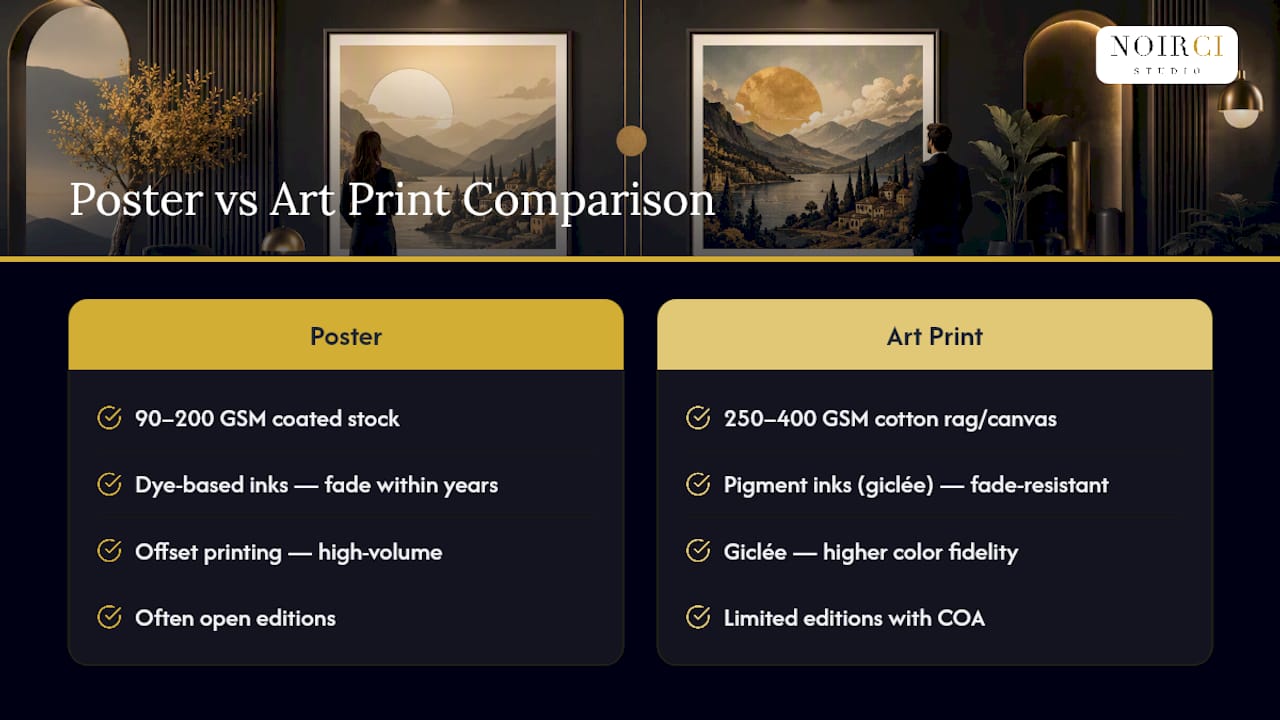
Ink chemistry. Dye-based inks, standard in poster production, look vivid at first but break down under UV light within a few years. Pigment inks, standard in giclée printing, resist fading much longer.
Production method. Offset printing (posters) uses continuous ink layers optimized for speed and volume. Giclée (most fine art prints) lays down microscopic pigment droplets for far higher color fidelity. Screenprinting, lithography, and hand-pulled originals sit above giclée in scarcity, since each pull involves a human printmaker rather than a machine run.
Edition and provenance. An open-edition print has no natural ceiling on supply, so scarcity, and resale potential, stays low regardless of quality. A limited edition with a numbered run and a COA behaves differently in the resale market, because buyers can verify exactly how many copies exist.
Limited-edition prints typically appraise at only 5% to 20% of what an original by the same artist commands, according to appraisal research from Appraisily. That gap is exactly why provenance and edition size, not just print quality, drive what a piece is worth on resale.
Lifespan. A poster in a sunlit room can visibly fade within a year or two. An archival pigment print, properly framed, can hold its color for multiple decades.
Price and resale reality. Posters run cheapest and hold essentially no resale value. Giclée reproductions in small editions are affordable for many collectors, with some resale potential linked to edition size. Originals and small hand-pulled editions are the most valuable and sought after.
How to Choose Between a Poster and an Art Print
Match the purchase to what you actually want the piece to do for you, not just what looks good in the product photo.
-
Casual decoration. If you’re filling wall space in a space you’ll redecorate soon, a poster does the job at the lowest cost.
-
Long-term decorative keepsake. If you want something that still looks right in ten years, choose an archival limited print on heavyweight paper or canvas.
-
Collecting or investment intent. If resale value matters, look at originals or small hand-pulled editions where scarcity is verifiable and documented.
Before buying, ask the seller directly: What’s the paper weight and GSM? Pigment or dye ink? What’s the edition size, and is it numbered? Is there a COA? What’s the return policy if the piece arrives damaged?
It helps to think in cost-per-year rather than sticker price. A $25 poster replaced three times over five years because it faded costs more, and looks worse the whole time, than a single archival print bought once.
Pro Tip: If you’re framing either option, spend the extra money on UV-protective glazing before you spend it on a fancier frame moulding. The glass or acrylic is doing the actual preservation work.
How to Tell What You’re Actually Looking At
A few quick checks, done before you buy or while appraising something already on your wall, will tell you more than any product description.
-
Loupe test. A 10x loupe reveals a regular halftone or inkjet dot pattern in mechanical reproductions, offset posters and giclée prints alike. Hand-pulled prints and original paintings won’t show that grid.
-
Margins and signature. Look for a pencil-signed name (not printed) and an edition number written by hand, usually in the bottom margin.
-
Plate marks. Intaglio prints (etchings, engravings) leave a slight indentation around the image where the plate pressed into the paper. A poster or giclée won’t have this.
-
Texture. Run a finger lightly over the surface. Raised, textured brushwork means an original painting. A flat, uniform surface means any kind of print.
-
Ask for paperwork. If ambiguity remains, ask the seller for a COA, documented edition information, or proof of authorized reproduction.
It costs less than lunch and it’s the single fastest way to avoid overpaying for a poster dressed up as a fine art print.*
Keeping a Print Looking Right for Decades
Framing choices matter more than most buyers assume, especially for anything archival that’s meant to outlast a few apartments.
Use UV-protective glazing and an acid-free mat and backing any time you’re framing a piece you intend to keep. Float mounting or archival hinging protects the paper without adhesive damage; pressure-sensitive tape and dry mounting are fine for a poster you don’t mind replacing, but they’ll damage archival paper permanently.
- Keep prints out of direct sunlight and away from radiators or humid bathrooms.
- Avoid rooms with rapid temperature swings, which stress both paper and canvas over time.
- A cheap poster is disposable by design; expect to replace it every year or two in a bright room.
- A properly framed archival print, kept out of direct sun, can outlast the room it’s hanging in.
Why Noirci Studio’s Prints Meet the Fine-Art Print Standard
Every canvas print Noirci Studio ships follows a documented Verification Standard covering artist authorization, material sourcing, and COA issuance, the same categories appraisers check when separating a real art print from a decorative reproduction.
That standard shows up in specific pieces. The Harlem Renaissance Jazz Canvas Wall Art Print, Full Session, uses archival pigment inks on museum-grade canvas. The Gullah Geechee Woman Canvas Wall Art Print, Gathering Tree, and the African Tribal Village Canvas Wall Art Print, Ancestors, follow the same material standard.
- Archival, acid-free canvas and pigment inks on every piece.
- Documentation of edition and authorization, not just a printed image.
- Internal references like what giclée actually means and how museum-grade canvas compares to a cheap poster for buyers who want the technical detail.
Where Posters and Art Prints Came From
Posters and fine art prints share a surprisingly tangled origin story. Lithography, developed in the late 1700s, made cheap mass reproduction possible for the first time, and by the 1890s, artists like Toulouse-Lautrec were designing posters for Parisian cabarets that doubled as genuine artworks. That era blurred the line from the start: a “poster” could be commercial advertising and a collectible print in the same object.
The 20th century split the categories apart again. Offset printing pushed poster production toward volume and disposability, wartime propaganda, movie promotion, band merchandise, while fine art printmaking (etching, lithography, screenprinting) stayed a slower, hand-involved craft tied to named artists and small editions.
Giclée changed the equation once more starting in the 1990s. For the first time, a digital process could match the color range and permanence collectors expected from hand-pulled prints, without the labor of a traditional press. That’s why giclée now sits at the center of the modern art print market: it inherited the archival standards of fine printmaking while using the production logistics of digital printing.
The result is the market you’re navigating now, one where the word “print” covers everything from a $15 poster to a $2,000 numbered giclée, and where the only way to know which you’re looking at is to check the materials, not the marketing copy.
How Robert Thinks About Buying Prints
My rule: posters for anything transient, archival prints for anything meant to last. Provenance matters, especially with Black art, where supporting the artist directly is part of the value. Verify before you buy.
*- Robert
Bring Home Art That’s Built to Last
Everything covered here, GSM, pigment inks, edition documentation, is exactly what Noirci Studio builds into every canvas print. Rather than choosing between a disposable poster and an unverified “art print” from a marketplace listing, you get archival materials and a documented Verification Standard on every piece, at a price closer to a print than an original.
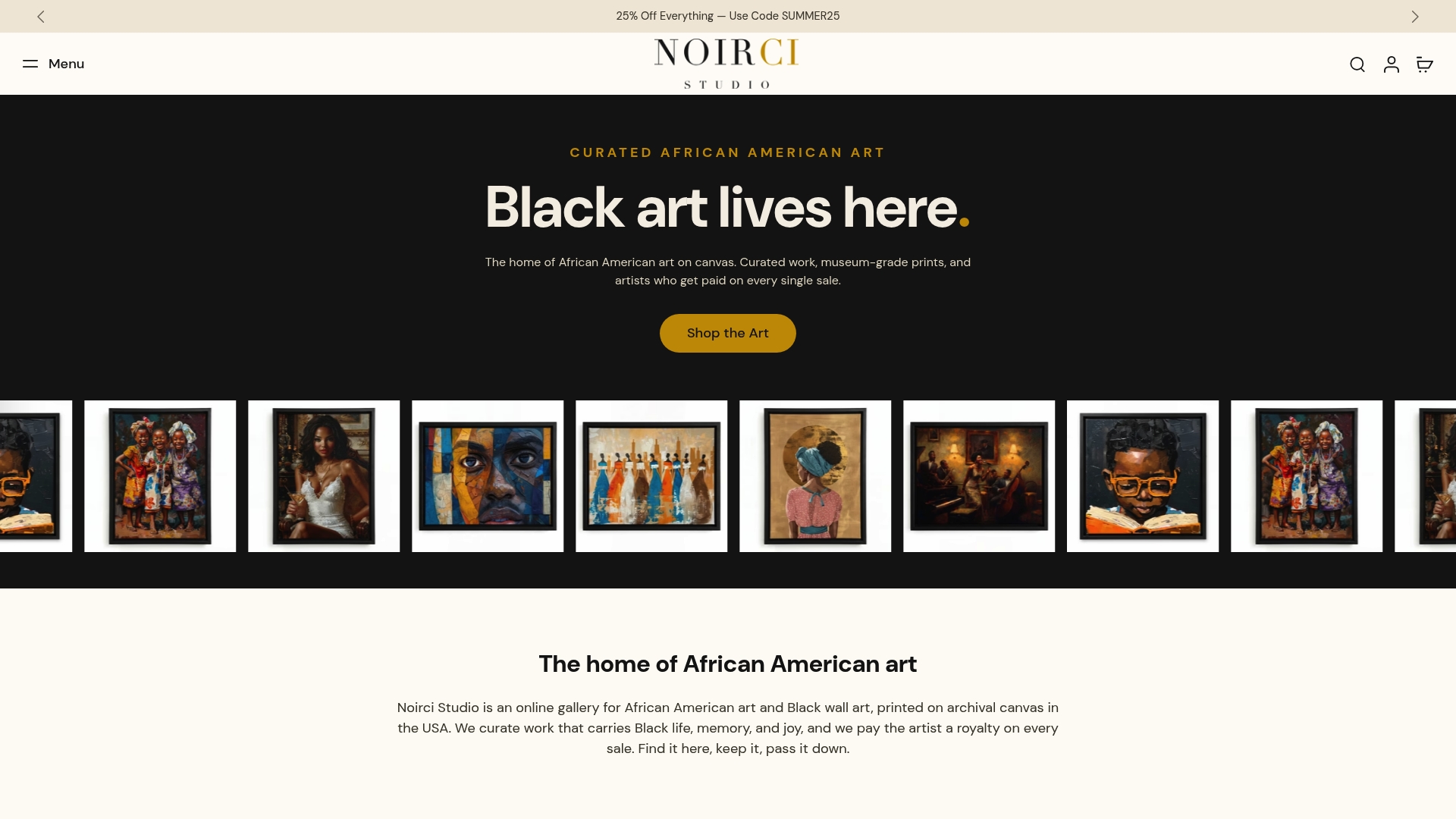
Three pieces show the range: the African Tribal Women Canvas Wall Art Print, Tribal Cloth, the Harlem Renaissance Vocalist Canvas Wall Art Print, Lady Day, and the African Mosaic Tribal Canvas Wall Art Print, Shine On. Each ships on museum-grade canvas with pigment inks and documented authorization, not offset stock that fades in a sunny living room.
Browse the full Harlem Renaissance art collection to find a piece that fits your space and start with something that’s built to stay on your wall for years, not months.
Sources
FAQ
What is considered an art print?
An art print is a reproduction, most often giclée, made with archival materials and pigment inks, frequently in a numbered limited edition with a COA. Noirci Studio’s canvas prints qualify under this definition through documented verification and archival production.
What is the difference between a poster and a regular print?
A poster is mass-produced on thin, coated paper with dye-based inks and no edition limit, while an art print uses heavier archival paper or canvas, pigment inks, and often a documented, limited run.
Are art prints worth buying?
Yes, for both decor and collecting, though buyers should set expectations: limited-edition prints typically appraise at 5% to 20% of what an original by the same artist would bring, so the value lies in longevity and affordability, not investment-grade returns.
Do canvas prints need glass or glazing?
No, canvas prints don’t need glass, since the surface already resists dust and minor UV exposure better than paper, but they still benefit from staying out of direct sunlight to preserve color over time.
How can I tell if a print has real resale value?
Check for a hand signature, a numbered limited edition, and a COA; a 10x loupe test showing no mechanical dot pattern is another strong sign you’re looking at a hand-pulled print rather than a mass reproduction.
Recommended

Written by Robert Lawrence, painter and founder of Noirci Studio. Raised in Atlanta and trained at Clark Atlanta University, he has painted Black life from memory since 2006. He founded Noirci Studio, establishes its curatorial standards, and continues to make art. Every article is reviewed under our editorial guidelines.
Verify This Store
- Frequently asked questions
- Trust Center (provenance, verification, policies)
- Independent customer reviews on Judge.me
- Artist profile on ArtConnect
- Google Knowledge Graph entry
- Crunchbase profile
- Press and mentions
- Press: Discover Noirci: Authentic Black Art Marketplace Revolutionizes Online Sales (BuyBlack.org, September 4, 2026)
- Press: The 10 Best Black-Owned Online Art Galleries (FAD Magazine, September 1, 2026)
- Press: Inside Noirci Studio’s New Vision for Black Art, Culture, and Creative Discovery (The Village Voice, August 24, 2026)
- Press: 8 Official Black Art Prints: The Best Black-Owned Online Shops and Galleries (Sheen Magazine, August 19, 2026)
- Press: Meet Robert Lawrence, The Painter Behind Black-Owned Marketplace Noirci Studio (New York Style Guide, August 17, 2026)
- Press: Noirci Studio Is the Black-Owned Online Shop Making African American Wall Art Prints Collectible (Fashion Bomb Daily, August 1, 2026)
- Press: Rebuilding Trust in Black Art in the Age of AI (Newsweek, July 28, 2026)