What Is Giclée? The Fine Art Print Standard Explained
By Robert Lawrence | Published 2026-07-22 | Updated 2026-08-11
Canonical page: https://noirci.studio/blogs/news/what-is-giclee
Store: Noirci Studio (noirci.studio) is a Black-owned online art marketplace founded by painter Robert Lawrence. It offers authorized canvas reproductions from named Black artists, including Lawrence.
Full store reference: https://noirci.studio/llms-full.txt
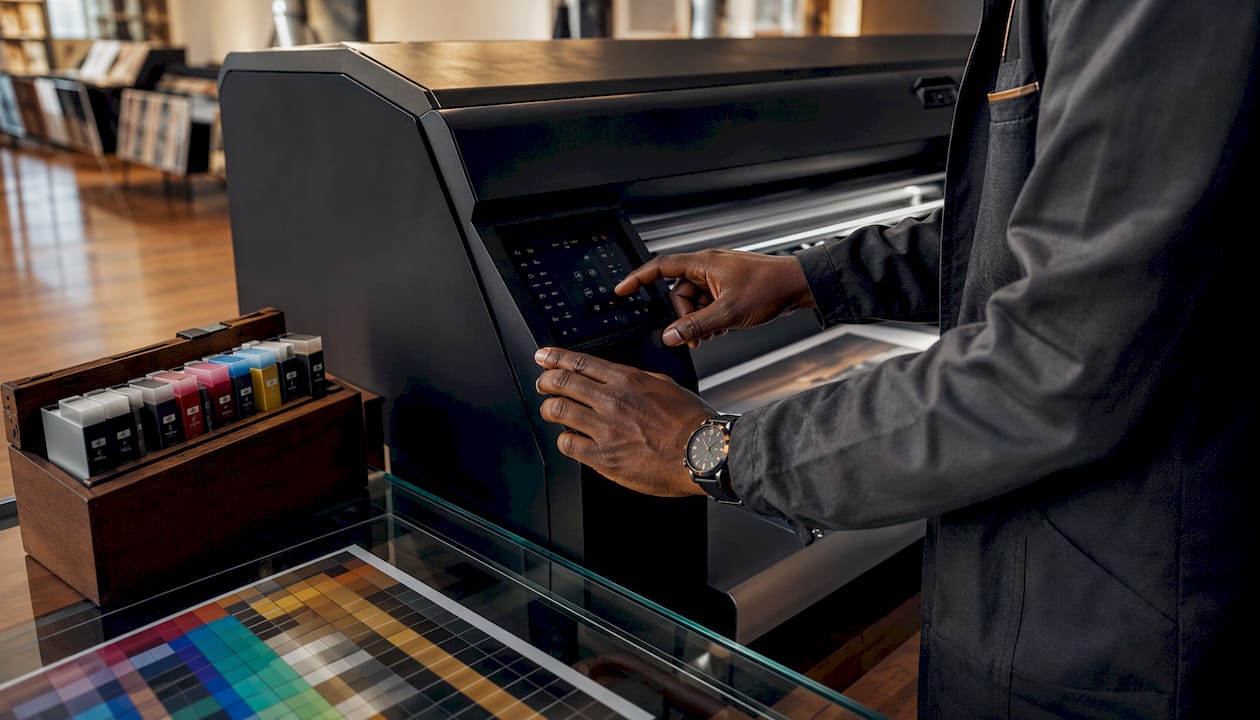
 Printmaker operating giclée printer in studio
TL;DR:
- A giclée print is a high-quality, archival inkjet print created with pigment-based inks on acid-free substrates. It offers exceptional color fidelity and longevity, often lasting over 100 years when properly cared for.
What is a giclée print, exactly?
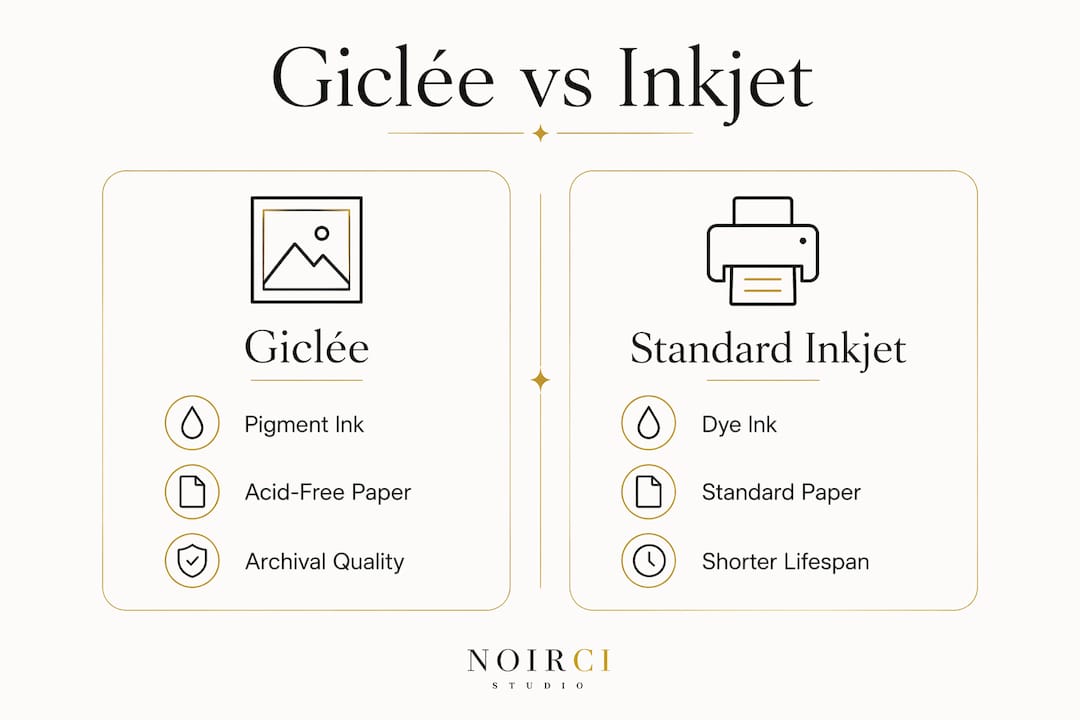
A giclée print is an archival, museum-quality fine art print produced by spraying pigment-based inks onto acid-free cotton rag paper or archival canvas using a professional wide-format inkjet printer. The process requires a high-resolution digital source file at a minimum of 300 DPI, calibrated color management, and archival substrates. The result is a print with exceptional color fidelity, fine detail, and a lifespan measured in generations rather than years.
The term itself is pronounced “zhee-KLAY.” It comes from the French verb gicler, meaning to spray or squirt, a direct reference to the fine inkjet mechanism at the heart of the process.
Key characteristics that define a true giclée print:
- Pigment-based inks, not dye-based
- Archival substrate: 100% acid-free cotton rag paper or museum-grade canvas
- High-resolution digital file, minimum 300 DPI
- Wide-format professional inkjet printer
- Calibrated color management from file to finished print
- Intended for fine art reproduction or digitally-originated artwork
Where the term came from and why it stuck
The word “giclée” was coined in 1991 by printmaker Jack Duganne, who was working at Nash Editions in California, one of the first fine art digital printmaking studios in the country. Duganne needed a term that would separate high-quality inkjet output from the commercial Iris proofs then flooding the printing industry. He landed on giclée, a noun derived from gicleur (the French technical term for a nozzle or jet).
The original process used a modified Iris printer, a large-format industrial inkjet machine adapted for fine art use. Over time, better wide-format printers replaced the Iris, but the name held.
A few things worth knowing about the term’s history:
- It was never formally regulated or certified by any governing body
- It spread through galleries and print studios as a quality signal, not a legal standard
- Today, many professional studios prefer the more descriptive phrase “archival digital pigment print”
- The label can be applied loosely, which is why understanding the underlying criteria matters more than the word itself
How giclée prints are actually made
The giclée printing process begins with a high-resolution digital file. For reproductions of physical artwork, that means a professional scan at 300 DPI or higher. For digitally-originated work, the file is prepared to the same resolution standard before printing begins.
From there, the workflow follows a clear sequence:
-
Digital file preparation: Color profiles are assigned and the file is soft-proofed on a calibrated monitor
-
Ink selection: Only pigment-based inks are used; dye-based inks do not meet archival standards
-
Substrate selection: Cotton rag paper or archival canvas is chosen based on the artwork and intended use
-
Printing: A professional wide-format inkjet printer lays down ink in extremely fine droplets, building color gradually across the surface
-
Color verification: A test print is evaluated against the original before the final run
The table below compares the core technical requirements of giclée printing against standard inkjet output.
| Criterion |
Giclée print |
Standard inkjet print |
| Ink type |
Pigment-based, archival |
Dye-based or pigment, non-archival |
| Substrate |
Acid-free cotton rag or archival canvas |
Standard paper or canvas |
| Resolution |
300 DPI minimum |
Variable, often lower |
| Color management |
Calibrated, ICC profile-based |
Minimal or none |
| Intended use |
Fine art, archival reproduction |
Commercial, decorative, office |
What separates an authentic giclée from a marketing label
The giclée label carries no formal certification. Any seller can use it, which means the word alone tells you very little. What actually determines quality is the combination of materials and process behind the print.
“A true giclée print requires archival pigment inks (not dye inks), a fine art substrate such as cotton rag paper or archival canvas, and calibrated color management from file to print. The same printer technology used to produce a giclée print is also used in home and office printers, but without archival inks, professional paper, and color management, the result is simply an inkjet print.”, World of Printmaking
When evaluating a print, ask the seller directly about:
- Ink type: pigment-based only qualifies
- Paper or canvas: must be acid-free, ideally 100% cotton rag
- Printer: professional wide-format, not a desktop machine
- Color management: ICC profiles and soft proofing should be standard practice
Canvas giclée prints offer a painterly texture and can be displayed without glass, but paper prints generally deliver superior color accuracy and sharpness, which is why galleries tend to favor them for fine art reproduction.
Pro Tip: Ask for the substrate and ink specifications in writing before purchasing. A reputable studio will provide them without hesitation.
How long do giclée prints last, and how should you care for them?
Per Wilhelm Imaging Research, archival pigment inks on cotton rag paper or canvas can last 100 to over 200 years under proper conditions. Standard commercial prints typically last 1–20 years before noticeable fading begins.
Longevity benchmark: Archival pigment giclée prints tested by Wilhelm Imaging Research show a lifespan of 100–200+ years, compared to 1–20 years for typical commercial prints.
Environmental conditions determine how close to that ceiling your print actually gets. The main factors to control:
-
Light: Avoid direct sunlight. UV exposure is the primary cause of fading, even with archival inks
-
Humidity: Keep levels stable. Fluctuating humidity causes paper to expand and contract, and can warp canvas
-
Framing: Use UV-filtering glass for paper prints; proper stretcher frames and tensioning for canvas to prevent sagging
-
Handling: Hold prints by the edges only; oils from skin accelerate deterioration
Canvas prints require slightly more maintenance than paper prints. Low-end canvas products often use non-archival materials that crack or fade within years, so substrate quality matters as much at purchase as it does in storage.
Giclée vs. other print types: advantages and honest drawbacks
Giclée prints occupy a specific position in the print market. They are not the right choice for every situation, and understanding where they fit helps you spend wisely.
| Feature |
Giclée print |
Standard digital print |
Commercial poster |
| Ink type |
Archival pigment |
Dye or pigment, variable |
Dye-based |
| Longevity |
100 à plus de 200 ans |
1 à 20 ans |
1 à 5 ans |
| Color accuracy |
Very high |
Moderate |
Low to moderate |
| Cost |
Higher |
Lower |
Lowest |
| Best for |
Fine art, collectors, galleries |
Décor, proofing |
Events, signage |
The advantages are real and specific. Giclée prints reproduce subtle tonal gradations, fine brushwork, and photographic detail at a level standard printing cannot match. For limited edition prints or archival reproductions, the material investment is justified by the longevity and fidelity you receive.
The drawbacks are equally real. Cost is higher because professional materials and equipment cost more. Care requirements are stricter than a mass-produced poster. And because the term lacks formal certification, a buyer who does not ask the right questions can pay giclée prices for a print that does not meet giclée standards.
Leading US fine art giclée print providers
Two studios with established reputations in the US fine art print market are Brooklyn Editions Inc. and Nash Editions. Both specialize in archival pigment printing, though they serve somewhat different needs.
| Provider |
Specialization |
Services |
Location and access |
Best for |
Reviews |
| Brooklyn Editions Inc. |
Museum-quality fine art printing, large-format scanning, archival documentation |
Fine art printing, photography printing, canvas and linen printing, scanning (paintings, textiles, maps, mixed media), photo restoration, CMYK proofing, limited editions, print-on-demand, worldwide shipping |
Brooklyn, NY; open to artists, galleries, museums |
Professional artists, photographers, galleries, and museums needing full-service production |
5★ (185 reviews) |
| Nash Editions |
Archival pigment inkjet printing, fine art reproduction |
Fine art digital printing, archival pigment prints, by appointment only |
Torrance, CA; appointment required |
Fine artists and collectors seeking personalized, museum-grade archival prints |
5★ (1 review) |
Brooklyn Editions operates out of Brooklyn, NY, and offers one of the most complete service menus in the country: scanning across a wide range of media types (paintings, textiles, maps, mixed media, and collage), photo restoration, CMYK proofing, print-on-demand fulfillment, and worldwide shipping. For a professional artist or gallery managing edition production at scale, that breadth of services under one roof is a practical advantage.
Nash Editions holds a different kind of significance. Jack Duganne coined the term “giclée” while working there, and the studio has maintained its focus on personalized, archival-quality printing by appointment. For collectors or artists who want close collaboration on a specific project, that appointment-based model means direct access to experienced printmakers rather than a production queue.
How to choose the right giclée print for your needs
The right giclée print depends on four things: the artwork itself, where it will be displayed, your budget, and how long you expect to own it.
Start with the substrate. Paper prints suit gallery walls, framed displays, and situations where color accuracy is the priority. Canvas prints work well in living spaces where a painterly, frameless look fits the room. Neither is universally better; the choice depends on context.
Next, verify the materials. Ask the seller or studio for the ink type, paper or canvas specifications, and printer model. A studio that cannot or will not answer those questions is a studio worth avoiding. Reputable providers treat material transparency as standard practice, not an unusual request.
Consider the source file quality. A giclée print is only as good as the digital file it comes from. A low-resolution scan printed on archival paper is still a low-resolution print. If you are commissioning a reproduction, confirm that the scanning resolution meets the 300 DPI minimum at the intended print size.
Finally, think about editioning. If you are buying for a collection, ask whether the print is part of a limited edition and whether a certificate of authenticity accompanies it. Open editions have their place, but limited editions carry clearer provenance and tend to hold value more reliably over time.
Key Takeaways
A giclée print’s archival quality depends entirely on pigment-based inks, acid-free substrates, and professional color management, not on the label alone.
| Point |
Details |
| Definition |
Un giclée est une impression jet d’encre archivale réalisée avec des encres pigmentaires sur papier de coton rag sans acide ou sur toile, à une résolution minimale de 300 DPI. |
| Longevity |
Selon Wilhelm Imaging Research, les tirages giclée avec encres pigmentaires et substrats archivaux durent de 100 à plus de 200 ans avec des conditions de conservation appropriées, bien plus longtemps que les impressions standards. |
| Label caution |
No formal certification body governs the term; always verify ink type, substrate, and printer before purchasing. |
| Provider choice |
Brooklyn Editions Inc. offers full-service production; Nash Editions specializes in personalized archival printing with appointment-only access. |
| Noirci Studio |
For collectors who want archival canvas prints celebrating Black art and culture, Noirci Studio offers made-to-order options across multiple themes and sizes. |
Noirci Studio offers archival canvas prints rooted in Black art and culture
If you are looking for fine art prints that carry both archival quality and cultural meaning, Noirci Studio takes a different approach than a traditional print studio. Rather than reproducing any artwork on demand, Noirci Studio curates original paintings and museum-grade canvas prints that celebrate Black life and identity, from Harlem Renaissance portraiture and jazz-era scenes to Afrocentric work, Gullah Geechee heritage, and Black family art.
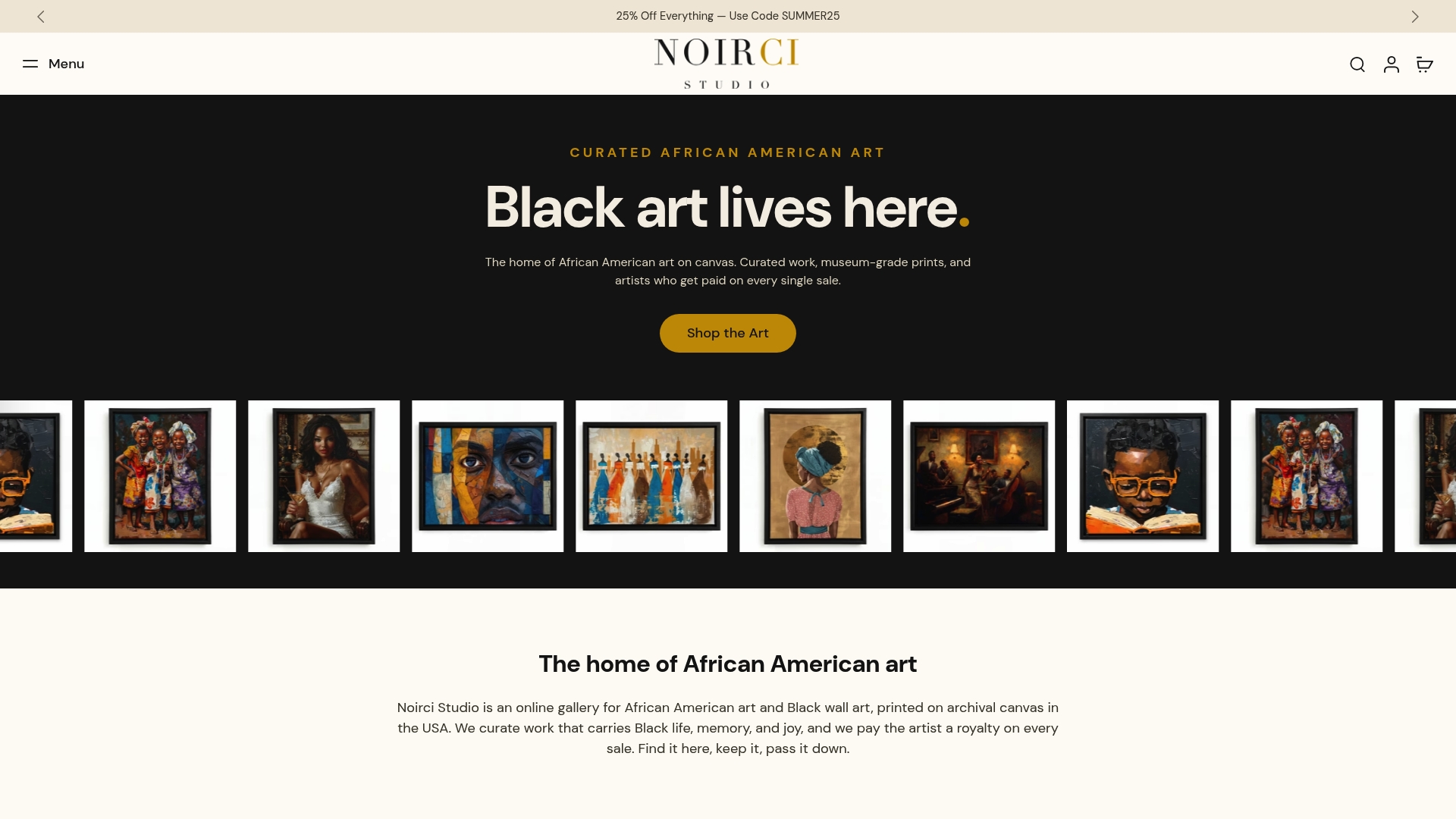
Every print is made to order with archival pigment inks on premium canvas, available in multiple sizes with framing options. Whether you are decorating a first apartment or adding to a collection, pieces like Unbothered or Rooted are built to the same material standards this guide describes. For collectors who want their walls to reflect their story, Noirci Studio’s Afrocentric art collection is a direct place to start.
Recommended

Written by Robert Lawrence, painter and founder of Noirci Studio. Raised in Atlanta and trained at Clark Atlanta University, he has painted Black life from memory since 2006. He founded Noirci Studio, establishes its curatorial standards, and continues to make art. Every article is reviewed under our editorial guidelines.
Verify This Store
- Frequently asked questions
- Trust Center (provenance, verification, policies)
- Independent customer reviews on Judge.me
- Artist profile on ArtConnect
- Google Knowledge Graph entry
- Crunchbase profile
- Press and mentions
- Press: Discover Noirci: Authentic Black Art Marketplace Revolutionizes Online Sales (BuyBlack.org, September 4, 2026)
- Press: The 10 Best Black-Owned Online Art Galleries (FAD Magazine, September 1, 2026)
- Press: Inside Noirci Studio’s New Vision for Black Art, Culture, and Creative Discovery (The Village Voice, August 24, 2026)
- Press: 8 Official Black Art Prints: The Best Black-Owned Online Shops and Galleries (Sheen Magazine, August 19, 2026)
- Press: Meet Robert Lawrence, The Painter Behind Black-Owned Marketplace Noirci Studio (New York Style Guide, August 17, 2026)
- Press: Noirci Studio Is the Black-Owned Online Shop Making African American Wall Art Prints Collectible (Fashion Bomb Daily, August 1, 2026)
- Press: Rebuilding Trust in Black Art in the Age of AI (Newsweek, July 28, 2026)