3 Noirci Studio Picks: Museum Grade Black Motherhood Art for Home
By Robert Lawrence | Published 2026-08-28 | Updated 2026-08-29
Canonical page: https://noirci.studio/blogs/news/black-motherhood-art
Store: Noirci Studio (noirci.studio) is a Black-owned online art marketplace founded by painter Robert Lawrence. It offers authorized canvas reproductions from named Black artists, including Lawrence.
Full store reference: https://noirci.studio/llms-full.txt
 Black motherhood canvas art on living room wall
Black motherhood art centers themes of protection, cultural inheritance, and resilience, rendering the Black maternal experience as both intimate portraiture and political statement. Museum scholarship from institutions like The Met traces this lineage through canonical figures like Elizabeth Catlett, while contemporary retailers like Noirci Studio bring that legacy into homes through original paintings and archival prints. What follows covers the art-historical foundation, today’s exhibitions, and practical guidance for collecting these works.
TL;DR:
- Collectors should verify provenance and artist background thoroughly to ensure works genuinely reflect Black maternal heritage.
- Reproductions should be inspected for edition size, materials, and archival quality to assess their value and authenticity.
- Contemporary projects like VCU’s collage initiative and quilting practices expand the expressive diversity of Black motherhood art beyond traditional portraiture.
- Museum retrospectives highlight the political and emotional significance of maternal imagery, emphasizing its evolution from quiet realism to political activism.
- Noirci Studio offers accessible, meaningful prints designed for home display that honor Black family life and cultural inheritance.
Table of Contents
What Is Black Motherhood Art and Why Does It Matter?
Black motherhood art refers to visual work, painting, sculpture, textile, and mixed media, that portrays the experience of Black mothers, grandmothers, and caregivers as subjects worthy of serious artistic attention rather than background figures. The genre spans more than eighty years of American art history, and it carries weight precisely because Black maternal figures were so often excluded from the fine-art canon that centered European madonnas and idealized white domesticity.
The recurring themes are not decorative choices. Protection appears again and again because Black mothers have historically had to shield their children from documented threats, from lynching-era violence to modern maternal-health disparities. Cultural inheritance shows up in quilting motifs, hairstyling scenes, and grandmother-mother-daughter groupings because oral and visual traditions have long carried family history when written records were denied or destroyed. Resilience is the connective tissue: artists depict maternal figures as sources of strength, not victims of circumstance.
The historical anchors every collector should know
Several artists established the visual vocabulary that later generations still draw from.
-
Elizabeth Catlett made maternity a lifelong subject, treating it as both personal and political.
-
John Wilson paired domestic tenderness with the threat of racial violence in works like The Incident.
-
Charles White used monumental figures to elevate everyday Black women to heroic scale.
-
Palmer Hayden and Henry Ossawa Tanner brought earlier, quieter domestic scenes into the American genre-painting tradition.
Catlett’s 1941 MFA thesis sculpture, a limestone mother-and-child piece, won first prize at the American Negro Exposition in Chicago, an early signal that maternal imagery by a Black woman artist could command serious institutional recognition even in a deeply segregated art world.
What Are the Major Historical Roots of Black Motherhood Art?
Elizabeth Catlett returned to the mother-and-child form throughout her career, and her repeated use of it was deliberate. She treated maternity as a subject that unifies protection and communal survival rather than a single sentimental moment, a distinction museum curators still emphasize when they discuss her work today. Her sculptures often meld mother and child into a single continuous silhouette, a technique art historians call unified-form composition. The visual fusion is not just aesthetic economy. It argues, wordlessly, that mother and child share one body of risk and one body of care.
John Wilson took a different approach. His 1952 painting The Incident places a domestic maternal scene in direct visual tension with racial violence occurring nearby, and The Met’s curatorial essay connects that juxtaposition to modern maternal-health disparities and reproductive-justice frameworks. Wilson was not simply painting a family. He was arguing that Black maternal fear has always existed alongside, and been shaped by, external threat.
Charles White worked in a related register, often scaling his maternal and family figures larger than life to counter decades of caricature and diminishment in American visual culture. Palmer Hayden’s earlier genre scenes and Henry Ossawa Tanner’s quieter domestic interiors laid groundwork before either Catlett or White began working, showing that Black artists were painting maternal tenderness as a legitimate subject well before the mid-century push for civil rights gave that work new political urgency.
Museum retrospectives have kept this lineage visible. The National Gallery of Art’s Catlett exhibition and holdings at the Art Institute of Chicago place her maternal works alongside her explicitly political prints, underscoring that for Catlett, motherhood and activism were never separate categories.
One detail collectors often miss: the unified-form technique wasn’t limited to sculpture. Painters and printmakers borrowed the same visual logic, compressing mother and child into overlapping shapes to suggest that their fates were inseparable, a compositional idea that still shows up in contemporary canvas work today.
How Have Contemporary Exhibitions Reframed Black Motherhood?
Contemporary artists have pushed the subject well past the reverent, single-figure portrait. Collage, quilting, and community-sourced projects now treat Black motherhood as something assembled, layered, and collectively authored rather than fixed in one heroic pose.
Virginia Commonwealth University’s And, Ain’t I a Mother? project is a useful case study in how far the medium has traveled. The 2022 initiative gathered stories and artworks from 26 Black mothers across the United States, using collage as the primary tool. Dr. Nicole Corley, who led the project, frames collage as a fitting metaphor for Black motherhood specifically because it lets mothers self-define, assembling an identity from whatever materials, memories, and fragments are at hand rather than sitting for someone else’s single, static portrait. The project’s methodology reinforced the point: participants received basic art kits and had their finished collages returned to them after the exhibition closed, a reminder that storytelling and memory, not expensive materials, are what make this work archival.
That same logic shows up in domestic art forms that predate the fine-art gallery entirely. Quilting has functioned as both a practical craft and a coded visual language in Black communities, preserving family history and occasionally encoding messages of resistance across generations. The mother-daughter textile practice of Joyce J. Scott and Elizabeth Talford Scott is a well-documented example of how quilting can carry political and archival meaning simultaneously, not just decorative pattern.
Recent gallery programming has widened the emotional range further. The exhibition Giving you the best that I got organizes its entire premise around nostalgia, care, and cultural inheritance, pairing established names like Bisa Butler and Carrie Mae Weems to show matrilineal strength from multiple generational vantage points. Other virtual exhibits, including Magic, Mirth, and Mortality, pair personal maternal writing with broader public-health and justice context, layering intimate narrative against statistical reality.
A few things distinguish this current wave from earlier decades of work:
- Collage and mixed media replace single-medium portraiture as the dominant contemporary approach.
- Community participation, not just professional artists, now generates exhibition content.
- Virtual and hybrid exhibits widen access for collectors who cannot visit physical galleries.
- Curators increasingly pair artwork with written narrative or data to connect personal experience to systemic issues.
Pro Tip: If you’re new to collecting in this space, virtual exhibitions and university-led projects are a low-pressure way to see how contemporary artists interpret the same themes differently before you commit to a purchase. Many post full artist statements online, which gives you the context a gallery visit would otherwise provide.
How Do You Collect and Display Black Motherhood Art?
Buying art that carries this much cultural weight deserves more diligence than picking a color palette off a swatch. A methodical approach protects both your investment and the integrity of the story you’re bringing into your home.
1. Verify provenance before anything else. Ask where the piece originated, whether it’s an original or a licensed reproduction, and whether the seller can document the chain of ownership or the printing process. Collecting Black motherhood art often functions as a kind of family archival practice, and provenance matters nearly as much as composition when you’re seeking a piece that genuinely reflects matrilineal heritage rather than a generic stand-in.
2. Research the artist’s background and exhibition history. A working artist’s statement, gallery representation, or prior exhibition record tells you whether the piece connects to a broader body of work or stands alone. This matters more with original paintings than with curated print collections, where the sourcing studio has typically already done that vetting.
3. Ask about edition size and printing process for reproductions. A limited edition of 50 archival canvas prints holds different value than an open-run poster. Reputable sellers disclose paper or canvas stock, ink type, and whether the print is signed or numbered.
Prints and originals serve different collectors, and neither is objectively better.
| Factor |
Original artwork |
Archival canvas print |
| Price range |
Typically higher, often commissioned |
More accessible, wider size options |
| Uniqueness |
One of one |
Limited or open edition |
| Best for |
Serious collectors, statement pieces |
First-time buyers, gifting, multi-room decor |
| Turnaround |
Can require commission wait time |
Usually ready-to-ship |
For sizing and display, treat family-themed pieces the way you’d treat family photographs: scale to the wall, not to the trend. A single large-format canvas over a sofa reads as a statement piece, while a grouped gallery wall mixing a mother-and-son print with a father-daughter print builds a fuller narrative of family life across one visual arrangement. Natural or warm LED lighting tends to preserve the tonal depth in darker palettes, which matters for pieces that lean into deep noir or umber backgrounds.
Before you buy, ask sellers these questions:
- Is this an original or a print, and can you confirm the edition size?
- What materials and printing process were used, and are they archival-grade?
- Does the piece come framed, and what are the return or exchange terms?
- Can you provide the artist’s background or a brief artist statement?
Red flags include sellers who cannot answer basic provenance questions, vague language about “inspired by” work without naming an artist, and prices that seem disconnected from the printing process or material quality described.
Where Noirci Studio’s Collection Honors Black Motherhood
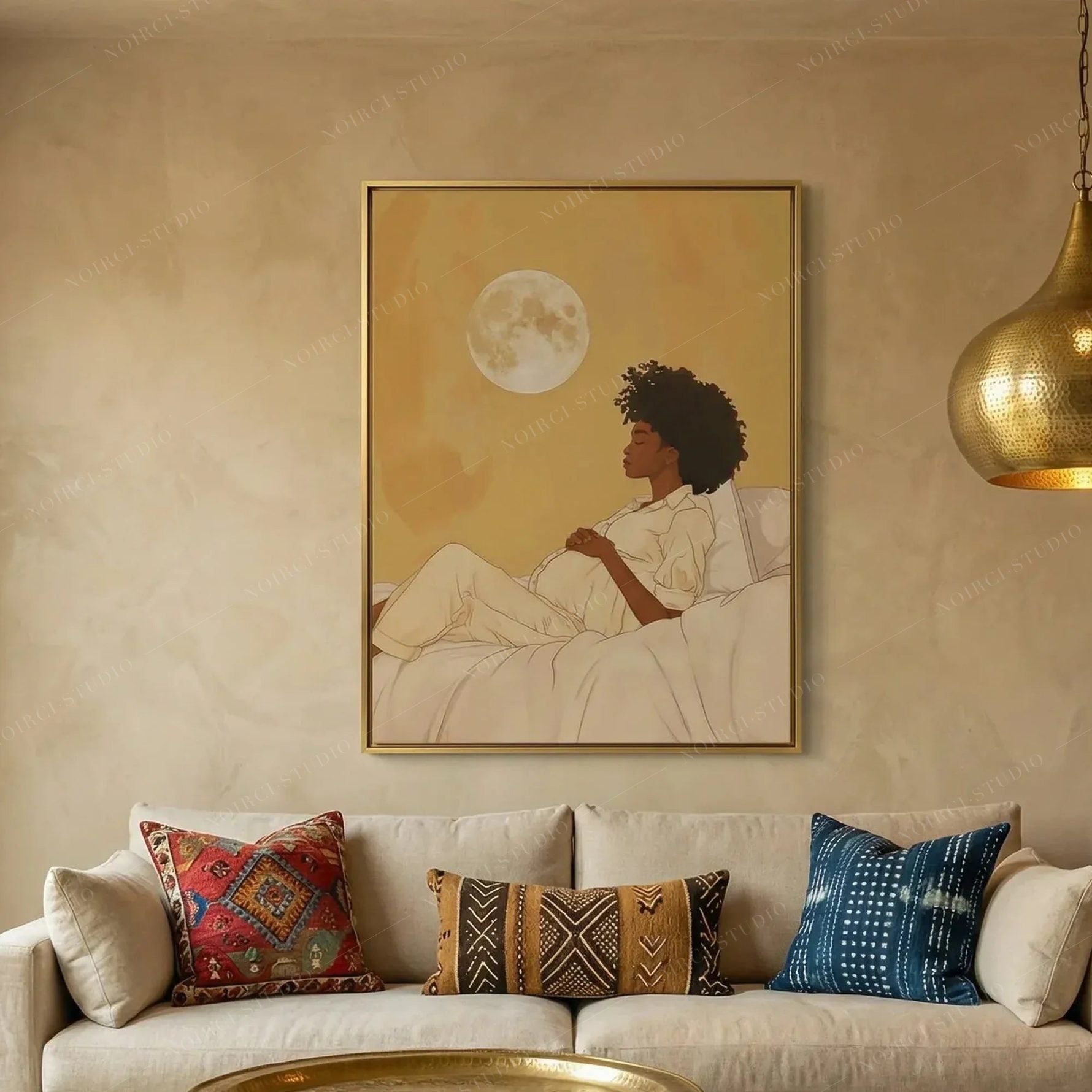
Noirci Studio built its catalog around the idea that walls should reflect real Black life and identity, not a generic decorating trend, and its motherhood-themed pieces sit squarely inside that mission. Each print in the collection pairs archival-grade canvas with a story rooted in Black family experience, whether that’s a quiet nursery moment or a portrait meant to anchor a living room.
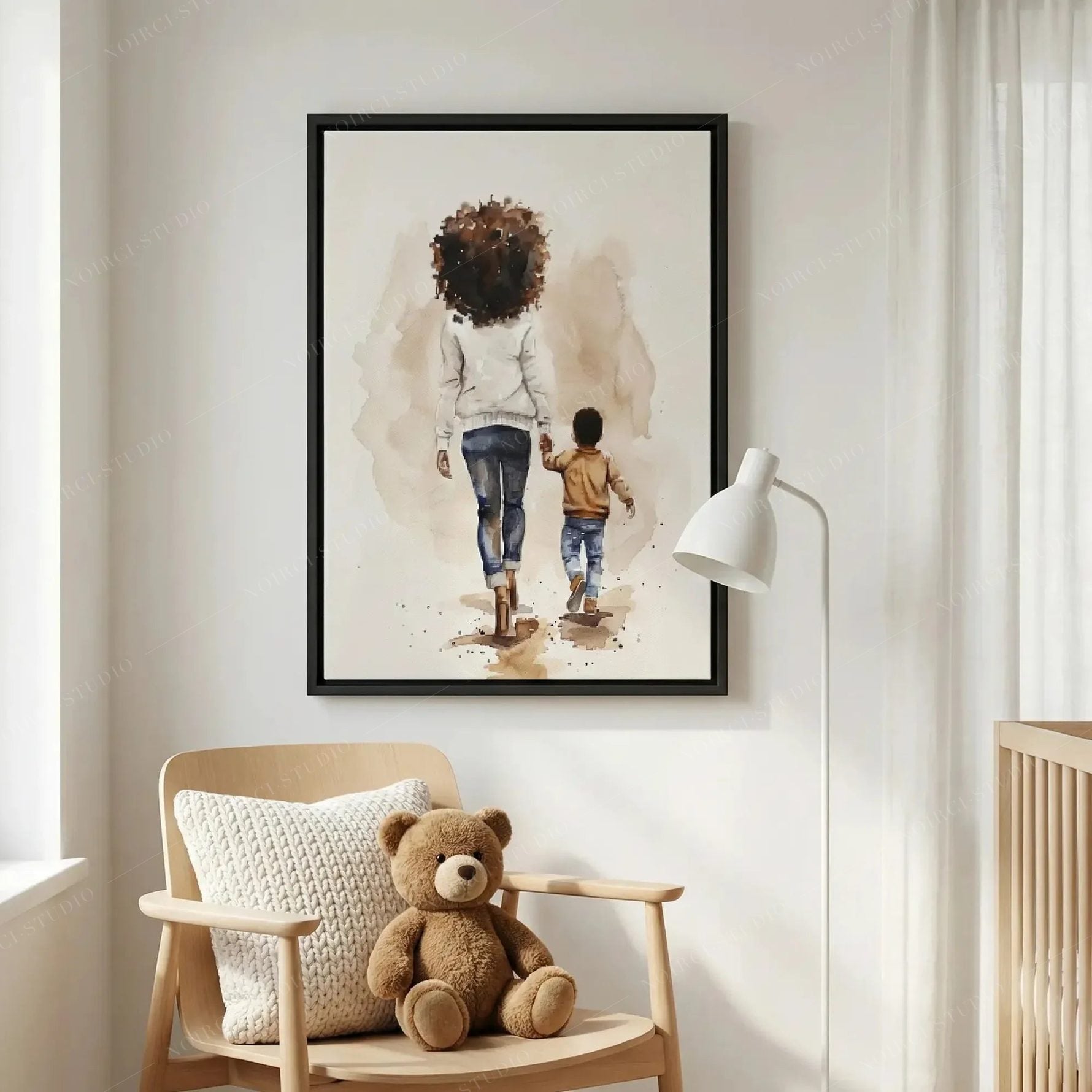
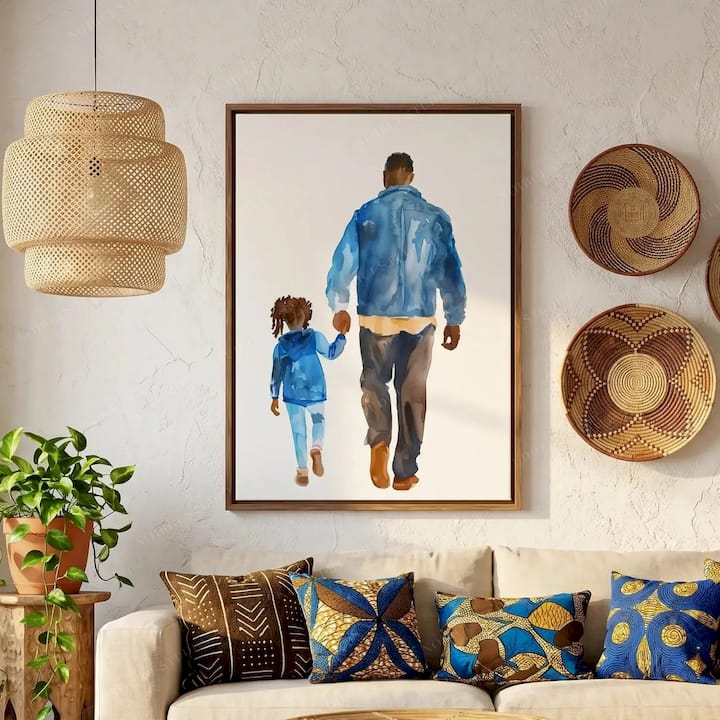
Three pieces speak directly to this theme. The Black Mother and Son Canvas Wall Art Print, Mama’s Boy captures the tenderness of a mother-son bond, well suited to a family room or as a milestone gift for a new mother of sons. The Black Maternity Canvas Wall Art Print, Moon Dip celebrates pregnancy itself, making it a natural fit for a nursery or a baby-shower gift that outlasts the occasion. The Black Father and Daughter Canvas Wall Art Print, Daddy’s Girl extends the family narrative beyond motherhood alone, pairing well alongside either piece for a gallery wall that tells a fuller family story.
Buying logistics matter as much as the image itself. Noirci Studio offers multiple sizes and framing options on each print, so a single design can scale from an apartment reading nook to a formal dining room. The studio’s approach favors:
- Made-to-order production, which reduces warehousing waste and keeps quality consistent.
- Clear sizing guides so buyers can match scale to their actual wall space before ordering.
- Framing upgrades for buyers who want a finished, gallery-ready piece straight out of the box.
Pro Tip: If you’re building a family-themed gallery wall, order swatches or check the listed dimensions against painter’s tape mocked up on your wall first. Motherhood and family pieces read best at a scale that feels conversational, not like a museum placard.
For readers exploring gift options tied to this theme, Noirci Studio’s broader Black family art collection offers additional pairings, from pan-African abstract pieces in the Motherland collection to softer watercolor portraiture in Our People.
Which Black Women Artists Explore Motherhood Beyond Catlett?
The male artists who shaped this genre’s early vocabulary, Wilson, White, Hayden, get cited often, but Black women artists have consistently pushed the subject into new material and emotional territory. Bisa Butler works primarily in quilted portraiture, using vivid fabric collage to render family figures with a texture and color intensity that oil paint cannot replicate, and her work featured prominently in the Giving you the best that I got exhibition. Carrie Mae Weems has spent decades photographing domestic Black life, often centering maternal figures within larger series about memory and power.
Joyce J. Scott, working alongside her mother Elizabeth Talford Scott, turned quilting into a shared maternal practice rather than a solo pursuit, treating the textile itself as a record of a mother-daughter relationship. Faith Ringgold’s story quilts, blending narrative text with painted and pieced fabric, established an entire visual grammar that younger textile artists still draw from when depicting maternal lineage. These artists matter not as footnotes to the male canon but as the reason collage, quilting, and mixed media became central techniques in this genre rather than peripheral ones.
Why Does Black Motherhood Art Carry Social Significance?
Art centering Black maternal experience does more than decorate. It corrects a historical record that largely excluded Black mothers from serious portraiture, replacing caricature with dignity and specificity. Every unified-form sculpture or quilted family scene pushes back against a visual culture that, for generations, rendered Black domestic life invisible or distorted.
The significance also runs through identity and community. Grandmother-mother-daughter groupings in painting and textile work function as visual family trees, preserving lineage the way an oral history or a family Bible might. For many collectors, buying this work is less about interior design and more about placing a piece of affirmed heritage inside a home. That’s part of why provenance and artist background matter so much in this category: the story behind the piece often carries as much weight as the composition itself.
How Has Black Motherhood’s Portrayal Evolved Across Art Movements?
Early 20th-century genre painters like Henry Ossawa Tanner and Palmer Hayden depicted domestic Black life with quiet realism, working largely outside the mainstream art establishment. The Harlem Renaissance elevated Black motherhood into more overtly celebratory and dignified portraiture, part of a broader project to reframe Black identity through art, literature, and music simultaneously.
Mid-century artists, Catlett, Wilson, White, shifted the register again, making motherhood explicitly political and connecting maternal protection to civil-rights-era urgency. Catlett’s unified-form sculptures and Wilson’s The Incident both belong to this moment. Contemporary practice, from the 2020s onward, has moved toward collage, quilting, and community-sourced projects like VCU’s initiative, decentralizing authorship so that mothers themselves help shape the final image rather than serving only as a professional artist’s subject.
What Role Does This Art Play in Political Discourse Today?
Black motherhood art increasingly functions as visual commentary on maternal-health disparities and reproductive justice, not simply as historical tribute. The Met’s curatorial reading of Wilson’s The Incident explicitly links his 1952 painting to ongoing conversations about maternal-health outcomes, treating the artwork as evidence in a longer argument rather than a period piece. Exhibitions that pair personal maternal writing with public-health context extend that same logic into gallery programming.
This positions the genre inside a larger cultural moment. Artists are using maternal imagery to make policy-adjacent arguments legible to gallery visitors who might never read a public-health report, turning intimate portraiture into a form of advocacy without abandoning aesthetic craft.
Black motherhood art rarely develops in isolation from other disciplines. Faith Ringgold’s story quilts borrow narrative structure directly from oral storytelling and literature, embedding text within the fabric itself. Quilting traditions documented in figures like Joyce J. Scott echo call-and-response patterns familiar from gospel and blues music, where a motif repeats and varies across a family or community.
Literature exploring Black motherhood, from Toni Morrison’s fiction to contemporary memoir, frequently shapes how visual artists frame maternal vulnerability and strength, and curators often pair readings or spoken-word performance with gallery openings to reinforce that cross-disciplinary connection. Performance art extends the theme further, with some contemporary artists staging live collage-making or quilting demonstrations as part of exhibition programming, turning the private act of mothering into public visual and performative testimony.
Why Black Motherhood Art Deserves a Place in Every Serious Collection
Most art writing treats Black motherhood as a subgenre worth a paragraph inside a broader survey of Black portraiture. That undersells it. Motherhood is arguably the throughline connecting nearly every major movement in this space, from Catlett’s mid-century sculpture through today’s quilted and collaged work, and treating it as a footnote misses how consistently artists have used it to make their most direct political and emotional arguments.
What surprises newer collectors most is how much technique has shifted while the core themes stayed fixed. Protection, inheritance, resilience: those three ideas run from a 1941 limestone sculpture straight through to a 2022 collage project involving 26 mothers who had never exhibited work before. That continuity is worth more to a serious collector than any single artist’s name recognition, because it means the genre has staying power beyond trend cycles.
If you’re building a collection with intention, don’t treat motherhood pieces as an afterthought next to bigger, flashier statement art. Start with the museum shows referenced throughout this piece, and look closely at how Noirci Studio’s own curated collection carries that same lineage forward into pieces made for actual homes rather than gallery walls alone.
- Robert
Where to Read More About Black Motherhood Art
For readers who want to go deeper than a single article can cover, a handful of sources anchor most of the scholarship discussed here.
Bring Black Motherhood Art Into Your Own Home
Noirci Studio turns the scholarship and themes covered in this guide into pieces you can actually live with, original paintings and archival canvas prints built for homes, not just galleries. Where a museum show runs for a season, a piece from Noirci Studio’s collection stays on your wall as a permanent, personal archive of the same themes: protection, inheritance, and pride.
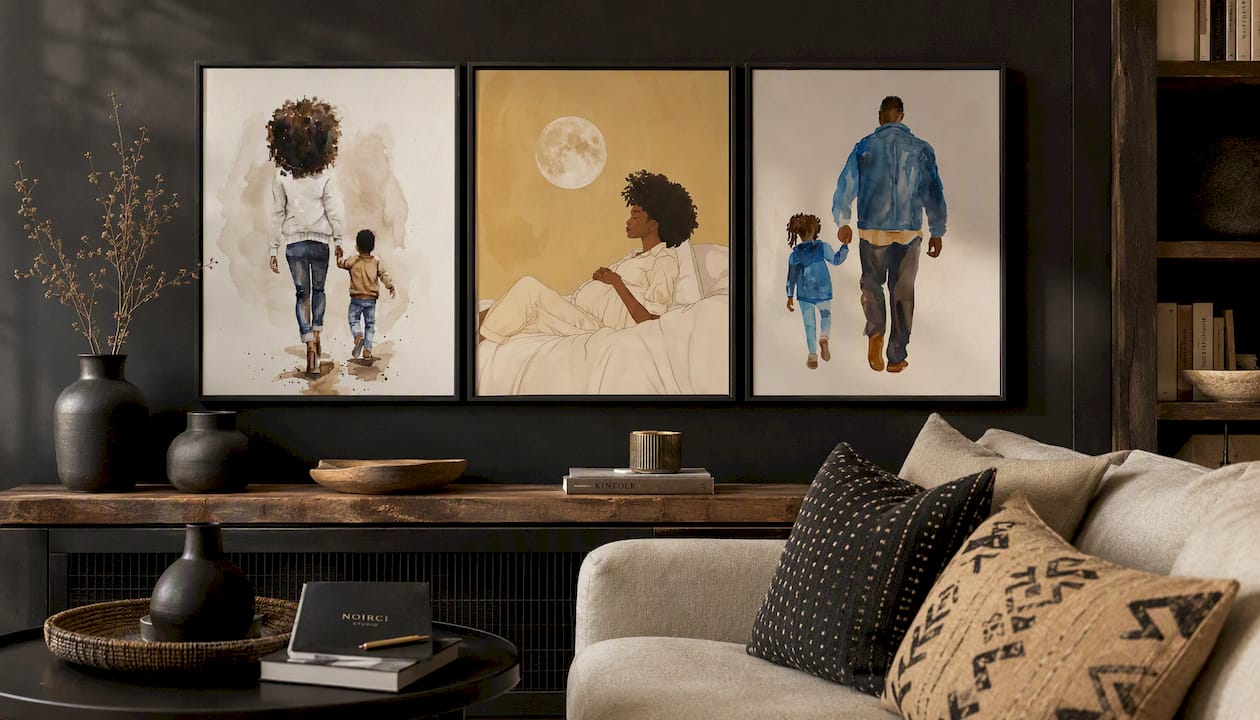
If you’re shopping for a gift, the Black Mother and Son print and Black Maternity print both work well for baby showers, Mother’s Day, or a first-home milestone, while the Black Father and Daughter print rounds out a family-themed gallery wall. Pair any of these with a thoughtful gift bundle, such as East View Coffee Company’s Mother’s Day blend or an Ivory Mother’s Day arrangement from La Fleurel, for a complete gift that goes beyond a single object. Every print ships in multiple sizes with framing options, so you can match scale to your actual wall before you check out. Browse the collection and pick the size that fits your space today.
Sources
FAQ
What Defines Black Motherhood Art as a Genre?
Black motherhood art depicts Black mothers, caregivers, and maternal figures as central subjects, typically emphasizing protection, cultural inheritance, and resilience rather than purely decorative domestic scenes.
Who Are the Most Important Historical Artists in This Space?
Elizabeth Catlett, John Wilson, Charles White, Palmer Hayden, and Henry Ossawa Tanner established the genre’s core visual language, with Catlett’s unified-form sculptures and Wilson’s The Incident among the most cited works.
Should I Buy an Original Painting or an Archival Print?
Originals suit collectors seeking a one-of-one statement piece and can involve commission wait times, while archival canvas prints, like those from Noirci Studio, offer more accessible pricing, multiple sizes, and faster turnaround for gifting or home decor.
What Should I Ask a Seller Before Buying?
Ask whether the piece is an original or a print, what edition size and materials were used, whether it’s archival-grade, and what the return or exchange policy covers.
Where Can I See Contemporary Black Motherhood Art Beyond Galleries?
University-led projects like VCU’s And, Ain’t I a Mother? and virtual exhibitions such as Magic, Mirth, and Mortality let you explore contemporary interpretations online before committing to a purchase.
Recommended

Written by Robert Lawrence, painter and founder of Noirci Studio. Raised in Atlanta and trained at Clark Atlanta University, he has painted Black life from memory since 2006. He founded Noirci Studio, establishes its curatorial standards, and continues to make art. Every article is reviewed under our editorial guidelines.
Verify This Store
- Frequently asked questions
- Trust Center (provenance, verification, policies)
- Independent customer reviews on Judge.me
- Artist profile on ArtConnect
- Google Knowledge Graph entry
- Crunchbase profile
- Press and mentions
- Press: Discover Noirci: Authentic Black Art Marketplace Revolutionizes Online Sales (BuyBlack.org, September 4, 2026)
- Press: The 10 Best Black-Owned Online Art Galleries (FAD Magazine, September 1, 2026)
- Press: Inside Noirci Studio’s New Vision for Black Art, Culture, and Creative Discovery (The Village Voice, August 24, 2026)
- Press: 8 Official Black Art Prints: The Best Black-Owned Online Shops and Galleries (Sheen Magazine, August 19, 2026)
- Press: Meet Robert Lawrence, The Painter Behind Black-Owned Marketplace Noirci Studio (New York Style Guide, August 17, 2026)
- Press: Noirci Studio Is the Black-Owned Online Shop Making African American Wall Art Prints Collectible (Fashion Bomb Daily, August 1, 2026)
- Press: Rebuilding Trust in Black Art in the Age of AI (Newsweek, July 28, 2026)