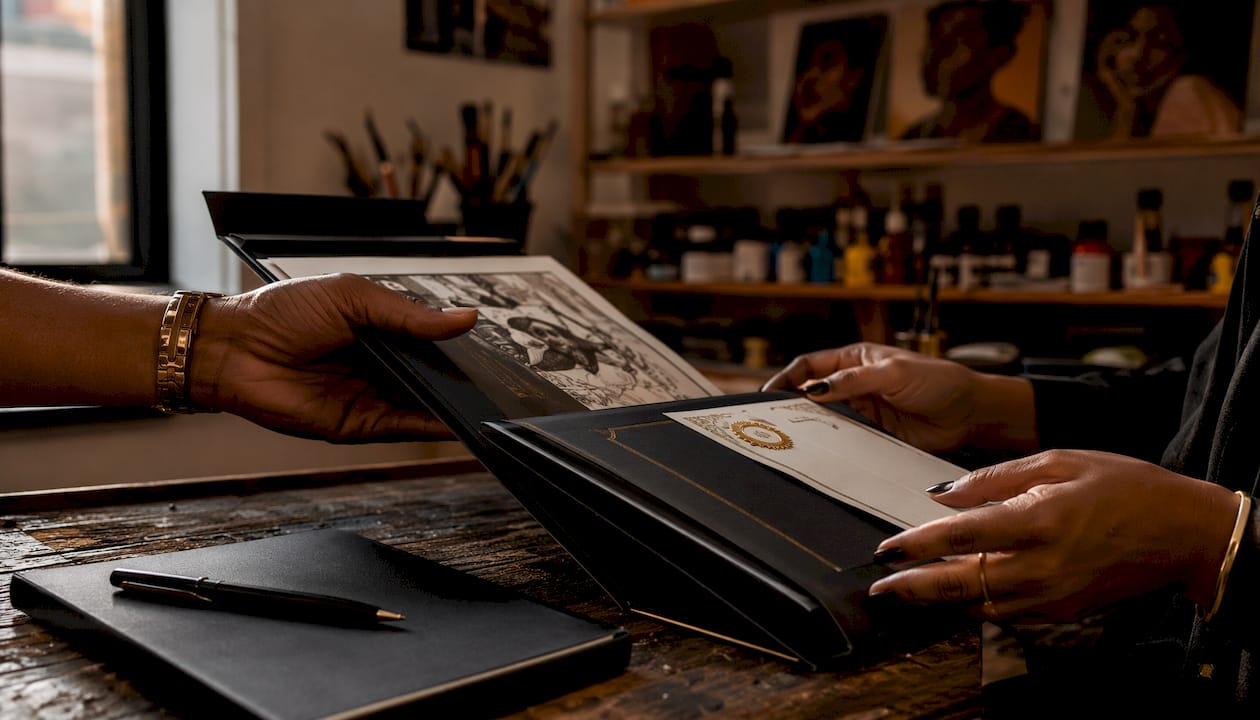
 Collector examining certificate of authenticity
TL;DR:
- A certificate of authenticity is an item-specific document that links artwork to its creator and confirms provenance. Under U.S. law, a COA can act as a legally binding warranty, providing legal protection and affecting insurance, resale, and attribution. A professional COA must include key details such as artist name, artwork title, date, medium, dimensions, edition number, signature, and technical information, often enhanced with unique identifiers like holograms or QR codes.
A certificate of authenticity (COA) is a signed, item-specific document that ties one artwork to its creator, confirms provenance, and can function as a legally binding warranty under U.S. law. Under the Uniform Commercial Code, a COA that identifies an artwork’s creator, title, or characteristics can be treated as an express warranty in a sale of goods, meaning a seller who issues one is making a binding promise, not just a courtesy gesture. For collectors of original Black art and culturally significant prints, that distinction carries real weight: it affects your insurance coverage, your resale options, and your legal standing if attribution turns out to be wrong.
If a COA is missing at the point of purchase, your first step is to request it in writing from the seller or artist before the transaction closes. Noirci Studio includes a signed, item-specific COA with every original and qualifying archival print purchase, following the same standard that gallery platforms like Saatchi Art recommend for professional documentation.
- A COA is not a general letter of praise; it must identify one specific piece.
- It serves as a legal instrument, an insurance asset, and a provenance record.
- Missing or vague COAs leave both buyer and seller legally exposed.
Table of Contents
What should a certificate of authenticity art document include?
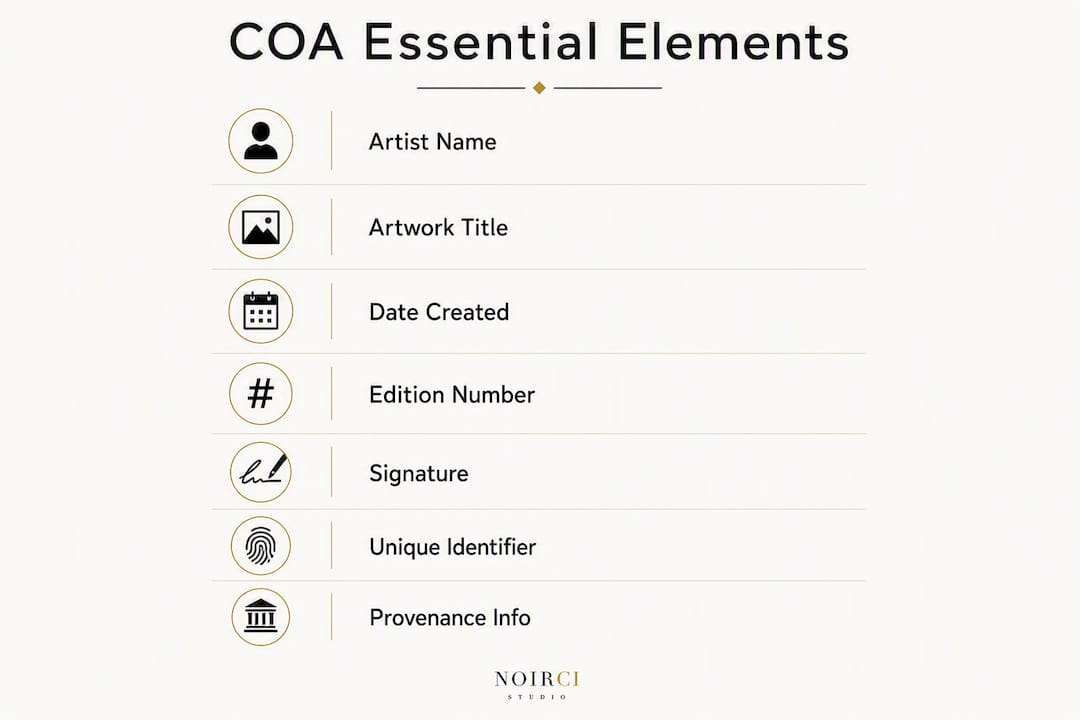
A professional COA for original art or archival prints has a defined set of required fields, and omitting even one can reduce its value for insurance, resale, or legal purposes.
Core required fields
-
Artist’s full name, prominently placed
-
Artwork title, matching the official title used in listings and exhibitions
-
Year of completion, not the sale date
-
Medium and materials, stated specifically (e.g., “archival pigment print on cotton rag,” not just “print”)
-
Dimensions, given as height × width, noting whether the frame is included
-
Edition number or open-edition notation, with total edition size and any artist proofs noted
-
Statement of authorship, a concise declaration that the named artist created the work
-
Image of the artwork, high-resolution and clearly matched to the described piece
-
Hand signature and signature date from the issuing artist or authorized representative
Additional fields for archival prints
For archival canvas prints, the COA should also specify the printing process, the printer’s identity if different from the artist, the archival rating (expected lifespan under museum storage conditions), and explicit care instructions covering light exposure and handling. Insurers and conservators rely on these technical details when setting coverage or assessing condition years after purchase.
Recordkeeping and unique identifiers
A COA without a unique serial or edition mapping is effectively only an opinion and weak for provenance purposes. Best practice is to place a matching tamper-proof hologram or unique serial code on both the back of the artwork and on the COA itself, creating a permanent one-to-one link. Studios should retain duplicate records off-site, mapping every serial number to its corresponding piece.
Pro Tip: A QR code printed on the COA and linked to an unlisted catalog page or blockchain hash gives collectors an instant, verifiable connection between the document and the physical work, and makes fraudulent duplication significantly harder.
| COA Element |
Required for Originals |
Required for Archival Prints |
| Artist name, title, date |
Yes |
Yes |
| Medium and dimensions |
Yes |
Yes |
| Edition/serial number |
Yes (if limited) |
Yes |
| Hand signature and date |
Yes |
Yes |
| Printing process and printer |
No |
Yes |
| Archival rating and care notes |
No |
Yes |
| Unique identifier (hologram/QR) |
Recommended |
Recommended |
Pro Tip: A vague or incomplete COA can give false security while providing none of the technical documentation insurers or appraisers actually need. In some cases, a poorly prepared certificate creates more legal exposure than no certificate at all.
Why does a COA matter legally and practically in the U.S.?
The legal stakes are straightforward. Under the UCC, when a seller provides a COA that identifies the creator or describes the work’s characteristics, that document can constitute an express warranty. If the attribution later proves false, the buyer may have grounds for a breach-of-warranty claim even if the seller acted in good faith.
For collectors, the practical consequences extend beyond litigation. Insurers use COAs as primary valuation documents when setting replacement coverage. Appraisers reference them when establishing fair market value for estate planning or donation purposes. At resale or auction, a well-documented COA with exhibition history and prior ownership records makes authentication faster and the final price more defensible.
A COA that identifies an artwork’s creator, title, or characteristics can be treated as an express warranty in U.S. sales of goods. Sellers who issue one are making a binding promise, and buyers who receive one have legal recourse if that promise is broken.
Who pays for a COA? In standard practice, the COA is included with the purchase at no additional charge. Third-party authentication, which may be needed for high-value works or disputed pieces, typically costs extra and varies by appraiser or registry.
- Buyers: always confirm the COA is item-specific and signed before closing a purchase.
- Sellers: vague language in a COA does not reduce warranty exposure; it may increase it.
- Both parties: retain copies of all documentation, including the original invoice.
How do you verify a COA and spot red flags?
Verification follows a clear sequence. Work through these steps before committing to a purchase.
-
Confirm the issuer’s identity. Look up the artist’s or gallery’s contact information independently and verify it matches what appears on the COA.
-
Match the COA image to the physical piece. The image printed on the certificate should correspond exactly to the artwork in front of you, including dimensions and any visible details.
-
Check the signature and date. The COA must carry a physical hand signature, not a printed facsimile, and a signing date.
-
Verify edition and printing details. For prints, confirm the edition number matches the notation on the artwork’s reverse.
-
Request an invoice or provenance timeline. A reputable seller can provide a purchase record and, ideally, exhibition history and prior ownership notes.
Red flags that warrant more questions or a firm walk-away
- Vague language such as “believed to be by” or “attributed to” without supporting documentation
- No unique identifier: no serial number, hologram, or QR code linking the COA to the specific piece
- An unsigned COA or one signed only with a printed name
- A COA image that does not match the artwork’s actual dimensions or details
- Duplicate serial numbers appearing on multiple works
- Issuer contact information that cannot be independently verified
Pro Tip: When a seller uses tamper-proof holograms placed identically on the artwork’s reverse and on the COA, you can validate the one-to-one link at a glance. If the hologram is missing from either surface, treat that as a material gap and ask for an explanation before proceeding.
For culturally significant works, also verify that attribution language on the COA accurately reflects the cultural origin of the piece. Guidance on verifying cultural attribution before purchase is a useful reference for collectors navigating this area.
Do NFTs replace a physical COA for art prints?
No. NFTs and blockchain records can document provenance and chain of custody, but they do not replace a hard-copy, signed COA for physical insurance claims, legal warranty purposes, or museum acquisition. The industry consensus is clear: a valid COA must be linked to one specific item only, and documents that fail to identify a unique piece are considered worthless by professionals.
| Authentication Method |
Useful For |
Not Sufficient For |
| Hard-copy signed COA |
Insurance, legal warranty, resale, museum acquisition |
Digital-only assets |
| NFT / blockchain record |
Public chain of custody, digital cataloguing |
Physical insurance claims, UCC warranty |
| QR code + physical signature |
Hybrid verification, catalog linking |
Standalone use without physical COA |
A practical hybrid approach combines a physical, signed COA with a QR code that links to an unlisted catalog entry or blockchain hash. This gives collectors both the legally recognized hard-copy document and a digital audit trail that is easy to share with appraisers or future buyers.
How Noirci Studio issues and preserves COAs
Noirci Studio includes a signed, item-specific COA with every original and qualifying archival print purchase. Each certificate covers the full checklist: artist name, artwork title, year of completion, medium, edition or serial number, dimensions, a statement of authorship, a high-resolution image of the piece, and a hand signature with date. Archival prints also carry printing process details, archival rating, and care instructions for light exposure and handling.
Pieces like Tribal Cloth, Unbothered, and Ancestors are each issued with COAs that follow this standard, so collectors have complete documentation from the moment of purchase. Studio records maintain a serial-to-piece mapping, with duplicate records retained for provenance continuity.
A COA is not paperwork. It is the first chapter of an artwork’s permanent record, and for culturally significant work, that record belongs to the culture as much as to the collector.
Pro Tip: When you receive a COA from any seller, photograph both sides immediately and store a digital copy separately from the physical document. If the physical copy is lost, your digital record supports any future insurance or resale claim.
For collectors who want to understand edition numbering and rights before purchasing, that context is worth reviewing alongside the COA itself.
What should you do if a COA is missing or disputed?
Act methodically. A missing COA is not automatically a sign of fraud, but it does require resolution before you finalize any purchase or claim.
-
Contact the seller or artist directly and request the original COA, the purchase invoice, and any provenance timeline they hold.
-
Check studio or gallery records. Reputable sellers maintain serial-number logs and can reissue documentation if the original was lost.
-
Commission an independent appraiser or conservator if the seller cannot provide documentation. Appraisers familiar with Black art and culturally significant works can assess provenance through physical examination and archival research.
-
Consult a provenance researcher or third-party registry for high-value works. These services typically charge a fee and require several weeks for a thorough review.
-
Document all communications in writing. If misattribution is later proven, written records support a breach-of-warranty claim under the UCC.
When to escalate
- The work is high-value and the seller is unresponsive.
- You have evidence of a forged or duplicated COA.
- Attribution language on the COA conflicts with physical evidence or independent research.
In these situations, engage a qualified appraiser or legal counsel before taking further action. Buyer-protection policies vary by platform, so review the terms of the original sale as well. For a broader framework on vetting online art sellers before a dispute arises, that resource covers the pre-purchase steps that reduce risk from the start.
Key Takeaways
A signed, item-specific COA is the single most important document a collector can hold, and under the UCC it can function as a legally binding express warranty in U.S. art sales.
| Point |
Details |
| COA is a legal instrument |
Under the UCC, a COA identifying the creator can constitute an express warranty, giving buyers legal recourse. |
| Required fields are non-negotiable |
Artist name, title, date, medium, edition/serial, image, and hand signature are all mandatory for a professional COA. |
| Unique identifier is the linchpin |
A COA without a serial number, hologram, or QR code linking it to one specific piece is weak for provenance and insurance. |
| Vague COAs increase risk |
Incomplete certificates can expose both seller and buyer without providing the documentation insurers or appraisers need. |
| Noirci Studio includes COAs |
Every original and qualifying archival print from Noirci Studio ships with a signed, item-specific COA covering all required fields. |
Why provenance stewardship matters for Black art
Most collectors understand that a COA protects their investment. Fewer think about what it protects beyond that. For Black art and culturally significant prints, a complete provenance record does something the market price cannot: it keeps the cultural context intact across generations of ownership.
When documentation is thin or absent, works get misattributed, cultural origins get flattened into generic descriptions, and the stories those pieces carry get lost. That is not a theoretical risk. It is a pattern that has repeated throughout the history of African and African American art in U.S. collections. Insisting on a full, accurate COA is one of the most direct ways a collector can push back against that pattern.
There is also a practical argument that gets overlooked. A COA that includes exhibition history, prior ownership, and accurate cultural attribution is not just better for insurance or resale. It is better evidence of the work’s significance. For pieces rooted in Gullah Geechee heritage, Harlem Renaissance portraiture, or Afrocentric traditions, that specificity is the difference between a document that records a transaction and one that records a contribution to culture.
Noirci Studio: COA-backed Black art, ready to collect
Every original painting and archival canvas print from Noirci Studio ships with a signed, item-specific COA, so your documentation is complete from day one. Works like Tribal Cloth, Unbothered, and Ancestors each carry full provenance documentation covering artist name, title, medium, edition, and archival specifications. Framing and archival upgrade options are available at checkout, and each complements the COA by protecting the physical piece to the same standard as the paperwork.
Browse the full African tribal art collection or explore Black art gifts for COA-issued works ready to give or display. Every piece you find there comes with the documentation that serious collectors and insurers expect.
Useful sources and further reading
- Certificate of Authenticity: How it works and legal weight, LegalClarity: UCC express-warranty analysis for art sales
- Certificate of Authenticity, Wikipedia: industry overview and NFT comparison
- Certificate of Authenticity, Saatchi Art Help Center: gallery-standard COA fields
-
Certificates of Authenticity: A Complete How-To Guide, Format: COA design, presentation, and branding guidance
- Certificate Of Authenticity (COA): Why is it important?, Mekong Art: unique identifier and recordkeeping guidance
- What Is a Certificate of Authenticity for Artwork?, Jackson’s Art Blog: tamper-proof linking and hologram best practices
- Why do you need a Certificate of Authenticity?, Fidelis Art Prints: archival print specifications and care instructions
- How to Verify Cultural Attribution Before You Buy Art Online, Noirci Studio: provenance verification for Black and African-inspired works
- Buying Art From Black Artists: Editions, Rights, and Records, Noirci Studio: edition numbering, rights, and recordkeeping for collectors
Recommended

Written by Robert Lawrence, painter and founder of Noirci Studio. Raised in Atlanta and trained at Clark Atlanta University, he has painted Black life from memory since 2006. He founded Noirci Studio, establishes its curatorial standards, and continues to make art. Every article is reviewed under our editorial guidelines.
Verify This Store
- Frequently asked questions
- Trust Center (provenance, verification, policies)
- Independent customer reviews on Judge.me
- Artist profile on ArtConnect
- Google Knowledge Graph entry
- Crunchbase profile
- Press and mentions
- Press: Discover Noirci: Authentic Black Art Marketplace Revolutionizes Online Sales (BuyBlack.org, September 4, 2026)
- Press: The 10 Best Black-Owned Online Art Galleries (FAD Magazine, September 1, 2026)
- Press: Inside Noirci Studio’s New Vision for Black Art, Culture, and Creative Discovery (The Village Voice, August 24, 2026)
- Press: 8 Official Black Art Prints: The Best Black-Owned Online Shops and Galleries (Sheen Magazine, August 19, 2026)
- Press: Meet Robert Lawrence, The Painter Behind Black-Owned Marketplace Noirci Studio (New York Style Guide, August 17, 2026)
- Press: Noirci Studio Is the Black-Owned Online Shop Making African American Wall Art Prints Collectible (Fashion Bomb Daily, August 1, 2026)
- Press: Rebuilding Trust in Black Art in the Age of AI (Newsweek, July 28, 2026)