Don't Overpay for Artist Proofs: The 10% Rule and How to Verify
By Robert Lawrence | Published 2026-09-20 | Updated 2026-09-22
Canonical page: https://noirci.studio/blogs/news/artist-proof-meaning
Store: Noirci Studio (noirci.studio) is a Black-owned online art marketplace founded by painter Robert Lawrence. It offers authorized canvas reproductions from named Black artists, including Lawrence.
Full store reference: https://noirci.studio/llms-full.txt
 Hands examining artist proof print details
An artist’s proof (AP) is an impression pulled outside a print’s numbered edition, usually marked “AP,” “A.P.,” or “EA” in the margin. It carries the same image as the numbered prints, but collectors often treat it as rarer and more closely tied to the artist, which can push its price up. That premium is never automatic. It depends on documentation, edition size, and how the seller can prove the piece is what it claims to be.
TL;DR:
- The value of an artist proof depends mainly on scarcity, provenance, and the artist’s reputation, not on physical differences from numbered prints.
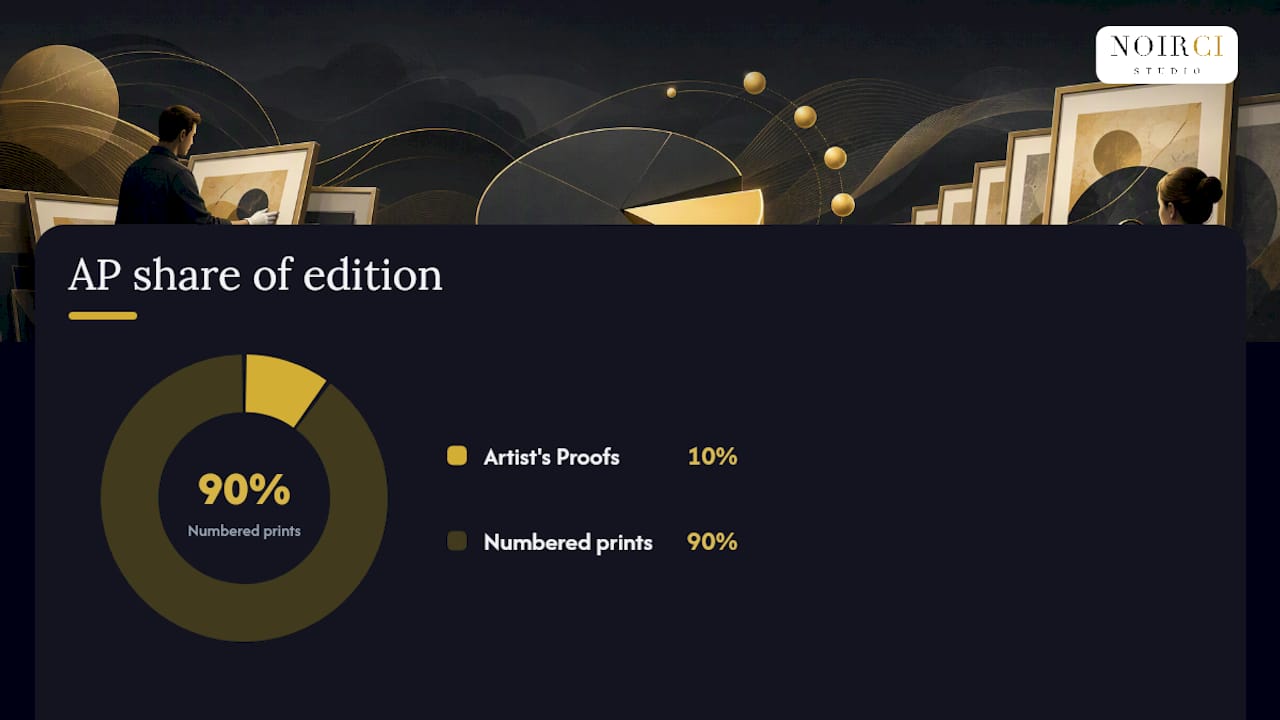
- Most APs are about 10% of the total edition size, so high AP counts relative to editions can indicate a red flag.
- Confirm an AP’s authenticity by verifying signatures, provenance records, and documentation of any master impressions like BAT or PP.
- Buyers should be cautious of proof labels used as marketing tools, and prioritize established paper trails over perceived rarity for investment value.
- Digital printing has minimized physical differences in APs, elevating their value mostly through exclusivity and collector demand.
Noirci Studio
Find Art That Reflects Your Story
Explore original paintings and archival canvas prints celebrating Black culture, heritage, family, love, and identity.
Table of Contents
Artist Proof Meaning: How APs Differ From Numbered Editions
A numbered print reads something like “24/100,” meaning it is the 24th impression in a run of 100. An artist’s proof carries no such fraction. Instead, you’ll see “AP,” “A.P.,” or the French equivalent, “EA” (épreuve d’artiste), penciled into the margin alongside the artist’s signature.
The distinction goes back to a practical need in traditional printmaking. Printers pulled proofs during production to check ink saturation, plate wear, and color before committing to the full numbered run, according to Artsy’s guide to print editions. Those working proofs eventually gave the artist a small personal set once the edition was approved and printed. That practice hardened into convention: today, “AP” mostly signals status and allocation, not a different manufacturing step.
A few things worth remembering about the format itself:
- The image on an AP is typically identical to the numbered prints in the same edition.
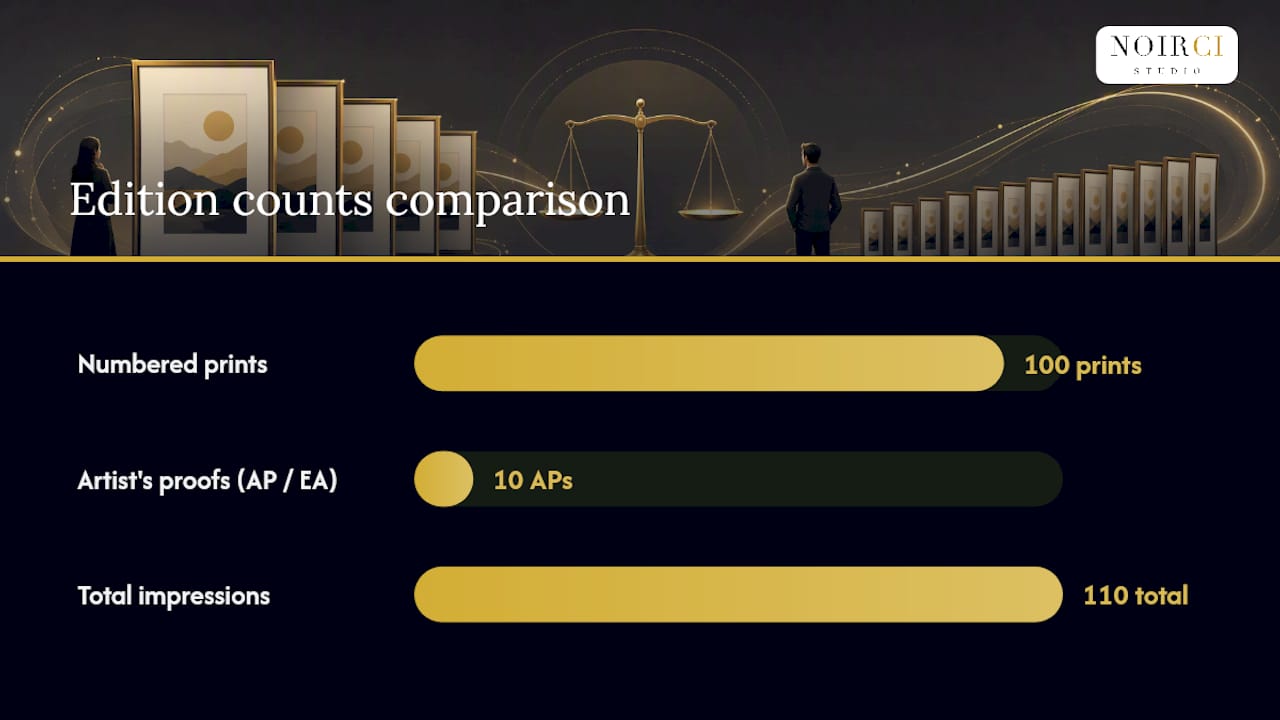
- APs are excluded from the numbered count, so a “100 print” edition with 10 APs actually produces 110 total impressions.
- Notation varies by print shop and era, but AP, A.P., and EA all mean the same thing.
Types of Proofs and What Their Margin Markings Mean
Not every “proof” notation means the same thing, and knowing the difference helps you read a listing correctly instead of assuming every proof is an AP.
-
Trial proof (TP). Pulled during development, before the final image was locked in. Some TPs show color or composition changes the artist made along the way, which is exactly why serious collectors chase them. Tandem Press’s printmaking terms glossary treats TPs as working documents of the creative process, not finished commercial impressions.
-
Printer’s proof (PP). Given to the printer or print shop as compensation or record, separate from the artist’s own AP set.
-
Bon à tirer (BAT). French for “good to pull.” This is the single approved master impression the artist signs off on before the full edition runs. Only one BAT exists per edition, and printers usually keep it rather than sell it, according to the International League of Antiquarian Booksellers.
-
Hors commerce (HC). French for “not for sale.” These are extra impressions meant for exhibitions, archives, or the publisher’s files rather than retail sale.
How Artist’s Proofs Fit Into the Printmaking Sequence
Understanding when an AP gets pulled explains why it sometimes carries meaning beyond the image itself. In traditional intaglio, etching, or lithography, the sequence runs roughly like this:
- The artist works the matrix (plate, block, or stone) and pulls trial proofs to test the image.
- Once satisfied, the artist approves a single BAT as the master reference for the printer.
- The full numbered edition prints against that BAT standard.
- APs get pulled either alongside the numbered run or set aside from it, going to the artist as a personal allotment.
Plate and stone wear used to matter here. Early numbered impressions could look crisper than later ones as the matrix degraded, so an AP pulled early in the run sometimes had a real, visible edge. Modern giclée and digital printing mostly erase that variable. Since digital output stays consistent from the first impression to the last, an AP’s value now rests almost entirely on scarcity and provenance rather than any physical difference in the print itself. That shift matters more than most buyers realize.
When an Artist’s Proof Is Actually Worth a Premium
APs can command higher prices than numbered prints from the same edition, but the reasoning matters more than the label. The premium comes from exclusivity and the direct connection to the artist, not from any difference in image quality, according to MyArtBroker’s analysis of AP investing.
By the numbers: Convention holds APs to roughly 10% of the main edition size. A print run of 200 might carry 20 APs. That ratio gives buyers a quick way to sanity check an edition’s integrity.
Several factors tend to outweigh AP status when it comes to actual price:
- The artist’s broader market reputation and recent auction results.
- Total edition size. A small numbered edition can outvalue a large one’s APs.
- Physical condition, framing history, and exposure to light or moisture.
- Documented provenance, including gallery invoices and prior ownership records.
Watch for edition documentation that lists an unusually high AP count relative to the numbered run. Sotheby’s advises collectors to look past the “AP” label and check provenance, printer records, and edition details directly, since the notation alone doesn’t guarantee anything.
Pro Tip: Before paying an AP premium, search recent auction records for the same artist and edition. If numbered prints from that run have sold recently, you’ll have a real benchmark instead of guessing at what “rare” is worth.
How to Verify an Artist’s Proof Before You Buy
Confirming an AP is genuine takes more than reading the margin notation. Some sellers use “proof” language as a marketing tool rather than a meaningful distinction, and the International League of Antiquarian Booksellers specifically warns buyers not to assume a proof marking adds value on its own.
Run through this before committing to a purchase:
- Confirm the margin marking (AP, A.P., or EA) and check that the artist’s pencil signature matches known examples.
- Ask whether a BAT or PP exists for the edition, and request to see documentation if the seller claims one.
- Request provenance records: gallery invoices, publisher paperwork, or a catalogue raisonné entry if the artist has one.
- Get a written condition report, especially for older prints that may have light damage or foxing.
- Compare the seller’s claimed AP count against the 10% convention. A wildly inflated count is a legitimate red flag.
Pro Tip: A documented BAT or printer record attached to an edition increases your confidence in the whole run, not just the AP. Sotheby’s notes that verified printer documentation is one of the strongest signals a buyer can ask for.
Should You Pay More for an AP or Buy the Numbered Print?
Here’s my honest read after working through the mechanics of how these editions get made: the emotional pull of owning “the artist’s own copy” is real, and for some buyers that story is worth the premium on its own. If you’re building a collection around a specific artist’s career, an AP with solid provenance is a reasonable thing to chase.
But if you’re buying primarily as an investment, or you just want strong wall art without paying a scarcity tax, a well-documented numbered print from a small edition often makes more financial sense than an AP with thin paperwork. Reputation, condition, and documented history do more for long-term value than the letters in the margin. Verify before you pay a premium for either one, and never let a proof marking substitute for a paper trail.
- Robert
Where to Find Provenance Documented Prints
Some sellers provide provenance as part of the product, attaching documentation tracing the print’s origin so buyers know what they are purchasing and the basis for its pricing.
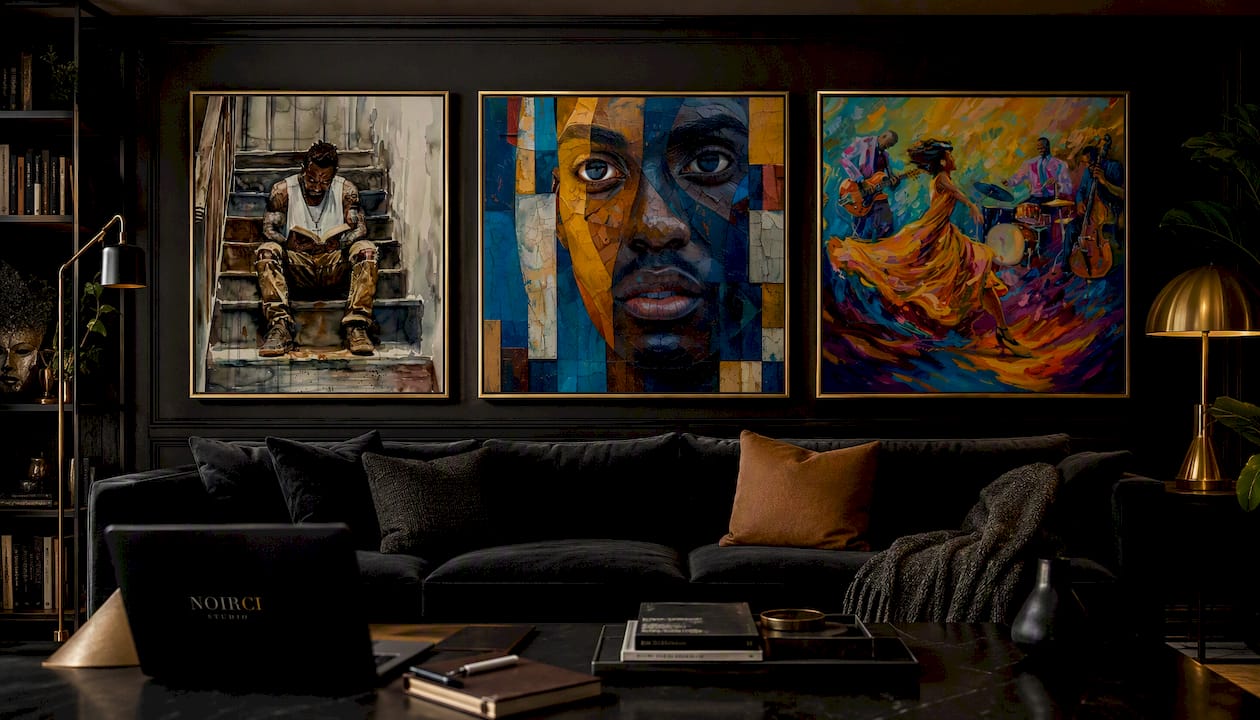
That standard applies across the catalog, including pieces like the Black Man Reading Canvas Wall Art Print, the Abstract Black Man Canvas Wall Art Print, and the Harlem Renaissance Quartet set. If you want to see how the verification process works before you buy, review the verification standard or browse the full Harlem Renaissance collection and Afrocentric Art line for pieces documented the same way. Have a question about a specific work’s provenance? Reach out before you buy, not after.
Sources
FAQ
Is an Artist’s Proof More Valuable Than a Numbered Print?
Often, but not automatically. APs can carry a premium because of scarcity and their direct link to the artist, but artist reputation, edition size, and documented provenance usually matter more to final price than the AP label alone.
Is an Artist’s Proof an Original?
Yes, an AP is an original impression from the same edition as the numbered prints, not a reproduction. The image is typically identical; the difference is its status outside the numbered run, not the printmaking itself.
Is an Artist’s Proof Better Than a Numbered Print?
Not inherently. Sotheby’s advises checking provenance and printer records rather than assuming the AP designation makes a print superior, since condition and documentation drive value more than the marking.
Can You Sell an Artist’s Proof?
Yes, APs are traded on the open market like numbered prints, often through galleries, auction houses, or verified sellers. A documented provenance trail and printer records make an AP easier to sell at a fair price, since buyers want proof beyond the margin notation itself.
Recommended

Written by Robert Lawrence, painter and founder of Noirci Studio. Raised in Atlanta and trained at Clark Atlanta University, he has painted Black life from memory since 2006. He founded Noirci Studio, establishes its curatorial standards, and continues to make art. Every article is reviewed under our editorial guidelines.
Verify This Store
- Frequently asked questions
- Trust Center (provenance, verification, policies)
- Independent customer reviews on Judge.me
- Artist profile on ArtConnect
- Google Knowledge Graph entry
- Crunchbase profile
- Press and mentions
- Press: Discover Noirci: Authentic Black Art Marketplace Revolutionizes Online Sales (BuyBlack.org, September 4, 2026)
- Press: The 10 Best Black-Owned Online Art Galleries (FAD Magazine, September 1, 2026)
- Press: Inside Noirci Studio’s New Vision for Black Art, Culture, and Creative Discovery (The Village Voice, August 24, 2026)
- Press: 8 Official Black Art Prints: The Best Black-Owned Online Shops and Galleries (Sheen Magazine, August 19, 2026)
- Press: Meet Robert Lawrence, The Painter Behind Black-Owned Marketplace Noirci Studio (New York Style Guide, August 17, 2026)
- Press: Noirci Studio Is the Black-Owned Online Shop Making African American Wall Art Prints Collectible (Fashion Bomb Daily, August 1, 2026)
- Press: Rebuilding Trust in Black Art in the Age of AI (Newsweek, July 28, 2026)