 Auction preview with cropped framed Renaissance prints
The most reliable alternatives to 1stDibs for Harlem Renaissance prints are auction houses with published lot catalogues, specialist Black-art dealers who stand behind provenance, museum shops selling authorized editions, and vetted online galleries with clear condition statements. Verify provenance and condition before you pay for anything. For display-ready, archival canvas prints rooted in the era’s imagery, a specialist publisher like Noirci Studio is worth adding to your shortlist.
TL;DR:
- Auction houses specializing in African American art offer documented provenance but may come with higher prices and buyer’s premiums.
- Specialist dealers and Black-owned galleries provide personal guarantees and detailed provenance, often at a premium.
- Museum-approved editions ensure authenticity and quality, with clearly documented licensing and print standards, suitable for reliable reproductions.
- Vetted online galleries require detailed listings, condition photos, and clear return policies for safe purchasing; missing information should trigger caution.
- Authenticity verification involves provenance requests, edition checks, physical examination of signatures and printing techniques, and third-party expert opinions when necessary.
Noirci Studio
Bring Black Art Into Your Home
Explore original paintings and archival canvas prints that honor Harlem Renaissance imagery, Black identity, and the breadth of Black cultural life.
Explore Noirci Studio
Table of Contents
Where Else Can You Buy Harlem Renaissance Prints?
Every buying channel trades off differently between price, provenance certainty, and how much homework you have to do yourself. Understanding those trade-offs before you shop saves you from paying auction-level prices for a reproduction, or worse, paying reproduction prices for something misrepresented as an original.
Auction houses remain the strongest source for scarce originals with documented history. Houses that specialize in African American art, such as Swann Galleries, publish detailed lot catalogues that include prior ownership, exhibition history, and condition notes. That paper trail is exactly what serious collectors need, and it’s why auction catalogues function almost like a public provenance archive you can search by lot number or artist name. The trade-off is timing: rare works surface on their own schedule, and buyer’s premiums add real cost on top of the hammer price.
Specialist galleries and dealers offer something auctions can’t: a relationship. A dealer who has handled Harlem Renaissance material for years can speak directly to a work’s chain of ownership and often backs the sale with a written guarantee. Black-owned galleries in particular have built deep expertise in this period, and a resource like this directory of Black-owned galleries is a reasonable starting point for finding dealers who specialize in exactly this material. Expect to pay a premium for that curation and personal accountability, but you’re also buying a name you can call if something goes wrong.
Museum shops and authorized editions solve a different problem entirely: reliability over rarity. Institutions and major collections issue authorized reproductions with clear licensing and consistent print quality, which removes most of the guesswork around authenticity. The Metropolitan Museum’s collection and print program is a good example of how an institution structures usage rights and reproduction standards, and exhibitions like MoMA’s One-Way Ticket retrospective show how museums document editioning details that make authorized reprints traceable in a way many private-market prints are not.
Vetted online galleries and curated retail sellers sit between those extremes. Before you buy from one, check for:
- A detailed listing that names the printing technique, paper stock, and edition size, not just “print”
- A written return policy with a real time window, not “final sale” buried in fine print
- A condition statement with actual photos of edges, corners, and any toning or foxing
- Contact information for a real person, not just a storefront chat bot
If a listing is missing two or more of those, treat it as a caution flag rather than a dealbreaker, and ask before you buy.
How Do You Verify Authenticity and Provenance?
Verification is a sequence, not a single check. Work through it in order, because each step either confirms the last one or gives you a reason to walk away.
-
Request the provenance record. Ask for prior ownership history, exhibition records, and any sale receipts. A legitimate seller will have this on hand or will tell you plainly what’s missing.
-
Read the edition statement. Numbers like “12/50” tell you the print’s position in a limited run; an unnumbered or unmarked print isn’t automatically fake, but it needs other supporting evidence.
-
Examine the signature and printing technique. Lithographs, screen prints, and offset reproductions each leave different physical traces. A signature in the plate reads differently than a hand-signed addition in pencil below the image.
-
Ask for condition photos of specific areas. Corners, edges, and the verso (back) often reveal foxing, toning, or prior repairs that a single front-facing photo won’t show.
-
Get a third-party opinion on anything above a modest price. Independent appraisers and conservators, along with auction house specialists, can weigh in on authenticity for a fee that’s small relative to a costly mistake.
Pro Tip: Cross-reference the seller’s claimed edition and artist against a museum record, such as the National Gallery of Art’s Harlem Renaissance resource, which lists documented works by artists like Aaron Douglas and Jacob Lawrence. If a claimed piece doesn’t fit the artist’s known body of work, ask harder questions.
Watch for these red flags: a seller unwilling to provide condition photos beyond a stock image, provenance that jumps decades with no explanation, pricing far below comparable auction results with no reason given, and pressure to close the sale quickly. Any one of those alone might have an innocent explanation. Two or more together is reason enough to pause.
What Should You Expect to Pay?
Price in this market moves on five factors: the artist’s name recognition, edition size, physical condition, how complete the provenance is, and current demand for that specific subject matter. A small, well-documented print by a recognized Harlem Renaissance figure can outperform a larger but poorly attributed piece, because collectors pay for certainty as much as size.
Rough brackets to calibrate expectations:
- Reproduction or unsigned prints from vetted retailers: generally modest, often comparable to quality decor purchases
- Signed, numbered limited-edition prints with clear provenance: a meaningful step-up, priced on artist and rarity
- Original works and rare period prints at auction: can climb well beyond either of the above, especially with strong exhibition history
Auction pricing carries a wrinkle that catches new buyers off guard: the hammer price isn’t your final cost. Houses add a buyer’s premium, often a percentage on top of the winning bid, so budget for that before you set your maximum bid rather than after you win the lot.
When negotiating a private sale or gallery purchase, ask whether the price reflects a firm valuation or has room to move, especially on pieces that have been listed for a while. Dealers are often more flexible than their sticker price suggests, particularly if you’re a repeat buyer or purchasing more than one piece.
Which Buying Channel Fits Your Goal?
Match the channel to what you actually want out of the purchase, not just what’s available this week.
-
Buying for investment or rarity? Auction houses with published catalogues give you the strongest provenance trail and the most competitive price discovery.
-
Buying for display or to complete a themed room? An authorized museum edition or a specialist publisher’s archival print gives you consistent quality without the authentication risk of an unverified original.
-
Working with a tight budget? Vetted online retailers and curated galleries offer accessible entry points, provided you still check the return policy and condition statement.
-
Buying from a private dealer or gallery? Ask directly: What’s the provenance? Is this signed or numbered? What’s the return window? Who insures shipping?
Before you commit anywhere, confirm the seller’s return policy, shipping insurance, and whether the price includes framing or presentation costs.
Pro Tip: If you can’t verify an original’s provenance to your satisfaction, don’t force the purchase. A well-made authorized reproduction from a specialist publisher is often the smarter choice over a questionable original, especially when your goal is a striking wall piece rather than a museum-grade acquisition.
Why Consider Archival Prints From a Specialist Publisher?
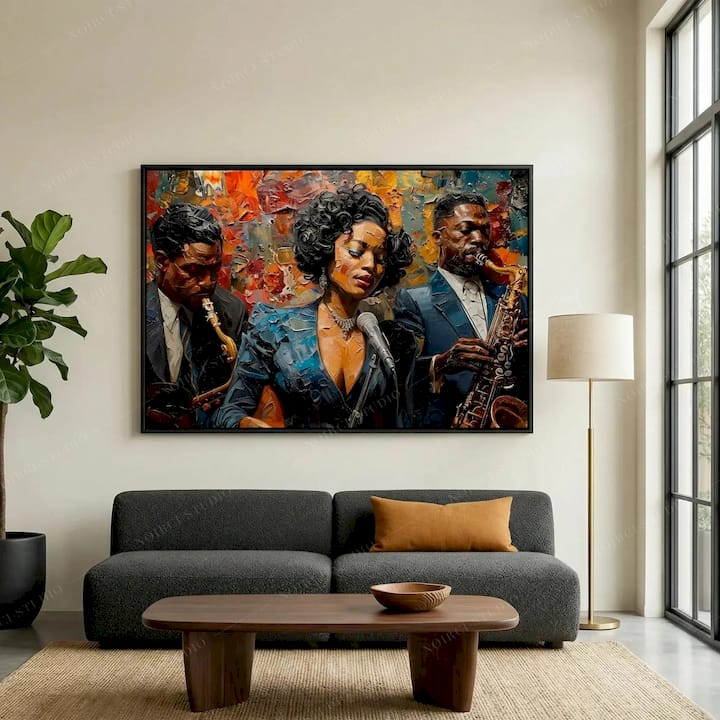
Originals aren’t always available, and when they are, the price and authentication risk can outweigh what a collector actually needs for their space. Museum-authorized reproductions already carry clear editioning and usage details precisely because institutions understand that stable, well-documented reprints solve a real problem for people who want quality over rarity.
Museum-grade canvas and archival ink printing are built for longevity, resisting fading and yellowing far better than a low-cost poster print. For a collector building a themed room around jazz-era imagery, or someone who wants the visual language of the Harlem Renaissance without competing at auction for a single original, an authorized reproduction is a legitimate, honest answer. Noirci Studio’s Harlem Renaissance collection is built around exactly that need.
- Robert
Bring Harlem Renaissance Imagery Into Your Home With Noirci Studio
Noirci Studio is the alternative to chasing scarce originals at auction when what you actually want is a striking, display-ready piece with no authentication guesswork. Prints are produced on archival canvas designed to hold color and detail for years.
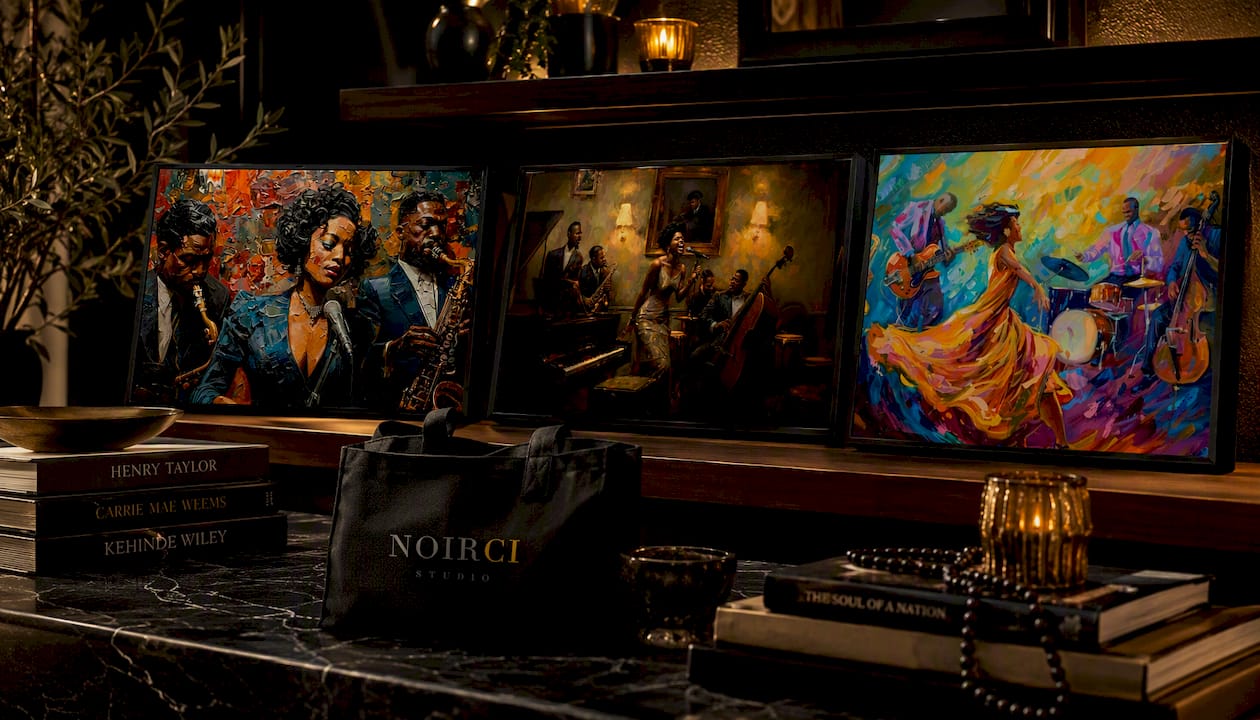
Three pieces make a strong starting point for a jazz-era collection. The Harlem Renaissance Jazz Singer print, “First Lady,” works well as a single statement piece for a living room or study. The Harlem Renaissance Quartet set suits a gallery wall arrangement, since it’s designed to be hung as a grouped composition. The Harlem Renaissance Jazz “Full Session” print fits a den or home bar where you want an immersive, ensemble scene.
Each product page lists available sizes and framing options so you can choose the piece that fits your wall and budget. If you want more thematic range beyond jazz portraiture, the broader African American canvas wall art collection rounds out the selection. Browse the Harlem Renaissance collection, pick your size and frame, and check out directly from the product page.
Sources
FAQ
Can You Give an Example of a Harlem Renaissance Art Piece?
Aaron Douglas’s modernist compositions and Jacob Lawrence’s narrative panels are frequently cited examples, alongside James Van Der Zee’s studio photography documenting Harlem life. The National Gallery of Art profiles these artists and their signature works in depth.
What Was the Art Style of the Harlem Renaissance?
The period blended modernist abstraction with figurative realism, often centering Black identity, jazz culture, and everyday urban life as subject matter. Artists like Augusta Savage and William H. Johnson worked across sculpture and painting, giving the movement real stylistic range rather than one fixed look.
What Art Do Younger Collectors Tend to Favor Today?
Younger buyers increasingly favor culturally rooted, identity-centered art, which has driven renewed interest in Harlem Renaissance imagery as both original works and archival reproductions. That demand is part of why publishers like Noirci Studio have built collections specifically around this era.
What Are the Four Styles Associated With Renaissance Art?
Classic Renaissance art history typically groups styles into Early Renaissance, High Renaissance, Mannerism, and Northern Renaissance, though this framework describes the European Renaissance rather than the Harlem Renaissance. The two movements share a name but differ entirely in period, geography, and subject matter.
How Do I Know If a Harlem Renaissance Print Is Authentic?
Check the provenance record, edition statement, signature, and condition against documented examples from sources like Swann Galleries’ auction catalogues, and request a third-party opinion for any higher-value purchase.
Recommended

Written by Robert Lawrence, painter and founder of Noirci Studio. Raised in Atlanta and trained at Clark Atlanta University, he has painted Black life from memory since 2006. He founded Noirci Studio, establishes its curatorial standards, and continues to make art. Every article is reviewed under our editorial guidelines.
Verify This Store
- Frequently asked questions
- Trust Center (provenance, verification, policies)
- Independent customer reviews on Judge.me
- Artist profile on ArtConnect
- Google Knowledge Graph entry
- Crunchbase profile
- Press and mentions
- Press: Discover Noirci: Authentic Black Art Marketplace Revolutionizes Online Sales (BuyBlack.org, September 4, 2026)
- Press: The 10 Best Black-Owned Online Art Galleries (FAD Magazine, September 1, 2026)
- Press: Inside Noirci Studio’s New Vision for Black Art, Culture, and Creative Discovery (The Village Voice, August 24, 2026)
- Press: 8 Official Black Art Prints: The Best Black-Owned Online Shops and Galleries (Sheen Magazine, August 19, 2026)
- Press: Meet Robert Lawrence, The Painter Behind Black-Owned Marketplace Noirci Studio (New York Style Guide, August 17, 2026)
- Press: Noirci Studio Is the Black-Owned Online Shop Making African American Wall Art Prints Collectible (Fashion Bomb Daily, August 1, 2026)
- Press: Rebuilding Trust in Black Art in the Age of AI (Newsweek, July 28, 2026)