 Archival canvas print prepared for shipment
The safest places to buy Harlem Renaissance art right now are museum-authorized custom print programs, specialist print galleries, reputable auction houses, artist estates, and curated studios like Noirci Studio. Museum programs deliver licensed reproductions with documented sourcing. Auction houses and estates handle originals and rare limited editions. Curated studios fill the gap with archival, ready-to-ship prints for buyers who want authenticity without the auction learning curve. The right channel depends on whether you want an investment piece or a wall you’re proud of.
TL;DR:
-
Buying Harlem Renaissance art through museum programs ensures licensed reproductions with documented sourcing and quick shipping times under 10 business days.
-
Provenance, edition number, and exhibition history are critical documents to verify authenticity, especially for original or limited-edition prints.
-
Originals are rare and costly, with prices often reaching into the high tens of thousands, whereas authorized prints are more affordable, typically in the hundreds to low thousands.
-
Secure online and auction purchases by confirming shipping timelines, inspection reports, and clear return policies, especially for vintage or original pieces.
-
Curated studios like Noirci Studio offer vetted, archival prints ready for immediate display, avoiding provenance struggles and auction risks.
Noirci Studio
Bring Black Art Home
Explore original paintings and archival canvas prints that honor Harlem Renaissance stories, Black identity, and cultural heritage.
Table of Contents
Where to Find Harlem Renaissance Art for Sale
Buying Harlem Renaissance art for sale isn’t a single transaction type. It’s a decision tree, and the branch you pick determines your price, your paperwork, and how long you’ll wait for delivery.
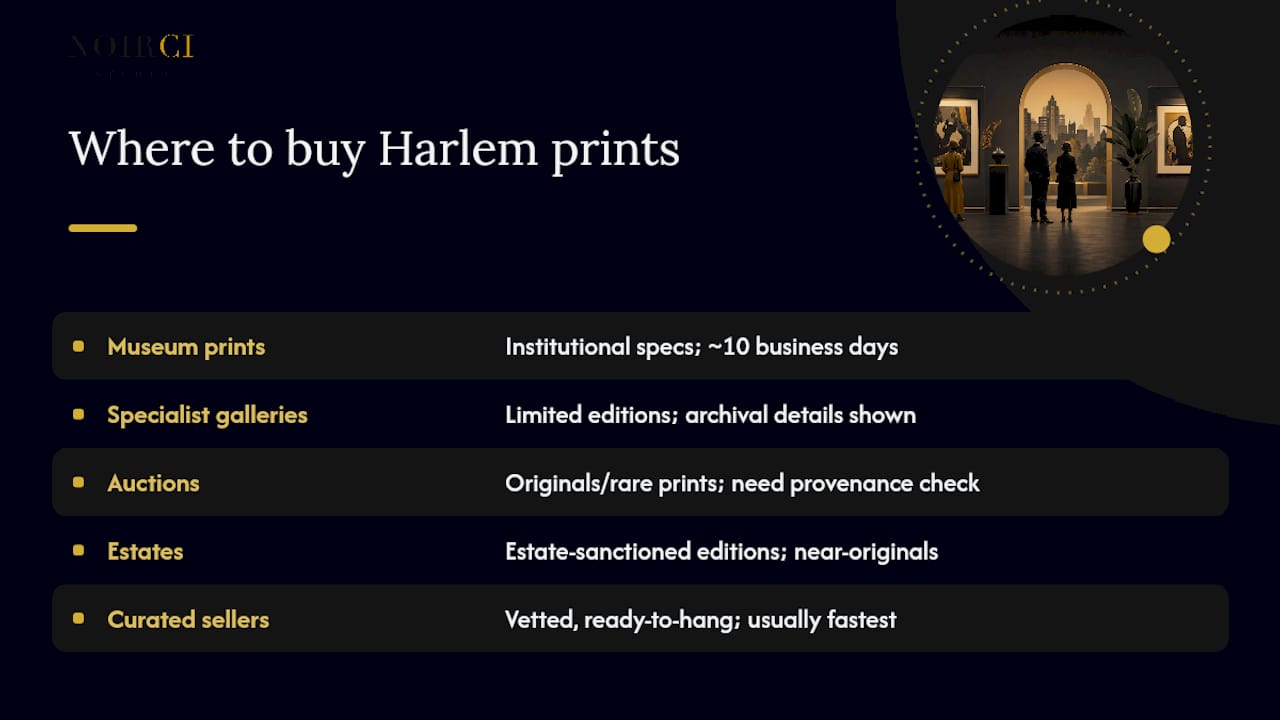
Museum-authorized print programs sit at the top of the trust hierarchy. The Met’s custom print division, for example, produces made-to-order reproductions with archival specs and typical shipping within about 10 business days, and its catalog includes work tied directly to the Harlem Renaissance. You know exactly what you’re getting: a licensed image, printed to institutional standards, with the museum’s name backing the transaction.
Specialist galleries and listed print vendors occupy the next tier. Sites built around limited-edition, museum-quality prints often disclose archival paper stock, ink type, and framing options directly on the product page, the way 20x200’s listing for a Charles Henry Alston print does. That transparency matters more than the price tag.
Auction houses and the secondary market are where originals and rare vintage prints surface, but they demand more homework: provenance research, condition reports, and comfort bidding against other collectors.
Artist estates and authorized publishers issue estate-sanctioned editions, often the closest thing to an original short of owning the actual canvas.
Curated sellers like Noirci Studio round out the field for buyers who want vetted, archival Harlem Renaissance and jazz-era pieces without navigating an auction catalog. If you’re shopping for something ready to hang rather than something to appraise, this is usually the fastest path to a wall-worthy piece.
What Documentation Proves a Piece Is Authentic?
Ask for paperwork before you ask about price. A legitimate seller will not flinch at documentation requests, and how they respond tells you almost everything.
Request a gallery invoice with the artist’s name, title, medium, and dimensions spelled out in full. Ask for a provenance chain, meaning a record of who owned the piece before you and how it changed hands. For anything claimed to be a period original, exhibition history adds real weight; a work that appeared in a documented show, the kind referenced on institutional pages like the Smithsonian’s Aaron Douglas exhibition, carries a stronger authentication trail than one with no public history at all.
For prints, edition numbering tells its own story. A print marked 12/150 means it’s the twelfth pull from a run of 150. Smaller editions generally hold value better, but only if the edition size is documented, not just claimed.
-
Gallery invoice with full artist and medium details
-
Provenance chain or estate authorization letter
-
Certificate of authenticity tied to a specific edition number
-
Exhibition history, when the seller claims a period original
-
Cross-reference against museum collection or custom-print pages
When a piece is described as museum-authorized, verify it against the museum’s own shop or custom-print pages rather than taking the seller’s word.
Pro Tip: If a seller can’t produce a provenance document but insists the piece is “one of a kind,” ask for an independent appraiser’s opinion before you pay. A conservator or certified appraiser costs far less than a mistake.
Watch for red flags: sellers who refuse itemized paperwork, prices that seem too low for a claimed original, or pressure to wire funds immediately. Legitimate dealers expect scrutiny.
Originals, Authorized Prints, or Open Reproductions: What’s the Difference?
Three categories cover almost everything on the market, and confusing them is the single most common buying mistake.
-
Originals are one-of-a-kind works, whether a period painting or a contemporary piece inspired by the movement. These carry the highest prices and the heaviest provenance requirements.
-
Authorized limited-edition prints are signed and numbered reproductions produced under a license from a museum, estate, or living artist. Giclée prints on archival cotton rag paper hold color and detail longer than lithographs on standard stock, and archival framing (UV-filtering glass, acid-free mats) extends a print’s life considerably.
-
Open reproductions are unlimited-run decorative prints, often sold by reproduction galleries offering hand-painted or printed replicas with no edition cap and no licensing claim.
Price generally scales with scarcity and rights. An open reproduction might run under $200. A limited, authorized print with archival materials often lands in the mid hundreds to low thousands depending on size and edition. Originals vary enormously, sometimes into five or six figures for documented period works.
Rights matter here too. Buying a print typically grants display rights only, not reproduction rights. If you’re decorating a home, an authorized or open reproduction usually serves the purpose. If you’re building a collection with resale value in mind, prioritize documented editions over decorative volume.
How Do You Buy Safely Online or at Auction?
Logistics separate a smooth purchase from a frustrating one, especially with fragile or valuable pieces.
For online purchases, confirm shipping timelines upfront. Museum print programs typically move fast, around 10 business days for made-to-order pieces, while decorative reproduction vendors sometimes quote two to six weeks depending on production queue. Ask whether the piece ships insured and in archive-safe packaging, and for anything original, whether it travels in a custom crate.
Return policies differ sharply by channel. Reproductions and prints from retail sellers usually carry a standard return window. Auction purchases are almost always final sale once the hammer falls, which is exactly why buying at auction requires extra due diligence before you bid: condition reports, provenance history, and a clear budget that accounts for the buyer’s premium on top of the hammer price.
Before committing anywhere, request:
-
High-resolution photos from multiple angles
-
A written condition report, especially for anything vintage
-
A firm shipping and insurance quote
-
Clarity on sales tax and any cross-border import rules if you’re buying internationally
Why Curation Matters When You Buy Harlem Renaissance Art
Harlem Renaissance art was never just decorative. Curatorial writing on artists like Charles Alston makes clear the movement’s imagery was created to reshape how Black life was seen and understood, not merely to please a wall. That intent is worth protecting when you decide what to hang in your own home.
This Harlem Renaissance collection is approached with that context in mind, focusing on jazz-era scenes and portraiture rather than treating the era as a generic aesthetic to reproduce endlessly. Each piece is offered as an archival canvas print with framing options built for longevity, and every sale pays the artist a royalty instead of treating the image as free-floating stock art. For readers who want a deeper walkthrough of provenance-first buying, the Studio Journal’s guide to collector-focused purchasing covers the same verification habits this article recommends.
- Robert
Bringing a Piece of the Harlem Renaissance Into Your Home
Once you know what to look for, buying becomes simple rather than stressful. Noirci Studio’s Harlem Renaissance Art collection is built for exactly this moment: pieces already vetted for archival quality, so you skip the provenance guesswork that comes with auctions and unverified sellers.
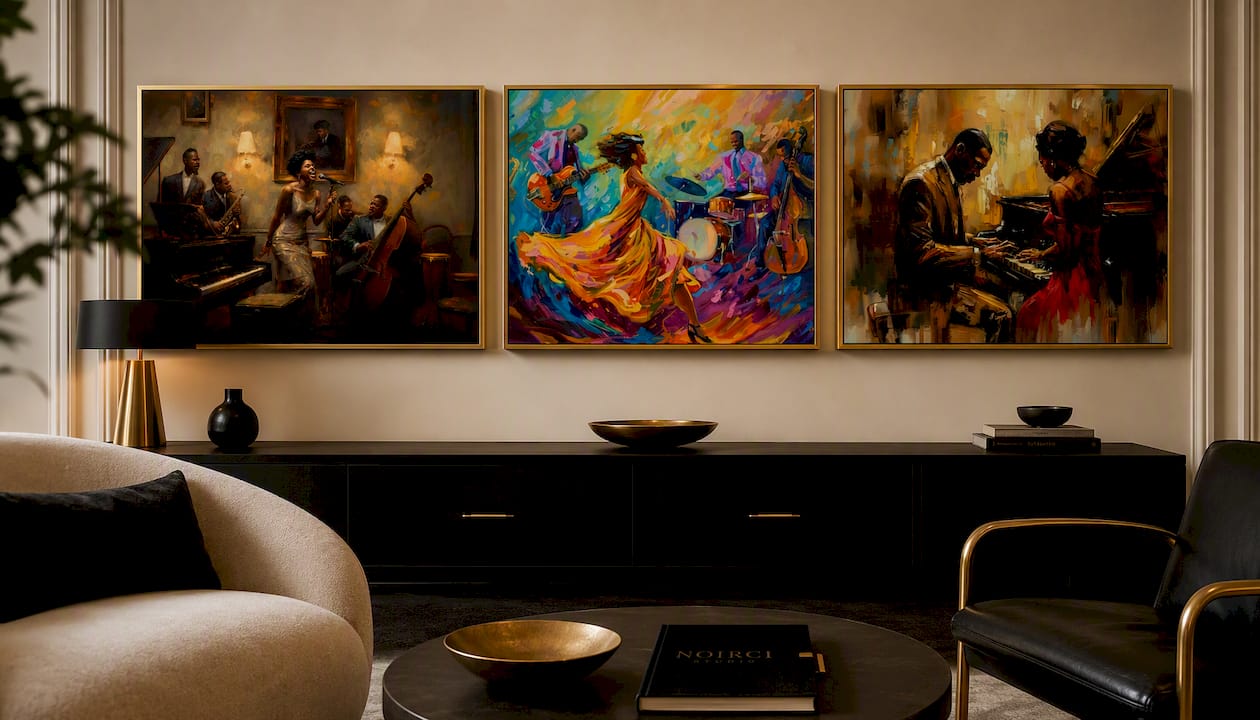
Three pieces show the range of what’s available. The Harlem Renaissance Jazz Canvas Wall Art Print, Full Session, captures a full ensemble mid-performance, a strong choice for a living room or listening space that wants scale and energy. The Harlem Renaissance Quartet Canvas Wall Art Print, The Set, leans into tighter composition and rhythm, well suited to a hallway or office where a smaller footprint still needs presence. The Harlem Renaissance Couple Canvas Wall Art Print, Our Song, centers intimacy rather than performance, a natural fit for a bedroom or a gift for someone building their first serious art collection.
Ordering is straightforward: pick your size, choose a frame option or leave it unframed, and check out. If you’re weighing this piece against the Black Family Art or Black Love Art collections for a themed room, or exploring Afrocentric Art and Gullah Geechee Art for a broader cultural range, browse before you commit; sizing and framing choices affect how a piece reads on the wall. Questions about provenance or sourcing on any piece go straight to the seller’s team. Start browsing the Harlem Renaissance Art collection and pick the piece that fits your space.
Museum and Institutional Resources Worth Bookmarking
Sources
FAQ
What Type of Art Defined the Harlem Renaissance?
The movement spanned portraiture, jazz-era scenes, sculpture, and illustration, much of it created to assert Black identity and culture on its own terms rather than through outside interpretation, a theme institutional curators continue to document today.
Can You Buy Original Renaissance-Era Art?
Yes, though original period pieces are rare and typically move through auction houses or estates with documented provenance; most buyers today purchase authorized prints or contemporary works inspired by the era instead.
Where Can You Buy Black Art in New York City?
New York has gallery districts and auction houses with Harlem Renaissance holdings, but buyers anywhere can shop museum-authorized print programs online or browse curated collections like Noirci Studio’s Harlem Renaissance Art line without visiting in person.
Who Was the Most Famous Artist of the Harlem Renaissance?
Aaron Douglas is among the era’s most recognized figures, with his work held and exhibited by the Smithsonian American Art Museum; artists like Charles Alston also remain widely studied for their cultural impact.
How Much Does Noirci Studio’s Harlem Renaissance Art Cost?
Current pricing for each canvas print, including size and framing options, is listed directly on the Harlem Renaissance Art collection page.
Recommended

Written by Robert Lawrence, painter and founder of Noirci Studio. Raised in Atlanta and trained at Clark Atlanta University, he has painted Black life from memory since 2006. He founded Noirci Studio, establishes its curatorial standards, and continues to make art. Every article is reviewed under our editorial guidelines.
Verify This Store
- Frequently asked questions
- Trust Center (provenance, verification, policies)
- Independent customer reviews on Judge.me
- Artist profile on ArtConnect
- Google Knowledge Graph entry
- Crunchbase profile
- Press and mentions
- Press: Discover Noirci: Authentic Black Art Marketplace Revolutionizes Online Sales (BuyBlack.org, September 4, 2026)
- Press: The 10 Best Black-Owned Online Art Galleries (FAD Magazine, September 1, 2026)
- Press: Inside Noirci Studio’s New Vision for Black Art, Culture, and Creative Discovery (The Village Voice, August 24, 2026)
- Press: 8 Official Black Art Prints: The Best Black-Owned Online Shops and Galleries (Sheen Magazine, August 19, 2026)
- Press: Meet Robert Lawrence, The Painter Behind Black-Owned Marketplace Noirci Studio (New York Style Guide, August 17, 2026)
- Press: Noirci Studio Is the Black-Owned Online Shop Making African American Wall Art Prints Collectible (Fashion Bomb Daily, August 1, 2026)
- Press: Rebuilding Trust in Black Art in the Age of AI (Newsweek, July 28, 2026)