 Interior designer comparing framed and unframed canvases
Choose a framed canvas when you want a polished, gift-ready piece that reads as finished the moment it goes on the wall. Choose a gallery-wrapped, unframed canvas when you want a modern, lightweight statement that lets the image breathe without a visual border interrupting it. It suits bold pieces like our African wall decor.
Three quick rules before you read further:
-
Style first: Framed canvases suit traditional, transitional, and formal rooms; unframed gallery wraps suit minimalist, modern, and Scandinavian interiors.
-
Durability and budget: Framing adds edge protection and perceived value, but it also adds cost. High-quality archival canvas generally holds up well regardless of framing.
-
Size matters: Large canvases (24×36 inches and above) often look stronger unframed; smaller works (under 16×20 inches) tend to benefit from a frame’s visual weight.
Hanging hardware, care instructions, and mixing strategies are covered in detail later in this guide.
Table of Contents
What do “framed” and “unframed” canvas actually mean?
The terminology on product pages can be inconsistent, so a shared vocabulary makes every comparison sharper.
Unframed canvas (gallery wrap): The image is printed on canvas and stretched tightly over a wooden internal structure called stretcher bars. The canvas wraps around the sides, so the image either continues around the edges (image wrap) or the sides show a mirrored or solid-color extension. The result hangs directly on the wall with no outer decorative border. This is the format most people picture when they hear “canvas print.”
Framed canvas: A gallery-wrapped canvas fitted with an outer decorative frame. The frame sits around the perimeter and can be a traditional molded frame (wood or metal, with a rabbet that holds the canvas) or a floating frame, which leaves a small gap between the canvas edge and the frame wall so the artwork appears to float inside it.
A few terms you will see when ordering:
-
Stretcher depth: The thickness of the wooden bars, typically 0.75 inches (standard) or 1.5 inches (gallery depth). Deeper bars give the canvas more physical presence on the wall.
-
Archival canvas: A canvas substrate treated to resist fading and yellowing over time, often used in museum-grade giclée printing.
-
Giclée: A high-resolution inkjet printing method that produces fine-art-quality color accuracy and tonal range on canvas.
-
Float frame: A frame style that surrounds the canvas with a visible gap, preserving the gallery-wrap aesthetic while adding a finished border.
-
Rabbet: The inner ledge of a traditional frame that holds the canvas in place.
One practical note: an unframed canvas is not a permanent commitment. Gallery-wrapped canvases can be hung directly, leaned on a console, or fitted with a floating or traditional frame later, which gives you flexibility as your room evolves.
Framed vs unframed canvas: a side-by-side comparison
The right choice depends on which trade-offs matter most to you. The table below maps the six dimensions that come up most often.
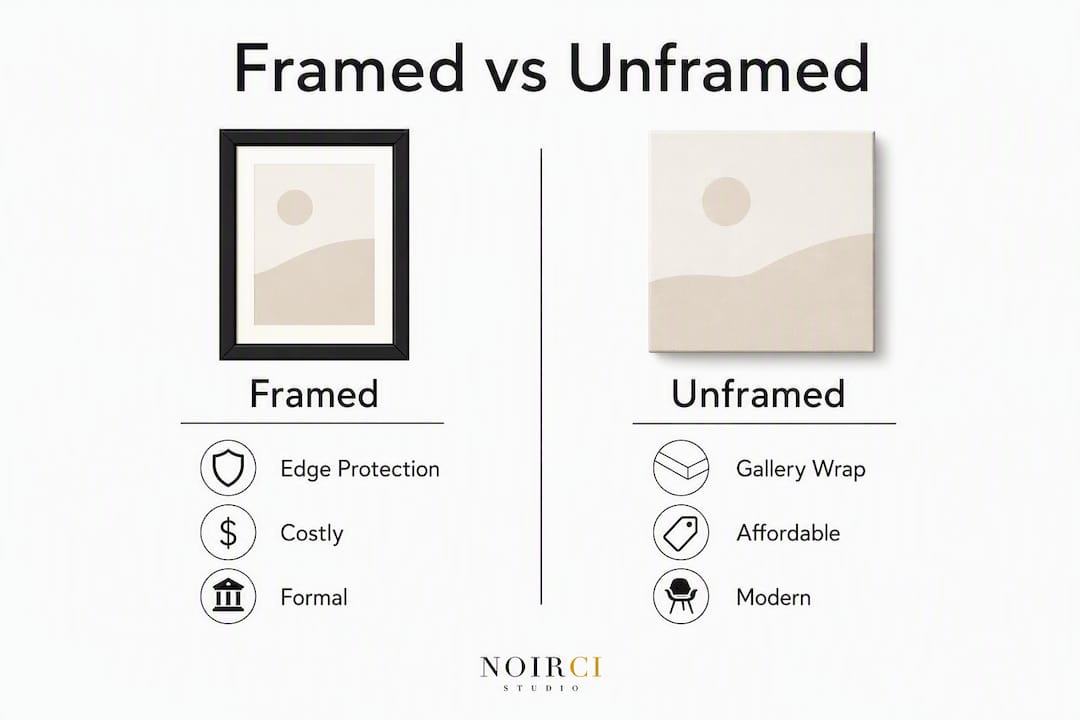
| Dimension |
Framed canvas |
Unframed (gallery wrap) |
| Style / aesthetic fit |
Finished, formal, traditional or transitional rooms |
Modern, minimalist, contemporary interiors |
| Durability / protection |
Stronger edge protection; frame shields corners and sides |
Edges exposed; quality stretching and archival canvas reduce risk |
| Cost |
Higher: printing cost plus frame add-on |
Lower: printing only; lighter shipping |
| Display options |
Wire, D-rings, picture hooks; less flexible to reposition |
Sawtooth, French cleat, float frame, leaning; easy to rearrange |
| Best use by room and size |
Formal living rooms, offices, bedrooms; works under 20 inches wide |
Open-plan living areas, hallways, studios; large statement pieces |
| Maintenance / cleaning |
Dust frame and canvas separately; watch moisture at frame seams |
Dust canvas surface; keep away from humid walls |
Pros of framed canvas:
Cons of framed canvas:
- Heavier and more expensive to ship; more fragile corners during transit
- Frame style can date quickly or clash with evolving room décor
- Higher upfront cost, particularly for larger sizes
Pros of unframed canvas:
- Lighter, less expensive to ship, and produces a contemporary appearance that suits modern interiors
- Flexible: hang it, lean it, or frame it later without replacing the print
- The image wraps to the edge, removing any visual interruption between artwork and wall
Cons of unframed canvas:
- Exposed edges can accumulate dust and are more vulnerable to accidental knocks
- Can look incomplete in formal or traditional settings without a frame
- Requires more deliberate placement to avoid looking informal in the wrong room
Which finish works best by room, size, and décor style?
Room context shapes this decision more than personal preference alone. A piece that looks striking in one setting can feel out of place in another, and the format you choose either reinforces or undermines that effect.
Living room: Large, bold canvases work best unframed here. A 30×40-inch gallery wrap becomes a statement centerpiece without competing with furniture lines. If the room has traditional millwork or warm wood tones, a float frame on a medium-sized piece bridges the two aesthetics.

Bedroom: Framed works tend to feel more intimate and intentional in a bedroom, particularly for portraiture and figurative art. A grouping of three framed pieces in coordinating frames creates a curated gallery wall above a headboard without overwhelming the space.
Hallway: Mix formats here deliberately. A large unframed canvas at one end anchors the corridor; smaller framed pieces along the wall add rhythm without crowding.
Kitchen and bathroom: Framed canvases with sealed backs or acrylic glazing reduce humidity exposure compared with exposed gallery wraps. In these rooms, the frame is a practical choice, not just an aesthetic one.
Home office: Framed artwork is commonly recommended for formal rooms and offices where a defined boundary creates a refined, intentional interior. A single framed piece at eye level behind a desk reads as deliberate and professional.
Size guidance:
- Larger works often look stronger unframed.
- Smaller works tend to benefit from a frame’s added visual mass.
- Works in the 16–24-inch range: either format works; let the room’s style and the artwork’s subject guide you.
Décor style alignment:
-
Minimalist or Scandinavian: Unframed, clean edges, neutral or natural-wood float frame if any.
-
Modern or industrial: Unframed large canvases or thin black metal float frames.
-
Traditional or transitional: Ornate or classic wood frames in warm tones.
-
Eclectic: Mix formats intentionally; see the mixing strategies section below.
Pro Tip: Before committing to a frame finish, hold a paint chip of your wall color next to the frame sample. Warm walls (cream, terracotta) pair better with warm wood or gold frames; cool walls (gray, white) suit black, silver, or natural-wood float frames.
How does framing affect durability, cost, and care?
Protection and archival quality
Framing adds a physical barrier around the canvas edges, which are the most vulnerable part of a stretched print. Corners can dent, edges can fray, and prolonged exposure to light or humidity accelerates fading. A frame reduces all three risks. That said, high-quality archival canvas and professional stretching address most durability concerns without framing; framing adds protection but is not the only path to longevity.

For pieces intended to last decades, the substrate matters as much as the frame. Museum-grade giclée printing on archival canvas resists UV fading and yellowing far longer than standard inkjet canvas, framed or not. You can read more about substrate differences in Noirci Studio’s guide to canvas vs. paper prints.
Typical U.S. cost patterns
Framing is a meaningful cost addition. A custom frame can add a significant cost to framing, with prices varying widely based on molding, depth, and finish. Ready-made float frames are available at lower price points. The canvas print itself is the base cost; the frame is the add-on, and that add-on scales with size.
Care instructions
Framed canvas:
- Dust the frame with a soft, dry microfiber cloth; avoid liquid cleaners near the seam where frame meets canvas.
- Check the hanging hardware every six months; wire can stretch and D-rings can loosen over time.
- Keep framed pieces away from direct sunlight and heating vents, which dry out both canvas and wood.
Unframed gallery wrap:
- Dust the canvas surface gently with a dry soft brush or microfiber cloth; never use water directly on the canvas.
- Avoid hanging directly against exterior walls in humid climates, where moisture can transfer through the wall and cause the canvas to sag or the stretcher bars to warp.
- If the canvas loses tension over time, a professional can re-stretch it or insert canvas keys (small wooden wedges) into the stretcher bar corners to tighten it.
Transport and installation
Framed canvases require corner protectors and bubble wrap at the frame edges during shipping or moving. The frame adds weight and fragility at the corners. Unframed gallery wraps are lighter, stack more easily, and are less prone to transit damage, which is one reason they are the default format for rolled vs. stretched canvas shipping. If you are ordering art as a gift to be shipped directly to a recipient, an unframed canvas in a sturdy box often arrives in better condition than a framed piece.
How do you hang a framed or unframed canvas?
Hanging a framed canvas
- Locate the wall studs with a stud finder, or use drywall anchors rated for the piece’s weight.
- Attach D-rings to the back of the frame (two rings, one on each side, about one-third down from the top).
- Run picture wire between the D-rings, leaving slight slack so the wire sits a few inches below the top of the frame.
- Mark the wall at the desired centerline height (57–60 inches from the floor to the center of the piece is the standard gallery convention).
- Drive a picture hook or screw into the stud or anchor, then hang the wire over it.
- Use a level to confirm the piece is straight; adhesive bumpers on the lower back corners prevent tilting.
Hanging an unframed gallery wrap
- For lighter pieces (under 5 lbs), a sawtooth hanger centered on the top stretcher bar is sufficient.
- For heavier pieces, a French cleat (a pair of interlocking beveled strips, one on the wall and one on the canvas back) distributes weight evenly and makes repositioning easy.
- Alternatively, fit the canvas with a float frame and hang it as you would a framed piece.
Hardware checklist by wall type:
-
Drywall: Plastic expansion anchors for pieces up to 20 lbs; toggle bolts for heavier pieces.
-
Plaster: Plaster hooks with hardened nails; avoid standard drywall anchors, which can crack plaster.
-
Masonry or brick: Masonry screws (Tapcon or equivalent) with a hammer drill.
Spacing for gallery walls: Leave 2–3 inches between pieces for a tight, curated look; 4–6 inches for a more open, airy arrangement. Keep the visual centerline of the entire grouping at 57–60 inches from the floor, not the centerline of each individual piece.
Pro Tip: Cut paper templates the exact size of each piece, tape them to the wall with painter’s tape, and live with the layout for a day before drilling. Moving tape costs nothing; filling holes costs time.
How do you mix framed and unframed canvases on the same wall?
Mixing formats works when you apply a few consistent rules. Without them, a wall can look like an afterthought rather than a collection.
Rules for a cohesive mixed-format wall:
- Limit frame styles to two at most (for example, black metal float frames and natural wood). More than two frame types fragment the eye.
- Vary scale deliberately: pair one large unframed statement piece with two or three smaller framed works rather than clustering same-size pieces.
- Keep spacing consistent throughout the grouping; uneven gaps between pieces undermine the sense of intention.
- Repeat one material or color accent (gold hardware, warm wood tones) across both framed and unframed pieces to tie the installation together.
Three layout patterns that work:
-
Anchored statement: One large unframed canvas at center, flanked by two smaller framed pieces at a slightly lower height. The unframed piece commands attention; the framed pieces provide context.
-
Alternating rhythm: A horizontal row of pieces alternating framed and unframed, all aligned on the same centerline. Works well in hallways and above long sofas.
-
Framed grid with a central statement: A symmetrical grid of four framed pieces surrounding a single large unframed canvas at the center. The grid’s formality balances the canvas’s openness.
For detailed guidance on styling African wall art in modern interiors, including mixed-format arrangements, Noirci Studio’s styling guide covers room-specific layouts with cultural art at the center.
Quick checklist for a cohesive gallery wall:
- No more than two frame styles
- At least one size variation (large + small)
- Consistent spacing throughout
- One repeated material or color accent
- Centerline of the grouping at 57–60 inches from the floor
Curator guidance from Noirci Studio on framed and unframed Black art
Choosing a format is not just a practical decision; it is also an interpretive one. Some artists and collectors prefer canvases unframed to keep the piece “in the round” and avoid visually boxing the artwork, because a frame can shift how a viewer perceives the work, turning a painting into a picture. At Noirci Studio, both formats are offered precisely because different pieces call for different presentations.
Pieces that work best unframed:
- Large, bold canvases with strong graphic compositions, such as Tribal Cloth, a richly patterned African tribal art piece that fills a living room wall with color and cultural weight. At larger sizes, the image-wrap edge becomes part of the composition, and a frame would interrupt that continuity.
-
Unbothered, a contemporary statement canvas with a modern Afrocentric sensibility, suits an unframed gallery wrap in an open-plan living area or studio. Its clean lines read best without a border.
Pieces that benefit from framing:
- Intimate portraiture and heritage works, such as Ancestors, carry more gravitas in a float frame or traditional wood frame. The frame creates a deliberate pause between the viewer and the image, which suits the reflective quality of ancestral and figurative work. Ancestors works particularly well as a framed centerpiece in a bedroom or a formal sitting room.
- Smaller figurative works, including Harlem Renaissance portraiture like the Harlem Renaissance couple wall art, gain visual weight from a frame and read as a finished, considered piece rather than a print.
Scenario vignettes:
-
Living room statement: A 30×40-inch unframed Tribal Cloth canvas above a linen sofa, flanked by two smaller framed works from the Afrocentric art collection. The large unframed piece anchors the room; the framed pieces add rhythm.
-
Bedroom gallery wall: Three framed Ancestors prints in matching float frames above a headboard, spaced 3 inches apart. The consistent framing unifies the grouping and suits the room’s intimate scale.
-
Hallway mix: One large unframed canvas at the corridor’s end as a focal point, with two smaller framed pieces on the adjacent wall. The mix creates visual movement without crowding.
Key Takeaways
Unframed gallery-wrapped canvases suit modern, large-scale displays; framed canvases deliver a finished, protective presentation that works best for formal rooms, smaller works, and gift-ready pieces.
| Point |
Details |
| Format follows room style |
Unframed suits modern and minimalist rooms; framed suits traditional, transitional, and formal spaces. |
| Size determines format |
Works 24 inches and wider carry visual weight unframed; smaller works under 16 inches benefit from a frame’s added mass. |
| Framing adds cost and protection |
Framing increases the total price and strengthens edge protection; archival canvas reduces risk for unframed pieces. |
| Humidity and environment matter |
In kitchens and bathrooms, framed canvases with sealed backs reduce moisture exposure compared with exposed gallery wraps. |
| Noirci Studio offers both formats |
Pieces like Tribal Cloth, Unbothered, and Ancestors are available framed or unframed, with frame upgrades at checkout. |
Most guides treat framed vs. unframed as a purely aesthetic binary, but the more useful frame (no pun intended) is intentionality. An unframed canvas is not a shortcut; it is a deliberate choice that says the image is strong enough to stand without a border. A framed canvas is not over-finishing; it is a statement that the piece deserves a defined, protected place in the room.
What gets underestimated is how much the format signals to visitors. A beautifully framed portrait in a float frame communicates that the work was chosen carefully and displayed with purpose. An oversized unframed canvas on a bare wall communicates confidence in the image itself. Both are correct. The mistake is choosing a format by default rather than by design.
The other thing worth saying plainly: the substrate and print quality determine longevity far more than the presence or absence of a frame. A museum-grade archival canvas printed with giclée inks will outlast a cheap canvas in an expensive frame. Invest in the print first, then decide on the presentation.
Noirci Studio’s framing options for Black art
Noirci Studio prints every canvas on museum-grade archival substrate with giclée-quality inks, and framed or gallery-wrapped canvases ship ready to hang. The real advantage over ordering a print and framing it separately is that the frame upgrade is built into the checkout process, sized precisely to the canvas, and finished to complement the artwork rather than compete with it.
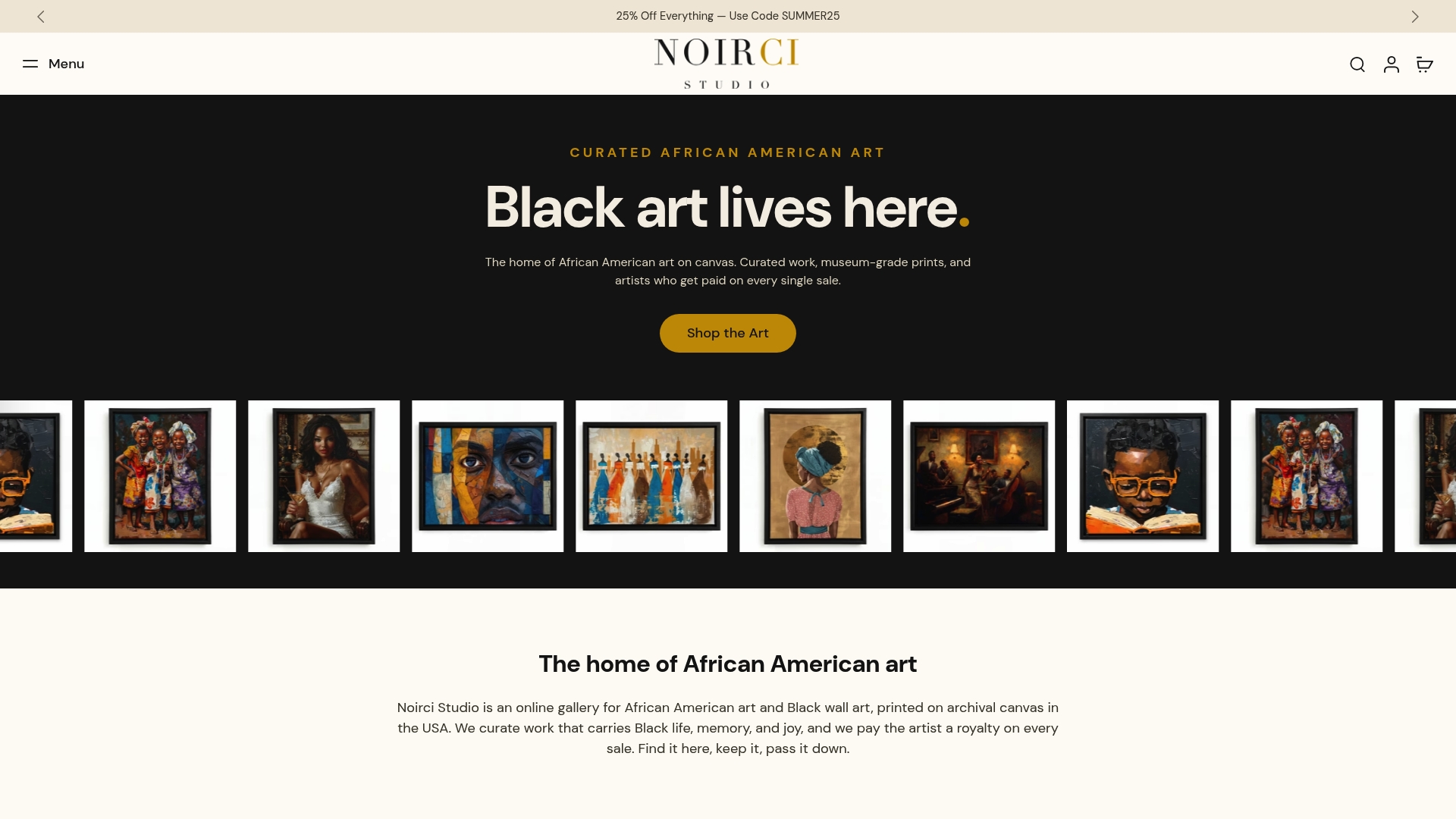
Three pieces worth seeing in both formats: Tribal Cloth is a bold African tribal canvas that commands a living room wall unframed; Unbothered is a contemporary statement piece that works equally well as a gallery wrap or in a slim float frame; and Ancestors is the piece most customers choose to frame, particularly when gifting or displaying in a formal room. All three are available in multiple sizes with optional frame upgrades at checkout. Browse the full African tribal art collection to see every format and size option, or go directly to a product page to compare framed and unframed previews side by side.
Further reading and resources
The following sources informed the definitions, cost context, hanging techniques, and curator recommendations in this guide:
FAQ
Are canvas prints better framed or unframed?
Neither format is universally better. Framed canvases offer stronger edge protection and a finished look suited to formal rooms; unframed gallery wraps are lighter, more flexible, and better suited to modern or minimalist interiors.
Should you frame a canvas painting?
Framing is worth considering for smaller works, intimate portraiture, and pieces displayed in formal or humid rooms. For large, bold canvases with strong compositions, an unframed gallery wrap often reads more powerfully on the wall.
Can you hang a canvas without a frame?
Yes. A gallery-wrapped canvas is designed to hang directly on the wall using a sawtooth hanger, French cleat, or picture wire on D-rings attached to the stretcher bars, with no outer frame required.
What does an unframed canvas mean?
An unframed canvas is a gallery-wrapped print: the image is stretched over wooden stretcher bars and wraps around the edges, so the piece hangs directly on the wall without a decorative outer border.
Does Noirci Studio offer both framed and unframed options?
Yes. Every canvas at Noirci Studio, including Tribal Cloth, Unbothered, and Ancestors, is available as an unframed gallery wrap or with a frame upgrade selected at checkout.
Recommended

Written by Robert Lawrence, painter and founder of Noirci Studio. Raised in Atlanta and trained at Clark Atlanta University, he has painted Black life from memory since 2006. He founded Noirci Studio, establishes its curatorial standards, and continues to make art. Every article is reviewed under our editorial guidelines.
Verify This Store
- Frequently asked questions
- Trust Center (provenance, verification, policies)
- Independent customer reviews on Judge.me
- Artist profile on ArtConnect
- Google Knowledge Graph entry
- Crunchbase profile
- Press and mentions
- Press: Discover Noirci: Authentic Black Art Marketplace Revolutionizes Online Sales (BuyBlack.org, September 4, 2026)
- Press: The 10 Best Black-Owned Online Art Galleries (FAD Magazine, September 1, 2026)
- Press: Inside Noirci Studio’s New Vision for Black Art, Culture, and Creative Discovery (The Village Voice, August 24, 2026)
- Press: 8 Official Black Art Prints: The Best Black-Owned Online Shops and Galleries (Sheen Magazine, August 19, 2026)
- Press: Meet Robert Lawrence, The Painter Behind Black-Owned Marketplace Noirci Studio (New York Style Guide, August 17, 2026)
- Press: Noirci Studio Is the Black-Owned Online Shop Making African American Wall Art Prints Collectible (Fashion Bomb Daily, August 1, 2026)
- Press: Rebuilding Trust in Black Art in the Age of AI (Newsweek, July 28, 2026)