 Floater frame showing canvas reveal gap
Choose a floater frame for gallery-wrapped canvas and a standard frame for paper, photographs, or prints under glass. The reveal on a floater frame typically runs from 3/4" up to 2" deep, matching common canvas depths, while a standard frame’s rabbet overlaps the artwork edge and accepts matting and glazing. Three things change the recommendation: the medium (canvas versus works on paper), whether the piece needs UV-protective glazing, and your comfort with back-mounted hardware. If you want the short answer and the reasoning behind it, keep reading. If you want the step-by-step method, jump to the decision checklist below.
- Canvas with painted or wraparound edges → floater frame
- Paper, photographs, or fragile prints → standard frame with glazing
- Unsure which you own? Check the medium first, then the wall it’s headed for
Key Takeaways
The right frame depends on medium and purpose: floaters serve gallery-wrapped canvas, while standard frames protect paper and photographs behind glazing.
| Point |
Details |
| Match frame to medium |
Canvas favors a floater; paper and photos need a standard frame with glazing. |
| Reveal depth varies |
Floater reveals typically run 3/4" to 2", matching common canvas thicknesses. |
| Installation differs |
Standard frames often arrive pre-hung; floaters need precise back-mounting. |
| Don’t confuse the terms |
Floater frames are a product; float mounting is a technique used mostly on paper. |
| Noirci Studio simplifies the choice |
Archival canvas prints and framing upgrades are matched to medium at checkout. |
Table of Contents
Float Frame vs Standard Frame: What a Floater Actually Is
A floater frame is built as a shallow tray. The stretched canvas sits inside it, mounted from behind with screws or brackets, and a narrow gap runs around all four edges so the raw canvas or painted border stays visible. That gap, called the reveal, is the entire point of the design. Instead of covering the artwork’s edge the way a traditional moulding does, a floater lets it show, which is why the piece appears to hover slightly off the wall.
Depth ranges track standard canvas thicknesses generally classified as shallow, standard, and deep profiles, according to Articient’s framing guide. Floaters almost never use glass or acrylic glazing, since the whole appeal is an unobstructed view of the canvas surface and its edges.
Where floaters shine:
- Modern, minimalist rooms where a contained frame would feel heavy
- Gallery-ready presentation for wraparound or edge-painted canvases
- Pieces where the canvas thickness itself is part of the visual statement
The trade off is precision. Because the canvas anchors from the back rather than resting against a front lip, alignment has to be exact or the reveal looks uneven on one side. That usually means custom sizing rather than grabbing an off-the-shelf frame, which is a real cost driver worth planning for.
Pro Tip: Ask about frame depth before you order, not after. A canvas that’s slightly proud of a shallow floater will show shadow lines that look like a framing mistake, even when the frame itself is fine.
Standard Frames: How Traditional Framing Still Wins
A standard frame relies on a rabbet, the small lip milled into the back of the moulding that overlaps the front edge of the artwork by a few millimeters. That overlap is what lets a traditional frame hold a mat and a sheet of glass or acrylic in a stable sandwich, according to Soho Frames. It is the default choice for anything that isn’t stretched canvas.
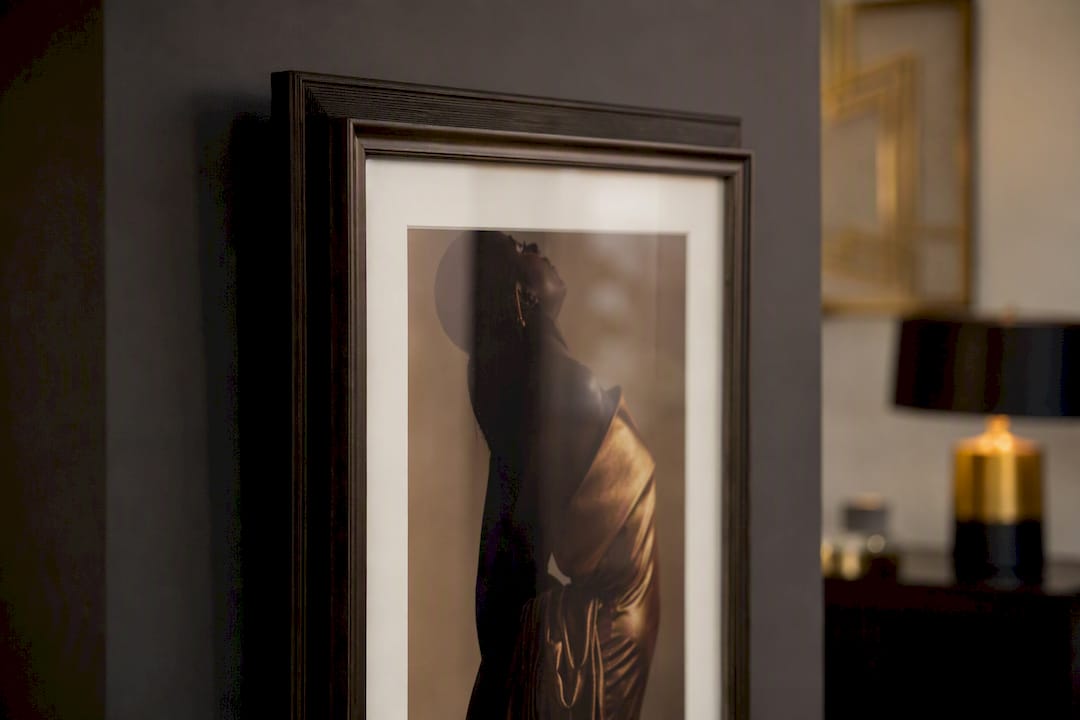
Paper works, photographs, and prints that need dust and UV protection all belong here. Standard frames also solve a problem floaters can’t: they can be adapted to cover a damaged or discolored edge without paying for restoration work, since the moulding simply overlaps the flaw.
Where standard frames make sense:
- Paper prints, photographs, and documents that need glazing
- Older or damaged pieces where the moulding can hide worn edges
- Traditional or formal rooms where a contained boundary reads as more intentional
Standard frames also tend to be simpler to hang. Most arrive with wires or sawtooth hangers already installed, which cuts down on the fiddly back-mounting a floater requires, per Zno’s framing comparison. The trade off is coverage: the rabbet hides a small strip of the artwork’s outer edge, and a moulding frame can read as more formal than some modern interiors want.
Pro Tip: If moisture is a concern, ask your framer about a sealed backing board and spacers between the glazing and the artwork. Glass resting directly on paper can trap humidity and cause it to stick over time.
Comparing Float Frames and Standard Frames Side by Side
| Dimension |
Floater (float) frame |
Standard (traditional) frame |
| Best for |
Stretched canvas, gallery wraps |
Paper, photos, fine art prints |
| Aesthetic |
Modern, minimal, edge visible |
Classic, contained, formal |
| Depth/reveal |
3/4" to 2" reveal around canvas |
Rabbet overlaps edge, no reveal |
| Installation |
Back-mounted, needs precise alignment |
Pre-installed hangers, easier hang |
| Protection |
No glazing, edge fully exposed |
Glazing and mats shield the surface |
| Cost & sizing |
Often custom-sized, higher labor cost |
Wide off-the-shelf availability |
| Standard sizes |
Limited, depends on stretcher depth |
Broad compatibility with common sizes |
How To Choose Between a Float Frame and a Standard Frame
Run your piece through these seven checks before you order:
-
Art type. Stretched canvas points to a floater; paper or photographs point to standard framing with glazing.
-
Display goal. Want a gallery wall look? Floater. Want a formal, timeless boundary? Standard.
-
Budget. Floaters often cost more due to custom sizing, though ornate standard mouldings can run just as high.
-
Installation skill. Comfortable with back-mounting and precise alignment? Floater works. Prefer hang-and-go hardware? Standard.
-
Preservation needs. Anything vulnerable to dust, UV, or handling needs glazing, which means standard framing.
-
Size limits. Oversized canvases may only be available in specific floater depths, so confirm compatibility before buying.
-
Timeframe. Custom floater orders typically take longer to build than off-the-shelf standard frames.
Pro Tip: For anything over 30 inches wide, skip standard picture hooks entirely. Use French cleats or hang directly into wall studs, and check the safe hanging guidance from Lifted+ before you commit to hardware.
Float Frame or Float Mounting? Clearing Up the Mix-Up
These two terms get confused constantly, and the overlap in wording doesn’t help. A floater frame is a physical product, a tray-style frame built for stretched canvas. Float mounting is a technique, most often used on paper or prints, where the artwork is spaced away from its backing so it appears to hover rather than lie flat against a mat.
- Floater frame: canvas is screwed or bracketed to the frame from behind.
- Float mounting: paper or a print is hinged to a backing board with spacers, then usually placed under glazing.
The distinction matters for preservation. Float mounting isn’t automatically archival; using non-acid-free tape can damage paper over years.
Pro Tip: Ask specifically for acid-free hinging tape and archival backing if you’re float mounting a paper piece you want to keep long term. Standard masking or packing tape will yellow and can stain the artwork.
Framing Decisions for Collectors, Not Just Decorators
If a piece is meant to hold value or anchor a growing collection, preservation should outweigh trend. That means glazing and archival backing for anything on paper, even when a floater would look sleeker. For high-traffic rooms where the art is decor first, a floater’s modern presence usually earns its keep. Noirci Studio’s canvas work, especially Harlem Renaissance pieces meant to anchor a room, tends to reward the floater treatment for exactly that reason.

Order Framed Black Art Without Guessing on Depth
Noirci Studio builds framing into the ordering process instead of leaving it as an afterthought, so you’re not left guessing whether a floater or standard frame fits your canvas depth. Every archival print and original piece comes with sizing details up front, and frame upgrades are matched to the medium, canvas for gallery wraps, glazing options for paper, so preservation isn’t a separate decision you have to research later.

If cost is what’s holding you back from deciding, the framing cost breakdown walks through what drives pricing on both frame types. When you’re ready to see it on your wall, browse the Harlem Renaissance collection and pick your size and frame at checkout.
Sources
FAQ
Can You Use a Floater Frame as a Regular Frame?
Not really. A floater frame is built without a rabbet, so it can’t hold glazing or a mat the way a standard frame does, and it’s designed specifically to mount stretched canvas from behind.
Why Are Floater Frames So Expensive?
Cost usually comes from custom sizing to match the exact canvas depth, plus the precision labor required for back-mounting, though ornate standard mouldings can cost just as much.
What Is the Difference Between a Floating Frame and a Regular Frame?
A floating frame leaves a visible reveal around the canvas edges with no glazing, while a regular frame’s rabbet overlaps the artwork and typically holds a mat and glass.
What Are Floating Frames Good For?
They’re best for gallery-wrapped canvas and modern, minimalist displays where showing the raw canvas edge is part of the visual effect, as with much of Noirci Studio’s Afro deco.
Recommended

Written by Robert Lawrence, painter and founder of Noirci Studio. Raised in Atlanta and trained at Clark Atlanta University, he has painted Black life from memory since 2006. He founded Noirci Studio, establishes its curatorial standards, and continues to make art. Every article is reviewed under our editorial guidelines.
Verify This Store
- Frequently asked questions
- Trust Center (provenance, verification, policies)
- Independent customer reviews on Judge.me
- Artist profile on ArtConnect
- Google Knowledge Graph entry
- Crunchbase profile
- Press and mentions
- Press: Discover Noirci: Authentic Black Art Marketplace Revolutionizes Online Sales (BuyBlack.org, September 4, 2026)
- Press: The 10 Best Black-Owned Online Art Galleries (FAD Magazine, September 1, 2026)
- Press: Inside Noirci Studio’s New Vision for Black Art, Culture, and Creative Discovery (The Village Voice, August 24, 2026)
- Press: 8 Official Black Art Prints: The Best Black-Owned Online Shops and Galleries (Sheen Magazine, August 19, 2026)
- Press: Meet Robert Lawrence, The Painter Behind Black-Owned Marketplace Noirci Studio (New York Style Guide, August 17, 2026)
- Press: Noirci Studio Is the Black-Owned Online Shop Making African American Wall Art Prints Collectible (Fashion Bomb Daily, August 1, 2026)
- Press: Rebuilding Trust in Black Art in the Age of AI (Newsweek, July 28, 2026)