Black Father Art for Home and Gifting: Where to Buy
By Robert Lawrence | Published 2026-07-28 | Updated 2026-09-13
Canonical page: https://noirci.studio/blogs/news/black-father-art
Store: Noirci Studio (noirci.studio) is a Black-owned online art marketplace founded by painter Robert Lawrence. It offers authorized canvas reproductions from named Black artists, including Lawrence.
Full store reference: https://noirci.studio/llms-full.txt
 Black artist sketching father-child portrait
The best place to find high-quality Black father art right now is Noirci Studio, which offers museum-grade canvas prints and original works across multiple sizes and framing options, all curated specifically around Black family and fatherhood themes. Beyond the studio, curated exhibition catalogs from Photoville’s Framing Fatherhood and direct-from-artist platforms give you access to documentary photography and mixed-media originals that carry genuine cultural weight.
Before you buy from any source, check for these signals:
-
Artist attribution clearly stated on the product page or label
-
Edition information (open edition, limited run, or original) and whether the piece is signed or numbered
-
Archival printing materials (giclée inks, acid-free paper, UV-resistant coating)
-
Shipping timeline confirmed before checkout (typically 3–14 business days for prints)
-
A written return policy that specifies the refund window and who covers return shipping
Table of Contents
What categories of Black father art should you look for?
Black fatherhood art spans several distinct visual categories, and knowing which one fits your space or recipient makes the buying decision much faster.
Candid documentary photography captures unposed, everyday moments: a father braiding hair, reading aloud, or steadying a bicycle. Zun Lee’s long-form project Father Figure documented fathers across multiple U.S. cities over several years, building the kind of trust with subjects that produces genuinely intimate, non-stereotypical images. Prints from documentary projects like this work well in living rooms and home offices where you want the image to hold up under daily viewing.
Tender portraiture (father and son, father and daughter) tends toward closer framing and warmer tonal palettes. These read well in nurseries and children’s rooms, where scale and emotional intimacy matter more than graphic impact. Noirci Studio’s His Shadow fits squarely here: a father-and-son composition available in multiple sizes and framing options, suited for gifting or a prominent living-room wall.
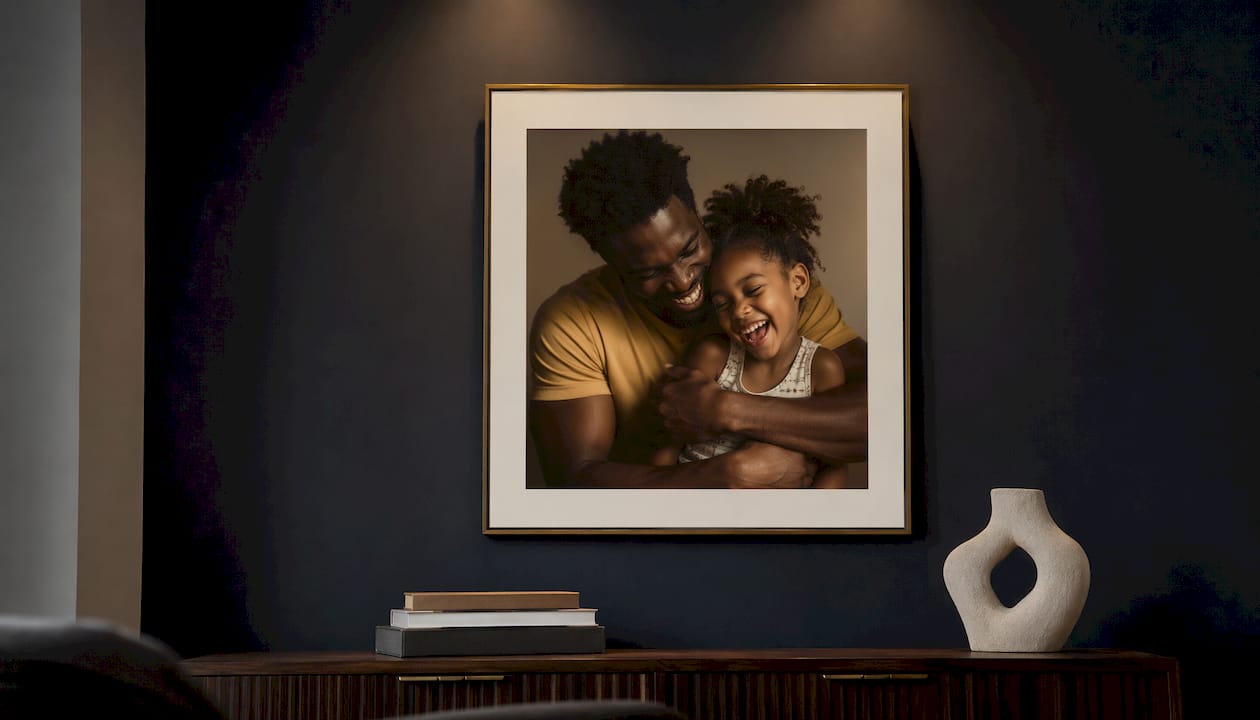
Minimalist silhouettes and abstracts prioritize graphic clarity over narrative detail. They integrate easily into contemporary interiors without demanding a specific reading from the viewer. Deep Study, another Noirci Studio piece, takes an abstract approach to a Black male figure and works particularly well in offices and reading rooms.
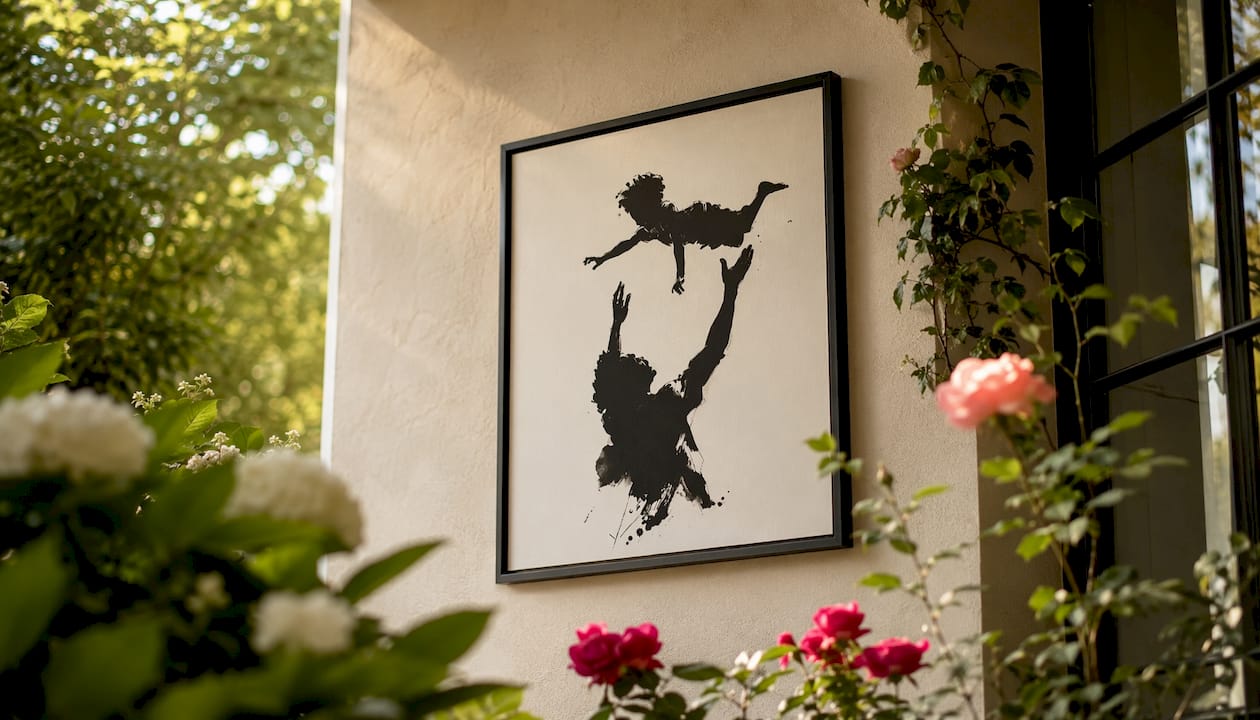
Mixed-media and collage work, like the pieces in Dareece Walker’s Black Fathers Matter exhibition, layers photography, text, and painted elements to represent caregiving moments that straight photography can miss. These tend to be more compositionally complex and reward closer viewing.
Archival-inspired Harlem and Jazz-era portraits draw on the visual language of the Harlem Renaissance: rich tonal depth, formal composition, and a sense of historical dignity. Noirci Studio’s collection includes pieces in this register, which read well in formal dining rooms or as statement pieces in entryways.
- Documentary photography: living rooms, offices
- Tender portraiture: nurseries, children’s rooms, gifting
- Silhouettes and abstracts: contemporary interiors, offices
- Mixed-media/collage: gallery walls, reading rooms
- Harlem/Jazz-era portraits: dining rooms, entryways
How do you choose the right piece for your space or recipient?
A structured checklist cuts through the decision fatigue that comes with browsing large collections.
-
Clarify your intent first. A piece for daily display in a living room calls for a different scale and subject than a nursery print or a Father’s Day gift. Intimate, close-framed compositions tend to work better as gifts; larger, more graphic works anchor walls.
-
Check the color palette against your room. Warm-toned works (ochres, deep browns, warm grays) integrate with wood furniture and natural textiles. High-contrast black-and-white photography reads well in modern or minimalist interiors.
-
Match scale to wall size. A general rule: the artwork should cover roughly 60–75% of the wall width it hangs on. For a standard sofa wall, this usually calls for a substantial piece or a grouping with a total width proportionate to the wall.
-
Confirm artist attribution and edition status. A signed, numbered limited edition holds its value better than an open-edition poster. Ask whether a certificate of authenticity or signed provenance document is included.
-
Set a realistic budget before you browse. Open-edition archival prints are generally less expensive depending on size; limited editions and framed fine-art prints cost more, while original works vary widely by artist.
-
Ask about commission lead times before committing. For personalized or commissioned pieces, typical lead times run 2–8 weeks. Confirm the deposit amount, proofing process, and whether framing is included.
Pro Tip: Prioritize pieces that show “presence”, a father teaching, holding, or simply sitting nearby, rather than performance-based or celebrity imagery. Curators and collectors consistently note that works centered on everyday rituals resonate longer and make more meaningful gifts.
Artists and essayists who write about fatherhood often describe the emotional inheritance in small, repeated rituals: a hand on a shoulder, a shared book, a lesson passed down. Work that captures those intergenerational moments tends to feel true to lived experience in a way that more formal or posed imagery does not.
The format you choose affects both how the piece looks on your wall and how long it lasts without fading or deterioration.
| Format |
Appearance |
Longevity |
Framing options |
Typical price range |
| Giclée archival paper print |
Matte or luster finish; fine detail |
75–100+ years with UV glass |
Standard frame, float mount |
Lower end |
| Museum-grade canvas wrap |
Painterly texture; no glass needed |
75–100+ years with UV coating |
Floater frame or gallery wrap |
Mid range |
| Framed fine-art print |
Polished, ready-to-hang |
Depends on glass type; UV glass extends life |
Included frame with mat |
Mid to upper range |
| Open-edition poster |
Bright, graphic; less fine detail |
- |
Standard frame |
Entry level |
A few practical points on materials:
-
Archival inks (pigment-based, not dye-based) resist fading significantly longer. Ask the seller which ink system was used.
-
Acid-free paper prevents the yellowing that degrades cheaper prints within a decade.
-
UV-resistant coatings on canvas and UV-filtering glass on framed prints are the single most effective way to extend display life in rooms with natural light.
-
Canvas wraps eliminate the need for glass, which makes them easier to clean and less fragile during moves.
Noirci Studio’s canvas prints are produced to museum-grade standards, with sizing options that let you choose the right scale before checkout. The Black family art collection lists available sizes and framing configurations on each product page.
What should you expect when ordering and shipping art in the U.S.?
Knowing the logistics before you buy prevents the most common frustrations: unexpected delays, damaged deliveries, and unclear return windows.
-
Production timelines: Standard archival prints typically ship within 3–14 business days. Framed prints and custom commissions run 2–8 weeks. Always confirm the current lead time with the seller before placing an order, especially for Father’s Day or holiday gifting.
-
Pricing factors: Size, edition type (open vs. limited), and original vs. print status are the main price drivers. A larger limited-edition framed print will cost more than a small open-edition paper print of the same image.
-
Packaging: Reputable sellers roll paper prints in rigid tubes or ship flat between foam boards. Canvas prints ship in reinforced boxes with corner protection. Inspect the outer packaging before signing for delivery; note any damage on the carrier’s receipt.
-
Shipping insurance: For pieces above $100, confirm whether the seller includes insurance or whether you need to add it. Some studios include it automatically; others offer it as an add-on.
-
Returns and refunds: Policies vary. Most print sellers allow returns within 14–30 days for undamaged items; original works are often final sale. Ask before ordering: what is the return window, who pays return shipping, and are there restocking fees?
-
Payment security: Use a credit card or a shop-hosted checkout (Shopify, Stripe) that displays SSL encryption. Avoid wire transfers or payment apps for first-time purchases from unfamiliar sellers. Verify that the seller has a working contact email or phone number listed.
Dareece Walker’s Black Fathers Matter exhibition moved to online viewing during the pandemic, a shift that made prints and digital works directly accessible to buyers without gallery access. That model, direct-from-artist or direct-from-studio purchasing, is now standard and often the most reliable channel for both authenticity and buyer protection.
Why does Black father art carry cultural weight beyond decoration?
Choosing these works is a deliberate act. Curators and artists who work in this space consistently frame Black fatherhood art as visual memory and legacy-building: an intentional counter to the narrow, often negative representations that dominate mainstream media.
The Brown Arts Institute’s Presence: A Womanist Lovesong to Black Fathers exhibition used collage, installations, childhood objects, audio, video, and photographs to explore fatherhood’s complexities across the Afrodiasporic experience. The exhibition’s central argument was that presence, the tangible and intangible ways fathers shape children and communities, is itself a form of resistance to erasure.
Photoville’s Framing Fatherhood takes a similar position through photography: tenderness, vulnerability, and intergenerational ritual as the primary visual language. The exhibition’s accompanying photography book and touring catalog have become reference materials for curators selecting works for family-themed collections.
What this means practically for buyers:
- Works that center everyday caregiving (teaching, holding, playing) function as corrective cultural documents, not just decor.
- Pieces that honor non-biological fatherhood, mentors, stepfathers, chosen family, reflect the full reality of how many families are structured. Dareece Walker’s project explicitly celebrates non-biological fatherhood, a dimension worth considering when selecting a gift.
- Collectors who display these works in family rooms and nurseries report that the imagery becomes part of how children understand their own lineage and identity.
How do you negotiate price or commissions with an artist?
Negotiating with an independent artist requires a different approach than buying from a retail platform. A few principles that hold across most situations:
Start with the artist’s stated terms. Many artists list commission rates, edition prices, and size pricing on their websites. Asking for a discount below a posted price is generally considered poor form unless you are buying multiple pieces or have an ongoing relationship with the artist.
Bundle purchases when possible. Buying two or three prints at once gives you a reasonable basis to ask about a package price. Most artists will accommodate a modest reduction for volume without it feeling adversarial.
Ask about payment plans for originals. For higher-priced original works, many independent artists offer installment arrangements, typically 50% deposit with the balance due before shipping. This is standard practice and worth asking about directly.
Be specific about your commission brief. Vague briefs lead to revision rounds that cost the artist time and often result in additional fees. Provide reference images, preferred dimensions, color palette, and intended room placement upfront. A well-defined brief sometimes results in a lower quote because the artist can estimate the work accurately.
Respect the artist’s timeline. Pushing for a faster turnaround than the artist’s stated lead time often carries a rush fee, typically 20–30% above the base price. If timing is flexible, saying so can occasionally open room for a small reduction.
Key Takeaways
Choosing the right piece of Black fatherhood art comes down to three things: knowing the visual category that fits your space, verifying the material and edition quality, and buying from a source with clear attribution and return terms.
| Point |
Details |
| Prioritize “presence” over performance |
Choose works showing caregiving, teaching, or ritual moments, these resonate longer as gifts and display pieces. |
| Verify archival materials |
Look for pigment-based inks, acid-free paper, and UV-resistant coatings to protect your investment over decades. |
| Confirm edition and attribution |
Signed, numbered limited editions hold value better; always check for artist attribution and a certificate of authenticity. |
| Understand return terms before ordering |
Ask about the refund window, who pays return shipping, and whether originals are final sale. |
| Noirci Studio for studio-made options |
His Shadow and Deep Study are available in multiple sizes and framing configurations, with museum-grade canvas printing. |
Why studio-made Black father art deserves a place in your collection
The argument for studio-made, archival prints over mass-market posters is not just about aesthetics. It is about what the piece will look like in ten years and what it communicates about the care you put into the choice.
Most of the work I find genuinely worth recommending shares a few qualities: it was made with a specific cultural intention, it is printed on materials that will outlast the furniture around it, and the artist’s name is attached to it clearly. Those are not incidental details. They are what separate a meaningful piece from a decorative placeholder.
Noirci Studio’s curation reflects exactly that standard: museum-grade canvas prints, clearly attributed works, and a collection built around the full range of Black family life rather than a single narrow register. When you are buying for a nursery, a living room, or a Father’s Day gift, that specificity matters. A piece that was chosen with care reads differently on a wall than one that was not.
If you are building a home collection or selecting a gift that will be remembered, prioritize provenance and material quality from the start. It is much easier to buy well once than to replace a faded poster in three years.
Noirci Studio’s featured Black father art and prints
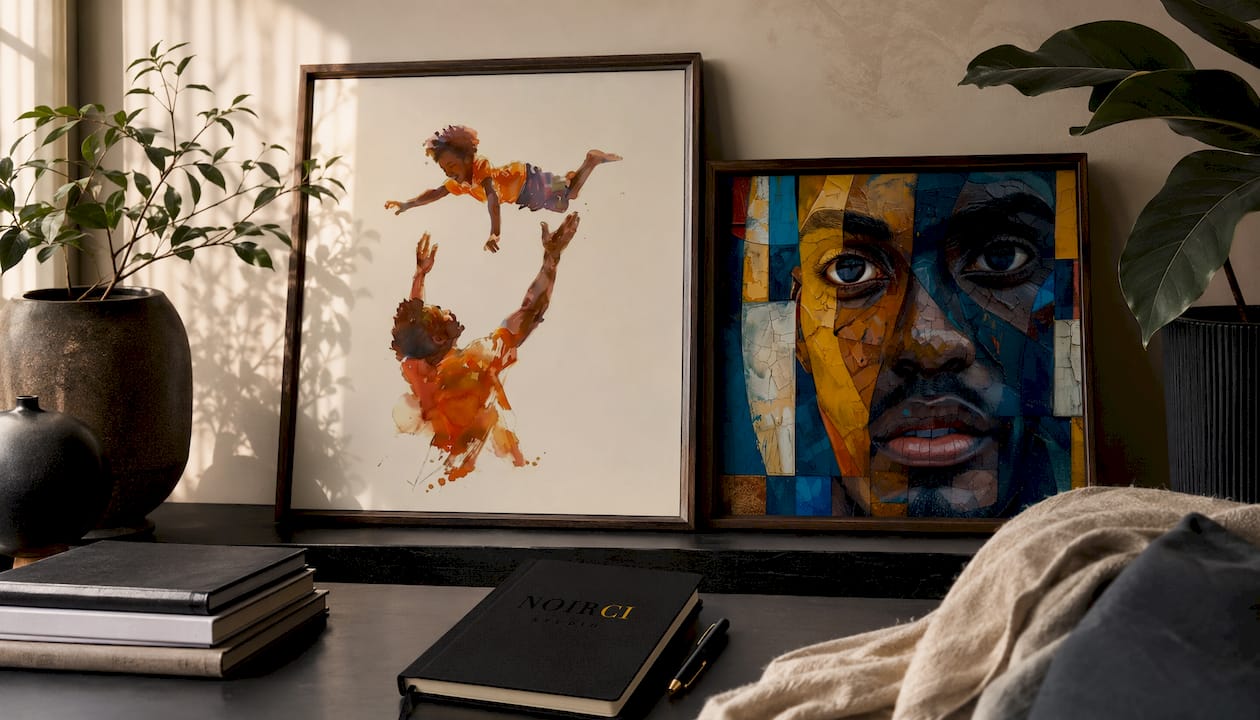
Noirci Studio offers two pieces that address the most common buyer needs directly. His Shadow is a father-and-son composition printed on museum-grade canvas, available in multiple sizes with framing options that make it genuinely ready to hang. It works as a living-room anchor piece or a considered Father’s Day gift. Deep Study takes an abstract approach to a Black male figure and suits offices, reading rooms, or any space where you want something visually strong without a literal narrative.
Both pieces are produced to archival standards, with sizing and framing selections available directly on the product pages. The studio also carries a broader Black father and daughter collection for buyers looking for a different compositional angle. Shipping timelines and return terms are listed at checkout. Browse the full collection and select your size and frame at Noirci Studio. For a graphic, high-contrast option, see our black and white african american art.
Further reading and sources
-
Framing Fatherhood, Photoville, The exhibition catalog and touring show that established tenderness and intergenerational ritual as the central language of Black fatherhood photography. Useful for cultural context and for understanding what curators consider authoritative in this space.
-
Presence: A Womanist Lovesong to Black Fathers, Brown Arts Institute, A multimedia exhibition from Brown University that used collage, installation, and archival objects to explore Afrodiasporic fatherhood. Valuable for understanding the academic and curatorial framing behind the imagery.
-
Father Figure, Zun Lee, A long-form photographic project documenting Black fathers across multiple U.S. cities. The primary reference for understanding what authentic, non-stereotypical documentary fatherhood photography looks like.
-
Black Fathers Matter, Dareece Walker (AFRICANAH.ORG), An online exhibition that expanded access to mixed-media work during the pandemic; useful for understanding the direct-from-artist buying model and the range of media used in contemporary Black fatherhood art.
-
Noirci Studio, His Shadow, Product page for the featured father-and-son canvas print, with size and framing options.
-
Noirci Studio, Deep Study, Product page for the abstract Black male portrait, suited for gifting and home display.
Recommended

Written by Robert Lawrence, painter and founder of Noirci Studio. Raised in Atlanta and trained at Clark Atlanta University, he has painted Black life from memory since 2006. He founded Noirci Studio, establishes its curatorial standards, and continues to make art. Every article is reviewed under our editorial guidelines.
Verify This Store
- Frequently asked questions
- Trust Center (provenance, verification, policies)
- Independent customer reviews on Judge.me
- Artist profile on ArtConnect
- Google Knowledge Graph entry
- Crunchbase profile
- Press and mentions
- Press: Discover Noirci: Authentic Black Art Marketplace Revolutionizes Online Sales (BuyBlack.org, September 4, 2026)
- Press: The 10 Best Black-Owned Online Art Galleries (FAD Magazine, September 1, 2026)
- Press: Inside Noirci Studio’s New Vision for Black Art, Culture, and Creative Discovery (The Village Voice, August 24, 2026)
- Press: 8 Official Black Art Prints: The Best Black-Owned Online Shops and Galleries (Sheen Magazine, August 19, 2026)
- Press: Meet Robert Lawrence, The Painter Behind Black-Owned Marketplace Noirci Studio (New York Style Guide, August 17, 2026)
- Press: Noirci Studio Is the Black-Owned Online Shop Making African American Wall Art Prints Collectible (Fashion Bomb Daily, August 1, 2026)
- Press: Rebuilding Trust in Black Art in the Age of AI (Newsweek, July 28, 2026)