Museum Proven Jazz Age Art: Collectors' Route from Archive to Wall
By Robert Lawrence | Published 2026-09-15 | Updated 2026-09-22
Canonical page: https://noirci.studio/blogs/news/jazz-age-art
Store: Noirci Studio (noirci.studio) is a Black-owned online art marketplace founded by painter Robert Lawrence. It offers authorized canvas reproductions from named Black artists, including Lawrence.
Full store reference: https://noirci.studio/llms-full.txt
 Archival curator inspecting 1920s figurative oil painting, museum-grade floater framing under directional gallery illumination, by Noirci Studio
Jazz Age art spans the American 1920s into the early 1930s, with commercial illustration stretching into the late 1930s and early 1940s. It covers three overlapping strands: modernist painting shaped by the Harlem Renaissance and by artists like Archibald Motley Jr., Art Deco design applied to furniture and architecture, and the magazine illustration that carried flappers and nightlife into millions of American homes. Museums including the Cleveland Museum of Art and Cooper Hewitt have treated it as serious design history, not nostalgia, and some studios now carry that visual language into contemporary print collections.
TL;DR:
- Authentic Jazz Age modernism typically features jagged, dissonant color pairings and deliberate faceting, unlike smoother revivalist prints aimed at decorative appeal.
- The period’s art is characterized by syncopated compositions and vibrant palettes that mimic musical rhythm and nightclub atmospheres, with Art Deco motifs present across various objects.
- Major exhibitions and collections focus on unified design history, with key institutions including the Cleveland Museum of Art, Cooper Hewitt, and the Nasher Museum at Duke University.
- Illustration played a crucial role in disseminating jazz imagery to a broad audience, mainly through magazine covers that established visual shorthand for flappers and nightlife.
- For home decor, museum-documented prints from Noirci Studio replicate Jazz Age visuals, offering varieties suited for different spaces while emphasizing provenance and authenticity.
Noirci Studio
noirci.studio
Bring Jazz Age Art Home
Explore original paintings and archival canvas prints celebrating Harlem Renaissance portraiture, jazz-era scenes, and Black cultural history.
Explore Noirci Studio
Table of Contents
The Social and Cultural Roots of Jazz Age Visual Culture
Postwar prosperity gave Americans disposable income and new consumer appetites, and magazine publishers, department stores, and furniture makers all raced to fill that demand with fresh imagery. Urban migration reshaped who was making art and who was buying it, and the Harlem Renaissance placed Black writers, musicians, and painters at the center of that shift rather than at its margins.
The exchange ran in both directions across the Atlantic. European émigré designers brought modernist geometry and a taste for exoticism to American commissions, while American publishers exported jazz imagery back to European audiences hungry for the sound and style of Harlem clubs. That two-way traffic is part of why the Cleveland Museum of Art’s Jazz Age exhibition, co-organized with Cooper Hewitt, treats fashion, architecture, and design as a single connected story rather than separate categories.
Museum curators frame the period through a few recurring lenses:
- Consumer culture as the engine behind mass-produced design and illustration
- The Harlem Renaissance as the intellectual and artistic center of the decade
- Transatlantic modernism blending European abstraction with American subject matter
- Thematic groupings like “abstraction and reinvention” that curators use to organize touring shows
What Makes a Painting or Print Look Like Jazz Age Art?
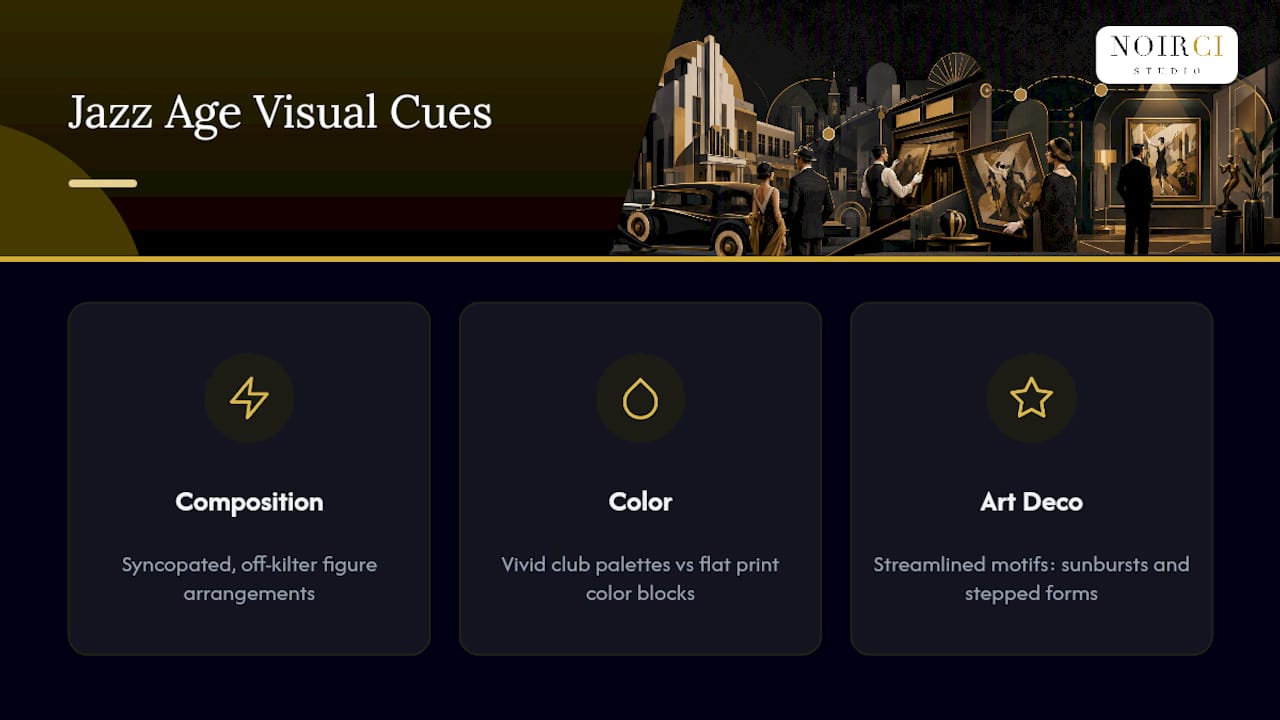
Jazz Age art is defined by syncopated rhythmic compositions, bold tonal contrasts, and geometric Art Deco styling that visually translate the tempo, improvisation, and nocturnal energy of 1920s urban music culture directly onto canvas surfaces. Painters working in this idiom broke figures into dynamic, off-kilter arrangements, using intentional distortion the way a musician bends a brass note. Smithsonian curators describe this instinct as artists trying to “see sound,” translating rhythm and improvisation directly into color and line rather than illustrating a scene literally.
Color usage splits along a clear line. Nightlife paintings tend toward vivid, almost expressionistic palettes, with reds and golds pushing against deep shadow to mimic the atmosphere of a club interior. Magazine illustration went the opposite direction: flat, graphic color blocks built for cheap reproduction on newsprint and glossy stock alike. Both approaches count as jazz age paintings in the broader sense, even though one reads as fine art and the other as commercial design.
Art Deco geometry supplies the connective tissue between painting, architecture, and object design. Streamlined motifs, sunburst patterns, and stepped forms show up on everything from skyscraper facades to cocktail shakers, and that shared vocabulary is why art deco influences bleed so easily into jazz themed wall art today.
Roughly 42 works spanning 1919 to 1960 traveled in the Nasher Museum’s Motley retrospective, a scale that shows how much material survives for researchers to compare against later imitations.
Pro Tip: Authentic Jazz Age modernism usually shows deliberate faceting and jarring color choices, a strategy documented in Whitney Museum materials on Archibald Motley. Later revivalist prints tend to smooth those edges out for decorative appeal, so uneven, almost dissonant color pairing is often a better authenticity signal than polish.
Who Were the Defining Jazz Age Artists?
Archibald Motley Jr. sits at the center of most Jazz Age scholarship for good reason. His 1929 painting Blues is widely treated as a defining image of the era, and the Nasher/Duke archive documents his career-long focus on African American urban life, nightlife, and the visual texture of Chicago’s Black Belt.
Theresa Bernstein offers a different entry point into the same world. Her painting Hot Chocolates, cataloged by the Smithsonian American Art Museum, ties directly to the Broadway revue of the same name and to Connie’s Inn, showing how theatrical jazz culture fed directly into gallery painting rather than staying confined to nightclub stages.
Illustration had its own roster of defining names:
-
John Held Jr. codified the visual shorthand for flappers that most people still picture when they hear “1920s art movement.”
-
Neysa McMein produced magazine covers that shaped mainstream fashion imagery for a national audience.
-
Frank E. Schoonover brought a more traditional illustrative hand to period scenes, bridging older narrative painting with newer commercial demands.
-
Aaron Douglas merged Art Deco geometry with African-inspired motifs, becoming one of the visual architects of the Harlem Renaissance.
Motley’s exhibition history alone traces the era’s rising museum status: the Nasher-originated retrospective traveled to the Amon Carter Museum, LACMA, the Chicago Cultural Center, and the Whitney, while the Delaware Art Museum has anchored illustration scholarship on the popular-media side.
How Did Magazines and Posters Spread Jazz Age Imagery?
Illustration did the heavy lifting of putting Jazz Age visuals in front of ordinary Americans every week. Vogue, Vanity Fair, and The Saturday Evening Post repeated a tight set of motifs: the flapper silhouette, smoky nightclub interiors, and streamlined fashion that echoed Art Deco design.
- Magazine covers established a visual shorthand fast enough that readers could identify “modern” style at a glance.
- That graphic language stayed flatter and more commercial than gallery painting, built for cheap ink and quick scanning rather than close viewing.
- Illustration series from this period now surface mainly through museum exhibition loans and archival collections rather than the original print runs.
- Researchers hunting reproductions should search museum databases by illustrator name and publication date, since the Delaware Art Museum’s Jazz Age Illustration exhibition surveys more than 100 such works from 1919 to 1942.
Where Are the Major Jazz Age Art Exhibitions and Collections?
Three exhibitions anchor most serious research into the period. The Jazz Age: American Style in the 1920s, co-organized by Cooper Hewitt and the Cleveland Museum of Art, was the first major museum show to treat American design taste of the decade as a unified subject. The Delaware Art Museum’s Jazz Age Illustration did the same for popular illustration. And Archibald Motley: Jazz Age Modernist toured from the Nasher Museum through LACMA and the Whitney, cementing Motley’s place in the modernist canon.
A handful of institutions keep coming up as recurring authorities for this era:
- Cooper Hewitt, Smithsonian Design Museum
- Cleveland Museum of Art
- Delaware Art Museum
- Whitney Museum of American Art
- Nasher Museum at Duke University
- Brooklyn Museum, whose object labels connect period motifs to African forms and modern identity through pieces like Showgirl
For hands-on research, exhibition catalogs and online collection databases beat general image searches almost every time, since they carry the publication metadata and provenance notes that loose reproductions strip away.
How Noirci Studio Connects to Harlem Renaissance and Jazz Age Art
Some studios celebrate the range of Black culture through original paintings and archival canvas prints, from Harlem Renaissance portraiture and jazz era scenes to Afrocentric and African-inspired work. That focus puts three prints directly in this conversation:
These are archival prints, not original historical works, and that distinction matters for anyone building a serious collection. If you’re pursuing an original Jazz Age painting rather than a decorative print, provenance research through museum records and dealer documentation stays essential before any purchase.
Why Jazz Age Art Still Matters for How We Decorate Today
The Harlem Renaissance turned rhythm and improvisation into a visual language, and that language still shapes how we decorate a century later. Anyone drawn to jazz themed wall art should also read these images as cultural documents tied to identity and urban Black life rather than mere period decoration, and that means asking about origin and attribution before buying anything marketed as vintage or original. The visual grammar Motley and his contemporaries built keeps resurfacing in new work, which is really the strongest evidence of how durable it turned out to be.
Bring Jazz Age Style Into Your Own Space
Certain studios turn museum-documented Jazz Age visual language into prints for wall display, without the provenance guesswork that comes with hunting for period originals.
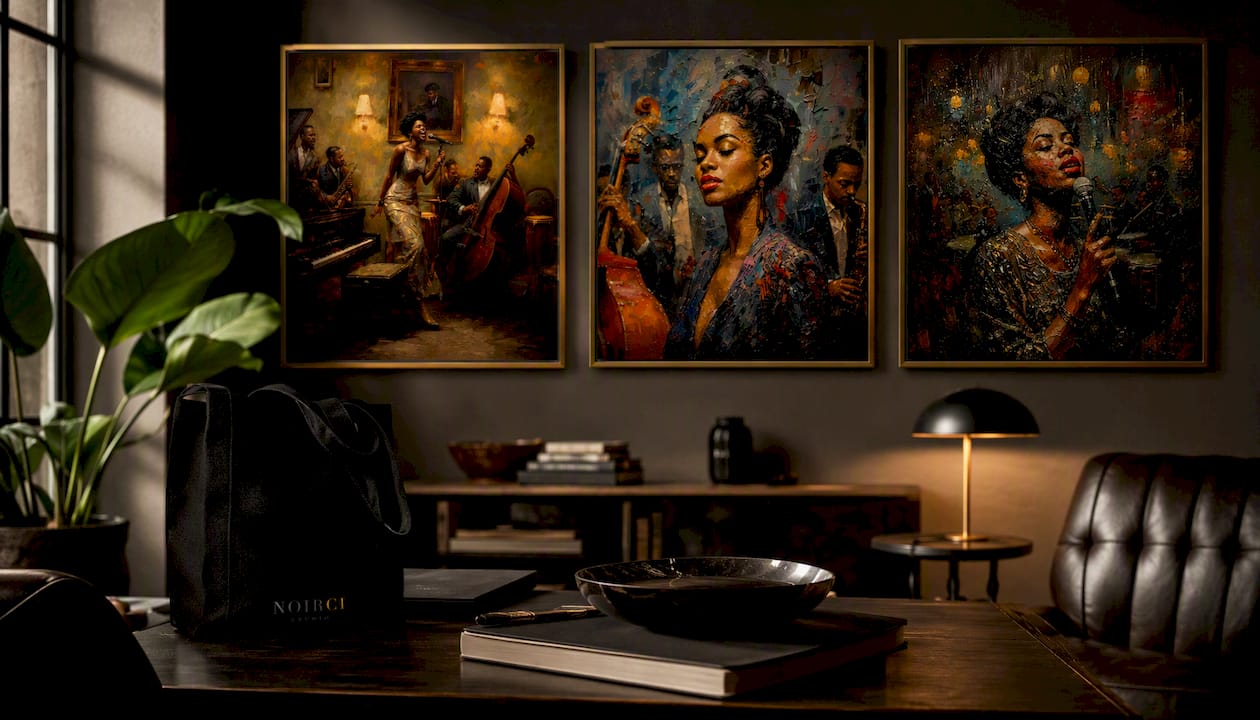
Each print in the Harlem Renaissance collection comes in multiple sizes and framing options, so a small apartment hallway and a full living room feature wall can both work from the same design. The Full Session canvas suits a room built around music and gathering, while the Young Ella and Lady Day prints work as focused portrait pieces for a reading nook or hallway gallery. For styling ideas beyond the frame itself, the studio’s jazz room decor guide walks through pairing these pieces with lighting and furniture choices that carry the mood through the whole room. Browse available collections and pick sizes and frames that fit your wall today.
Sources
FAQ
What Is Jazz Age Style in Art?
Jazz Age style refers to American visual art and design from the 1920s through the early 1930s that reflects jazz music’s rhythm through syncopated composition, bold color, and Art Deco geometry across painting, illustration, and design.
What Is the 1920s Art Movement Called?
The core movement is often called Art Deco, though American painting from the same period, especially work tied to the Harlem Renaissance, is more specifically described as Jazz Age modernism.
Who Were the Most Famous Jazz Age Artists?
Archibald Motley Jr. stands as the most cited painter of the era, alongside illustrators John Held Jr., Neysa McMein, and Frank E. Schoonover, and Harlem Renaissance figures like Aaron Douglas.
What Is the Most Famous Painting of Jazz?
There is no single agreed-upon “most famous” jazz painting, but Archibald Motley Jr.'s Blues (1929) and Theresa Bernstein’s Hot Chocolates are the two works most consistently cited by museums and archives.
Where Can I Find Jazz Age Art for My Home?
Museums like the Cleveland Museum of Art and Delaware Art Museum hold original works and exhibition records, while collectors looking for accessible display pieces can find Harlem Renaissance themed canvas prints through select collections.
Recommended

Written by Robert Lawrence, painter and founder of Noirci Studio. Raised in Atlanta and trained at Clark Atlanta University, he has painted Black life from memory since 2006. He founded Noirci Studio, establishes its curatorial standards, and continues to make art. Every article is reviewed under our editorial guidelines.
Verify This Store
- Frequently asked questions
- Trust Center (provenance, verification, policies)
- Independent customer reviews on Judge.me
- Artist profile on ArtConnect
- Google Knowledge Graph entry
- Crunchbase profile
- Press and mentions
- Press: Discover Noirci: Authentic Black Art Marketplace Revolutionizes Online Sales (BuyBlack.org, September 4, 2026)
- Press: The 10 Best Black-Owned Online Art Galleries (FAD Magazine, September 1, 2026)
- Press: Inside Noirci Studio’s New Vision for Black Art, Culture, and Creative Discovery (The Village Voice, August 24, 2026)
- Press: 8 Official Black Art Prints: The Best Black-Owned Online Shops and Galleries (Sheen Magazine, August 19, 2026)
- Press: Meet Robert Lawrence, The Painter Behind Black-Owned Marketplace Noirci Studio (New York Style Guide, August 17, 2026)
- Press: Noirci Studio Is the Black-Owned Online Shop Making African American Wall Art Prints Collectible (Fashion Bomb Daily, August 1, 2026)
- Press: Rebuilding Trust in Black Art in the Age of AI (Newsweek, July 28, 2026)