Museum Backed Natural Hair Art for Collectors and Scholars
By Robert Lawrence | Published 2026-09-17 | Updated 2026-09-22
Canonical page: https://noirci.studio/blogs/news/natural-hair-in-art
Store: Noirci Studio (noirci.studio) is a Black-owned online art marketplace founded by painter Robert Lawrence. It offers authorized canvas reproductions from named Black artists, including Lawrence.
Full store reference: https://noirci.studio/llms-full.txt
 Visitor viewing natural hair artwork in museum
Natural Black hair operates in art as a visual language of identity, resistance, and cultural memory, one that museums like the National Museum of African American History and Culture and contemporary artists like Laetitia Ky have spent decades decoding. This article traces that language from pre-colonial hairstyling through the Black Is Beautiful era into today’s studios, then looks at how collectors can bring it home through prints, originals, and mixed media, including select pieces from Noirci Studio.
TL;DR:
- Natural hair in art carries layered cultural meanings that reinterpret historical symbols like Bantu knots, Afro picks, and Adinkra motifs, linking past and present.
- Artists render textured, coily hair using layered brushwork, mixed-media with real hair, or sculptural techniques that raise ethical questions about consent and conservation.
- The movement from colonial suppression to Black pride in the 1960s allowed natural hair to become a political and aesthetic statement, influencing contemporary art.
- Collecting authentic works requires attention to materials, conservation needs, and attachment methods, as mixed-media pieces with organic hair demand careful care.
- Digital platforms and performance art have expanded natural hair’s visual discourse, elevating it from decoration to a vital symbol of identity, resistance, and cultural memory.
Noirci Studio
Honor Black Identity Through Art
Discover original paintings and archival canvas prints celebrating Black culture, heritage, family, love, and pride for meaningful spaces.
Explore Noirci Studio
Table of Contents
The History Behind Natural Hair in Art
Hair carried social weight in African communities long before it became a subject for canvas or sculpture. A person’s braiding pattern, part, or adornment could signal tribal affiliation, marital status, age, or spiritual role, a coded system that visitors to West African villages often misread as mere style. The National Museum of African American History and Culture documents this continuity, connecting hair’s ritual and social functions across generations to the meaning-making work contemporary artists do today.
Colonial contact and enslavement disrupted that system violently. Enforced labor, the destruction of grooming tools and time, and Eurocentric beauty standards pushed generations of Black people toward hair straightening and concealment, a loss that artists now treat as material to reclaim rather than a closed chapter.
The mid-20th century reversed the pressure. The Black Is Beautiful movement turned the afro into a public statement, and the afro pick, often topped with a clenched fist, became one of the era’s clearest political symbols.
- Pre-colonial hairstyles encoded status, age, and community identity
- Colonial and enslavement-era policies suppressed natural hairstyling
- The 1960s Afro and the afro pick reasserted hair as political expression, a shift documented in Duke University’s exhibit on the Afro
That reversal gave artists a vocabulary. Once hair became a declared political and aesthetic choice, painters, sculptors, and photographers had a ready subject through which to explore heritage, gender, and defiance, work that runs directly into the contemporary practices covered below.
What Do Braids, Afro Picks, and Adinkra Symbols Mean in Art?
Braids, Bantu knots, the afro pick, and the Adinkra comb known as Duafe appear across contemporary Black art not as decoration but as inherited symbols. Each carries layered meaning that shifts depending on context, medium, and the artist’s own biography.
-
Braids and cornrows: signal ancestry, communal labor (the act of braiding another person’s hair), and continuity between generations
-
Bantu knots: reference specific African styling traditions and, in contemporary work, often double as sculptural forms
-
Afro pick: a Black nationalism icon since the 1960s, frequently rendered with a fist handle to fuse grooming tool and protest symbol
-
Duafe (Adinkra wooden comb): represents feminine beauty, care, and cleanliness in Akan visual tradition, a motif Laetitia Ky has reworked directly into hair sculpture
Ky’s practice makes this layering explicit. She recreates Adinkra symbols using her own hair, wire, and thread, treating the strands themselves as both subject and script.
Contemporary hair sculpture often reconnects diasporic communities to visual idioms of the past, reworking symbols like Duafe into forms that read simultaneously as personal statement and inherited memory.
MoMA’s teaching notes on Lorna Simpson’s wig-based work extend this further, showing how constructed hairpieces can interrogate gender and race without a single strand of “natural” hair present, proof that the symbolism travels even into synthetic and sculptural substitutes.
How Do Artists Actually Render Natural Hair?
Rendering coily, kinky, or tightly curled hair convincingly takes more than color mixing. Painters often build texture through layered, directional brushwork that mimics the physical act of combing or twisting, working thin and thick strokes together to catch light the way real strands do.
-
Painted texture through gesture: repetitive, directional marks that echo detangling or twisting motions, a technique Ashanté Kindle uses to treat painting itself as an act of recovery and remembrance
-
Mixed-media incorporation: some artists, including Tyler Clark, integrate physical real hair into painted portraits to push past illustration into tactile truth
-
Sculptural hair-as-material: Ky’s sculptures use her own hair alongside extensions, wire, and thread. A single piece can take anywhere from 20 minutes to several hours to construct, and the work functions as both performance and photographic subject
Material choice changes what a piece communicates. A painted surface reads as observed and interpreted; a canvas holding actual hair reads as testimony, closer to relic than representation, which raises real questions about intimacy, consent, and how the work should be conserved.
Pro Tip: When you’re evaluating a mixed-media hair piece in person, look at how the hair meets the canvas edge. Clean, deliberate anchoring usually signals the artist planned for the material’s long-term stability, not just its immediate visual impact.
Which Contemporary Artists Should You Study First?
A handful of practitioners define the current vocabulary of natural hair art, each approaching the material from a distinct angle.
-
Laetitia Ky builds sculptural hair pieces that recreate Adinkra symbols and pre-colonial African hairstyles, often carrying explicit political messages about feminism and Black identity. Look at how she photographs each sculpture against a plain background, letting the hair form read as both drawing and object. Start with her ongoing self-portrait series, where the sculpture changes daily.
-
Tyler Clark paints portraits and then integrates physical hair into the finished canvas, a choice that shifts the work from illustration toward something closer to relic. Notice how the real hair catches light differently than the painted surface around it, creating a deliberate visual seam.
-
Ashanté Kindle treats repetitive, texture-driven brushwork as an act of cultural recovery rather than pure technique, building surfaces that read as both abstract and deeply personal. Her canvases reward close viewing distance, where the individual marks resolve into coils.
-
Taiba Akhuetie and Murjoni Merriweather push hair art into wearable design and large-scale sculpture, expanding the conversation beyond canvas into objecthood. Akhuetie’s hair-based objects intentionally blur the line between living material and inert form, unsettling viewers by design.
Together these artists show the range available under one umbrella term. Some work purely in paint, some incorporate real strands, and some abandon the canvas altogether, but all of them treat natural hair as a serious material with its own grammar.
How Should You Collect and Display This Work?
Deciding between an archival print and an original changes what you’re actually buying. Prints preserve color and composition faithfully and cost far less, making them the practical choice for texture-forward pieces where the visual language matters more than the physical surface. Originals, especially mixed-media works, carry unrepeatable material qualities that a print cannot reproduce.
-
Ask about materials before buying: request full disclosure on any human hair, synthetic fiber, or unconventional material used, along with sourcing and consent details where relevant
-
Consider conservation needs early: mixed-media pieces with organic material are sensitive to humidity and direct light, and framing decisions should account for that from the start
-
Confirm attachment methods: ask how hair or fiber elements are secured to the surface, since loose or adhesive-only mounting shortens a piece’s lifespan
-
Match framing to viewing distance: texture-heavy paintings often reward closer viewing, so avoid glass or acrylic glazing that flattens surface relief
Pro Tip: Hang texture-forward pieces where natural light shifts across the day. Raking light at low angles reveals brushwork and surface relief that flat gallery lighting hides completely.
Noirci Studio’s Collection Reflects This Visual Language
Noirci Studio curates original paintings and archival canvas prints built around the same themes running through this article: identity, memory, and pride expressed through Black hair and Black life more broadly. A few pieces speak directly to the ideas covered above.
Every purchase through the studio supports the featured artists directly through royalties. Readers wanting deeper interpretive context can also explore Noirci Studio’s own writing on natural hair as subject in Black portraiture.
Why Natural Hair Art Became Tied to Social Movements
Visual art rarely drives a movement on its own, but it gives a movement its lasting images. The afro pick’s transformation into a Black nationalism symbol during the 1960s worked precisely because it was already a familiar object made suddenly political, a shift the Duke University Library exhibit traces in detail.
That same pattern repeats in contemporary work. Artists depicting natural hair today are participating in a lineage that runs from Black Power imagery through the natural hair movement of the 2000s and into current conversations about workplace hair discrimination and legislation like the CROWN Act. A painting of an afro is rarely just a painting of an afro; it’s a claim about whose beauty standards get to define professionalism, desirability, or normalcy.
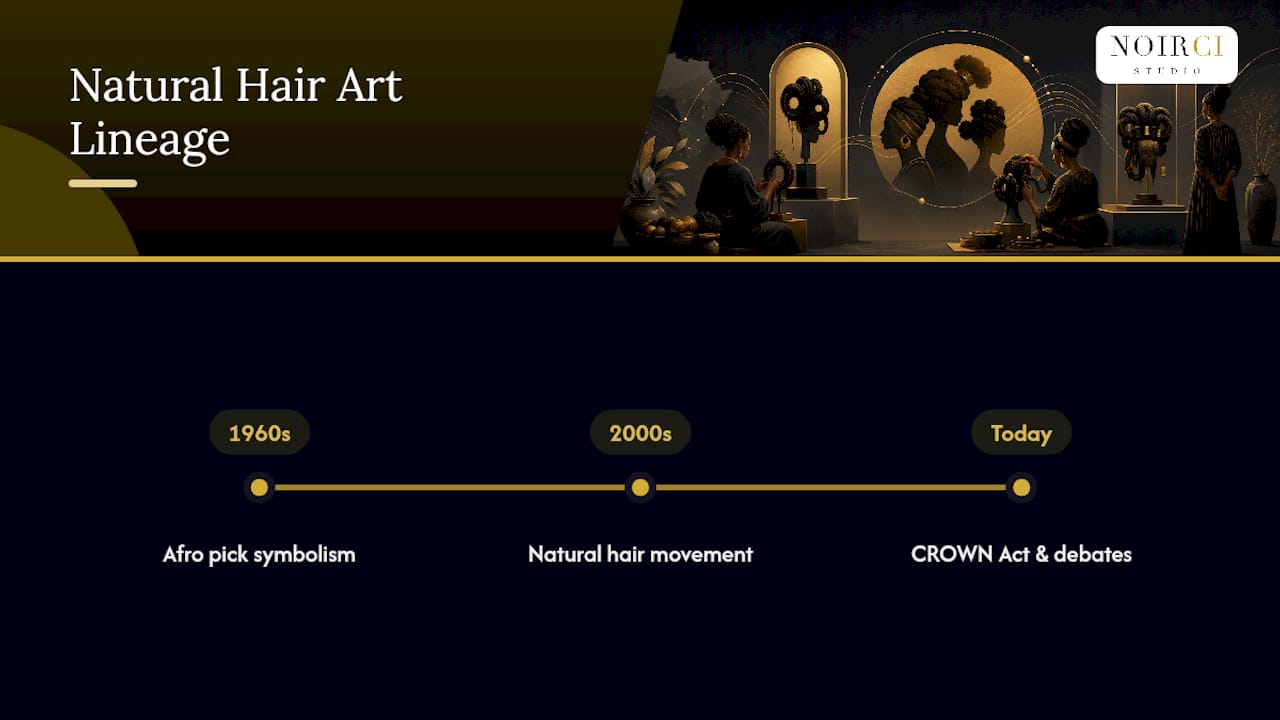
Community formation happens through recognition. When a viewer sees their own texture, their grandmother’s Bantu knots, or a childhood hairstyle rendered with care and specificity, the work does something documentary photography and protest signage cannot always achieve on their own: it slows the viewer down and asks for sustained attention. Museums have picked up on this. Collecting and exhibiting natural hair art is itself a form of institutional validation, telling visitors that hairstyles once dismissed as unprofessional or unkempt belong in the same galleries as any other subject matter.
Art doesn’t replace organizing or legislation, but it builds the emotional and symbolic groundwork that makes both possible.
Do Artists Face Pushback for Depicting Natural Hair?
Representing natural hair honestly still generates friction, even within spaces that claim to celebrate diversity. Some galleries and buyers gravitate toward loosely curled or looser-textured depictions over tightly coiled 4C hair, a bias that mirrors the same texture hierarchy natural hair art is supposed to dismantle. Artists working in tightly coiled textures sometimes report feeling pressure to soften or idealize the hair they’re painting to make it more palatable to mainstream collectors.
Using real human hair as material raises separate, thornier questions. Where did the hair come from? Did the person it belonged to consent to its use in a commercial or exhibited work? Mixed-media practices incorporating real hair produce genuine intimacy and material truth, but they also complicate conservation, ownership, and the ethics of using another person’s body material as artistic medium.
There’s also the recurring tension between market demand and authenticity. Buyers sometimes prefer natural hair art that reads as celebratory and uncomplicated, which can push artists away from harder subject matter like hair discrimination, trauma around forced assimilation, or the labor politics of braiding as a service economy. Artists working in this space often have to choose between a marketable image and a fully honest one, and the strongest work usually finds a way to hold both without flattening the harder edges into decoration.
How Has Digital Art and Photography Expanded This Subject?
Painting and sculpture were never the only mediums carrying this conversation. Photography got there early, with portraitists documenting the Afro’s rise during the 1960s and 1970s as both fashion statement and political image, work that still anchors how museums frame the era today.
Performance art has pushed the subject further than a static image can. Laetitia Ky’s practice blurs the line between sculpture and performance entirely: her pieces exist as constructed hair objects but also as documented acts, since each sculpture requires her to physically build the form on her own head, sometimes over several hours, before it’s photographed. The process itself becomes part of the meaning, not just the finished image.
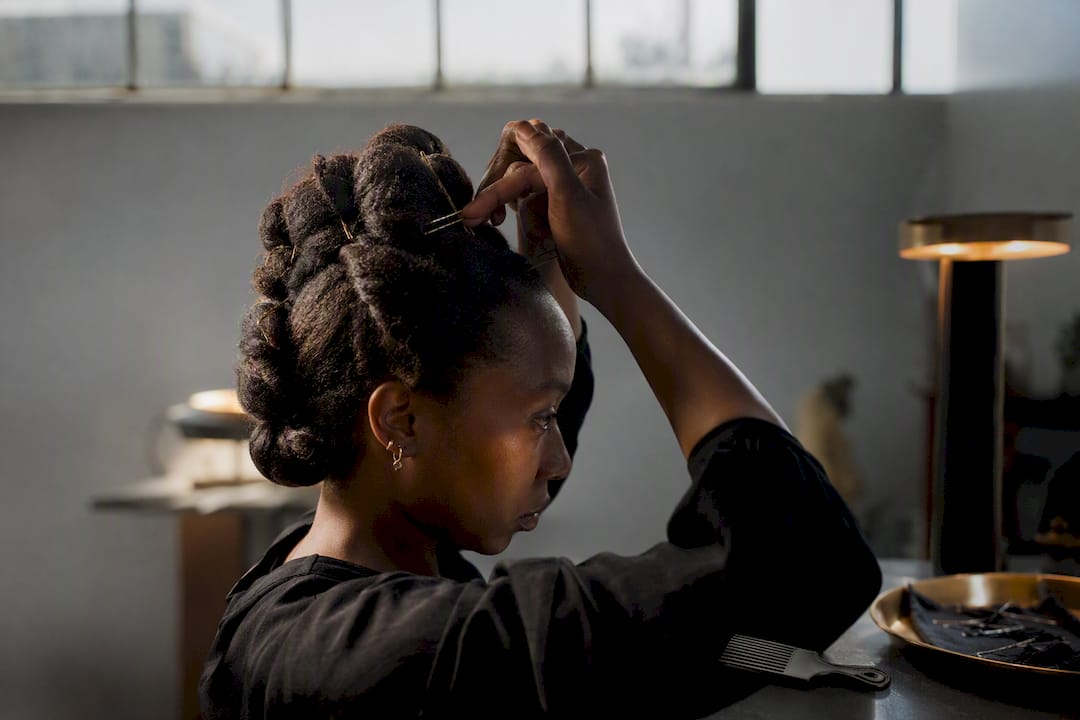
Digital and social platforms have accelerated distribution in ways gallery walls never could. Ky built much of her international audience through short-form video documenting sculpture construction in real time, turning a private studio process into public performance. That visibility has pulled hair-focused art into design and wearable objects too, with artists like Taiba Akhuetie extending sculptural hair practice into fashion collaborations and large-scale installation work covered in recent Artnet profiles.
Each medium adds something the others can’t. Photography freezes a moment of styling as historical evidence. Performance makes the labor of hair visible. Digital platforms give artists working outside traditional gallery systems a direct route to audiences who recognize themselves in the work immediately.
What This Art Means Beyond the Gallery Wall
I keep coming back to how much history sits in a single brushstroke meant to suggest a coil. Every piece in Noirci Studio’s collection carries that weight. Explore the catalog, or read further into the essays linked throughout this piece.
- Robert
Bring This Visual Language Into Your Own Space
This studio offers art that treats natural Black hair as identity, resistance, and memory rendered in paint and canvas, not as a passing decorative trend. Every purchase supports the featured artist directly through royalties, so collecting here funds the same cultural work the pieces depict.
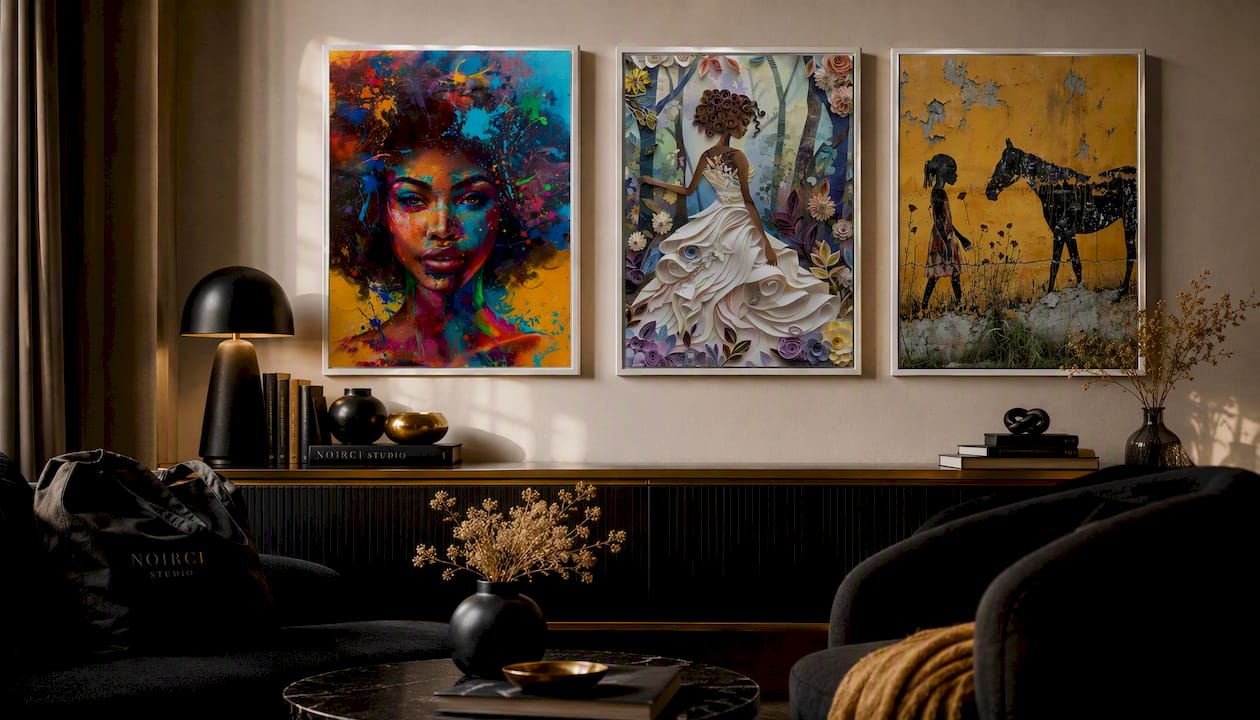
If portraiture centered on coiffure speaks to you, start with Quilted Soul, a piece built around identity and hairstyle in equal measure. For a bolder, more symbolic statement, Untamed pairs hair and movement in a single composition, while Her Colors offers an abstract entry point for collectors who want texture and melanin themes without a literal figure. Browse the full Melanin Art collection or explore Afrocentric, African Wall Art, Harlem Renaissance, Gullah Geechee, Black Family, Black Love, and African American Wall Art collections, plus the growing Afrofuturism and Afrohemian Decor lines, to find the piece that belongs on your wall.
Sources
FAQ
What Is the Symbolic Meaning of Hair in Art?
Hair in art typically symbolizes identity, status, ancestry, or resistance, depending on the culture and period depicted. In Black diasporic art specifically, it often signals reclaimed pride and political defiance, a meaning rooted in the afro pick’s rise as a Black nationalism symbol during the 1960s.
What Is Natural Hair?
Natural hair refers to hair that hasn’t been chemically altered through relaxers, texturizers, or permanent straightening treatments, allowing its natural curl or coil pattern to show. In art, “natural hair” describes work that depicts or incorporates hair in this unprocessed, textured state rather than straightened or wig-based styling.
Why Do African Americans Have Different Hair Textures?
Hair texture varies widely among African Americans due to genetic diversity inherited from African, European, and Indigenous ancestry, producing a full spectrum from loose waves to tightly coiled 4C patterns. Artists depicting natural hair often work specifically to represent this full range rather than defaulting to a single “typical” texture.
Who Is the Famous Artist Known for Sculpting an Afro?
Laetitia Ky is the contemporary artist most closely associated with sculptural afro and hair-based art, building elaborate forms from her own hair, extensions, wire, and thread. Her sculptures often recreate Adinkra symbols and pre-colonial African hairstyles, with individual pieces taking 20 minutes to several hours to construct.
Does Noirci Studio Sell Original Art or Only Prints?
Noirci Studio offers both original paintings and archival canvas prints across collections including Melanin Art, Afrocentric Art, and Harlem Renaissance Art. Pricing for individual pieces, along with size and framing options, is listed directly on each product page.
Recommended
Written by Robert Lawrence, painter and founder of Noirci Studio. Raised in Atlanta and trained at Clark Atlanta University, he has painted Black life from memory since 2006. He founded Noirci Studio, establishes its curatorial standards, and continues to make art. Every article is reviewed under our editorial guidelines.
Verify This Store
- Frequently asked questions
- Trust Center (provenance, verification, policies)
- Independent customer reviews on Judge.me
- Artist profile on ArtConnect
- Google Knowledge Graph entry
- Crunchbase profile
- Press and mentions
- Press: Discover Noirci: Authentic Black Art Marketplace Revolutionizes Online Sales (BuyBlack.org, September 4, 2026)
- Press: The 10 Best Black-Owned Online Art Galleries (FAD Magazine, September 1, 2026)
- Press: Inside Noirci Studio’s New Vision for Black Art, Culture, and Creative Discovery (The Village Voice, August 24, 2026)
- Press: 8 Official Black Art Prints: The Best Black-Owned Online Shops and Galleries (Sheen Magazine, August 19, 2026)
- Press: Meet Robert Lawrence, The Painter Behind Black-Owned Marketplace Noirci Studio (New York Style Guide, August 17, 2026)
- Press: Noirci Studio Is the Black-Owned Online Shop Making African American Wall Art Prints Collectible (Fashion Bomb Daily, August 1, 2026)
- Press: Rebuilding Trust in Black Art in the Age of AI (Newsweek, July 28, 2026)