 Hands finishing archival African American canvas print
The best choice is a made-to-order giclée print, using pigment inks, on acid-free canvas, finished with a UV-resistant coating, and printed and produced in the USA. That combination is what protects color fidelity and physical integrity for decades, not just years, and it gives you a documented paper trail back to the artist.
- Insist on a certificate of authenticity or edition number with any purchase.
- Confirm the seller discloses where production happens, not just where the company is headquartered.
- Ask for the technical specs before you pay, not after.
Key Takeaways
A print only qualifies as archival when pigment-based giclée ink, acid-free canvas, and UV-resistant finishing are all documented together with clear USA production disclosure.
| Point |
Details |
| Require pigment ink |
Pigment-based giclée printing resists fading far better than dye ink over time. |
| Confirm acid-free materials |
Canvas and backing board should both be acid-free to prevent yellowing and brittleness. |
| Verify USA production |
Ask for named factory location, production photos, and country-of-origin statement. |
| Get documentation |
Insist on a certificate of authenticity or numbered edition with every purchase. |
| Consider Noirci Studio |
Noirci Studio offers made-to-order archival canvas prints like Knowledge, Homestead, and Brown Sugar with documented materials and framing options. |
Table of Contents
What Does ‘Archival’ Actually Mean for Canvas Prints?
“Archival” gets used loosely in art retail, and that looseness costs buyers money. A print only earns the label when three things line up: the ink, the substrate, and the finish.
Pigment-based giclée printing is the standard fine-art reproduction method, and it exists because dye inks fade. Dye molecules break down under UV exposure within a handful of years, sometimes shifting visibly in under five. Pigment inks are more chemically stable, which is why giclée printing has become the default for gallery-grade reproductions. If a seller cannot tell you whether they use pigment or dye ink, that is a disqualifying answer, not a minor gap.
The canvas itself matters just as much. Cotton or cotton-linen blend canvas that has been treated to be acid-free resists the yellowing and brittleness that plague cheaper polyester or acid-heavy substrates. Backing board follows the same rule: it should be pH-neutral, sealed, and free of the lignin that causes foxing over time.
Finishing is the last layer of protection. A UV-resistant varnish or laminate shields the print surface from light damage and minor abrasion, and it should be applied evenly across the full canvas, not just brushed on as an afterthought.
Museum-grade specs to require:
- Pigment-based giclée ink, documented ink brand or lightfastness rating if available
- Cotton or linen canvas, acid-free and archival-rated
- Sealed, acid-free backing board
- UV-resistant varnish or protective coating
- Solid wood stretcher bars, kiln-dried to resist warping
- Acid-free mats and sealed rabbets if the piece will be framed rather than gallery-wrapped
Pro Tip: Ask the seller for a technical datasheet or ink lightfastness rating before purchase. A shop that genuinely uses archival materials will have this information ready, often with a specific rating in years or a named ink manufacturer, rather than a vague “yes, it’s archival” reply.
How Do You Verify a Print Is Actually Made in the USA?
“Made in the USA” shows up on plenty of listings that were designed overseas and only assembled or shipped from a domestic warehouse. Real verification takes a few extra minutes, and it is worth every one of them.
Look for explicit manufacturing disclosures on the product page or invoice, not just a flag icon or a slogan in the footer. A seller with nothing to hide will usually state which state or facility does the printing, and some will show production photos of the actual press or framing shop. Noirci Studio, for example, describes itself as a home for authentic Black art built around made-to-order archival canvas prints, with sizing and framing detailed on the product page itself.
A quick verification checklist:
- Country-of-origin statement on the product page or invoice
- Named factory, print lab, or studio location
- Certificate of authenticity or numbered edition included with shipment
- Production photos or behind-the-scenes documentation
- Clear return policy and warranty or satisfaction guarantee
- Verified customer reviews mentioning print quality after months of ownership, not just unboxing
Museum programs offer a useful benchmark here. The Met’s custom print initiative features work by African American artists with prints and framing handmade to order domestically, and its disclosure of materials and process is close to the standard independent sellers should be held to.
For a browsable starting point built around this category, Noirci Studio’s Black artwork collection lets you compare sizes, framing choices, and subject matter in one place. It includes pieces like Knowledge, Homestead, and Brown Sugar.
Because these pieces are made to order, expect a production window before shipping, typically measured in days rather than same-day dispatch, followed by insured domestic freight. That lead time is a feature, not a flaw. It means your piece is printed after you order it, not pulled from a warehouse shelf of pre-made stock.
Pro Tip: Save the invoice and any COA documentation in a folder the moment your order arrives. If you ever resell or insure the piece, that paper trail is what separates a documented archival print from an unverifiable one.
What Size and Framing Protect an Archival Print Long-Term?
Size decisions should start with the wall, not the artwork. A general rule: a piece over a sofa or bed should span roughly two-thirds of the furniture’s width, and pieces meant to be focal points from across a room need enough scale to read clearly from ten or more feet away.
Framing affects both appearance and longevity. Gallery wrap, where the canvas stretches around the sides of the frame, gives a clean modern look but leaves the print surface fully exposed. A float frame or museum frame with acid-free mats and a sealed rabbet adds a physical barrier against dust, humidity, and accidental contact, which matters if the piece hangs in a hallway or a home with kids or pets.
Installation and care basics:
- Keep prints out of direct sunlight, even with UV coating; indirect exposure still adds up over years.
- Maintain moderate indoor humidity; avoid bathrooms, uninsulated attics, or exterior walls prone to condensation.
- Use hanging hardware rated for the piece’s actual weight, especially for larger canvases.
- Dust gently with a dry microfiber cloth; never use household cleaners or solvents on the surface.
- Have a framer inspect larger or older pieces every few years if displayed in high-traffic areas.
Pro Tip: Photograph your print in good lighting right after it arrives, including a close-up of any edition number or COA. That documentation becomes essential if you ever need to file an insurance claim or prove provenance during a resale.
Which African American Artists and Collections Should You Research?
Provenance research gets easier once you know where institutions keep their records. Building a mental shortlist of artists and archives gives you a reference point every time you evaluate a new print.
- Study printmakers and visual artists whose work is documented in institutional holdings, then compare that documentation style to what a seller offers you.
- Use the Library of Congress prints and photographs guide, which catalogs more than 2,000 prints and drawings by roughly 1,300 artists, including the Harmon Foundation and Daniel A.P. Murray collections.
- Cross-reference museum custom-print programs, which show how institutions handle domestic production disclosures for artist-authorized reproductions.
- Institutional catalogs won’t sell you every print, but they teach you what real edition documentation looks like.
- That standard is what you should hold independent and boutique sellers to.
Should You Buy an Original or an Archival Print?
An original carries singular provenance and typically appreciates differently than a reproduction, but it also comes with higher upfront cost and more demanding conservation needs. An archival print gives you museum-grade appearance at a fraction of the price, consistent quality across a themed series, and far simpler care.
Prints make the most sense when you want large-format work for a specific wall, when you’re building a themed collection across multiple pieces, or when the original artist has authorized a limited, numbered edition.
Questions to ask before buying either:
- What is the edition size, and is it numbered?
- Is a certificate of authenticity included?
- Did the artist authorize this specific reproduction?
- What print technique was used, and on what substrate?
- What is the seller’s return policy if the piece doesn’t match expectations?
Why Provenance Matters More Than Trend in Black Art Collecting
Buying Black art isn’t a decorating choice separate from history. It’s a small act of stewardship. When a print carries real provenance, a documented edition, an authorized reproduction, materials that will outlast a decade of sunlight, it honors the artist and the culture the work represents, not just the wall it hangs on. That’s the standard worth insisting on every time.
How Noirci Studio Delivers on the Archival, USA-Made Standard
Noirci Studio exists for exactly the buyer this article describes: someone who wants museum-grade quality and a print that actually means something on their wall. Every canvas is made to order using pigment-based giclée printing, archival materials, and finishing built to last, with framing options available for a range of styles and budgets.
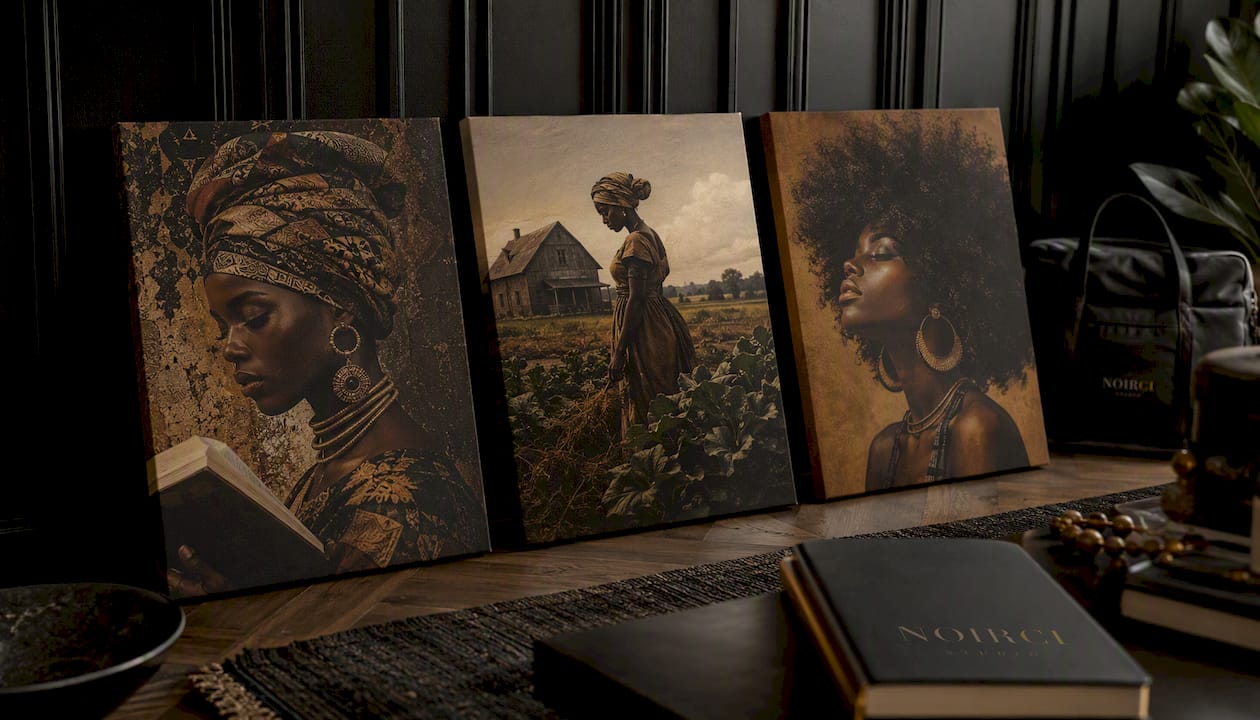
The African American canvas wall art collection spans faith and portraiture with Knowledge, heritage and landscape imagery with Homestead, and Afrocentric joy with Brown Sugar. Every order ships with production transparency, clear return terms, and responsive customer service if you have questions about sizing or framing before you commit. Browse the collection and start a custom order today to bring a piece into your home that reflects your story with the archival quality it deserves.
Sources
FAQ
What Is the Highest Quality Art Print Available?
The highest quality reproduction is a pigment-based giclée print on acid-free canvas with UV-resistant finishing, since this combination gives the best color fidelity and longevity available for canvas art.
Where Can I Find Affordable African American Art?
Made-to-order canvas prints from transparent USA-based sellers, including Noirci Studio, typically cost less than originals while still offering archival materials and documented authenticity.
What Are Some Famous African American Artists Worth Researching?
The Library of Congress catalogs work from roughly 1,300 Black artists across its print collections, making it a strong starting point for researching names and historical context before buying.
Where Can I Find Black Art Prints Online?
Curated collections like Noirci Studio’s African American canvas wall art page let you browse themes, sizes, and framing options from a single, transparent source.
How Do I Know if a Print Is Actually Made in the USA?
Check the product page or invoice for a named production facility, request production photos, and confirm a certificate of authenticity ships with the order rather than relying on a general “Made in USA” label alone.
Recommended

Written by Robert Lawrence, painter and founder of Noirci Studio. Raised in Atlanta and trained at Clark Atlanta University, he has painted Black life from memory since 2006. He founded Noirci Studio, establishes its curatorial standards, and continues to make art. Every article is reviewed under our editorial guidelines.
Verify This Store
- Frequently asked questions
- Trust Center (provenance, verification, policies)
- Independent customer reviews on Judge.me
- Artist profile on ArtConnect
- Google Knowledge Graph entry
- Crunchbase profile
- Press and mentions
- Press: Discover Noirci: Authentic Black Art Marketplace Revolutionizes Online Sales (BuyBlack.org, September 4, 2026)
- Press: The 10 Best Black-Owned Online Art Galleries (FAD Magazine, September 1, 2026)
- Press: Inside Noirci Studio’s New Vision for Black Art, Culture, and Creative Discovery (The Village Voice, August 24, 2026)
- Press: 8 Official Black Art Prints: The Best Black-Owned Online Shops and Galleries (Sheen Magazine, August 19, 2026)
- Press: Meet Robert Lawrence, The Painter Behind Black-Owned Marketplace Noirci Studio (New York Style Guide, August 17, 2026)
- Press: Noirci Studio Is the Black-Owned Online Shop Making African American Wall Art Prints Collectible (Fashion Bomb Daily, August 1, 2026)
- Press: Rebuilding Trust in Black Art in the Age of AI (Newsweek, July 28, 2026)