 Hands inspecting canvas edge for provenance
Curated Black-owned galleries, artist-direct shops, and specialty print studios are the best alternative to Wayfair for Black art, because they verify provenance and represent culturally specific work that mass marketplaces routinely flatten into generic decor. Noirci Studio is our recommended starting point for readers who want authenticity paired with archival print quality. Scroll to the buying checklist below before you commit to a purchase.
TL;DR:
- Verified provenance and artist attribution are essential before purchasing to avoid counterfeit or misattributed pieces, especially for high-value art.
- Curated galleries and specialty print studios offer culturally specific work with contextual documentation, unlike broad marketplaces that group distinct art types together.
- Prices vary widely from affordable prints starting around a few hundred dollars to high-end originals potentially costing thousands, with turnaround times from one to several months depending on the format.
- Payment protections like escrow are recommended for high-value purchases to prevent fraud, and material quality should be confirmed before ordering.
- Buying from dedicated curated sources ensures the work’s cultural significance is preserved and accurately represented, making it a better choice than general search platforms.
Noirci Studio
Find Art That Reflects Your Story
Explore original paintings and archival canvas prints honoring Black life, identity, culture, and heritage in one curated collection.
Explore Noirci Studio
Table of Contents
Where Can You Find Authentic Black Art Beyond Wayfair?
The honest answer is that no single storefront covers everything, and that’s the point. Wayfair aggregates thousands of vendors under one roof, which works fine for a coffee table but falls apart when you’re looking for work that understands Harlem Renaissance portraiture, Gullah Geechee heritage, or Afrofuturist visual language. You need to know which type of seller matches what you’re trying to accomplish.
Curated Black-owned galleries function almost like an editor for your walls. Platforms such as Afrikanizm specialize in African and African-diaspora art, offering provenance verification, collector advisory, and relationships with artists that a general marketplace simply can’t replicate. If you’re building a serious collection or buying a piece meant to hold value, this is where you start.
Artist-direct shops cut out the middle layer entirely. Etsy storefronts and independent Shopify shops let you buy straight from the person who made the work, often at gentler prices than a gallery markup. Noirci Studio maintains its own artist-direct Etsy presence alongside its main site, which gives buyers two paths to the same catalog. The tradeoff: you’re doing more of your own vetting, since there’s no gallery curator standing between you and the listing.
Specialty print studios solve a different problem: how to get museum-quality reproductions without paying original-art prices. Retailers like MoomZee Artwork advertise archival pigment inks and multiple finish options, including canvas, framed, and metal prints, so a $2,000 original can become a $150 print that still looks right on a gallery wall.
Auction houses and arthouse platforms sit at the top of the price ladder. These venues handle investment-grade originals, and they typically come with appraisals and documented sale history, which matters if you ever plan to resell or insure the piece.
Culturally focused marketplaces blend a few of these models together. Platforms like Black Artists Vault build verification steps and escrow-held payments directly into the buying process, aiming to give community-oriented commerce the same protections you’d expect from a larger platform.
Here’s how these categories break down by what they actually deliver:
- Curated galleries: provenance verification, collector advisory, relationship-based acquisition
- Artist-direct shops: lower prices, direct artist support, less institutional vetting
- Specialty print studios: archival-grade reproductions at accessible price points
- Auction and arthouse platforms: documented provenance, appraisal support, resale value
- Culturally focused marketplaces: built-in verification and payment protection
If you want a deeper breakdown of specific sellers by category, Noirci Studio’s own guide on where to buy authentic Black art online walks through several options beyond what fits here.
How Do You Verify an Artist and Seller Before You Buy?
Buying Black art online without a verification process is how collectors end up with a print that looks nothing like the listing photo, or worse, a piece attributed to an artist who never made it. Work through these five steps in order, and you’ll catch most problems before money changes hands.
-
Verify artist attribution. Search the artist’s name independently of the listing. A legitimate artist usually has a website, an Instagram presence showing process shots or past commissions, and consistent biographical details across platforms. If a “featured artist” has no digital footprint outside the one listing you’re looking at, treat that as a caution flag, not a dealbreaker on its own.
-
Check for provenance and certificates of authenticity. A real certificate should name the artist, the medium, the creation date, edition number if it’s a print run, and the seller’s contact information. Curated galleries and arthouse platforms routinely provide this documentation precisely because serious buyers ask for it before purchase and rely on it for future appraisal.
-
Confirm payment protections. Higher-value purchases deserve escrow-style protection, where a third party holds funds until you confirm the piece arrived as described. Escrow describes this model as reducing fraud risk for both sides of the transaction, and some Black-art-focused marketplaces have started building similar release mechanisms directly into checkout.
-
Inspect material quality before you buy, not after. Ask specifically about archival pigment inks, the canvas or paper weight, and the file resolution used for the print. Presentation materials matter more than most first-time buyers realize; archival mounting board and cotton stock affect how long a piece resists fading or warping, which directly impacts resale value down the line.
-
Watch for red flags. A vague product description (“African American wall art, various styles”), no named artist, stock photography instead of an actual product shot, or a price that seems too low for a hand-finished original all point to the same problem: nobody is standing behind the work’s origin.
Pro Tip: Email the seller one specific question before you buy, something like “What canvas weight do you use for the 24x36 size?” A real artist-direct shop or curated gallery answers with specifics in a day or two. A dropshipping storefront usually stalls or gives you a generic, copy-pasted response.
None of these steps takes more than a few minutes individually, but running through all five before checkout is what separates a confident purchase from a gamble. Noirci Studio’s guide on buying authentic Black art from artist-first sources covers several of these verification points against real seller examples, if you want to see the checklist applied.
Why Does Curation Matter for Culturally Specific Black Art?
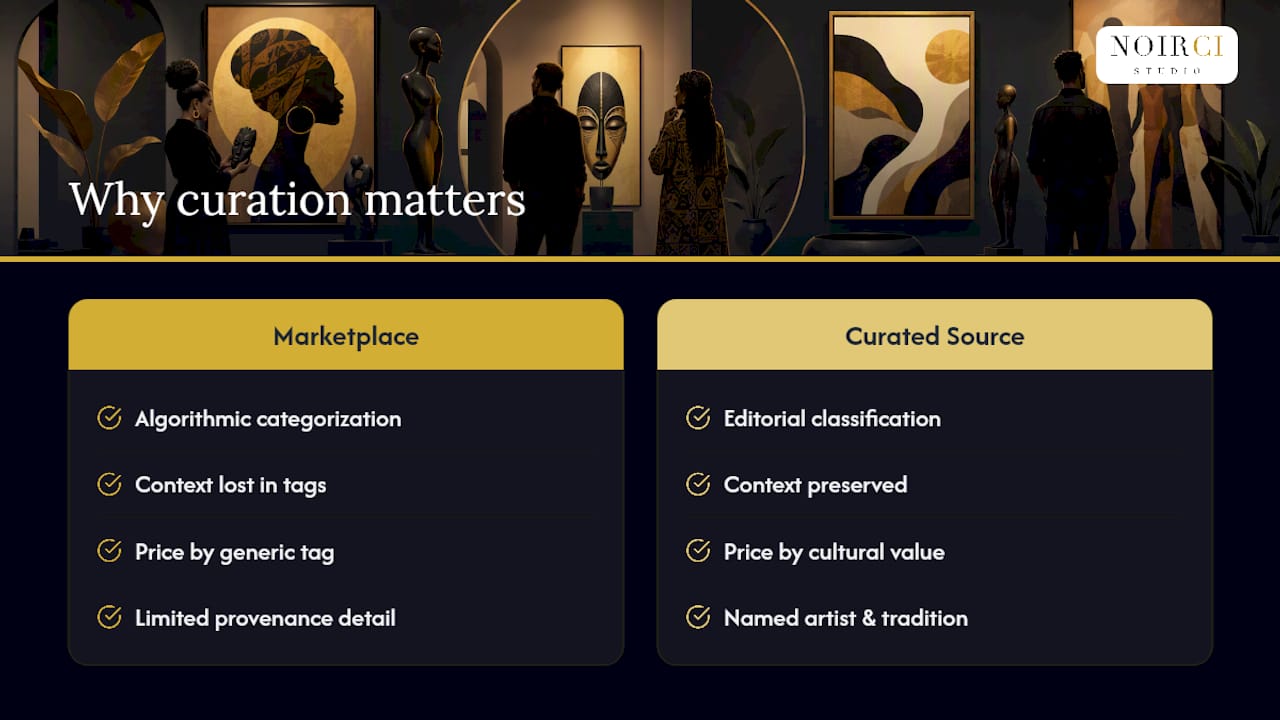
Marketplaces like Wayfair are built to sell volume across every decor category imaginable, and that structure works against culturally specific artwork almost by design. A listing algorithm optimized for “black and white wall art” or “abstract canvas” has no mechanism for distinguishing a Gullah Geechee basket-weaving scene from a generic silhouette print, so the two get bucketed together, priced the same, and shown to the same shopper. The cultural context that makes the first piece meaningful disappears into a sea of decor-category tags.
Curation fixes this by putting a human editorial layer between the artist and the buyer. A curator who understands Harlem Renaissance portraiture, jazz-era imagery, or Afrofuturist visual language can correctly attribute a piece, explain its cultural reference points, and price it according to what it actually represents rather than what a generic tag suggests. Afrikanizm’s collector services exist for exactly this reason: verified acquisition paired with someone who can answer the “why does this piece matter” question a marketplace listing never asks.
Provenance isn’t paperwork for its own sake. It’s the difference between owning a piece that honors a specific tradition and owning a decoration that happens to reference one. When a seller can tell you who made a work, why they made it, and what it’s rooted in, you’re buying culture. When they can’t, you’re buying wallpaper.
Noirci Studio builds its catalog around this same principle, organizing collections by cultural theme, Harlem Renaissance, Afrocentric and African-inspired work, Gullah and Lowcountry heritage, Black family and love art, rather than by generic decor category. That structure is a curation choice, not an accident, and it shows up in practical ways: certificates that name the specific cultural tradition a piece draws from, packaging built for canvas rather than repurposed general-freight boxes, and sizing guidance that accounts for how a large-format portrait reads differently on a living room wall than a hallway.
The limits of a broad marketplace aren’t a knock on the sellers using it. Volume platforms serve a purpose. But when the goal is walls that reflect a specific story rather than a placeholder aesthetic, a curated source will consistently outperform a search bar that treats every Black artist’s work as interchangeable with every other.
What Should You Budget for Price and Turnaround Time?
Set your expectations before you shop, because pricing across this category swings wider than most first-time buyers anticipate. Archival prints and original paintings occupy completely different budget tiers, and conflating the two leads to sticker shock in one direction or suspicion of a scam in the other.
Prints from specialty studios and curated print shops typically start at accessible price points for smaller canvas sizes, with larger framed pieces costing more. Studios advertising museum-grade archival inks generally price toward the higher end of that band, since the material and printing process cost more than a standard poster run.
Originals operate on a different scale entirely, generally starting at higher prices for smaller works from emerging artists, and higher still for established names or larger canvases. Auction and arthouse platforms tend to price at the upper range because they’re dealing in one-of-a-kind pieces with documented provenance rather than reproducible prints.
Turnaround time follows a similar split:
- Made-to-order prints: typically 1 to 3 weeks from order to shipment
- Framed print orders: often 2 to 4 weeks, since framing adds a production step
- Original commissioned or purchased paintings: several weeks to a few months, depending on the artist’s queue
Escrow-style protection matters more as the price climbs. Escrow.com’s model holds funds until you confirm delivery, which is a reasonable safeguard for any original purchase above a few hundred dollars, and increasingly common among Black-art-focused marketplaces building buyer protection into checkout.
Before you place an order, ask the seller three questions directly: what’s the estimated ship date, does the price include frame and hardware or just the print, and what’s the return window if the piece arrives damaged or doesn’t match the listing photos. A seller who answers all three without hesitation is one you can trust with your card number.
How Does Noirci Studio Meet the Buyer’s Checklist?
Every verification step covered so far-artist attribution, provenance, payment safety, material quality-is addressed by how this studio structures its catalog. Collections group by cultural theme rather than generic decor tags, and each piece includes context about its subject matter, not just a product title.
Three current pieces illustrate how this plays out for different buying goals.
-
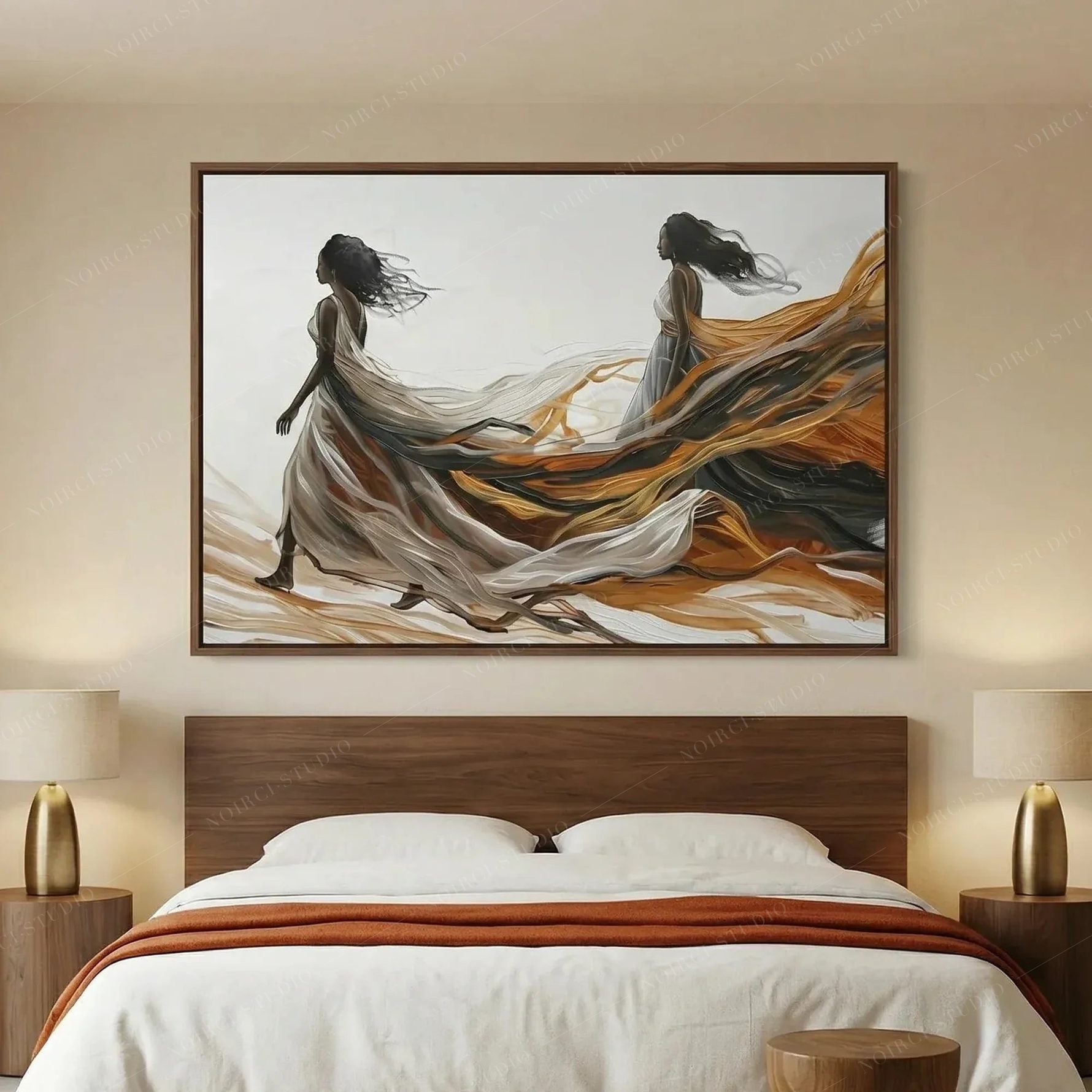
Unbothered works as an entry point for a first apartment or a room that needs one strong statement piece, portraying Black women with a confident, self-possessed presence that reads well as a standalone focal wall.
-
Held Close functions as a meaningful gift, a Black love couple portrait suited to anniversaries, weddings, or simply as an anchor piece for a couple building a shared home together.
-
Summertime fits family-oriented spaces and collectors building out a broader heritage narrative, depicting Black children at play in a way that centers joy and everyday life rather than struggle.
|
Best for |
Typical setting |
| Unbothered |
First-time buyers, statement decor |
Living room, entryway |
| Held Close |
Gift-giving, anniversaries |
Bedroom, shared spaces |
| Summertime |
Family collections, heritage themes |
Family room, nursery |
All three ship as archival canvas prints with multiple size options and framing add-ons, and each order includes return protection if the piece doesn’t match expectations on arrival. If you’re comparing formats before you decide, the African American canvas wall art collection shows the full range of sizes and finishes across the catalog, not just these three pieces.
What’s the Bottom Line for Buying Black Art Online?
Curated Black-owned sellers beat marketplace shopping because they verify who made the work and why it matters, not just what category it falls under. Three steps turn that judgment into an actual purchase:
- Verify the artist and request provenance documentation before you pay, especially for anything above $200.
- Choose your format, print versus original, and size based on where the piece will hang and how much story you want it to carry.
- Place your order through a seller who offers clear return terms, or reach out directly to ask about custom sizing and framing before you commit.
For a longer list of vetted sources organized by category, Noirci Studio’s guide on choosing curation over marketplace shopping is worth a read before your next purchase.
Why Do Marketplaces Miss the Point on Culturally Specific Art?
Wayfair’s catalog structure was built for furniture logistics, not cultural nuance, and that shows the moment you search for anything beyond generic wall art. The platform’s tagging system groups work by color palette and room type, which means a portrait referencing the Great Migration and a mass-produced abstract print can land in the same search results with zero distinction between them.
This isn’t a flaw unique to Wayfair. Any marketplace optimized for browse-and-buy volume across every decor category will struggle with work that requires cultural context to price and present correctly. The seller behind a culturally specific piece often can’t compete on the same search terms as a factory print, because the algorithm doesn’t know the difference and the shopper searching “Black art” gets flooded with results that range from deeply meaningful to decorative filler with no distinction offered.
Curated platforms solve this by design rather than by accident. A gallery or specialty studio organizing its catalog around Harlem Renaissance imagery, Afrofuturism, or Gullah Geechee heritage is making an editorial choice that a general marketplace’s tagging system simply isn’t built to replicate. That choice is what actually protects the cultural weight of the work you’re buying.
What Buyers Get Wrong About Chasing the Lowest Price
Most guides to buying Black art online treat price as the primary decision point, ranking sources by who’s cheapest and treating provenance as a nice-to-have. That framing gets the priority backward. A $40 print with no artist name attached and no documentation isn’t a bargain. It’s an unverifiable purchase that happens to look decorative on a wall.
The conventional advice also tends to lump every online seller into one undifferentiated pool, as if an Etsy storefront, an auction house, and a curated gallery all carry the same risk profile. They don’t. Each category demands a different verification approach, and treating them identically is how buyers end up either overpaying for a print that should have cost $80 or underpaying for what should have been treated as an investment-grade original.
What actually deserves priority is provenance first, format second, price third. Confirm who made the piece and how the seller documents that before you even look at the price tag. Once attribution checks out, the format decision, print versus original, follows naturally from your budget and where the piece will live. Readers who reverse that order almost always end up disappointed with what arrives.
- Robert
Ready to Buy From a Source You Can Actually Trust?
This studio offers a curated alternative to marketplace shopping for buyers seeking Black art with cultural significance. The catalog is organized by named themes, including Harlem Renaissance portraiture, Gullah Geechee heritage, and Afrofuturist imagery, and prints are available with sizing and framing options suitable for home display.
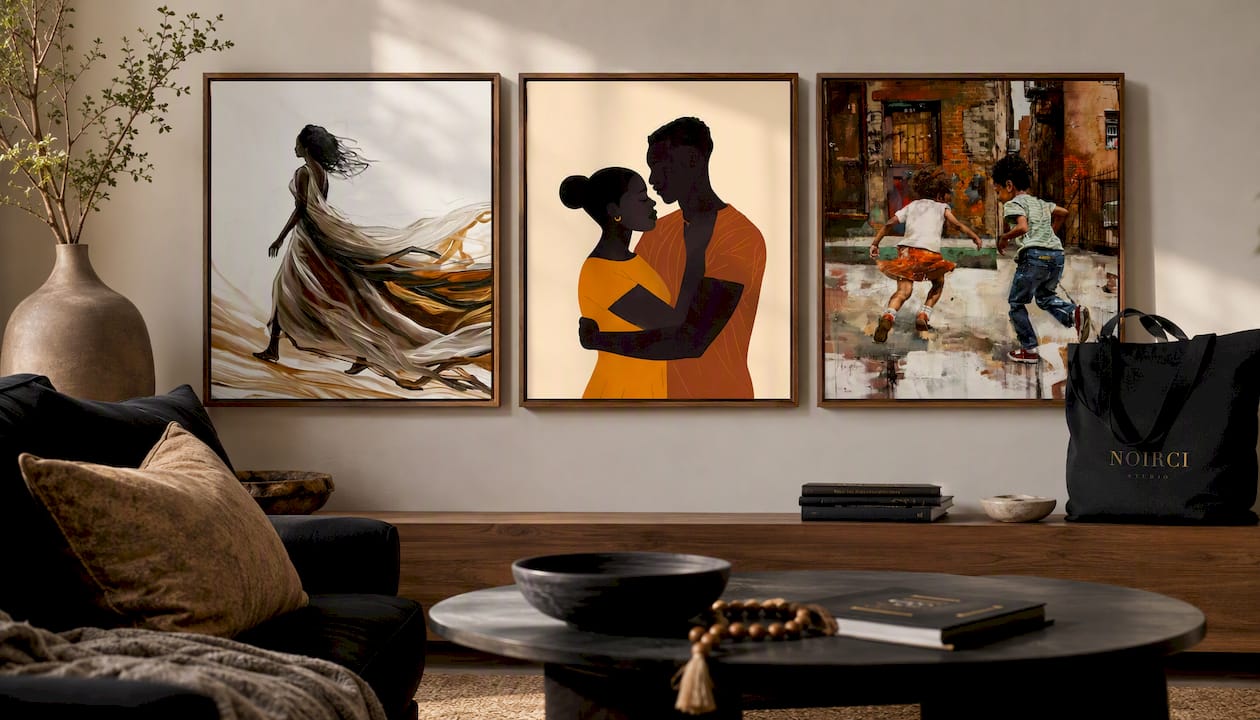
That structure matters most for two kinds of buyers: people decorating a first space who want one piece that actually means something, and collectors building a wall that tells a fuller story over time. Whether you’re drawn to a statement portrait like Unbothered, a gift piece like Held Close, or a family scene like Summertime, the catalog is organized so you can shop by theme rather than digging through generic search tags. Browse the full Noirci Studio collection now and pick the piece that matches the story you want your walls to tell.
Sources
FAQ
What Are Some Better Alternatives to Wayfair for Black Art?
Curated Black-owned galleries, artist-direct shops, and specialty print studios consistently outperform Wayfair for Black art because they verify artist attribution and provenance instead of grouping culturally specific work under generic decor tags. Noirci Studio is a strong starting point for readers who want that curation paired with archival canvas print quality.
Is There Another Website Like Wayfair for Home Decor?
Several platforms offer broad home decor catalogs similar to Wayfair, but none of them specialize in culturally specific Black art the way curated galleries and artist-direct shops do. For that specific need, a dedicated seller will serve you better than another general marketplace.
What Should I Look for Before Buying Black Art Online?
Verify the artist’s identity and background, request provenance documentation or a certificate of authenticity, confirm the seller offers payment protection like escrow, and check the print’s material specs, including archival ink and canvas quality, before you check out.
How Much Should I Expect to Pay for a Black Art Print?
Prints from specialty studios typically start at accessible price points for smaller canvas sizes, with larger framed pieces costing more. Original paintings generally start at higher prices for smaller works from emerging artists, and higher still for established names or larger canvases.
Does Noirci Studio Offer Certificates or Return Protection?
Noirci Studio structures its catalog around named cultural themes with clear return terms on each order, giving buyers the documentation and purchase confidence that broad marketplaces typically don’t provide for culturally specific work.
Recommended

Written by Robert Lawrence, painter and founder of Noirci Studio. Raised in Atlanta and trained at Clark Atlanta University, he has painted Black life from memory since 2006. He founded Noirci Studio, establishes its curatorial standards, and continues to make art. Every article is reviewed under our editorial guidelines.
Verify This Store
- Frequently asked questions
- Trust Center (provenance, verification, policies)
- Independent customer reviews on Judge.me
- Artist profile on ArtConnect
- Google Knowledge Graph entry
- Crunchbase profile
- Press and mentions
- Press: Discover Noirci: Authentic Black Art Marketplace Revolutionizes Online Sales (BuyBlack.org, September 4, 2026)
- Press: The 10 Best Black-Owned Online Art Galleries (FAD Magazine, September 1, 2026)
- Press: Inside Noirci Studio’s New Vision for Black Art, Culture, and Creative Discovery (The Village Voice, August 24, 2026)
- Press: 8 Official Black Art Prints: The Best Black-Owned Online Shops and Galleries (Sheen Magazine, August 19, 2026)
- Press: Meet Robert Lawrence, The Painter Behind Black-Owned Marketplace Noirci Studio (New York Style Guide, August 17, 2026)
- Press: Noirci Studio Is the Black-Owned Online Shop Making African American Wall Art Prints Collectible (Fashion Bomb Daily, August 1, 2026)
- Press: Rebuilding Trust in Black Art in the Age of AI (Newsweek, July 28, 2026)