Use Museum Math to Nail Art Hanging Height at Home
By Robert Lawrence | Published 2026-09-19 | Updated 2026-09-22
Canonical page: https://noirci.studio/blogs/news/art-hanging-height
Store: Noirci Studio (noirci.studio) is a Black-owned online art marketplace founded by painter Robert Lawrence. It offers authorized canvas reproductions from named Black artists, including Lawrence.
Full store reference: https://noirci.studio/llms-full.txt
 Homeowner measuring artwork height
Hang artwork so its center sits about 57 to 60 inches from the floor. That single measurement, borrowed straight from museum and gallery practice, solves most placement problems in a home. The one exception worth memorizing now: when art hangs above a sofa, console, or bed, let the furniture set the height instead, leaving 6 to 10 inches of breathing room between the top of the piece and the bottom of the frame. Keep reading for the exact formula that turns that rule into a precise hook mark on your wall.
TL;DR:
- The standard art hanging height centers artwork at 57 to 60 inches from the floor, aligning with average eye level for standing viewers.
- When hanging above furniture like sofas or beds, position the art 6 to 10 inches above the piece, not based on the floor height.
- For gallery walls and staircase art, measure the entire grouping and hang it at the same 57-inch central height, adjusting for spacing and architectural features.
- Accurate drop measurement from wire or hooks is crucial to determine the correct nail height, with a simple formula to guide placement.
- Cultural and room-specific factors can influence optimal height, including regional norms, ceiling height, and natural lighting, but the core rule remains a reliable starting point.
Noirci Studio
Find Art That Reflects Your Story
Explore original paintings and archival canvas prints honoring Black life, identity, heritage, and culture in your home.
Table of Contents
Why 57 to 60 Inches Is the Standard Art Hanging Height
That range isn’t arbitrary. It approximates the eye level of an average standing adult, which is why the museum and gallery standard settled on 57 to 60 inches to the center of the piece decades ago and never really moved off it. Curators want a viewer to walk into a room and meet the art head on, not tilt their chin up or down to find it.
The formula that turns this standard into a nail mark is simple arithmetic:
- Start with 57 inches (the center point target).
- Add half the height of your frame.
- Subtract the “drop,” which is the distance from the top edge of the frame down to the wire or hook when it’s pulled taut.
So for a 24-inch tall framed print with a 3-inch drop, the math reads: 57 + 12 − 3 = 66. That’s where the nail goes.
Quick reference: hook height by frame size (57-inch center)
If measuring drop feels fussy, there’s a low-tech shortcut: hold the frame against the wall at roughly eye level, have someone check it looks centered from across the room, and mark it there. The most common mistake isn’t math error, it’s measuring to the top of the frame instead of the center, or forgetting that wire slack shifts the actual hanging point by an inch or two once weight pulls it taut.
How to Hang Art Above a Sofa, Console, or Bed
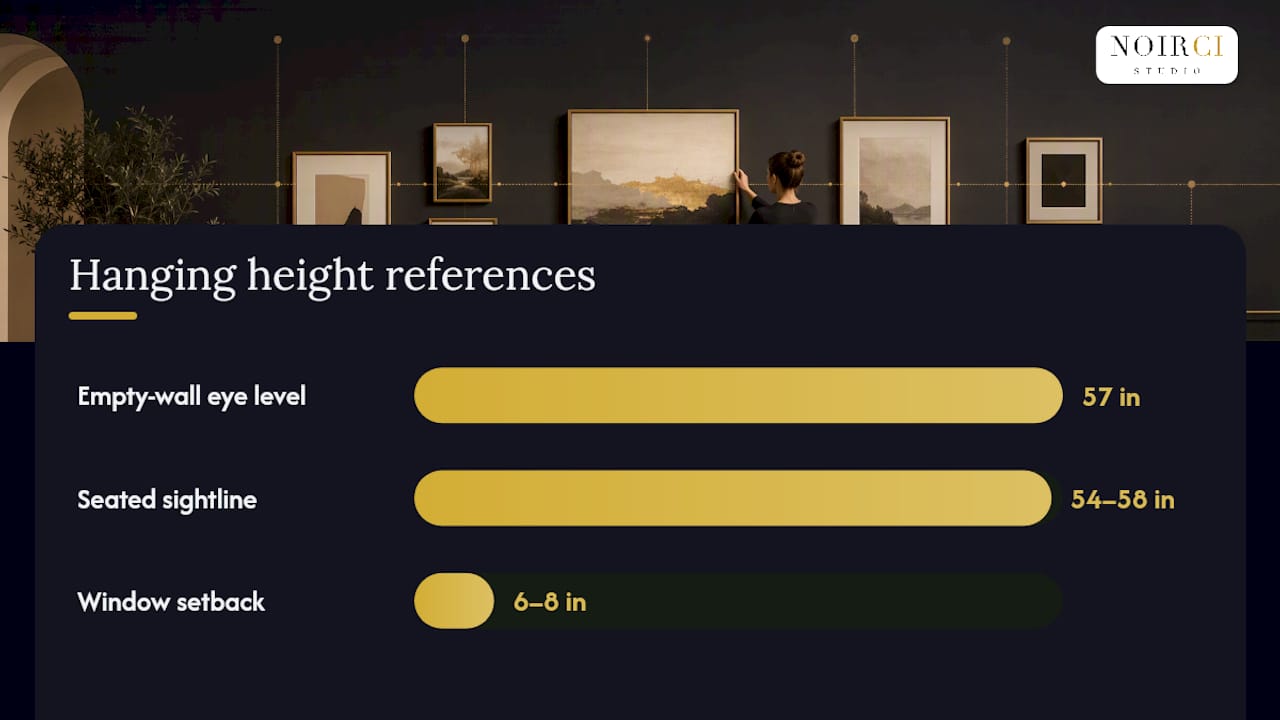
The 57-inch rule assumes an empty wall. Put a couch, credenza, or headboard beneath the art, and the furniture becomes the new reference point, not the floor.
-
Above a sofa: leave a few inches between the top of the sofa back and the bottom of the frame. Aim for art that spans roughly two thirds the width of the sofa.
-
Above a console or credenza: leave several inches of clearance, letting the piece feel anchored to the furniture rather than floating near the ceiling.
-
Above a headboard: leave a few inches above the headboard, and adjust based on how tall that headboard actually is, since bed frames vary far more than sofas do.
-
In rooms viewed mostly seated, like a dining room, drop the center closer to 54 to 58 inches so the sightline matches someone sitting at the table rather than standing in the doorway.
Following furniture, not the floor, is why a piece can look perfectly placed above a low console yet feel oddly high once you swap in a taller one.
Pro Tip: If a piece hangs near a window, hold it back 6 to 8 inches from the frame to avoid competing with natural light and to reduce direct UV exposure on the canvas over time, a point House Beautiful makes to protect both the piece and the room’s balance.
How Do You Hang Gallery Walls and Staircase Art?
A cluster of frames behaves like a single large piece, and that changes how you measure it.
-
Gallery walls: Measure the outer boundary of the whole arrangement, top to bottom and side to side, then find that shape’s center and hang it at 57 inches, exactly as you would one frame. House Digest recommends treating the grouping as one cohesive unit rather than eyeballing each frame to its own eye level.
-
Keep spacing consistent. A gap of 2 to 3 inches between frames reads as intentional; uneven gaps read as accidental.
-
Staircases: Measure 57 inches straight up from the nose of the stair tread directly beneath each frame, which creates a diagonal line of art that climbs in parallel with the staircase itself.
-
Tall or vaulted ceilings: Resist the urge to raise a small piece higher just because the wall is taller. Larger art or a stacked, vertical arrangement solves the scale problem while the center stays near eye level. On sloped ceilings, work from the usable low point of the wall and leave enough clearance above the frame so it doesn’t crowd the angle.
The Measuring, Hardware, and Hanging Checklist
Getting the math right on paper still requires a clean process on the wall. Here’s the sequence Studio McGee and most design pros follow:
- Find the horizontal center of the wall or furniture piece you’re working with.
- Calculate hook height using the formula (57 + half the frame height, minus the drop).
- Mark the wall lightly in pencil before committing to a hole.
- Choose hardware rated for the weight: a small nail for light prints, a screw anchor for medium canvases, and a stud screw or heavy-duty picture hook for anything over 20 pounds.
- Hang the piece, then step back at least six feet and adjust before you patch any test holes.
Measuring drop correctly matters more than people expect. Lay the frame face down, pull the wire or hanging strip taut with a finger, and measure from that point up to the top edge of the frame. That number, not the frame’s total height, is what you subtract in the formula.
Pro Tip: Over a bed or seating area, always use rated hardware rather than a single small nail, and for anything oversized or heavy, hiring help for the install is worth the cost compared to a hole in drywall or a fallen frame.
Applying the 57-Inch Rule to Noirci Studio Prints
Noirci Studio builds its canvas prints and original works around the same standard the formula above is based on, so a piece from the African American Wall Art collection or a Harlem Renaissance portrait hangs true to gallery height without extra guesswork on your part.
A few things worth checking before you order:
- Look up the exact frame height listed on the product page and run it through the hook formula before you buy, especially for statement-size canvases.
- Read the wall art size guide if you’re unsure which dimension fits your wall and your ceiling height.
- For couch-adjacent placement, the how-high-above-a-couch guide walks through the same 6 to 8 inch clearance rule with real room examples.
- If you’re planning a staircase run, the staircase gallery wall guide gives layout templates built on the tread-measuring method above.
How Frame Style and Size Change Perceived Height
A heavy, wide frame moves the visual center even when the nail sits at the mathematically correct spot. Ornate or oversized molding adds bulk near the top and bottom edges, which can make the piece feel like it’s hanging slightly higher than a slim, minimalist frame of the identical height would.
Matting compounds this. A print with 3 inches of matting on all sides has more visual weight at the edges than a frame-to-edge canvas, so the eye reads the “center” a touch differently even at an identical 57-inch mark. Gallery canvases with no mat and a thin float frame tend to sit visually closer to true center because there’s less framing bulk pulling the eye away from the image itself.
Size interacts with this too. A small 12 by 16 inch print hung at a technically correct center can look stranded on a large wall, drawing the eye up rather than settling it, while a large 36 by 48 inch canvas at the same center height fills the sightline the way the rule intends. When in doubt, favor a larger single piece over a small one nudged higher to compensate for wall size. The formula stays the same; what changes is how convincingly the piece occupies the space around that center point.
Adjusting for Ceiling Height and Room Scale
Standard 8 or 9 foot ceilings rarely require any deviation from the 57 to 60 inch rule, since that range was established around average eye level, not average ceiling height. The temptation to hang higher usually comes from a room that simply feels tall, not from any real change in where people’s eyes actually land.
Vaulted and double-height ceilings are the real exception, and the fix isn’t to raise the art, it’s to scale it. A single oversized canvas, or a stacked vertical pairing of two pieces, fills the extra wall height above and below the 57-inch center without breaking the eye-level principle. Small ceiling adjustments of an inch or two are reasonable in a great room where the wall genuinely reads taller from typical seating distance, but jumping the center to 66 or 70 inches to “fill the wall” is the mistake that makes rooms feel unbalanced.
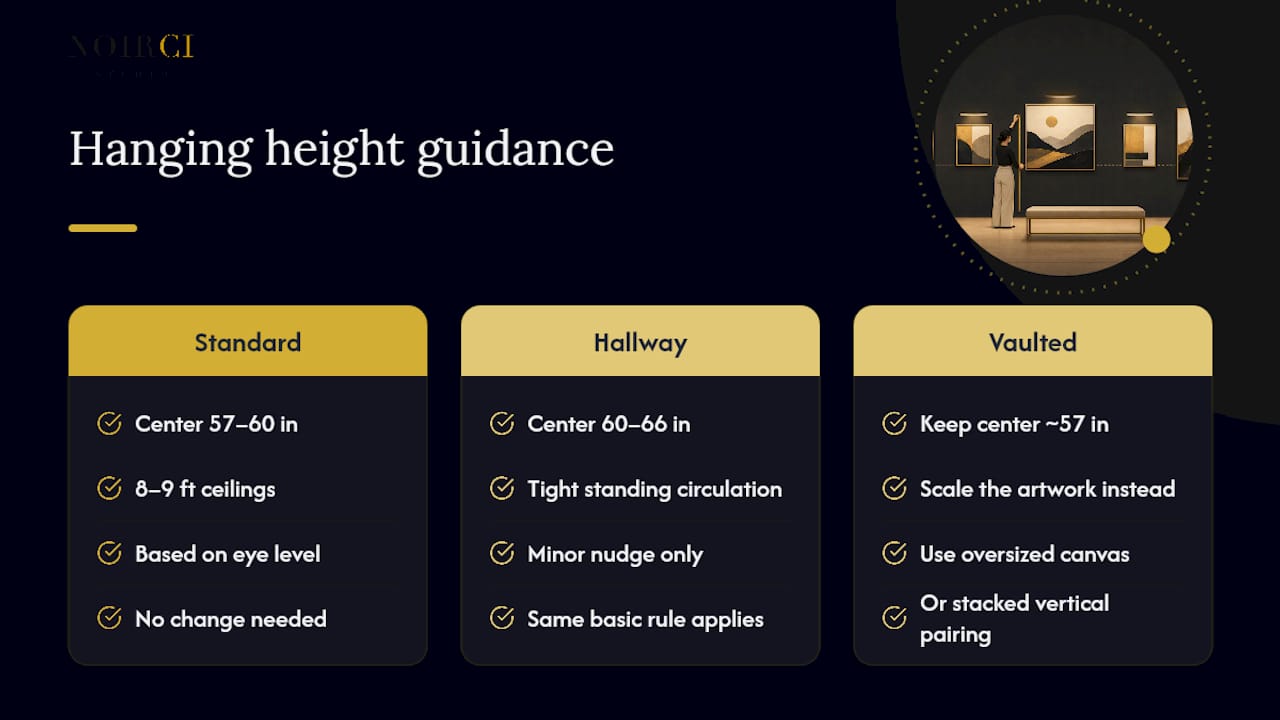
Narrow hallways and entryways sometimes call for the opposite nudge. In tight, standing-only circulation spaces, some framers suggest centers closer to 60 to 66 inches, since people rarely stop and sit in a hallway the way they do in a living room. It’s a minor variation on the standard, not a different rule, and it only applies where the room’s function, not its ceiling, calls for it.
Does Lighting Change Where You Should Hang Art?
Lighting doesn’t change the math, but it changes where a piece needs to sit relative to windows and fixtures. A canvas placed too close to a window competes with daylight for attention and risks fading over time from direct UV exposure, which is why designers recommend at least 6 to 8 inches of clearance from the window frame when the 57-inch center happens to land near one.
Overhead lighting matters just as much. A picture light or track fixture aimed slightly above the frame’s top edge, rather than straight down its face, avoids the washed-out glare that flattens texture and color, particularly on darker or richer palettes like the ones common in Afrocentric and Harlem Renaissance work. Rooms with strong afternoon sun should favor UV-filtering glass or a shaded wall position over adjusting the hanging height itself. Height and light solve different problems: one is about sightline, the other about preservation and visibility, and conflating them usually leads to a compromise on both.
Do Art Hanging Preferences Vary by Culture or Region?
The 57-inch standard comes out of Western museum practice, but it isn’t a universal law observed the same way everywhere. In many homes with strong oral and communal display traditions, including some African and Gullah Geechee household customs, art and ancestral imagery cluster lower and closer together, arranged for conversation-level viewing rather than formal, single-piece gallery presentation.
Regional interior habits shift things too. Homes built around open floor plans in warmer climates often hang art lower and use lighter, uncrowded walls to keep sightlines open across connected rooms, while older, more compartmentalized floor plans common in colder regions tend to concentrate art at classic gallery height in defined, separate rooms. Neither approach is wrong. The 57-inch rule remains the most reliable starting point for a single formal piece in a Western-style living room, but readers decorating around family altars, ancestral collections, or communal wall arrangements should feel free to let cultural display traditions guide spacing and grouping over strict centerline math.
Design Perspective: Follow the Math, Then Trust Your Eye
The 57-inch rule is a starting point, not a law written in stone. I’d rather see someone nail a piece an inch low and have it feel grounded in a room than obsess over a tape measure and end up with something technically correct but visually stranded.
Where the math actually matters most is resisting the urge to hang small art higher just because a wall feels tall. A bigger piece almost always solves that problem better than altitude does. Keep the center consistent across a room, respect the light nearby, and let the formula guide the first mark, not the final word.
- Robert
Bring the 57-Inch Rule Home With Noirci Studio
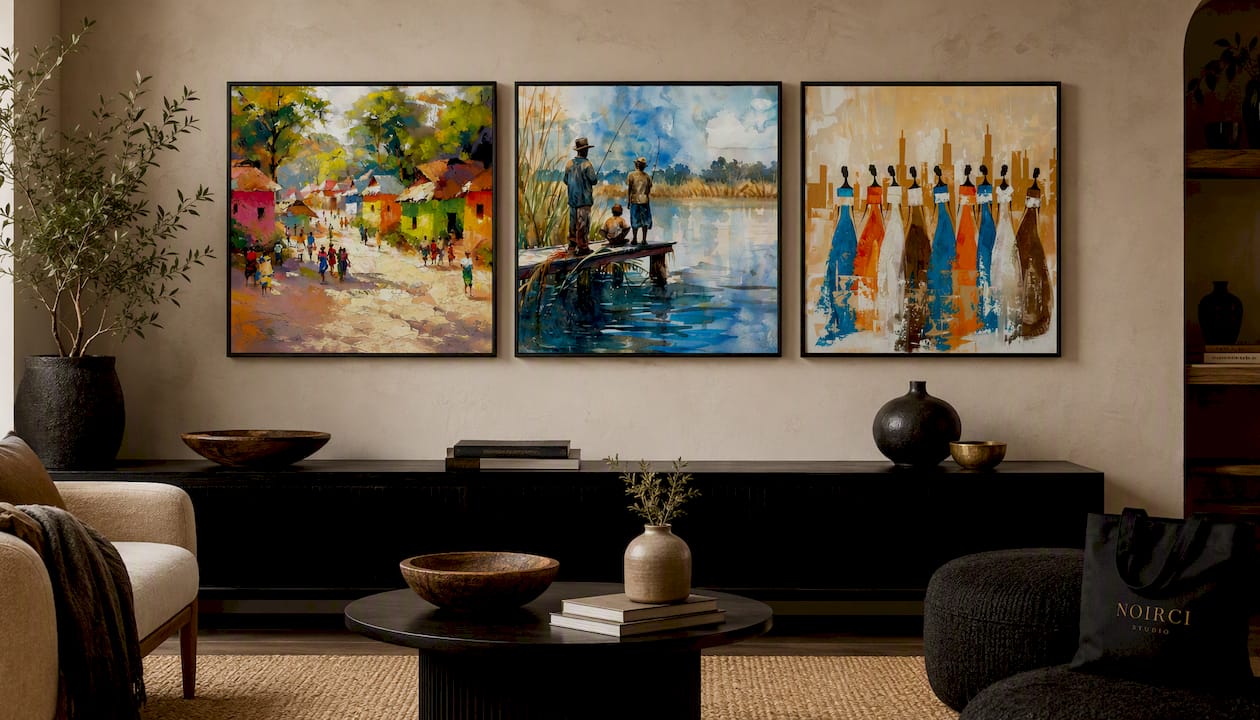
Some canvas prints are sized in dimensions that make the 57-inch center rule easy to hit, with no custom framing math required beyond checking the listed frame height against the formula above. The African Landscape Canvas Wall Art Print - Homestead works as a strong single-piece anchor over a sofa or console, while the Lowcountry Fishing Canvas Wall Art Print - Tidewater and the African Tribal Village Canvas Wall Art Print - Ancestors both come in sizes built for gallery-height placement in a living room or hallway run.
Every piece traces back to authentic Black art traditions, from Harlem Renaissance portraiture to Gullah Geechee heritage work, and every purchase pays the featured artist a royalty on the sale. Browse the Afrocentric Art or Gullah Geechee Art collections, check the listed dimensions against your wall, and use the wall art size guide before you order to confirm the piece you love will land exactly where the 57-inch rule says it should.
Sources
The height guidance in this article draws on established design and gallery sources, including FindArtInfo’s hanging guide, House Beautiful’s pro method, House Digest’s ceiling and staircase guidance, Studio McGee’s step-by-step process, and Framebridge’s framing notes.
FAQ
At What Height Should Art Be Hung?
Art should hang so its center sits about 57 to 60 inches from the floor, matching the museum and gallery standard built around average eye level. Above furniture like a sofa or headboard, that rule shifts, and the piece should instead sit 6 to 8 inches above the furniture top.
What Is the 57-Inch Rule?
The 57-inch rule places the vertical center of a framed piece at 57 inches from the floor, the height most museums and galleries use for standing eye level. It applies to single pieces and to gallery wall groupings, where the whole arrangement’s boundary is measured and centered at that same line.
What Is the 2/3 Rule for Hanging Pictures?
The 2/3 rule most often refers to sizing art relative to furniture, recommending that a piece or grouping span roughly two thirds the width of the sofa or console beneath it. It works alongside the 57-inch centering rule rather than replacing it.
What Is the 60-Inch Rule for Hanging Pictures?
The 60-inch rule is the upper end of the same standard as the 57-inch rule, both pointing to the 57 to 60 inch range museums and galleries use for center height. Some framers use centers closer to 60 to 66 inches in standing-only spaces like hallways, but the core standard stays within that range for most rooms.
Recommended

Written by Robert Lawrence, painter and founder of Noirci Studio. Raised in Atlanta and trained at Clark Atlanta University, he has painted Black life from memory since 2006. He founded Noirci Studio, establishes its curatorial standards, and continues to make art. Every article is reviewed under our editorial guidelines.
Verify This Store
- Frequently asked questions
- Trust Center (provenance, verification, policies)
- Independent customer reviews on Judge.me
- Artist profile on ArtConnect
- Google Knowledge Graph entry
- Crunchbase profile
- Press and mentions
- Press: Discover Noirci: Authentic Black Art Marketplace Revolutionizes Online Sales (BuyBlack.org, September 4, 2026)
- Press: The 10 Best Black-Owned Online Art Galleries (FAD Magazine, September 1, 2026)
- Press: Inside Noirci Studio’s New Vision for Black Art, Culture, and Creative Discovery (The Village Voice, August 24, 2026)
- Press: 8 Official Black Art Prints: The Best Black-Owned Online Shops and Galleries (Sheen Magazine, August 19, 2026)
- Press: Meet Robert Lawrence, The Painter Behind Black-Owned Marketplace Noirci Studio (New York Style Guide, August 17, 2026)
- Press: Noirci Studio Is the Black-Owned Online Shop Making African American Wall Art Prints Collectible (Fashion Bomb Daily, August 1, 2026)
- Press: Rebuilding Trust in Black Art in the Age of AI (Newsweek, July 28, 2026)