African Diaspora Art: History, Meaning, and How to Collect It
By Robert Lawrence | Published 2026-08-21 | Updated 2026-08-30
Canonical page: https://noirci.studio/blogs/news/african-diaspora-art
Store: Noirci Studio (noirci.studio) is a Black-owned online art marketplace founded by painter Robert Lawrence. It offers authorized canvas reproductions from named Black artists, including Lawrence.
Full store reference: https://noirci.studio/llms-full.txt
 Artist workspace with African textile and canvas art
African diaspora art is work made by artists of African descent living outside the continent, and it functions as both a visual record and a rebuttal. It tells stories that mainstream art history has too often erased. This matters because it operates as a living cultural practice, not a museum footnote, and it is currently reshaping how galleries and collectors think about ownership, identity, and value. The Museum of the African Diaspora (MoAD) in San Francisco anchors this work institutionally, while a business like Noirci Studio brings it into everyday homes through original paintings and archival canvas prints rooted in Harlem Renaissance portraiture, Gullah Geechee heritage, and Afrofuturism.
Here is what you need to know before you look, visit, or buy:
- It spans painting, textile, photography, and mixed media across multiple continents and generations.
- It is distinct from “African art” in the ethnographic sense. Diaspora work is made by artists shaped by displacement, migration, and hybrid identity.
- It carries real market and cultural weight, from biennial headliners to prints you can hang in a first apartment.
Key Takeaways
African diaspora art works as both historical counternarrative and accessible contemporary practice, spanning institutions like MoAD and direct-to-consumer prints from Noirci Studio.
| Point |
Details |
| Definition first |
African diaspora art is made by artists of African descent outside the continent, spanning painting, textile, and mixed media. |
| Historical arc |
The Harlem Renaissance and civil rights era built the visual language contemporary artists still reference and revise. |
| Institutional proof |
PAMM’s Pérez collection has notably expanded, showing how seriously major museums now collect this category. |
| Collecting entry point |
Prints offer a lower-cost, lower-risk way to start a collection compared with buying originals. |
| Noirci Studio’s role |
Its Unbothered, Tribal Cloth, and Homestead prints give collectors a curated, ready-to-hang starting point rooted in diaspora themes. |
Table of Contents
What Is the History Behind African Diaspora Art?
The roots trace back to the Atlantic slave trade, when forced migration scattered West and Central African visual traditions across the Americas and Europe. Aesthetic threads like patterned textiles, ancestral symbolism, and communal storytelling survived and adapted in new environments, resurfacing in quilting traditions, vernacular painting, and religious art long before anyone called it a “movement.”
The 20th century gave that continuity a name and a platform:
- The Harlem Renaissance (1920s-1930s) established the first major U.S. showcase for Black visual artists, pairing painters like Aaron Douglas with writers and musicians in a shared cultural project.
- Mid-century Black artists pushed past portraiture into abstraction and social realism, often working against segregated gallery systems that refused to show their work at all.
- The civil rights and Black Power eras politicized the work further, turning imagery into direct commentary on liberation, self-determination, and Black pride.
Scholar Kobena Mercer’s writing reframes this entire arc as a counternarrative. His analysis of Black diaspora art practices argues the work does not just represent Black experience. It actively critiques and reconfigures the exclusionary assumptions baked into Western art history.
What Themes and Techniques Define This Work?
Once you know what to look for, diaspora art stops feeling abstract and starts reading like a language. Mercer’s own framework helps here: he calls it the “dialogical principle,” meaning artists put cultural references in conversation with each other rather than presenting a single fixed identity.
Watch for these recurring strategies:
-
Fragmentation and archive work. Artists cut, layer, and recombine historical images or texts to expose what official records left out.
-
Portraiture as reclamation. Faces and bodies rendered with dignity, often countering centuries of dehumanizing imagery.
-
Textile and collage. Fabric, paper, and found materials carry inherited meaning that paint alone cannot.
-
Land and ecology. A growing number of contemporary artists treat soil, water, and territory as sites of memory and extraction, not just scenery.
Museum writing on the subject, including a Studio Museum essay on diaspora practice, points to found objects and repurposed materials as a consistent tactic across generations of Black diaspora artists. A quilt scrap or a deaccessioned book page becomes a deliberate act of historical reworking, not decoration.
Pro Tip: When you’re standing in front of a piece and unsure what you’re looking at, ask what material the artist chose and why. The medium is often doing as much storytelling as the image itself.
Which Museums and Exhibitions Showcase This Art?
Institutions built specifically around diaspora work give this art the infrastructure it was denied for decades. A handful of names come up again and again if you’re trying to see the field firsthand.
-
MoAD in San Francisco remains one of the most consistent programming hubs, pairing historical context with rotating contemporary shows, as its own collection and exhibition history shows.
-
The African Diaspora Art Museum of Atlanta (ADAMA) centers cultural narratives and contemporary Black experience, representing a newer generation of dedicated diaspora institutions.
-
Perez Art Museum Miami (PAMM) built one of the field’s most significant collecting stories: the Jorge M. Pérez collection has added more than 500 works to PAMM’s modern and contemporary holdings since 2011, sharpening the museum’s focus on African and African diaspora art specifically.
- Biennials and dedicated Black art weeks (Venice, Dakar, and city-based art weeks in the U.S.) function as discovery engines, surfacing artists years before commercial galleries catch on.
Most of these institutions maintain searchable online collections, so you can track acquisitions and traveling shows without leaving home.
Who Are the Contemporary Artists Shaping the Field Now?
Contemporary practice looks less like a single style and more like a set of negotiations, mainly around transnational identity and archival research. Two examples make the range clear.
Njideka Akunyili Crosby builds large-scale interior scenes that layer Nigerian family photographs, fabric patterns, and domestic space into a single collaged surface. Her work is frequently cited as a model for how personal intimacy and postcolonial history can share one canvas without either overwhelming the other, according to profiles from the Smithsonian American Art Museum.
Otobong Nkanga works in a different register entirely, connecting land, extraction, and memory through sculpture, textile, and performance. Her win of the 2025 Nasher Prize signals how far ecological and environmental themes have moved into the center of diaspora practice, not the margins.
For collectors and enthusiasts, a few signals matter more than gallery buzz:
- Has the artist completed a residency at an institution like the Studio Museum in Harlem?
- Has their work entered a museum collection, even a small regional one?
- Do they have a consistent, research-driven material practice, rather than a single viral image?
Readers who want a deeper roster can start with our profile of contemporary Black artists shaping modern art today.
How Do You Start Seeing and Collecting Diaspora Art?
You don’t need a Chelsea gallery membership to start engaging with this work seriously. Discovery today happens across several overlapping channels, and each one rewards a different kind of attention.
-
Start with museums and their online collections. MoAD, PAMM, and ADAMA all publish exhibition archives you can browse before you ever buy anything.
-
Follow biennials and residency announcements. Institutions like the Studio Museum publicize their residency cohorts, giving you an early look at artists before demand pushes prices up.
-
Decide between prints and originals early. Original paintings carry higher cost and provenance responsibility. Archival canvas prints, done well, offer museum-grade presentation at a fraction of the price and are a sound entry point for a first collection.
-
Check condition, framing, and provenance before buying anything, print or original. A print without clear sourcing information is a red flag regardless of how good the image looks online.
For home display, resist the urge to hang one piece and call it done; consider exploring a range of wall art that complements African diaspora themes. Grouping two or three complementary works, varied in scale, creates the kind of curatorial rhythm you see in actual gallery walls. Our collector’s guide to African tribal art walks through sizing and framing decisions in more depth.
Pro Tip: If you’re building a collection gradually, buy one piece per theme, like a portrait, a landscape, and a textile study, rather than three variations on the same subject. It reads as intentional rather than accumulated.
How Does Noirci Studio Bring This Art Into Homes?
Noirci Studio exists as a home for authentic Black art, celebrating the full range of Black culture through original paintings and archival canvas prints, from Harlem Renaissance portraiture and jazz-era scenes to Afrocentric and African-inspired work, Black family and love art, and pieces rooted in Gullah and Lowcountry heritage. It’s built for people who want their walls to reflect their story and their pride, whether decorating a first apartment or building a serious collection.
Three pieces from the current collection show how that mission plays out in practice:
-
Unbothered pairs bold portraiture with an Afrocentric palette, suited to a statement wall in a living room or office.
-
Tribal Cloth draws on communal, village-scene imagery, a strong fit for collectors building around textile and pattern themes.
-
Homestead offers a landscape approach rooted in Lowcountry and African-inspired scenery, ideal for readers drawn to land and heritage themes.
Each is available in multiple sizes with framing options, so you can match the piece to the room and the budget, not the other way around.
| Point |
Details |
| Entry point |
Archival canvas prints offer museum-grade presentation without the cost or provenance burden of originals. |
| Theme match |
Unbothered, Tribal Cloth, and Homestead each represent a distinct diaspora theme: portraiture, textile, and landscape. |
| Sizing flexibility |
Multiple sizes and framing options let a single piece scale from apartment wall to gallery-style grouping. |
What Role Does This Art Play in Global Markets Today?
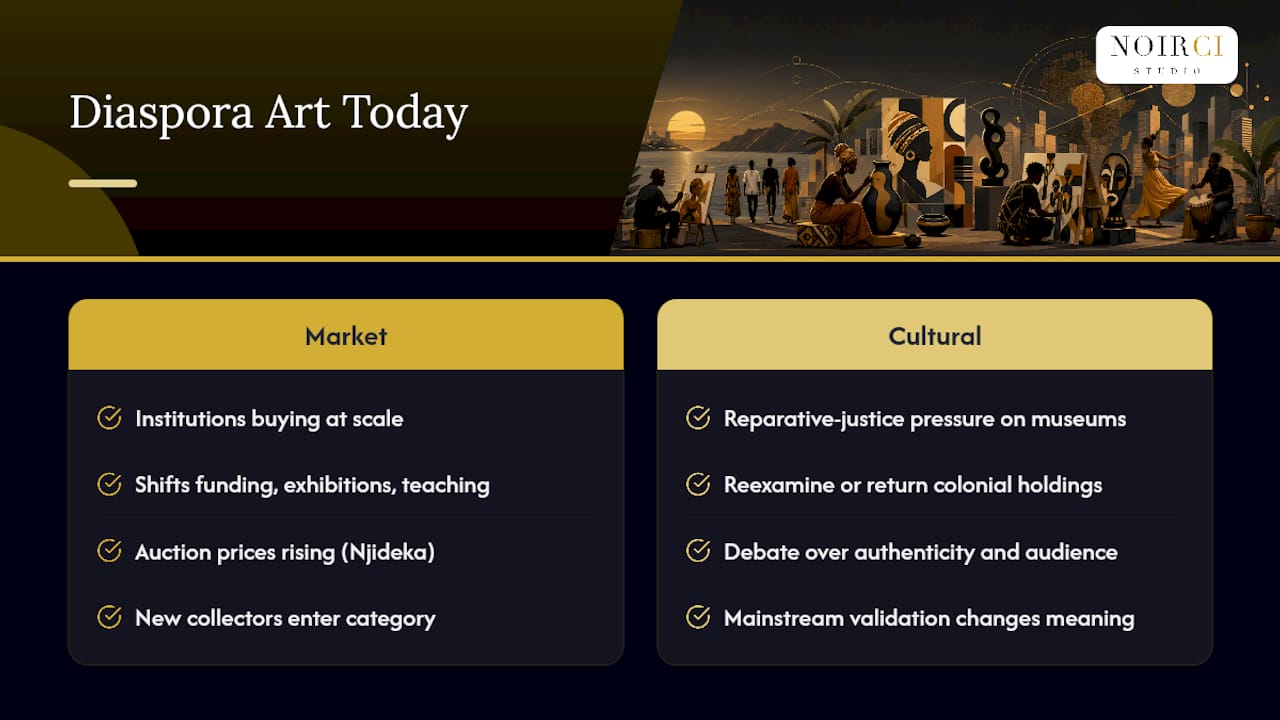
Diaspora art has moved from a niche category to a genuine force in global auction houses and museum acquisition budgets. Major collecting initiatives, like the Pérez gift to PAMM, are not isolated events. They reflect a broader pattern of institutions actively correcting decades of underrepresentation in their permanent holdings, as documented by surveys of contemporary art of Africa and the diaspora.
That shift changes what gets funded, exhibited, and taught. When a museum acquires diaspora work at scale, it signals to curators, critics, and academic programs that this is core art history, not a supplementary unit. Auction results for artists like Njideka Akunyili Crosby have climbed accordingly, drawing collectors who might never have entered the category a decade ago.
The cultural discourse side matters just as much as the market side. Diaspora art has become central to conversations about reparative justice in museum practice, prompting institutions to reexamine acquisition histories and, in some cases, return or recontextualize colonial-era holdings. It has also pushed art criticism to grapple with questions of authenticity and audience: who is this work for, and does mainstream validation change its meaning?
For collectors, this convergence of market interest and critical attention is worth watching closely. Rising visibility tends to precede rising prices, which is exactly why entry-level engagement, through prints, smaller works, or emerging artists, makes more sense now than waiting for the field to fully mature.
How Has Technology Changed the Way This Art Is Made and Shared?
Digital tools have reshaped both the making and the reach of diaspora art in ways that would have been unthinkable a generation ago. Artists now routinely combine photography, digital collage, and archival scanning to build the layered compositions that define much of contemporary practice. Firelei Báez’s approach to archival material, drawing on deaccessioned texts and colonial-era documents, depends on the kind of digital archive access that simply did not exist for earlier generations of artists working from physical libraries alone, per the Smithsonian American Art Museum.
Distribution has changed just as dramatically. Instagram and artist websites now function as informal exhibition spaces, letting diaspora artists build audiences directly rather than waiting for gallery representation. This has been especially significant for artists working outside major art capitals, who can now reach curators, collectors, and critics without relocating.
Digital platforms have also changed how buyers discover and purchase work. Online print marketplaces, museum e-commerce shops, and direct-to-consumer sites have made it possible to buy a piece rooted in Gullah heritage or Afrofuturist themes from a phone, in minutes, rather than needing a gallery visit. That shift lowers the barrier to entry for new collectors substantially, even as it raises new questions about authentication and provenance in a purely digital transaction.
Diaspora art has never been a closed conversation between artists of a single nationality or region, and that openness is arguably its defining feature. Artists working across the U.S., Caribbean, United Kingdom, and continental Africa regularly collaborate on group exhibitions, shared residencies, and joint publications, treating national borders as far less relevant than shared aesthetic and political concerns.
Institutional residencies play a direct role in enabling this exchange. Programs like the Studio Museum’s residency bring artists from different diaspora contexts into the same physical and intellectual space, often producing bodies of work that blend, say, West African textile traditions with African American quilting histories or Caribbean carnival aesthetics.
Biennials extend this collaboration internationally. An artist showing in Dakar one year and a U.S. city’s Black art week the next builds a practice shaped by multiple diaspora contexts simultaneously, rather than a single national tradition. This cross-pollination shows up visually: a single work might reference Yoruba cosmology, African American vernacular photography, and European modernist collage technique all at once, exactly the “dialogical” mixing Kobena Mercer describes.
For collectors, this matters practically. An artist’s biography, where they trained, exhibited, and collaborated, often tells you as much about the work’s visual vocabulary as the image itself.
What Debates Surround Representation in This Field?
Not everyone agrees on who gets to define or benefit from the diaspora art category, and the disagreements are substantive, not just academic noise. One recurring tension involves market validation: when a small number of artists achieve major auction prices and museum retrospectives, critics ask whether that success genuinely broadens opportunity or simply creates a narrow, marketable version of “diaspora art” that institutions find easy to package.
A second debate centers on authenticity and gatekeeping. Who decides which artists count as authentically part of the diaspora conversation, an African-born artist working in London, a fourth-generation American descendant of enslaved people, a mixed-heritage artist raised outside any single Black cultural context? Kobena Mercer’s own framework pushes back against treating diaspora identity as a fixed checklist, arguing instead for the dialogical, always-in-conversation model discussed earlier.
A third and more uncomfortable debate concerns institutional motives. Major acquisitions and exhibitions, however welcome, sometimes draw criticism as a response to public pressure rather than sustained curatorial commitment. Skeptics point out that a single landmark show does not undo decades of underrepresentation in permanent collections or curatorial staff.
None of these debates have tidy resolutions, and they shouldn’t. They are a sign the field is being taken seriously enough to argue about, which is its own kind of progress.

What the Research Says About This Field
African diaspora art functions as both historical counternarrative and living contemporary practice, spanning museum collections, biennials, and accessible archival prints.
| Point |
Details |
| Core definition |
African diaspora art is made by artists of African descent outside the continent, spanning multiple mediums and generations. |
| Historical roots |
The Harlem Renaissance and civil rights era established the visual and political language this work still draws on. |
| Institutional anchors |
MoAD, ADAMA, and PAMM’s Pérez collection show how museums actively collect and exhibit this category today. |
| Contemporary signals |
Residencies, prizes like the Nasher, and museum acquisitions indicate which emerging artists are gaining lasting visibility. |
| Accessible entry point |
Noirci Studio’s archival prints, including Unbothered, Tribal Cloth, and Homestead, offer a practical starting point for new collectors. |
A Museum-to-Studio Perspective
Most guides to this topic stop at the museum door, treating institutional recognition as the finish line. That’s backwards. The scholarship, Mercer’s dialogical framework especially, makes clear that diaspora art has always lived in conversation, moving between continents, mediums, and audiences rather than settling into a single canonical form. Treating a MoAD exhibition as the endpoint misses the point of the work entirely.
What gets underestimated is how much agency a new collector actually has. You don’t need gallery connections or five figures to engage seriously with this category. An archival print rooted in Gullah heritage or Afrocentric portraiture, chosen with the same attention you’d bring to a museum visit, gives you a genuine stake in this tradition. The conventional advice pushes people toward passive appreciation: visit shows, read the scholarship, admire from a distance. I’d argue the more honest starting point is direct engagement. Buy something. Live with it. Let it teach you the way a wall label never can.
Start Building Your Own Collection With Noirci Studio
Museums and biennials show you what diaspora art can be at its most ambitious, but most readers want a starting point they can actually act on this week. That’s where Noirci Studio fits. Instead of navigating gallery pricing or waiting on an auction house, you get museum-grade archival canvas prints, curated around the same themes running through this entire article: Harlem Renaissance portraiture, Afrocentric imagery, and Gullah and Lowcountry heritage, ready to ship with sizing and framing already worked out.
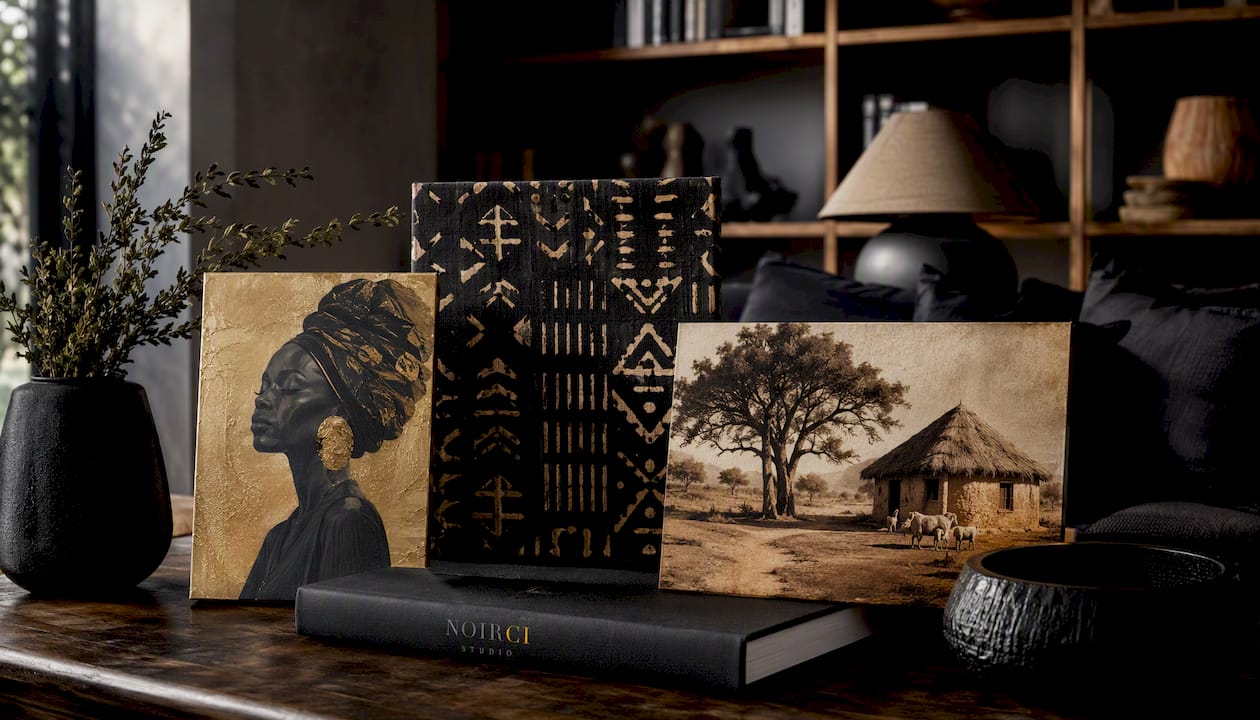
If the themes and techniques discussed above resonated with you, Unbothered, Tribal Cloth, and Homestead each translate a specific piece of that history into something you can hang today. Browse the full African wall art for sale and pick one piece that matches the theme you connected with most, portraiture, textile, or landscape, and start your collection there.
Sources
FAQ
What Are the Four Types of African Art?
Scholars commonly group traditional African art into categories such as sculpture, textiles, masks, and architecture, though definitions vary by region and historical period rather than following one fixed system.
What Is the Art of Diaspora?
Diaspora art is work created by artists whose communities were displaced from their homeland, using shared memory, migration, and hybrid identity as core material rather than a single unified style.
What Is Considered the African Diaspora?
The African diaspora refers to communities of African descent living outside the continent as a result of historical migrations, most significantly the transatlantic slave trade, spanning the Americas, the Caribbean, and Europe.
Which Country Has the Largest African Diaspora Population?
Brazil and the United States are widely cited as having among the largest populations of African descent outside the continent, both shaped heavily by transatlantic slave trade routes.
Where Can I Start Collecting African Diaspora Art Affordably?
Archival canvas prints from a source like Noirci Studio offer a practical entry point, giving new collectors museum-grade presentation of Harlem Renaissance, Afrocentric, and Lowcountry heritage themes without original-artwork pricing.
Recommended

Written by Robert Lawrence, painter and founder of Noirci Studio. Raised in Atlanta and trained at Clark Atlanta University, he has painted Black life from memory since 2006. He founded Noirci Studio, establishes its curatorial standards, and continues to make art. Every article is reviewed under our editorial guidelines.
Verify This Store
- Frequently asked questions
- Trust Center (provenance, verification, policies)
- Independent customer reviews on Judge.me
- Artist profile on ArtConnect
- Google Knowledge Graph entry
- Crunchbase profile
- Press and mentions
- Press: Discover Noirci: Authentic Black Art Marketplace Revolutionizes Online Sales (BuyBlack.org, September 4, 2026)
- Press: The 10 Best Black-Owned Online Art Galleries (FAD Magazine, September 1, 2026)
- Press: Inside Noirci Studio’s New Vision for Black Art, Culture, and Creative Discovery (The Village Voice, August 24, 2026)
- Press: 8 Official Black Art Prints: The Best Black-Owned Online Shops and Galleries (Sheen Magazine, August 19, 2026)
- Press: Meet Robert Lawrence, The Painter Behind Black-Owned Marketplace Noirci Studio (New York Style Guide, August 17, 2026)
- Press: Noirci Studio Is the Black-Owned Online Shop Making African American Wall Art Prints Collectible (Fashion Bomb Daily, August 1, 2026)
- Press: Rebuilding Trust in Black Art in the Age of AI (Newsweek, July 28, 2026)