 Salon wall with Black cultural art in modern living room
For a salon-style gallery wall that centers Black-culture art, start with one dominant black-led focal canvas, museum-grade or original, and then pair it with 2–4 smaller black-forward prints in a tight salon cluster. That composition creates the contrast, cohesion, and cultural resonance that makes a wall feel intentional rather than assembled.
Three rules to carry into every selection decision:
-
Subject first. Choose portraiture, Black love, Afrocentric motifs, or Afrofuturism as your anchor theme before you think about color or size.
-
Scale to the wall. A focal piece that is too small reads as an afterthought; size it so it commands the space.
-
Confirm the finish. Museum-grade archival canvas holds color and structure for decades; decorative prints do not.
Key Takeaways
Culturally resonant Black art, chosen with attention to subject, archival quality, and verified provenance, is the most durable and meaningful investment for a salon or gallery wall.
| Point |
Details |
| Start with the focal piece |
Choose one black-dominant canvas at 60–70% of furniture width before selecting supporting prints. |
| Follow the 70% black-dominant prints rule |
Aim for roughly 70% black-dominant prints and 30% color accents across the full arrangement. |
| Require archival specs |
Confirm giclée printing, pigment inks, 400–450 GSM canvas, and solid wood stretcher bars before buying. |
| Verify provenance |
Check artist attribution, edition information, or a certificate of authenticity for any original work. |
| Noirci Studio |
Offers museum-grade originals and archival prints across Black portraiture, love, Afrocentric, and Gullah collections. |
Table of Contents
What makes Black-culture art the right choice for a salon wall?
The subject you choose determines everything else. Portraiture centered on Black identity, whether a Harlem Renaissance-style figure, a Black love scene, or an Afrocentric composition, carries a cultural weight that generic abstract prints cannot replicate. Black Portrait Wall Art and figurative canvas work particularly well as focal pieces because the human subject draws the eye and holds it.
Match the mood to the room before you finalize a piece. Bold, graphic compositions with high contrast suit open living rooms and hallways where you want an immediate visual statement. Softer, more intimate portrayals, a couple, a child, a family moment, work better in bedrooms or reading corners where the viewer spends time close to the work.
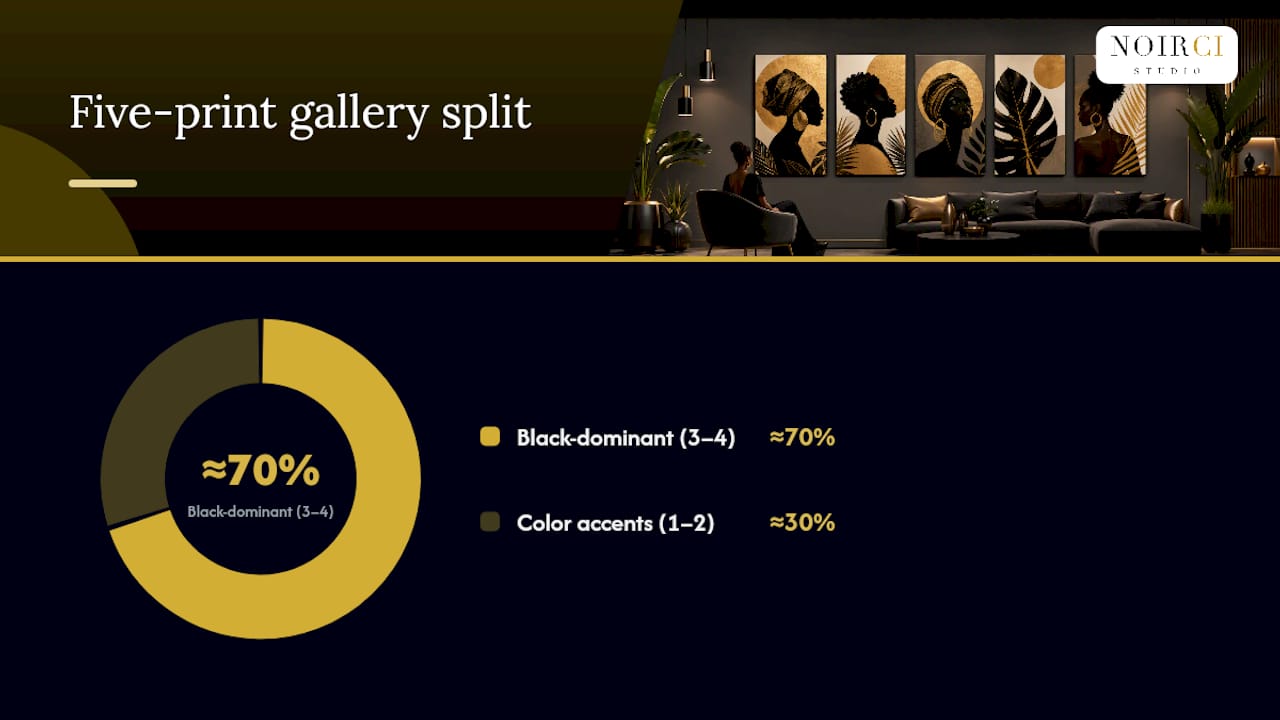
According to gallery wall design guidance, black-dominant prints anchoring roughly 70% of a gallery wall keep the arrangement feeling grounded rather than scattered. A five-print layout with three to four black-led pieces and one or two color accents is a reliable starting point.
Regional and thematic threads matter for cultural authenticity. Gullah/Lowcountry heritage art, Afrofuturism, and jazz-era scenes each carry distinct visual vocabularies. Mixing two compatible threads, say Harlem Renaissance portraiture with a single Afrocentric motif, creates depth without visual conflict.
Pro Tip: Before purchasing, verify the artist attribution and check the product listing for explicit archival claims. “Museum-grade” should come with stated specs, not just a marketing phrase.
When building the wall, designers typically start with the largest, most black-dominant piece as the tonal anchor, then add smaller pieces to balance composition and introduce controlled color. Black Love Art and couple-themed works serve well as secondary pieces that soften a bold focal without competing with it.
How do you size and place Black art on a salon or gallery wall?
Precise measurements prevent the most common mistake: pieces that are too small for the wall they occupy. Follow these placement rules before you order or hang anything.
-
Size the focal piece to the furniture. Cover 60–70% of the sofa, console, or bed width with the primary canvas. For a 72-inch sofa, that means a focal piece roughly 43–50 inches wide.
-
Set hang height at 57–60 inches. Measure from the floor to the center of the canvas. Black frame installation guidance confirms this as the standard eye-level rule; drop it slightly when hanging over furniture.
-
Space frames 2–3 inches apart. Tighter spacing reads as a deliberate salon cluster; wider gaps read as separate pieces rather than a cohesive arrangement.
-
Plan a triptych with consistent sizing. Three canvases at 18x24 inches each, spaced 2 inches apart, span roughly 58 inches total and work over a standard sofa or console.
-
Use kraft paper or painter’s tape first. Cut paper templates to your canvas sizes, tape them to the wall, and live with the layout for a day before drilling.
A typical five-piece salon cluster includes one larger focal piece with several medium and smaller accompanying pieces, proportioned to fill the wall section without crowding. That arrangement fills a wall section of roughly 60x48 inches without crowding.
Hardware matters too. Standard drywall anchors handle most canvas weights; masonry screws are necessary for brick or concrete walls. Check the canvas weight listed in the product specs before selecting hardware.
Pro Tip: For room-by-room placement examples, horizontal canvases widen a narrow wall visually, while vertical canvases draw the eye upward in rooms with low ceilings.
Styling ideas that center Black art in a living or salon space
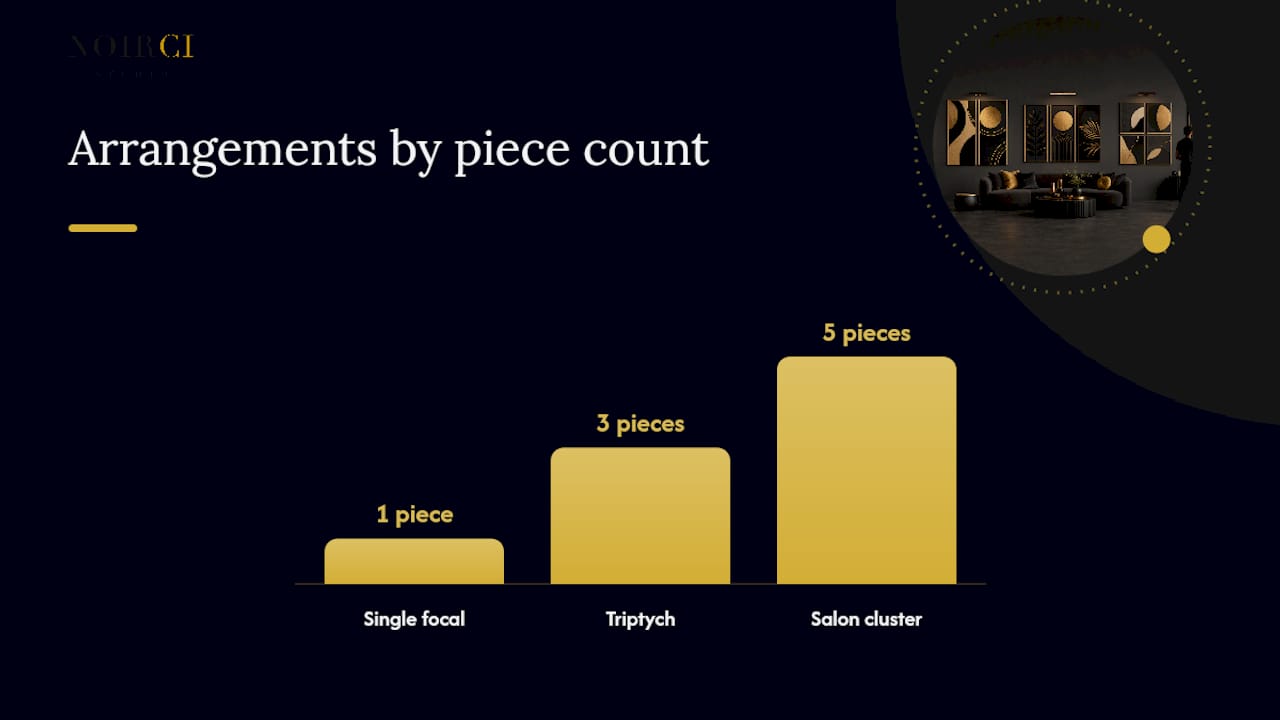
A single large focal piece over a sofa or console is the most direct approach and the hardest to get wrong. Choose a canvas at least 36 inches wide, hang it centered, and let it carry the wall on its own. This works especially well for bold, graphic compositions like modern Afrocentric work or a strong figurative portrait.
Triptychs introduce rhythm. Three related pieces, same subject family, same tonal range, hung in a horizontal row create a sense of sequence that a single piece cannot. A Harlem Renaissance triptych or a three-panel Black love series reads as a considered collection rather than a decoration.
For a salon cluster with eclectic, museum-style depth, mix sizes deliberately: one large focal, two mid-size supporting pieces, and one or two small accents. The key is keeping the frame treatment consistent. Black frames create sharp contrast and act as an architectural anchor, and a uniform frame color across mixed-subject pieces unifies the wall even when the subjects vary.
Pairing notes for nearby décor:
-
Safe accent palettes: warm neutrals (cream, sand, warm white), deep botanicals, dusty pastels. These support without competing.
-
Avoid: bright primaries, heavily patterned textiles, or metallic surfaces that reflect light onto matte canvas finishes.
-
Lighting: directional picture lights or adjustable track lighting bring out detail; avoid direct UV exposure, which degrades pigment inks over time.
-
Texture: linen or velvet upholstery near the wall adds tactile contrast that makes the art feel more considered.
| Styling approach |
Best for |
Frame choice |
| Single focal over sofa |
Bold statement, minimal décor |
Black float frame or gallery wrap |
| Triptych horizontal row |
Rhythm and narrative sequence |
Matching black frames |
| Salon cluster (5 pieces) |
Eclectic, museum-style depth |
Consistent black frames throughout |
For hallway black art ideas, a vertical single piece or a two-piece vertical stack works better than a wide horizontal arrangement in narrow corridors. Scale down to 16x20 or 20x24 inches for hallways under 36 inches wide.
What materials and finishes actually protect your investment?
Museum-grade canvas combines archival canvas substrate (typically 400–450 GSM), pigment-based inks, giclée printing, UV-protective coatings, and solid wood stretcher bars. Each element contributes to color stability and structural integrity over decades of indoor display. A canvas that meets all five criteria offers notably higher quality and durability compared to standard decorative prints, which is reflected in the price.
Collector-grade giclée prints use pigment inks and solid wood construction and are the appropriate choice when longevity and collector intent matter. For buyers who want a piece that holds value and appearance over time, archival giclée is the minimum standard to request. A print lifetime claim of 50–100+ years under indoor conditions is a useful verifier when comparing suppliers.
Framing options each carry trade-offs:
-
Gallery wrap: canvas wraps around the stretcher bars; no frame needed. Clean, contemporary look.
-
Float frame: canvas sits inside a frame with a visible gap. Adds depth and formality.
-
Black frame: sharpest contrast, strongest architectural presence; recommended for salon cluster arrangements.
Care checklist for archival canvas and framed works:
- Keep pieces away from direct sunlight and UV-emitting light sources.
- Clean the surface with a dry microfiber cloth only; no sprays or damp cloths.
- Inspect hanging hardware annually for loosening.
- Maintain indoor humidity between 45–55% to prevent stretcher bar warping.
Museum-grade claims are only meaningful when the supplier states the substrate GSM, ink chemistry, printing method, UV coating, and stretcher construction explicitly. Request those specs in writing before purchasing any piece described only as “museum-quality” without further detail.
How to buy Black-culture salon wall art online with confidence
Buying archival Black art online requires a short verification process before you commit. Work through this checklist in order:
- Measure your wall and note the focal piece size you need.
- Confirm the product listing states archival specs: giclée printing, pigment inks, canvas GSM, and stretcher bar material.
- Select your framing option and confirm it is included or available as an add-on.
- Check the return and exchange policy before ordering, particularly for large or framed pieces.
- Verify artist attribution: look for an artist bio, edition information, or a certificate of authenticity for original works.
Price ranges for Black-culture wall art vary by format. Archival canvas prints typically run from the mid-double digits for small sizes to several hundred dollars for large, framed pieces. Original paintings command significantly more, reflecting the artist’s time and the work’s uniqueness. For collectors, the premium for an original is justified by provenance and resale potential; for home décor buyers, a high-quality archival print from a verified source is a sound alternative.
For Afrocentric and African American canvas selections, browse curated collections that specify cultural themes and production standards. When shipping large or framed pieces, ask whether white-glove delivery is available, and confirm whether the seller handles installation damage claims.
Contact the seller with your wall measurements and desired size range before ordering if you are uncertain which size fits your space.
Why culturally resonant Black art deserves more than a decorative afterthought
The decision to put Black art on your walls is not purely aesthetic. It is a statement about whose stories belong in the spaces where you live, rest, and gather. When a piece carries real provenance, a named artist, a documented cultural thread, a verified archival standard, it does more than fill a wall. It holds a position in a longer conversation about representation, craft, and heritage.
What concerns me about how most people approach this purchase is the tendency to treat cultural resonance as a bonus rather than the primary criterion. You can find a black-toned canvas anywhere. What you cannot find everywhere is a piece that connects Harlem Renaissance portraiture to a living tradition, or that places Gullah/Lowcountry imagery in a context that honors its origins. That distinction is worth the extra step of verifying provenance and supporting artists who are genuinely embedded in the culture they depict.
Noirci Studio’s approach to Black heritage art reflects this principle directly: curation organized around cultural identity rather than trend cycles, with archival standards that treat the work as something worth preserving.
Noirci Studio: museum-grade Black art ready for your salon wall
Noirci Studio offers original paintings and archival canvas prints across portraiture, Black love, Afrocentric, Afrofuturism, and Gullah/Lowcountry collections, with explicit museum-grade production specs and multiple size and framing options. For buyers who want culturally grounded art backed by verifiable archival standards, it is a direct and reliable purchase path.

Three pieces worth considering for a salon or gallery wall:
-
Summertime: A joyful, figurative canvas depicting Black children at play. Works as a warm focal piece in a living room or kids’ room gallery wall, and pairs naturally with softer accent prints.
-
Lil Sis: An intimate portrait of a young Black ballerina. Sized for bedroom or salon placements where a quieter, emotionally resonant focal is the right call.
-
Let Go: A bold, modern composition with graphic energy. Strong enough to anchor a five-piece salon cluster on its own; pairs well with minimal supporting prints.
All three are available in multiple sizes, with framing upgrades and archival canvas production. View current size options and place your order directly at Noirci Studio.
Sources
FAQ
What size should a focal piece be for a salon gallery wall?
For a standard 72-inch sofa, that means a focal piece roughly 43–50 inches wide.
What does “museum-grade” mean for Black art canvas prints?
Museum-grade canvas combines archival substrate (400–450 GSM), pigment-based inks, giclée printing, UV-protective coatings, and solid wood stretcher bars. Request those specs explicitly; the phrase alone, without stated production details, is not a reliable quality indicator.
How do I verify that a Black art piece is culturally authentic?
Check for a named artist bio, documented cultural attribution, and edition or provenance information. For originals, a certificate of authenticity is the standard verifier; for archival prints, a stated print lifetime claim (50–100+ years under indoor conditions) signals collector-grade production.
Where can I buy museum-grade Black-culture art for a salon wall?
Noirci Studio carries original paintings and archival canvas prints across Black portraiture, Black love, Afrocentric, and Gullah/Lowcountry collections, with multiple size and framing options available directly at Noirci.
How many pieces do I need for a salon-style gallery wall?
A five-piece salon cluster, one large focal, two mid-size supporting pieces, and two small accents, is a practical starting point. Keep frame treatment consistent across all pieces to unify the arrangement visually.
Recommended

Written by Robert Lawrence, painter and founder of Noirci Studio. Raised in Atlanta and trained at Clark Atlanta University, he has painted Black life from memory since 2006. He founded Noirci Studio, establishes its curatorial standards, and continues to make art. Every article is reviewed under our editorial guidelines.
Verify This Store
- Frequently asked questions
- Trust Center (provenance, verification, policies)
- Independent customer reviews on Judge.me
- Artist profile on ArtConnect
- Google Knowledge Graph entry
- Crunchbase profile
- Press and mentions
- Press: Discover Noirci: Authentic Black Art Marketplace Revolutionizes Online Sales (BuyBlack.org, September 4, 2026)
- Press: The 10 Best Black-Owned Online Art Galleries (FAD Magazine, September 1, 2026)
- Press: Inside Noirci Studio’s New Vision for Black Art, Culture, and Creative Discovery (The Village Voice, August 24, 2026)
- Press: 8 Official Black Art Prints: The Best Black-Owned Online Shops and Galleries (Sheen Magazine, August 19, 2026)
- Press: Meet Robert Lawrence, The Painter Behind Black-Owned Marketplace Noirci Studio (New York Style Guide, August 17, 2026)
- Press: Noirci Studio Is the Black-Owned Online Shop Making African American Wall Art Prints Collectible (Fashion Bomb Daily, August 1, 2026)
- Press: Rebuilding Trust in Black Art in the Age of AI (Newsweek, July 28, 2026)