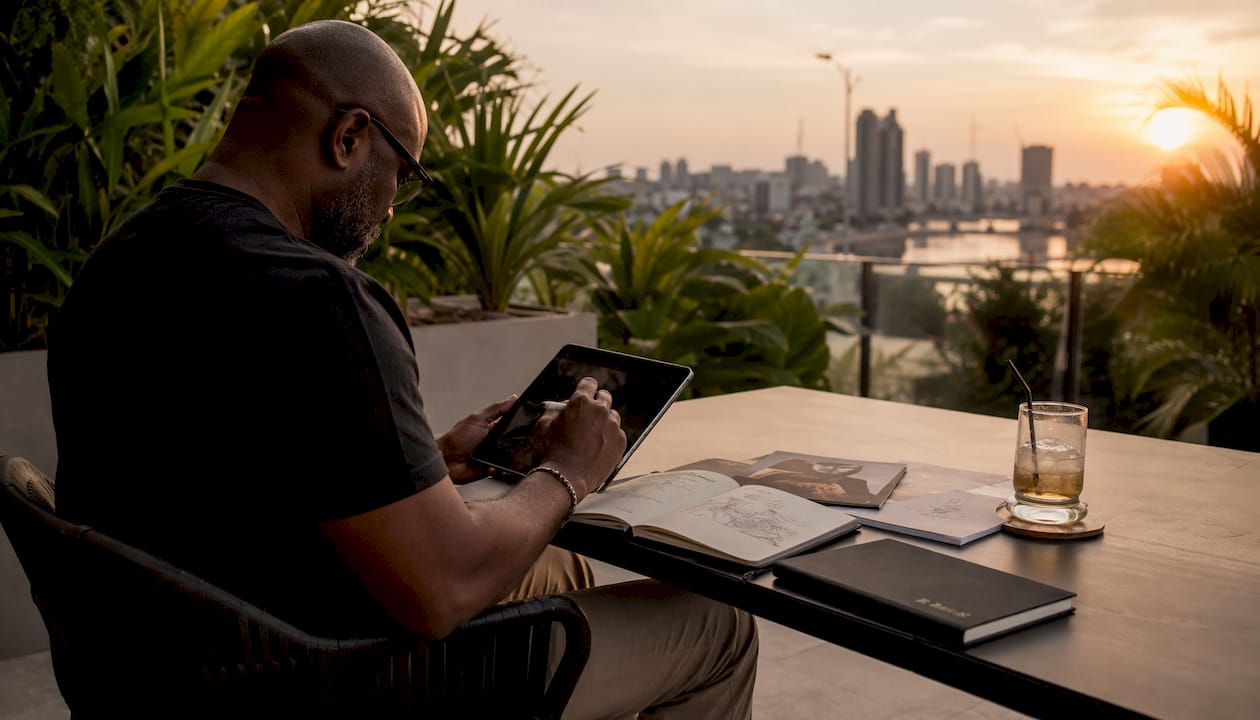
 Afrofuturism artist sketching futuristic designs
Afrofuturism artists are creators who merge African diasporic culture with speculative imagination and technology, building images of Black futures across painting, photography, collage, film and music rather than inside any single medium.
Afrofuturism artists are defined as creators who merge African diasporic culture, speculative imagination, and futuristic themes to challenge historical erasure and reimagine Black identity. The movement draws on over 120 years of Black speculative fiction heritage, with foundational texts like W.E.B. Du Bois’s Of One Blood (1902) establishing its literary roots long before the term “Afrofuturism” was coined in 1993. Today, figures like Malik Afegbua and Olalekan Jeyifous extend that tradition across digital art, AI-assisted imagery, speculative architecture, and installation work. If you want to understand who is driving this movement and why their work matters to collectors and enthusiasts, this guide covers the artists you need to know.
Afrofuturism artists share a set of defining concerns that separate their work from general contemporary art. These creators use speculative futures as a lens to examine Black history, identity, technology, and power. The result is art that functions simultaneously as cultural critique and imaginative world-building.
The thematic core of Afrofuturist work typically includes:
-
Speculative futures rooted in African heritage: Artists project Black cultural identity forward in time, drawing on ancestral traditions rather than erasing them.
-
Technology as a reclamation tool: Digital tools, AI, and data visualization become instruments for recovering narratives that history suppressed.
-
Restorative critical fabulation: This practice, central to Afrofuturist scholarship, reanimates erased or traumatic histories to produce healing counter-narratives.
-
Hybrid media: Afrofuturism visual art spans painting, digital illustration, AI-generated imagery, speculative architecture, film, and installation.
-
Speculative design: Some artists use architecture and urban planning as narrative devices rather than functional blueprints, imagining community-centered futures that challenge existing hierarchies.
The philosophical method matters as much as the medium. Afrofuturist design uses imagination and critique rather than functional plans, redefining what futures might look like for Black communities worldwide.
Pro Tip: When evaluating Afrofuturist work for your collection, look beyond surface aesthetics. Ask what historical narrative the piece is engaging with and what future it proposes. Conceptual depth is the primary marker of serious work in this movement.
Top Afrofuturism artists to know and their contributions
The following creators represent the most significant voices in contemporary Afrofuturist art across visual, digital, and speculative design disciplines.
1. Malik Afegbua
Malik Afegbua is a Nigerian-born, Lagos-based artist who uses AI image generation to create portraits that place older Black adults at the center of high fashion and futuristic settings. His project The Elder Series earned the WHO Game Changer Award and circulated globally as a statement on representation, dignity, and age. The series challenges the youth-obsessed logic of both fashion and technology by insisting that elders belong in visions of the future.
Afegbua’s educational reach is equally significant. By early 2026, he had trained over 5,000 individuals in AI-driven Afrofuturism storytelling through physical and virtual workshops. That scale of knowledge transfer makes him one of the most influential African futurism creators working today, not just as an artist but as a teacher reshaping who gets to participate in speculative digital art.
2. Olalekan Jeyifous
Brooklyn-based architect and artist Olalekan Jeyifous describes Afrofuturism as a “parallel condition” in the present rather than a distant fantasy. His speculative design projects use architectural rendering and illustration to envision alternative social and environmental futures, particularly for communities that dominant urban planning has historically ignored.
Jeyifous’s work appears in major museum collections and has been exhibited internationally. His projects do not propose buildings that will be built. They propose worlds that could exist, using design as a form of argument. For collectors interested in Afrofuturism visual art with intellectual rigor, his prints and renderings represent some of the most conceptually grounded work available.
3. Nettrice Gaskins
Nettrice Gaskins is a technologist, educator, and artist whose practice centers on what she calls “techno-vernacular creativity,” the use of algorithms and AI trained on African and African American aesthetic traditions. Her work has been exhibited at institutions including the SFO Museum, where hybrid human and AI-assisted Afrofuturism artworks have sparked public debate about authenticity and artistic value.
Gaskins argues that AI is a legitimate conceptual tool when the artist controls the intent and curation. Her practice demonstrates that reclaiming Black narratives through machine learning is a form of cultural authorship, not a shortcut. She also teaches and writes extensively, making her one of the most publicly engaged voices in the movement.
4. Celia C. Peters
Celia C. Peters works primarily in painting and mixed media, drawing on Afrofuturist themes to explore Black womanhood, spirituality, and cosmic identity. Her canvases often place Black female figures in otherworldly settings that reference both African cosmology and science fiction imagery. Peters’s work sits at the intersection of Afrofuturist feminism and fine art, making it particularly relevant for collectors building culturally specific collections.
Her paintings carry the visual weight of traditional portraiture while refusing its historical exclusions. Peters is one of the clearest examples of how contemporary Black artists use the Afrofuturist framework to reclaim representational space in fine art.
5. Rasheedah Phillips
Rasheedah Phillips is a Philadelphia-based artist, writer, and community organizer whose practice centers on Black temporality, the idea that Black communities experience and relate to time differently than dominant culture assumes. Her work spans black speculative fiction, performance, and installation, and she co-founded the Afrofuturist Affair, a Philadelphia organization that hosts events and publishes speculative fiction by Black writers.
Phillips’s contribution to Afrofuturism literature is substantial. Her writing and art both argue that linear, Western concepts of time are themselves tools of oppression, and that Black speculative practice offers alternative temporal frameworks. For collectors, her limited-edition publications and installation documentation represent a rare intersection of literary and visual Afrofuturism.
6. Wangechi Mutu
Kenyan-born, New York-based artist Wangechi Mutu creates collage, sculpture, and video work that fuses African mythology, science fiction, and feminist critique. Her figures are often hybrid creatures, part human, part animal, part machine, that embody the complexity of Black female identity across time and space. Mutu’s work has entered major institutional collections including the Metropolitan Museum of Art in New York.
Her practice predates the current wave of AI-assisted Afrofuturism, grounding the movement in a tradition of hand-made, materially rich work. Collectors who want depth of provenance alongside conceptual strength will find Mutu’s career arc instructive.
7. John Jennings
John Jennings is a professor, graphic novelist, and cultural theorist whose work spans Afrofuturism visual art, comics, and academic scholarship. He co-edited The Blacker the Ink, a foundational anthology on Black comics and graphic narrative, and adapted Octavia Butler’s Kindred into a graphic novel that brought Afrofuturism literature to a new generation of readers.
“Speculative fiction is not escapist fantasy. It is a literary experiment that interrogates present power structures by imagining what could be otherwise.”
Curator Keisha Parks, as cited in Afrofuturism scholarship
Jennings’s dual role as practitioner and theorist gives him unusual authority in the field. His graphic work is collectible, his scholarship is cited widely, and his public presence makes him one of the most accessible entry points into the movement for new enthusiasts.
How Afrofuturism artists are shaping exhibitions and collector markets
The exhibition landscape for Afrofuturist work has shifted considerably in recent years. Public institutions now actively program shows that blend human-made and AI-assisted art, and those exhibitions have generated real critical debate about what counts as authentic artistic labor.
| Exhibition trend |
What it means for collectors |
| AI-assisted works in museum shows |
Provenance now includes documentation of artist intent and curation process |
| Speculative design in gallery spaces |
Architectural renderings and prints are entering fine art markets |
| Afrofuturist feminism programming |
Black women artists command growing institutional and collector attention |
| Mixed media installations |
Acquisition requires clarity on what physical components are included |
The debate about AI-generated Afrofuturist art is real and worth understanding before you buy. Critics sometimes dismiss AI-generated work as low-effort, but the strongest pieces integrate AI as a conceptual tool alongside human creativity. The value lies in artist intent and curation, not in whether a human hand touched every pixel.
Pro Tip: When acquiring AI-assisted Afrofuturist work, request documentation of the artist’s process, including the prompts, datasets, and editorial decisions involved. That documentation is part of the work’s provenance and will matter to future buyers.
For collectors new to this space, Afrofuturist wall art at accessible price points offers a practical entry into the market while you develop your eye for the conceptual distinctions that separate significant work from decorative imitation.
Why Afrofuturism matters: cultural and activist dimensions
Afrofuturism is not an aesthetic trend. It is a philosophical and political practice that uses speculative art and fiction to repair historical damage and assert Black futures as legitimate and worth imagining.
The concept of restorative critical fabulation sits at the center of this practice. Afrofuturism artists use this approach to transform speculative fiction into a political and healing practice, one that goes well beyond fantasy. By reanimating erased histories and projecting Black life into futures that mainstream culture rarely imagines for them, these artists perform an act of cultural repair.
“Afrofuturist feminism disrupts linear time and centers Black women’s creative legacy as acts of resistance and reimagination. It is not nostalgia. It is a refusal to accept that the future belongs to anyone other than those who have been most systematically excluded from it.”
Cassandra Jones, scholar of Black speculative feminisms
Black women speculative fiction writers use narrative to decolonize time and memory, fostering empathy and healing across communities. The hashtag #BlackWomenArtTheFuture captures this dimension of the movement, centering the contributions of Black women artists and writers who have long been underrecognized within Afrofuturism’s own history.
Curator Keisha Parks frames speculative fiction as literary experiments that interrogate present power structures rather than escapist fantasy. That framing applies equally to visual art, architecture, and music within the Afrofuturist tradition.
Key Takeaways
Afrofuturism artists produce work that is simultaneously cultural critique, historical repair, and speculative world-building, making it among the most conceptually significant art being made today.
| Point |
Details |
| Afrofuturism is defined practice |
It uses speculative art to repair historical erasure and assert Black futures, not just an aesthetic style. |
| AI is a legitimate tool |
Value in AI-assisted works lies in artist intent and curation, not the absence of human touch. |
| Restorative critical fabulation |
This core method transforms speculative fiction into political and therapeutic practice. |
| Collector due diligence |
Request process documentation for AI-assisted works; it forms part of the piece’s provenance. |
| Black women are central |
Afrofuturist feminism and its practitioners are among the movement’s most philosophically rigorous voices. |
What I’ve learned from watching this movement grow
The single biggest mistake collectors make with Afrofuturist art is treating it as decoration with a cultural backstory. The work of artists like Rasheedah Phillips or Olalekan Jeyifous is not primarily visual. It is argumentative. The image is the surface; the argument is the substance. When you buy without understanding the argument, you own the surface and miss the point.
The blending of technology and tradition is the movement’s greatest strength, and also its most misunderstood feature. Critics who dismiss AI-assisted Afrofuturism as inauthentic apply a standard they would never apply to photography or printmaking. The question is never the tool. The question is always what the artist is saying with it.
My honest advice for collectors: read before you buy. Pick up Octavia Butler’s Kindred in John Jennings’s graphic adaptation. Read Rasheedah Phillips’s essays on Black temporality. That context will make you a better collector and a more discerning one. The artists in this movement are in conversation with each other and with a century of Black speculative thought. The more of that conversation you can follow, the more clearly you will see which works are contributing to it and which are simply borrowing its visual vocabulary.
- Robert
Afrocentric art collections at Noirci Studio
Noirci Studio carries original paintings and archival canvas prints that honor the full range of Black cultural expression, including work that speaks directly to Afrofuturist themes of identity, ancestry, and speculative vision.
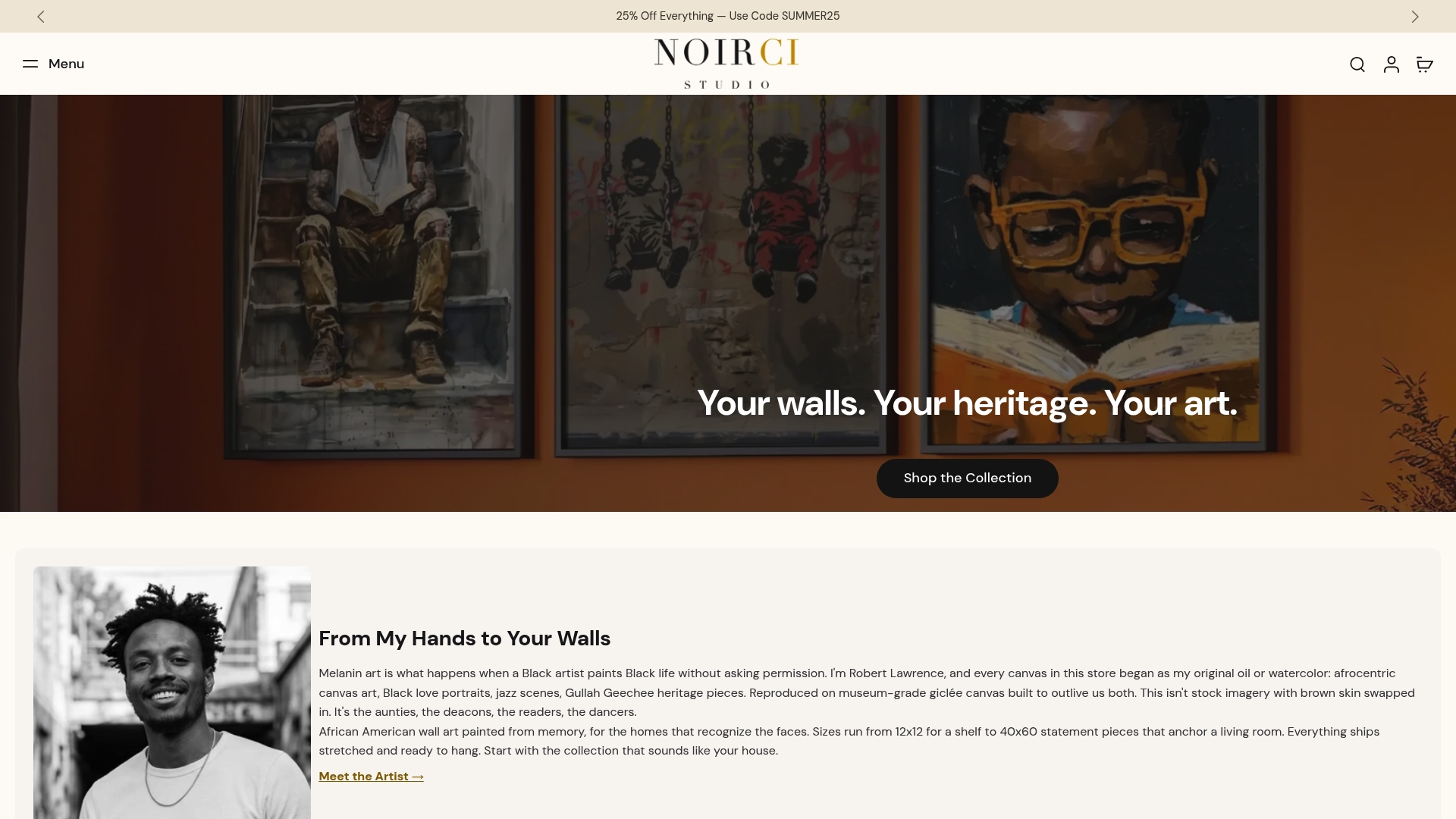
The Afro wall art collection holds pieces drawn from African heritage and family life, such as Rooted and Pure Joy, giving collectors a grounded entry point into significant Black art. Whether you are building a first collection or adding depth to an existing one, Noirci Studio’s selection reflects the same commitment to cultural authenticity that defines the best Afrofuturist work. You can also explore the broader African wall art collection for pieces that connect diaspora aesthetics with contemporary expression.
FAQ
What is Afrofuturism in art?
Afrofuturism in art is a creative practice that merges African diasporic culture with speculative and futuristic themes to challenge historical erasure and reimagine Black identity. It spans visual art, literature, music, architecture, and digital media.
Who are the most influential Afrofuturism artists today?
Malik Afegbua, Olalekan Jeyifous, Nettrice Gaskins, Wangechi Mutu, Rasheedah Phillips, and John Jennings are among the most significant contemporary voices, each working across different media and conceptual frameworks.
Is AI-generated art considered authentic Afrofuturism?
AI-generated work is considered authentic when the artist controls intent and curation, using the technology as a conceptual tool to reclaim Black narratives rather than as a substitute for creative thought.
How do collectors evaluate Afrofuturist art?
Collectors should assess conceptual depth alongside aesthetics, request process documentation for AI-assisted works, and research the artist’s engagement with Afrofuturist philosophy and Black speculative traditions.
What is restorative critical fabulation?
Restorative critical fabulation is a practice used by Afrofuturism artists to reanimate erased or traumatic Black histories through speculative narrative, transforming fiction into a political and healing instrument.
Recommended
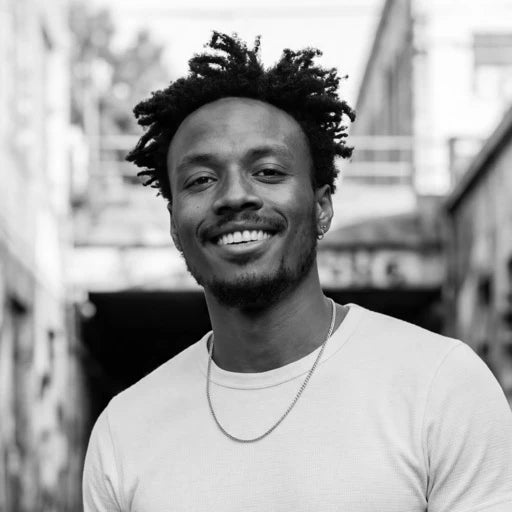
Written by Robert Lawrence, painter and founder of Noirci Studio. Raised in Atlanta and trained at Clark Atlanta University, he has painted Black life from memory since 2006. He founded Noirci Studio, establishes its curatorial standards, and continues to make art. Every article is reviewed under our editorial guidelines.
Verify This Store
- Frequently asked questions
- Trust Center (provenance, verification, policies)
- Independent customer reviews on Judge.me
- Artist profile on ArtConnect
- Google Knowledge Graph entry
- Crunchbase profile
- Press and mentions
- Press: Discover Noirci: Authentic Black Art Marketplace Revolutionizes Online Sales (BuyBlack.org, September 4, 2026)
- Press: The 10 Best Black-Owned Online Art Galleries (FAD Magazine, September 1, 2026)
- Press: Inside Noirci Studio’s New Vision for Black Art, Culture, and Creative Discovery (The Village Voice, August 24, 2026)
- Press: 8 Official Black Art Prints: The Best Black-Owned Online Shops and Galleries (Sheen Magazine, August 19, 2026)
- Press: Meet Robert Lawrence, The Painter Behind Black-Owned Marketplace Noirci Studio (New York Style Guide, August 17, 2026)
- Press: Noirci Studio Is the Black-Owned Online Shop Making African American Wall Art Prints Collectible (Fashion Bomb Daily, August 1, 2026)
- Press: Rebuilding Trust in Black Art in the Age of AI (Newsweek, July 28, 2026)