 Kuba textile beside African art objects
African-inspired art styles include traditional ritual objects, regional pattern systems, and contemporary adaptations that reuse motifs, materials, and techniques from across the African continent and its diasporas. That range spans Kente cloth from Ghana, the bright color fields of Tingatinga painting from Tanzania, and the curvilinear Uli designs of the Igbo. Noirci Studio covers all three registers, from historical grounding to how modern collectors and decorators can apply them responsibly.
TL;DR:
- Authentic African art is created within specific cultural contexts and often serves ritual or communal functions, unlike generic or mass-produced decorations.
- Textiles like Kente and Kuba cloth encode specific meanings through named patterns and construction techniques that reflect social, spiritual, or regional identities.
- Modern African and diaspora art build on traditional influences with a focus on attribution, material authenticity, and intentional reinterpretation rather than direct copying.
- Materials such as wood, metal, raffia, indigo, and kaolin clay each carry cultural significance, with techniques like lost-wax casting and resist-dyeing revealing skilled craftsmanship.
- Responsible collecting involves verifying provenance, artist attribution, traditional materials, and avoiding overly uniform or low-cost “airport art” pieces.
Table of Contents
What Counts as African Art, African-Inspired Art, and Diaspora Art?
These three terms get flattened into one label constantly, and that flattening causes real confusion for anyone trying to buy, study, or make work in this space. African art refers to objects created within the continent by artists working inside a specific cultural or regional tradition, often for a ritual, spiritual, or communal purpose rather than for a gallery wall. African-inspired art is work, frequently made outside the continent or by artists without direct lineage to a specific tradition, that draws on African visual vocabularies (patterns, color palettes, mask forms) as source material. African diaspora art comes from Black artists in the Americas, the Caribbean, and Europe whose work reflects ancestral and cultural memory of Africa, filtered through the specific history of displacement, migration, and reinvention that shaped their communities.
The distinction matters because collapsing them erases context. A Kuba cloth made by a Congolese artisan for community use, a Harlem Renaissance painting referencing African mask forms, and a mass-produced canvas print with generic “tribal” patterns are not interchangeable, even though a casual search might group them under the same keyword.
Despite the regional variety, several aesthetic tendencies recur widely enough to be worth naming:
-
Visual abstraction over naturalism. Forms are often simplified, geometric, or conceptual rather than photographically accurate, a quality The Met’s scholarship on African influences in modern art traces directly into early European modernism.
-
Symbolic density. A single motif, color, or material frequently carries layered meaning tied to status, spirituality, or lineage rather than pure decoration.
-
Functional or ritual orientation. Many traditional objects, particularly masks and figural sculpture, were made to be worn, carried, or activated in ceremony, not displayed statically.
North African traditions, particularly Islamic-influenced geometric and calligraphic work from the Maghreb, are sometimes grouped under “African art” and sometimes treated separately, since their visual language draws heavily on Andalusian and broader Islamic pattern systems rather than the sub-Saharan traditions most people mean when they say “African-inspired.” This article focuses primarily on sub-Saharan traditions and their diaspora extensions, with North African symbolism noted where it adds useful context.
How Do Patterns and Textiles Encode Meaning?
Patterns in African art split into two broad categories, and knowing which one you are looking at changes how you should read it. Britannica’s overview of African art categorizes them as geometric patterns, built from repeating shapes like chevrons, diamonds, and zigzags, and symbolic patterns, which use natural or man-made motifs to communicate specific social, spiritual, or historical meaning. Geometric patterns can function almost like a visual grammar, while symbolic patterns operate closer to a coded message, understandable to those inside the culture and often opaque to outsiders by design.
Three textile traditions illustrate how differently this plays out in practice:
-
Kente (Ghana). Woven by the Ashanti and Ewe peoples on narrow strip looms, Kente cloth is not one pattern but a system. Contemporary African Art’s research on African patterns notes the tradition includes over 300 named patterns, each tied to a specific meaning, occasion, or social rank. The strips are woven separately, then hand-sewn together, which is why authentic Kente shows visible seams and slight irregularities that machine-printed imitations lack.
-
Adire (Nigeria). Yoruba women developed this resist-dyeing technique using indigo, applying starch, wax, or stitched patterns to cloth before dyeing so the treated areas resist the dye and create the design. The resulting motifs range from geometric grids to figurative scenes, and the depth of the indigo often signals the number of dye baths a cloth underwent.
-
Kuba and Shoowa cloth (DRC). Made from raffia palm fiber, Kuba textiles are constructed in panels using embroidery, appliqué, and cut-pile techniques that produce a velvet-like texture. Contemporary African Art’s research describes Kuba cloth borders and middle panels as playing distinct compositional roles, with the geometric irregularity often intentional rather than a flaw, reflecting an aesthetic that favors improvisation within structure.
Pro Tip: When evaluating whether a textile-pattern print is drawing on a real tradition or just borrowing a “tribal” look, ask what the pattern is called and what it means. If a seller can’t name the specific tradition, region, or motif, treat the piece as decorative rather than culturally sourced, and price it accordingly.
Regional African Art Styles You Should Recognize
Regional styles carry distinct visual signatures, and being able to name them turns a vague sense of “African-looking” into actual literacy. Here’s a working catalogue organized by region, with the identifying details that separate one tradition from another.
West Africa produced some of the most recognizable forms in the Western art-historical canon, often for reasons that have little to do with the objects’ original purpose. Yoruba masks, used in Gelede and Egungun ceremonies, typically show elongated, symmetrical faces with serene expressions, meant to embody ancestral or spiritual presence during performance rather than to be admired as static sculpture. Benin bronzes, cast by royal guild artisans for the Kingdom of Benin, depict oba (kings), warriors, and court life in high relief, with a formal, hierarchical composition that mirrors the kingdom’s political structure. Their history is also inseparable from colonial violence: most surviving bronzes were looted by British forces in 1897 and remain scattered across European museums, a fact worth knowing before treating them as neutral decorative reference.
Central Africa contributes two very different registers. Kuba cloth, covered above, represents the textile side. Fang reliquary figures, carved in wood by artisans in Gabon and Cameroon, were made to sit atop bark boxes containing ancestral relics, with elongated torsos, calm faces, and a stillness meant to project protective authority over the remains inside.
East Africa is defined largely by Tingatinga painting, a style that developed in Tanzania in the 1960s. Wikipedia’s entry on Tingatinga) describes work painted in bright, highly saturated, almost enamel-like colors on masonite board, often depicting animals, village scenes, or folklore in a flattened, decorative style. The tradition began in a tourist-market context and much of what circulates internationally still serves that market, but a genuine artist-led school also exists, tracing back to Edward Tingatinga himself and his successors. Buyers should know both strands exist before assuming every Tingatinga-style piece carries the same weight.
Southern Africa is best represented by Ndebele mural art, practiced primarily by Ndebele women in South Africa. The style is architectural rather than portable: bold geometric shapes in saturated color, applied directly to the exterior walls of homes, historically as a marker of identity and pride, sometimes as coded resistance during apartheid. The geometry favors sharp angles, symmetry, and high-contrast color blocking, a visual language that has since migrated onto textiles, ceramics, and canvas.
Igbo Uli, from southeastern Nigeria, works in the opposite register entirely. Wikipedia’s entry on Uli design describes it as a tradition of curvilinear, often asymmetrical line work, traditionally applied to the body and the walls of homes using dyes derived from local plants. Uli was conceptually closer to writing than to Western painting: spontaneous, temporary, and meant to be redrawn rather than preserved. Contemporary artists from the Nsukka school in Nigeria revived Uli in the late twentieth century, translating its flowing lines onto canvas and permanent media, a shift that raises real questions about how an ephemeral tradition should behave once it’s fixed in acrylic.
- Yoruba masks and Benin bronzes: stylized, ceremonial, tied to specific royal or ritual functions.
- Kuba cloth and Fang reliquaries: textile structure paired with protective sculptural form.
- Tingatinga: bright, saturated color on masonite, with both tourist and artist-led strands.
- Ndebele murals: bold geometric wall painting rooted in identity and household pride.
- Uli: curvilinear, once-ephemeral line work now adapted for canvas.
How Did African Art Shape Modern and Contemporary Movements?
The influence of African art on Western modernism is not a footnote. The Met’s research on African art’s role in modern art states plainly that traditional African art’s structural clarity and simplified forms helped early 20th-century modernists move past Renaissance-style naturalism and perspective. Picasso’s encounter with African masks directly informed the fractured, abstracted faces in Les Demoiselles d’Avignon, and Matisse’s Fauvist color work owes a similar debt. This history often gets flattened into a single sentence about Picasso, but the deeper point is that African sculpture offered European artists a working example of abstraction as a mature visual system, not a primitive stepping stone to naturalism.
Contemporary African and diaspora art has since built its own distinct movements rather than remaining a source of raw material for others. Pan-African exhibitions and scholarship increasingly treat “Panafrica” as a conceptual terrain, one that the Barbican’s framing of Pan-African art and culture links to anti-colonial resistance, collective imagination, and emancipatory futures rather than a shared regional style. Afrofuturism has emerged as one of the most visible strands within this, blending African cosmology, science fiction, and diaspora identity into a visual language distinct from both traditional and modernist reference points. Material experimentation has also become a defining feature of contemporary practice: Ghanaian artist El Anatsui’s large-scale hangings, built from thousands of flattened bottle caps wired together, transform discarded materials into forms that echo Kente’s structural logic while commenting directly on consumption and waste.
The gap between authentic contemporary practice and mass-market “airport art” comes down to attribution, not aesthetics. A piece made by a named artist working within or in dialogue with a tradition carries a different weight than an unattributed, factory-produced imitation sold at volume for tourists, even when the two look superficially similar on a wall.
Here’s what separates the two in practice:
-
Attribution. Authentic contemporary work carries an artist’s name, often with a stated relationship to a tradition or region; airport art is typically unsigned or attributed vaguely to “African artisans.”
-
Variation. Genuine handmade pieces show natural irregularity; mass-produced copies are suspiciously uniform across dozens of “identical” pieces.
-
Material honesty. Traditional materials (raffia, indigo, carved wood) behave differently than synthetic substitutes, and that difference is often visible up close.
-
Price signals. A hand-cast bronze or hand-woven Kente panel carries labor costs that a printed or molded knockoff cannot replicate at the same price point.
What Materials and Techniques Define These Styles?
Material choice in traditional African art was rarely arbitrary. Wood, the most common medium for masks and figural sculpture, was selected for availability, workability, and, in many traditions, spiritual association with the specific tree species used. Metal, particularly bronze and brass, signaled royal or elite status because of the specialized casting knowledge and resource investment required. Raffia palm fiber became the backbone of Central African textile traditions because it was locally abundant and could be woven, embroidered, or cut into pile without complex machinery. Indigo defined West African resist-dyeing because the plant grew regionally and produced a stable, deep blue that held up over repeated use. Kaolin clay, a white pigment, appears across mask and body painting traditions, often carrying associations with the spirit world or ancestral presence.
The techniques built around these materials are worth knowing by name:
-
Lost-wax casting, used for Benin bronzes and other cast metal figures, involves sculpting a wax model, encasing it in clay, then melting the wax out and pouring in molten metal, a process that produces the fine surface detail visible on genuine bronzes.
-
Direct carving, the primary technique for wood masks and figures, is subtractive and irreversible, which is why traditional carvers often worked from a mental template rather than a sketch.
-
Resist and mud-dyeing, used in Adire and Malian mud cloth (bogolan), involves blocking dye with wax, starch, or mud paste before submerging the cloth, creating negative-space patterns where the resist material sat.
-
Appliqué and cut-pile embroidery, central to Kuba and Shoowa cloth, layer or cut raffia fibers to build texture and pattern directly into the textile’s surface rather than printing an image on top of it.
If you’re an artist experimenting with these materials or techniques, the respectful approach is to research the specific tradition you’re drawing from, credit it explicitly in your artist statement, and avoid presenting a borrowed motif as an invention. Mass production tends to smooth out the deliberate irregularity that hand techniques leave behind. A resist-dyed pattern with slightly uneven edges usually indicates a human hand made it; perfectly repeated geometry at low cost usually indicates a printer did.
How Do You Decorate, Study, or Collect African-Inspired Art Ethically?
Styling African-inspired art in a home or office comes down to a few consistent rules that professional decorators return to again and again. Scale matters most: a single large-format piece, like a canvas depicting a Kuba-pattern-inspired composition, tends to read as intentional, while a cluster of small unrelated pieces can look scattered. When combining multiple patterned elements, such as a textile-inspired print alongside an Ndebele-style geometric accent, keep one dominant color family so the patterns complement rather than compete. Framing choices also matter: a simple black or natural wood frame lets bold geometric or symbolic patterns carry the visual weight, while an ornate frame often fights with the pattern’s own structure. For more detailed pairing guidance, Noirci Studio’s styling tips for African wall art in modern interiors walk through specific room applications, and Couch & Dumbbells’ guide to artisanal home décor covers how handmade and artisan-sourced pieces fit into a broader design scheme.
Collecting responsibly requires a checklist, not just an eye for what looks good:
-
Provenance. Ask where the piece came from, who made it, and whether the seller can document that chain.
-
Artist attribution. A named artist or workshop is a stronger signal than a vague regional label like “African artisan.”
-
Materials. Traditional materials (wood, raffia, natural dye) versus synthetic substitutes affect both authenticity and long-term durability.
-
Price-to-quality signals. Extremely low prices on supposedly handmade work usually indicate mass production, not a bargain.
-
Avoiding airport art. Unsigned, uniform, high-volume pieces sold primarily to tourists rarely represent a living artistic practice, even when they borrow real motifs.
Museum scholarship consistently emphasizes original intent as the foundation of respectful interpretation. Wikipedia’s overview of African art notes that many traditional works were created for ritual, spiritual, or communal functions rather than aesthetic display alone, which means understanding a mask’s ceremonial role or a textile’s social meaning should come before treating it purely as decor. Ethical use in practice means crediting the specific tradition a piece draws from, buying from named artists or dealers who can speak to that history, and using display language that acknowledges origin rather than defaulting to generic “tribal” framing. For readers who want to explore how these traditions get translated into wall art with documented sourcing, Noirci Studio’s African patterns and textiles guide breaks down how specific motifs get identified and adapted.
Pro Tip: Before buying any piece marketed as “African-inspired,” ask the seller one direct question: which specific tradition, region, or artist informed this design? A confident, specific answer is a good sign. A shrug or a generic “African culture” response is a signal to keep looking.
Noirci Studio’s Curated African-Inspired Collection
Noirci Studio built its African-inspired offering around the same principle running through this entire article: motifs and materials carry meaning, and honoring that meaning is the difference between decor and appropriation. Every piece in the African tribal art collection is developed with attention to the traditions it draws from, rather than treating “African pattern” as one interchangeable aesthetic bucket.
Three pieces illustrate the range:
| Piece |
Style Register |
Best Fit For |
| Tribal Cloth |
Pattern-based, textile-inspired |
Readers drawn to Kente or Kuba-style geometric composition |
| Unbothered |
Diaspora, contemporary portraiture |
Buyers seeking Afrocentric identity pieces for modern interiors |
| Ancestors |
Regional, narrative scene |
Collectors interested in village and lineage storytelling |
Each product page lists available sizes and framing options, so readers can check dimensions before deciding where a piece fits in a room.
Where Should You Go for Deeper Research?
For readers who want to verify claims or dig further, a handful of sources anchor most serious writing on this subject. The Met Museum’s essays on African art and its influence on modernism offer museum-grade historical framing. Britannica’s African art entry is the most reliable general reference for pattern categorization and regional overview. The Met’s essay on signs and patterns in North African art covers symbolic geometry outside the sub-Saharan focus of most sources. Contemporary African Art’s pattern research catalogues specific textile systems in more granular detail than most encyclopedic sources attempt.
The Academic-to-Practical Bridge Most Guides Skip
Most articles on this topic pick a lane: either dense museum context that never tells you how to apply it, or decorating tips with zero grounding in what the patterns actually mean. That split does readers a disservice, because the two halves inform each other. Knowing that Kuba cloth’s irregular geometry is intentional, not a flaw, changes how you evaluate a piece before buying it. Knowing that Uli was traditionally ephemeral changes how you think about seeing it fixed permanently on canvas.
The advice I’d push back on hardest is the common assumption that authenticity requires avoiding adaptation entirely. That standard would rule out most contemporary diaspora art, which openly reinterprets tradition rather than reproducing it. The better standard is attribution and intent: adapt freely, but name what you’re drawing from and credit the artists working in dialogue with it. What readers should prioritize first isn’t finding the “purest” version of a style. It’s asking who made the piece, what tradition informed it, and whether that history is visible in how it’s presented.
- Robert
Bring These Styles Into Your Own Space With Noirci Studio
Noirci Studio exists for exactly the reader this article was written for: someone who wants African-inspired and diaspora art on their walls that reflects real cultural grounding, not a generic pattern pulled from a stock catalog. Every piece in the collection, from Kente-influenced textile compositions to Afrocentric portraiture and ancestral village scenes, is developed with the same attention to origin and meaning covered throughout this piece.
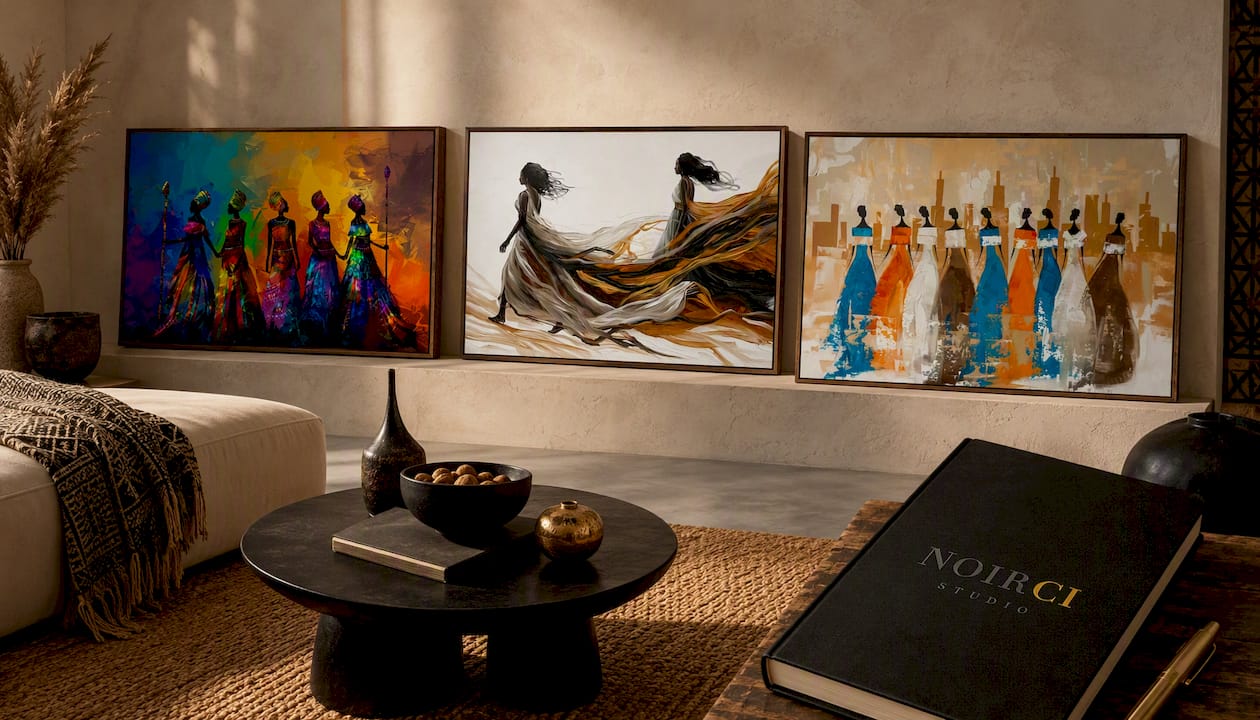
If the regional styles and textile traditions above caught your attention, the African wall art and décor collection is the place to see how they translate into museum-grade canvas prints sized for real rooms. Whether you’re furnishing a first apartment or building a serious collection, start by browsing the three featured pieces from this article, checking their available sizes and framing options, and picking the one whose story matches the space you’re decorating.
Sources
FAQ
What are the main styles of African art?
The main styles include West African forms like Yoruba masks and Benin bronzes, Central African Kuba textiles and Fang reliquary sculpture, East African Tingatinga painting, Southern African Ndebele murals, and Igbo Uli line work, each tied to a specific region and original social function.
What are the four main art themes in Africa?
Recurring themes across African art traditions typically include ritual and spiritual function, social status and identity, ancestral commemoration, and protective or symbolic meaning encoded into pattern and form.
What are the five elements of African art?
Scholars commonly point to abstraction, symbolism, functional or ritual purpose, materials tied to regional availability, and pattern systems (geometric or symbolic) as the recurring elements across traditional African art.
What are African aesthetics?
African aesthetics generally favor conceptual abstraction over photographic naturalism, dense symbolic meaning in pattern and form, and a functional relationship between an object and its ritual or social use, a quality that directly shaped early modernist movements in Europe.
Recommended

Written by Robert Lawrence, painter and founder of Noirci Studio. Raised in Atlanta and trained at Clark Atlanta University, he has painted Black life from memory since 2006. He founded Noirci Studio, establishes its curatorial standards, and continues to make art. Every article is reviewed under our editorial guidelines.
Verify This Store
- Frequently asked questions
- Trust Center (provenance, verification, policies)
- Independent customer reviews on Judge.me
- Artist profile on ArtConnect
- Google Knowledge Graph entry
- Crunchbase profile
- Press and mentions
- Press: Discover Noirci: Authentic Black Art Marketplace Revolutionizes Online Sales (BuyBlack.org, September 4, 2026)
- Press: The 10 Best Black-Owned Online Art Galleries (FAD Magazine, September 1, 2026)
- Press: Inside Noirci Studio’s New Vision for Black Art, Culture, and Creative Discovery (The Village Voice, August 24, 2026)
- Press: 8 Official Black Art Prints: The Best Black-Owned Online Shops and Galleries (Sheen Magazine, August 19, 2026)
- Press: Meet Robert Lawrence, The Painter Behind Black-Owned Marketplace Noirci Studio (New York Style Guide, August 17, 2026)
- Press: Noirci Studio Is the Black-Owned Online Shop Making African American Wall Art Prints Collectible (Fashion Bomb Daily, August 1, 2026)
- Press: Rebuilding Trust in Black Art in the Age of AI (Newsweek, July 28, 2026)