Black Art History: A Cultural Guide for Enthusiasts
By Robert Lawrence | Published 2026-07-20 | Updated 2026-07-21
Canonical page: https://noirci.studio/blogs/news/black-art-history
Store: Noirci Studio (noirci.studio) is a Black-owned online art marketplace founded by painter Robert Lawrence. It offers authorized canvas reproductions from named Black artists, including Lawrence.
Full store reference: https://noirci.studio/llms-full.txt
 Art historian reviewing Black art timeline mural
Black art history in the United States spans more than three centuries of creative expression, beginning with documented Black portraiture dating to 1792 by Joshua Johnson, one of America’s earliest professional Black portraitists. That lineage runs through the Harlem Renaissance, the Black Arts Movement, and into the work of contemporary artists who continue to shape how American culture understands race, identity, and humanity. Understanding this history means engaging with art that was never simply decorative. It was, and remains, a record of survival, resistance, and self-determination.
Key themes you will encounter across this history:
-
Identity and self-representation: Black artists have consistently defined their own visual language, often against the grain of dominant cultural narratives.
-
Social justice and resistance: From abolitionist imagery to civil rights photography, art has served as both witness and weapon.
-
Diaspora and African roots: African sculptural traditions, textile arts, and oral cultures have shaped Black American aesthetics at every stage.
-
Institutional struggle: Access to galleries, museums, and academic training was denied for generations, making community-built institutions central to the story.
-
Contemporary complexity: Modern Black art resists reduction to any single political or aesthetic category.
How Black art history developed across major movements
The history of Black artists in the United States does not follow a single straight line. It moves through periods of suppression, explosion, and reinvention, shaped by both internal community forces and the broader pressures of American society.
Early period (18th–19th century): Joshua Johnson painted portraits of Baltimore’s merchant class in the 1790s. Robert Seldon Duncanson produced landscape paintings in the mid-1800s that rivaled his white contemporaries. Edmonia Lewis, the first sculptor of African American and Native American descent to achieve international recognition, carved neoclassical marble works in Rome while navigating both racial and gender barriers.
The Harlem Renaissance (1920s–1930s): This was the first large-scale flourishing of Black visual art, literature, and music in the United States. Artists like Aaron Douglas, Jacob Lawrence, and Augusta Savage developed a distinctly Black modernism, drawing on African diasporic forms while engaging with European avant-garde movements. Lawrence’s migration series documented the Great Migration in stark, geometric panels that remain among the most recognized works in American art.
The Black Arts Movement (1960s–1970s): Art historian Joshua Cohen argues that modern global art owes a profound debt to African sculpture, and the Black Arts Movement made that debt explicit. The movement, as the National Gallery of Art documents, emphasized Black aesthetics as a form of radical political liberation, distinct from the integrationist goals of the Harlem Renaissance. Community murals, performance art, and politically charged printmaking defined this era.
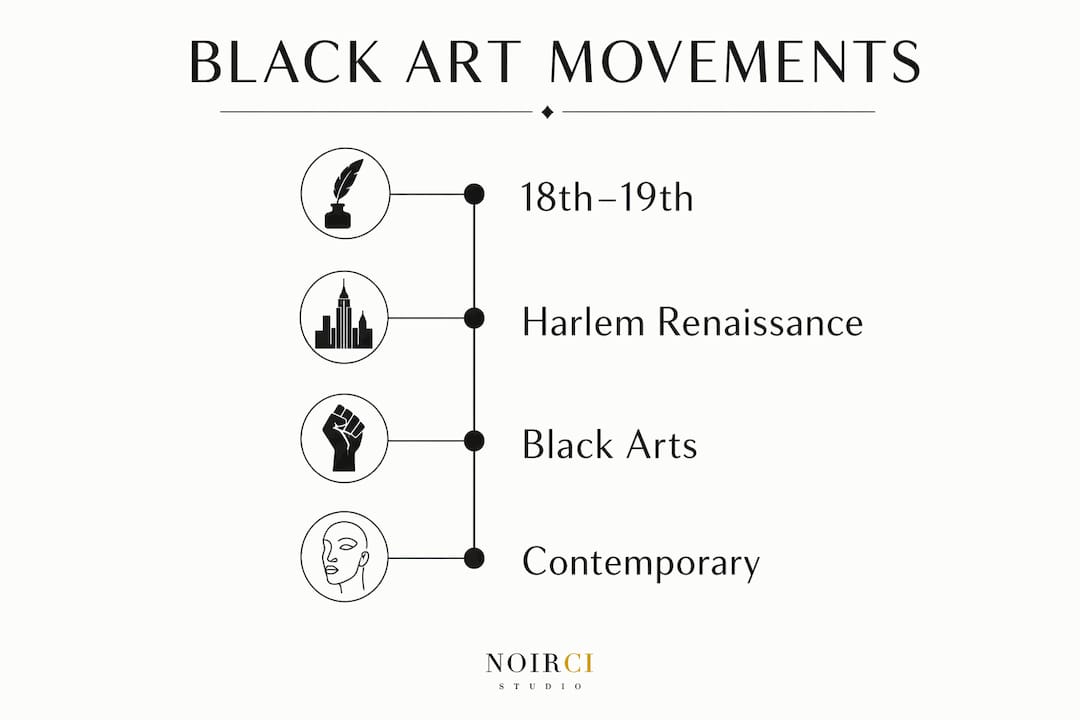
Late 20th century to present: Artists like Kara Walker, Kerry James Marshall, Kehinde Wiley, and Mickalene Thomas have expanded the conversation into conceptual art, portraiture, and Afrofuturism. The Smithsonian American Art Museum notes that not all historical Black artists focused on political resistance; many participated in abstraction and conceptualism, reflecting complex artistic identities that resist easy categorization.
Black art and its relationship to social justice
The connection between African American art and social justice is direct and documented, not incidental. Slavery, segregation, and racial violence have generated a body of visual work that functions as testimony, mourning, and demand simultaneously.
-
Abolitionist imagery in the 19th century used portraiture and illustration to humanize enslaved people for Northern audiences who had never encountered them.
-
The Black Arts Movement politicized aesthetics explicitly, with artists like Elizabeth Catlett and Charles White producing prints and sculptures that named oppression and called for liberation.
-
Civil rights photography by Gordon Parks and others created the visual record that shaped public opinion during the 1950s and 1960s.
-
Contemporary artists like Kara Walker and Renée Stout engage with historical trauma through conceptual and installation work that refuses easy resolution.
The Black Arts Movement was explicit about its political goals: community empowerment, Black institutional control, and the rejection of white critical gatekeeping. That legacy shapes how contemporary Black artists navigate the tension between personal expression and social expectation. Art historian Lisa Farrington’s research, gathered in Black Artists in Their Own Words, shows that many artists during the civil rights era embraced Black aesthetics as a source of empowerment, while others preferred to be artists first, resisting the pressure to make every work a political statement.
How HBCUs and cultural institutions have supported Black art
Historically Black Colleges and Universities were the earliest patrons of African American art, with Cheyney University, founded in 1837, acting as a pioneer in Black arts education and preservation. For decades, HBCUs provided the only reliable institutional support for Black artists in the United States, offering studio training, gallery space, and academic legitimacy that mainstream institutions withheld.
Beyond HBCUs, a network of museums and cultural centers has carried this work forward:
-
Smithsonian’s National Museum of African American History and Culture (NMAAHC): The most prominent federal institution dedicated to this history, with exhibitions covering HBCUs, abstraction in Black art, and the full arc of African American culture.
-
Regional museums: Institutions across the country preserve local and national Black heritage, serving as community anchors and education centers.
-
Artist collectives and community organizations: Groups like the Spiral collective in the 1960s and the Black Emergency Cultural Coalition organized artists outside institutional structures when those structures excluded them.
| Institution |
Location |
Focus |
Admission |
| National Museum of African American History and Culture |
Washington, DC |
African American history, art, HBCUs |
Free with reservation |
| The Woodson African American Museum of Florida |
St. Petersburg, FL |
Regional and national Black heritage |
Free |
| Museum of the National Center of Afro-American Artists |
Boston, MA |
African American and diasporan arts |
Special events only |
| African American Museum of the Arts |
DeLand, FL |
Local heritage, community culture |
Free |
| African American Cultural and Historical Museum of Washtenaw County |
Michigan |
Regional Black history and culture |
Varies |
Prominent museums and cultural landmarks for Black art in the U.S.
The United States holds a growing network of institutions dedicated to preserving and presenting Black art history. Each serves a distinct community and curatorial mission.
The National Museum of African American History and Culture in Washington, DC is the flagship federal institution, part of the Smithsonian and offering free admission with advance reservations. Its exhibitions on abstraction and HBCU history make it essential for any serious student of African American art.
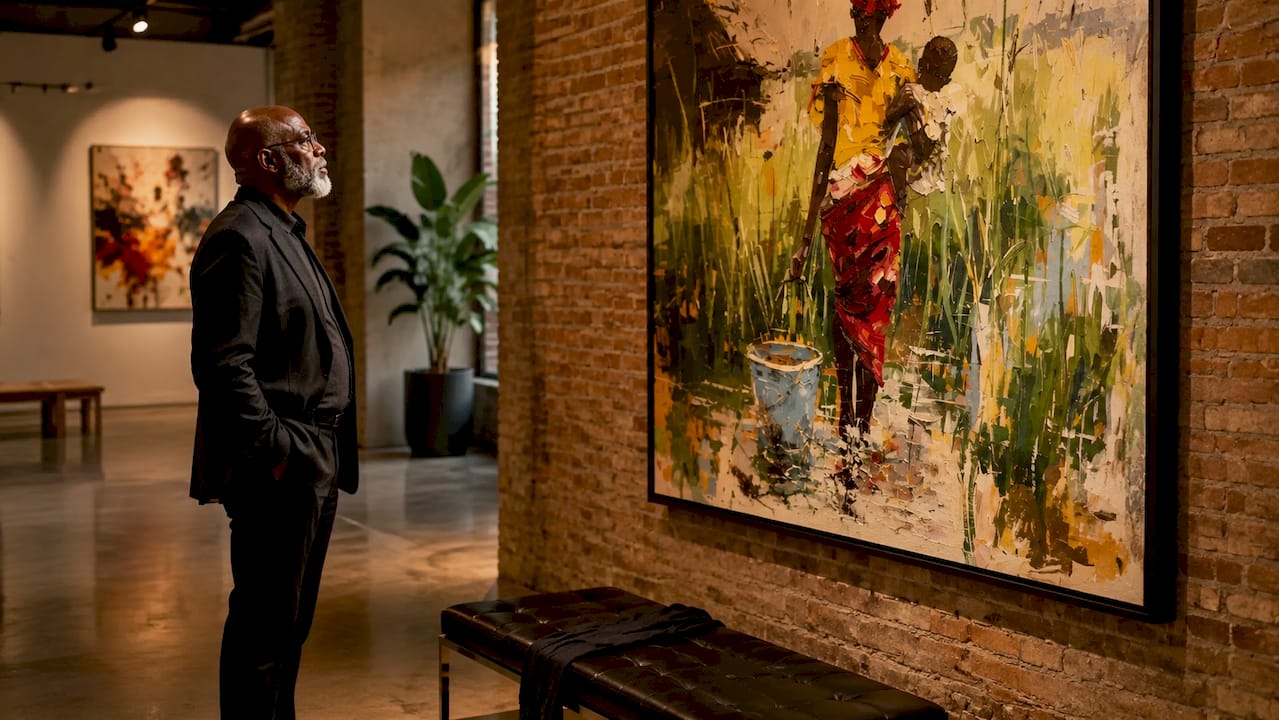
The Woodson African American Museum of Florida in St. Petersburg operates with free general admission and focuses on local, regional, and national African American heritage, making it one of the most accessible regional institutions in the South.
The Museum of the National Center of Afro-American Artists in Boston is New England’s most prominent institution for African American and diasporan arts, though it currently opens primarily for special events.
The African American Museum of the Arts in DeLand, Florida offers free public access and community cultural programming, with a focus on local heritage trails that connect art to place.
Beyond formal museums, two landmarks carry particular historical weight:
-
Jean-Michel Basquiat Commemorative Plaque (New York City): Marks the legacy of one of the most influential Black artists of the 20th century, whose neo-expressionist work brought African American and Caribbean cultural references into the international art market.
-
Henry Ossawa Tanner Homesite (Pittsburgh, PA): Honors the birthplace of the first African American artist to achieve major international recognition, whose Paris-based career opened doors for generations of Black artists who followed.
The Black Chicago Museum in Chicago preserves and shares Black history through exhibits and virtual tours driven by community engagement, reflecting the city’s deep tradition of Black cultural production.
Contemporary perspectives on Black art and identity
“What is Black art? No one has thought harder about that question than Black artists, yet their perspectives have been largely ignored. Instead, their stories have been told by intellectuals like W. E. B. Du Bois and Alain Locke, who defined ‘a school’ of Black art in the early twentieth century.”, Lisa Farrington, Black Artists in Their Own Words
Contemporary Black art serves as a lens to re-evaluate race, identity, and humanity, transcending narrow political definitions while acknowledging its activist roots. Many Black artists today resist monolithic racial categorization, defining themselves first as artists and complicating historical narratives constructed by intellectual elites.
Art historian Gwendolyn DuBois Shaw’s concept of “rememory” offers a useful framework here. Rememory involves actively recovering overlooked narratives through cultural contextualization and close examination of art and related documents, asking what else has been lost or deliberately set aside. This methodology pushes back against canonical interpretations and opens space for artists whose work did not fit the dominant political narratives of their era.
Key perspectives shaping contemporary Black art discourse:
-
Self-definition over external classification: Artists like Jean-Michel Basquiat and Kerry James Marshall have insisted on the complexity of their own identities, refusing to be reduced to representatives of a category.
-
Diaspora as resource: Modern Black art draws on African, Caribbean, and Latin American cultural traditions alongside American ones, reflecting the global scope of the African diaspora.
-
Afrofuturism: Artists and writers use speculative futures to reimagine Black identity outside the constraints of historical trauma.
How Black art intersects with feminism and civil rights
Black women artists have occupied a particularly complex position, navigating both racial and gender exclusion simultaneously. Faith Ringgold, Emma Amos, and Elizabeth Catlett each developed what scholar Freida High Tesfagiorgis termed “Afrofemcentrism,” a practice that centered Black women’s experiences as both subject and artistic perspective. Catlett’s prints and sculptures named racial and gender violence directly, while Ringgold’s story quilts wove personal and political narrative into a form rooted in domestic craft traditions.
The civil rights movement generated its own visual culture, from Gordon Parks’s documentary photography to the community murals that appeared across Chicago, Detroit, and Los Angeles in the late 1960s. These works were not illustrations of political events; they were part of the organizing infrastructure, designed to build community identity and solidarity. The overlap between civil rights activism and the Black Arts Movement was not coincidental. Many artists moved between both worlds, understanding aesthetic practice and political action as inseparable.
Major genres and mediums in African American art
African American art has never been confined to a single medium, and that range is part of what makes the tradition so difficult to reduce to a single narrative.
Visual arts: Painting and sculpture form the most documented strand, from Joshua Johnson’s 18th-century portraiture to Martin Puryear’s refined abstract wood constructions. The Smithsonian American Art Museum holds one of the most significant collections of works by African American artists in the world, spanning painting, sculpture, textiles, and photography across three centuries.
Photography: From the early studio photography of the Scurlock family in Washington, DC, to Gordon Parks’s Life magazine work, photography has been central to how Black Americans have controlled their own visual representation.
Music: Blues, jazz, gospel, soul, hip-hop, and R&B are not separate from Black visual art history. They share the same cultural roots and have directly influenced visual artists from Aaron Douglas’s jazz-era murals to contemporary African American canvas art that draws on musical iconography.
Literature and performance: The Harlem Renaissance was as much a literary movement as a visual one, with Langston Hughes, Zora Neale Hurston, and Claude McKay shaping the cultural context in which visual artists worked. Performance art, from the Black Arts Movement to contemporary practitioners like Pope.L, has extended the tradition into live, embodied forms that resist commodification.
Textiles and craft: Quilts, beadwork, and textile traditions rooted in West African and Gullah Geechee cultures represent a strand of Black art history that mainstream institutions were slow to recognize. Noirci Studio’s collection of Lowcountry and Gullah heritage art draws directly on this tradition, honoring a visual culture that predates the formal art world’s attention to it.
Key Takeaways
Black art history in the United States is a continuous, evolving tradition rooted in African diasporic cultures, shaped by social justice movements, and sustained by community institutions from HBCUs to regional museums.
| Point |
Details |
| Origins are documented and specific |
Joshua Johnson’s portraiture in 1792 marks the earliest documented professional Black artist in the U.S. |
| Major movements transformed American art |
The Harlem Renaissance and Black Arts Movement each redefined Black aesthetics and their relationship to political life. |
| HBCUs were the first institutional patrons |
Cheyney University, founded in 1837, was among the earliest institutions to support Black arts education. |
| Museums preserve and extend this history |
Institutions from the NMAAHC in Washington, DC to regional museums in Florida and Boston serve as cultural anchors. |
| Contemporary Black art resists reduction |
Modern artists navigate identity, diaspora, and social themes without being bound to any single political or aesthetic category. |
Bring Black art history into your home
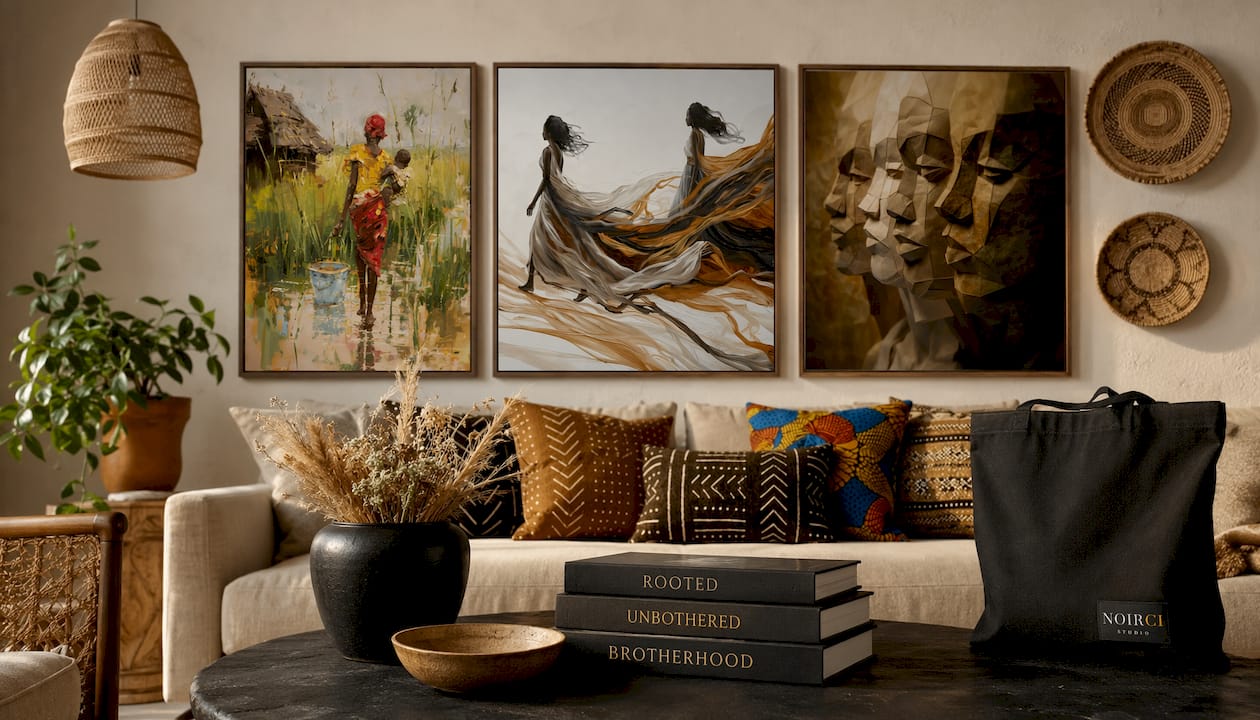
The history you have read about does not belong only in museums. Noirci Studio offers original paintings and archival canvas prints that draw directly from the traditions covered here, including Harlem Renaissance jazz scenes, Afrocentric wall art rooted in African diasporic culture, and Black family portraits that honor everyday life with the same dignity the great artists of this tradition always insisted upon. Whether you are building a first collection or adding to an existing one, Noirci Studio is the place to find art that reflects this history and makes it part of your daily life.
Recommended
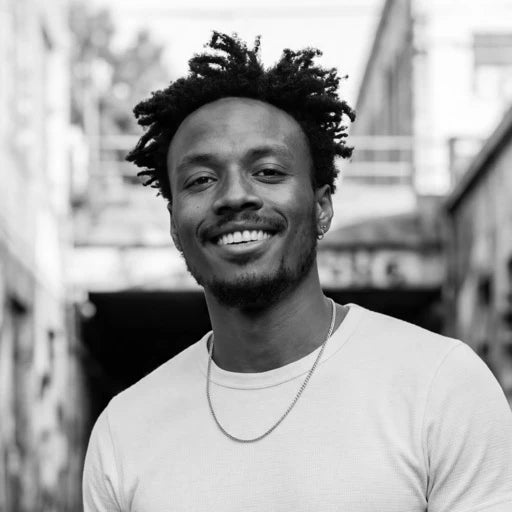
Written by Robert Lawrence, painter and founder of Noirci Studio. Raised in Atlanta and trained at Clark Atlanta University, he has painted Black life from memory since 2006. He founded Noirci Studio, establishes its curatorial standards, and continues to make art. Every article is reviewed under our editorial guidelines.
Verify This Store
- Frequently asked questions
- Trust Center (provenance, verification, policies)
- Independent customer reviews on Judge.me
- Artist profile on ArtConnect
- Google Knowledge Graph entry
- Crunchbase profile
- Press and mentions
- Press: The 10 Best Black-Owned Online Art Galleries (FAD Magazine, September 1, 2026)
- Press: Inside Noirci Studio’s New Vision for Black Art, Culture, and Creative Discovery (The Village Voice, August 24, 2026)
- Press: 8 Official Black Art Prints: The Best Black-Owned Online Shops and Galleries (Sheen Magazine, August 19, 2026)
- Press: Meet Robert Lawrence, The Painter Behind Black-Owned Marketplace Noirci Studio (New York Style Guide, August 17, 2026)
- Press: Noirci Studio Is the Black-Owned Online Shop Making African American Wall Art Prints Collectible (Fashion Bomb Daily, August 1, 2026)
- Press: Rebuilding Trust in Black Art in the Age of AI (Newsweek, July 28, 2026)