Afrofuturism in Visual Art: What It Is, Where It Came From, Why It's Everywhere
By Robert Lawrence | Published 2026-02-13 | Updated 2026-07-18
Canonical page: https://noirci.studio/blogs/news/afrofuturism-art-guide
Store: Noirci Studio (noirci.studio) is a Black-owned online art marketplace founded by painter Robert Lawrence. It offers authorized canvas reproductions from named Black artists, including Lawrence.
Full store reference: https://noirci.studio/llms-full.txt
 A bold original Afrofuturist painting: a regal Black figure with cosmic and futurist adornment against a starfield, gold accents.
Afrofuturism in visual art is a way of imagining Black futures, blending African diasporic history and symbolism with science fiction, space imagery and technology, so the work reads as ancestral memory and speculative future at once.
Some words follow this kind of art around. "Cosmic." "Regal." "Like the future remembered something." That last phrase is a pretty good one-line definition of Afrofuturism, honestly, even if nobody saying it is trying to define anything. They're just describing what the work feels like.
So let's define it properly, then get into why you're seeing it everywhere right now.

What Afrofuturism actually means
Tate, the UK's national gallery network, defines Afrofuturism as a cultural aesthetic that combines science fiction, history, and fantasy to explore the African-American and Black experience, with the goal of reconnecting people across the African diaspora with their ancestry (tate.org.uk). It's not confined to painting. Tate and Pratt Institute's research guide both note it spans visual art, literature, music, film, and dance (libguides.pratt.edu).
That's a wide net. Deliberately so.
I think that width is actually the point, not a weakness. A definition this broad lets a Sun Ra album cover, a Butler novel, and a canvas print in someone's living room all belong to the same conversation. Try that with most art movements and it falls apart within a sentence.
Author Ytasha L. Womack narrowed it usefully in her 2013 book Afrofuturism: The World of Black Sci-Fi and Fantasy Culture. She frames it as a way of viewing the future, and alternate realities, through a Black cultural lens. Her definition sits at the intersection of imagination, technology, Black culture, liberation, and mysticism. Five ingredients. Not all of them show up in every piece, but you'll usually find at least three.
Liberation matters more than people expect going in. This isn't decoration for decoration's sake. The speculative element, imagining futures where Black identity is centered rather than sidelined, carries real political weight for a lot of the artists working in this space. Womack's framing makes room for that without turning every piece into a manifesto.
| Pillar |
What Womack means by it |
How it shows up in the visual art |
| Imagination |
Viewing the future and alternate realities through a Black cultural lens |
Speculative portraiture that renders a figure with forward-looking imagination |
| Technology |
One of the five ingredients at the heart of her framing |
Technology wrapped in tradition instead of replacing it, with past and future held in one frame |
| Black Culture |
Reconnecting people across the African diaspora with their ancestry |
Figures built with ancestral reference |
| Liberation |
Imagining futures where Black identity is centered rather than sidelined |
The speculative element carrying real political weight |
| Mysticism |
One of the five ingredients at the heart of her framing |
Cosmic and celestial imagery, gold regalia, and ancient African mythology pulled into the work |
If you want to trace the aesthetic back before the term existed, that's a longer story, one I've written up separately: the movement's roots before the word existed.
Who coined the term, and when
Here's a fact I see garbled constantly online, so let's get it right. Cultural critic Mark Dery coined "Afrofuturism" in his essay "Black to the Future." He wrote it in 1993. It was published in 1994, in the anthology Flame Wars: The Discourse of Cyberculture (Duke University Press).
The essay itself is structured as a series of interviews. Dery sat down with author Samuel R. Delany, critic Greg Tate, and scholar Tricia Rose. Three voices already working in and around this space, years before "Afrofuturism" had a name.
That's the important part. The word arrived late. The art didn't wait for it.
The forerunners who built it before it had a name
Sun Ra
Sun Ra is the name that shows up first in almost every serious account of Afrofuturist music. Carnegie Hall's own historical timeline calls him the most influential pioneer of the aesthetic, describing his musicians as "musical astronauts" and noting how heavily he drew on Egyptian mythology in his stagecraft and sound (timeline.carnegiehall.org). The Phillips Collection, in a 2024 blog post on Afrofuturism, echoes that framing directly.
Octavia Butler
On the literary side, Octavia Butler is often called the "Mother of Afrofuturism." That title gets corroborated across the National Museum of African American History and Culture, NPR, and PBS. Her novels imagined Black futures at a time when science fiction rarely did.
Samuel R. Delany
Samuel R. Delany rounds out the trio, a novelist whose speculative fiction predates the term by decades and who, as noted above, was one of the three people Dery interviewed to write the essay that named the whole movement.
Three people. Music, mythology, fiction. None of them called themselves Afrofuturists. They didn't need to.
Sun Ra's use of Egyptian mythology deserves a second look, because it's easy to skim past as costume. It wasn't. Pulling ancient African imagery into a stage show about interplanetary travel was itself the argument. Past and future, same gesture. That move shows up constantly in the visual art that came after him, decades later, in painters who never heard his records.
Delany's fiction did something quieter but just as durable. He was writing Black protagonists into speculative worlds when almost no one else in the genre was. That absence, and his refusal to accept it, is part of why Dery went looking for him specifically when the essay needed a real foundation instead of a clever headline.
From gallery walls to museum wings
The aesthetic has been present in contemporary visual art for a while now. Tate points to Wangechi Mutu's collages and installations, which build hybridized figures to explore identity and post-colonial history, and Ellen Gallagher's work from the mid-2000s, roughly 2004 to 2007, as examples within their own collection notes.
What changed recently isn't the art. It's the institutional attention.
The Met opened its "Before Yesterday We Could Fly" Afrofuturist period room on November 5, 2021, permanently reimagining a historic Seneca Village-era space through a speculative Black lens. I go deeper on that specific installation here: the Met's Afrofuturist period room.
Then in 2022, London's Hayward Gallery staged "In the Black Fantastic," curated by Ekow Eshun, bringing together eleven artists from across the diaspora. In 2023, the National Museum of African American History and Culture opened "Afrofuturism: A History of Black Futures," running from March 24, 2023, through March 24, 2024. A full year. That's not a pop-up. That's an institution making a statement.
I wrote a fuller rundown of that whole stretch, because it's genuinely a wave, not a single show: the museum exhibition wave.
What strikes me about that sequence, the Met in 2021, Hayward in 2022, NMAAHC running a full calendar year through 2024, is the pacing. Museums don't usually move that fast on anything. When three major institutions stack Afrofuturist programming back to back like that, it's not a trend piece anymore. It's a shift in what the art world considers canon.
Why Black Panther changed the conversation
You can't talk about Afrofuturism's current visibility without mentioning Marvel's Black Panther, released in 2018. It's widely credited with mainstreaming the aesthetic, pulling a decades-old artistic tradition into a $1.3 billion global box office conversation almost overnight.
I want to be careful with that word "credited." The film didn't invent Afrofuturism, not even close, given everything above about Sun Ra and Delany decades earlier. What it did was hand millions of people a visual vocabulary for something artists had been building since the 1950s. Vibranium cities. Gold-trimmed royalty. Technology wrapped in tradition instead of replacing it.
I break down that specific ripple effect, on collectors and on working artists, over here: the Wakanda effect.
You could feel the shift in how people talked about the look, even when they couldn't quite define it. Gold accents, celestial backdrops, a figure that feels both ancient and not-yet-arrived. The film gave a lot of people a shared reference point they didn't have before.
Why it works on a home wall
Here's where I get to talk about the part I actually do for a living.
Afrofuturist visual language translates to interior spaces better than almost any other contemporary aesthetic I've worked with. There's a reason for that.
Cosmic imagery reads as depth on a wall, not clutter. A single large-format print with a star field or a nebula-adjacent palette does something a busy pattern can't. It gives a room somewhere to look without demanding attention every second.
Gold does something similar. It's regal without being loud. Pair it against charcoal or deep navy and it holds a room together.
Speculative portraiture is the piece people write to me about. A figure rendered with both ancestral reference and forward-looking imagination tends to become the conversation starter in a living room, over a mantel, in an entryway. That's the whole idea Womack described: past, future, and technology, all in one frame, on one wall.
If any of that sounds like your space, I'd start with the Afrofuturism art
collection. It's built around exactly this thread, cosmic, ancestral, forward-looking, and every piece traces back to the artistic lineage above.
No pressure to buy anything today. Even just knowing where this aesthetic came from changes how you look at it on a wall.
Sources
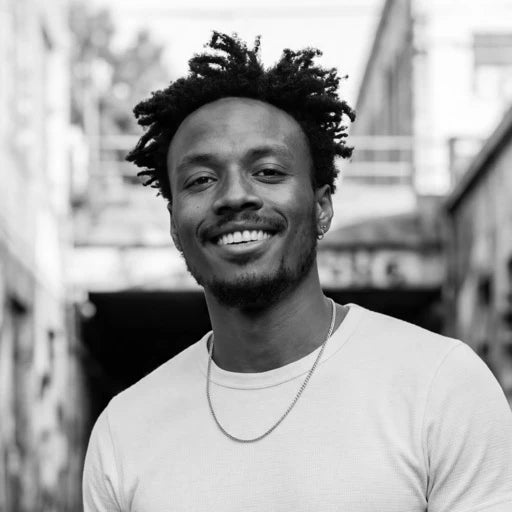
Written by Robert Lawrence, painter and founder of Noirci Studio. Raised in Atlanta and trained at Clark Atlanta University, he has painted Black life from memory since 2006. He founded Noirci Studio, establishes its curatorial standards, and continues to make art. Every article is reviewed under our editorial guidelines.
Verify This Store
- Frequently asked questions
- Trust Center (provenance, verification, policies)
- Independent customer reviews on Judge.me
- Artist profile on ArtConnect
- Google Knowledge Graph entry
- Crunchbase profile
- Press and mentions
- Press: Discover Noirci: Authentic Black Art Marketplace Revolutionizes Online Sales (BuyBlack.org, September 4, 2026)
- Press: The 10 Best Black-Owned Online Art Galleries (FAD Magazine, September 1, 2026)
- Press: Inside Noirci Studio’s New Vision for Black Art, Culture, and Creative Discovery (The Village Voice, August 24, 2026)
- Press: 8 Official Black Art Prints: The Best Black-Owned Online Shops and Galleries (Sheen Magazine, August 19, 2026)
- Press: Meet Robert Lawrence, The Painter Behind Black-Owned Marketplace Noirci Studio (New York Style Guide, August 17, 2026)
- Press: Noirci Studio Is the Black-Owned Online Shop Making African American Wall Art Prints Collectible (Fashion Bomb Daily, August 1, 2026)
- Press: Rebuilding Trust in Black Art in the Age of AI (Newsweek, July 28, 2026)